November 22, 2026Logistics & documents13 min read
Shipping from China: Sea, Air, Rail, LCL and FCL Compared
Published by AeonixTrade.
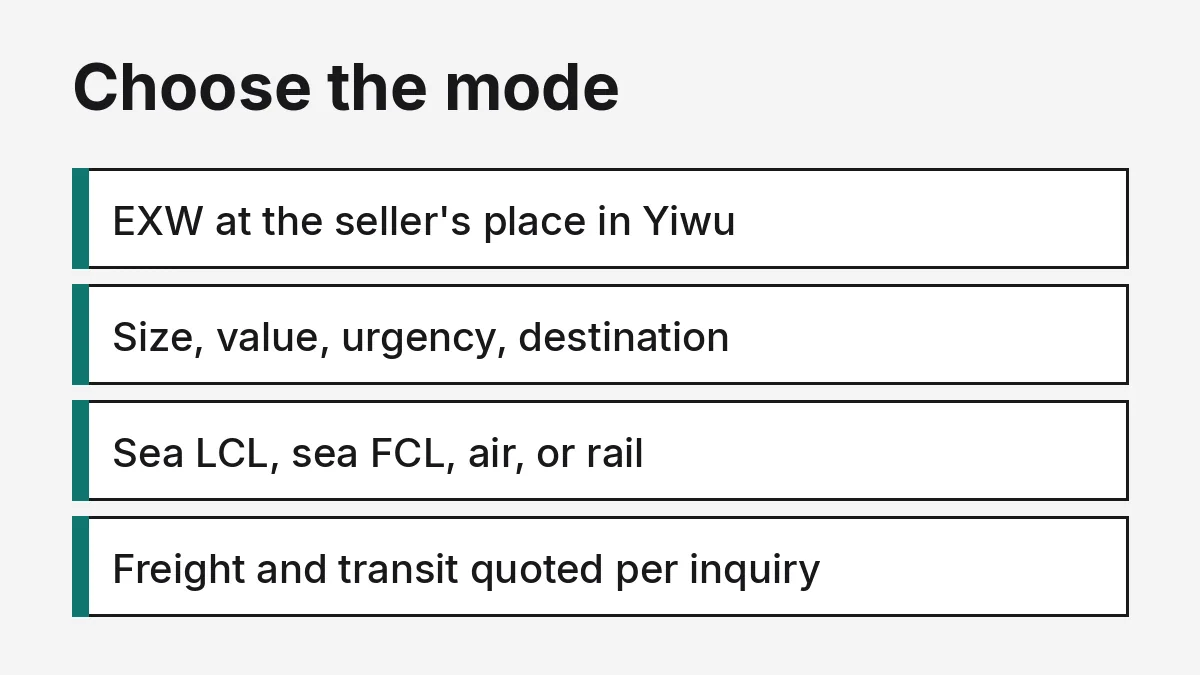
The goods are available EXW at a named place in Yiwu. The next decision is which booking to request. Match the mode to the order in front of you: the space and weight of the cartons, the value of the cargo, the date you can sell, and the country that will clear the entry. Freight amounts and transit days are quoted per inquiry.
Request a quote. First reply within 1 business day. Send the carton list, the EXW place, the destination, and the date the goods need to be selling.
Four inputs, then one quote
Start with space and weight. Use the cartons you can measure, or the packing lines the sellers already wrote. The forwarder charges the measure the quote defines. How that measure is built sits on CBM and what the forwarder charges.
Then value. A small cube of high-value goods can make the air quote the one you can hold. A large cube of low-value goods usually belongs on the sea quote. Compare each quote with the margin you keep. The worksheets are landed cost, meaning and how to calculate landed cost.
Then the selling date. Ask the carrier for the transit on this booking. If that date misses the date you can sell, price a faster mode on the same cargo. How to read a cutoff, with the schedule coming from the booking, is shipping-time planning.
Then the destination. The same Yiwu cartons face a different entry in each country. Corridor pages are listed below. Duty and tax figures stay on those pages and on the country import guides they point to.
Which quote to request
| What you are holding | Request this quote first | The quote has to name |
|---|---|---|
| Several Yiwu lots. The cube is short of a full container. The selling date can wait for sea. | LCL sea, after one consolidation | Shared container. The measure charged. What is included from the EXW place. What is included after arrival. |
| One lot that fills a container. The selling date can wait for sea. | FCL sea | Container size. The load port the forwarder will use. Who files the verified gross mass. The free time named on the booking. |
| The sea quote misses the selling date, or the cargo is small and valuable. | Air cargo | Chargeable weight. The airport pair. What is excluded after arrival. |
| A sample, or a few cartons that must move as a courier piece. | Express | Who is named as importer on the label. Whether the piece is a commercial shipment. |
| The destination is in Europe and you will compare a train with a ship. | Rail and sea, on the same cargo | The terminals. The same Incoterm. Whether the booking is the train the operator names. |
| Some marks are urgent. The rest can wait. | A split booking | Which marks go on air. Which marks stay on sea. Two invoices that still add up. |
Request the mode in the middle column. Also request the neighbouring mode when the cube is close to a full container, or when the selling date is tight. Accept the quote whose included charges and named transit match the date you can sell. Compare two offers only when both name the same place of delivery and the same place of arrival.
Sea: shared container or the whole box
LCL means the cartons share a container with other cargo. The calculation, and the moment to price a full container instead, is LCL from China: cost and when to switch to FCL. The move for a small order is how LCL from China works. How the shared-container quote is assembled is how LCL quotes are built.
When you are unsure the lot is small, request LCL and FCL on the same carton list. The break-even is that pair of quotes. FCL versus LCL walks through the comparison. The cube cutoff belongs in that comparison, calculated from your quotes.
FCL means you book the whole container. When that booking is the one to request is FCL: when to book the whole container. Once the cube and the weight are known, the box itself is a further choice among a 20-foot, a 40-foot, and a 40-foot high cube. That comparison is which container fills first.
Air, and a courier piece
Sea versus air, once both quotes are in hand, is sea freight versus air freight. Request air when the sea quote's transit misses the selling date, or when value and cube make the air quote the one you can hold. IATA's cargo program is where airlines publish the operating rules, including dangerous goods. A battery carton is its own line. Battery shipping sits on Shenzhen electronics and battery shipping.
A sample is a different booking from a commercial lot. Compare express, air, and a small sea parcel on express, air, or LCL for a small shipment, shipping samples: express, air, or sea, and Yiwu sample shipping. Send the weight and the papers those pages ask for. Sample transit is the number on the courier or airline quote.
Rail, when the destination is on a corridor
Request a China-Europe rail quote when the destination is on a rail corridor and the sea quote misses the selling date. Rail versus sea sets published ranges next to the source that printed each one. Day counts and prices stay on that page. Match the unit on your quote to the unit in the row you are reading. Compare a rail offer with a sea offer only when both use the same Incoterm and the same cargo.
How consolidation from Yiwu works
Most EXW Yiwu orders are several booth files. They become one booking after a warehouse receives them. The sequence is the same whether the onward mode is LCL, FCL, air, or rail.
- Keep each booth's commercial invoice and packing lines as its own file. Those lines have to survive into the export declaration and into the entry abroad.
- Receive the cartons in one Yiwu warehouse. What that hold is for is a Yiwu warehouse before export. Booth receipts and the carrier tracking number are different records. Tracking for the combined order is tracking a consolidated Yiwu order.
- Check marks and counts against the booth lines before anyone seals a container. A mismatch is a document problem. It is cheaper to fix at the warehouse than at the destination terminal.
- Book one mode for the combined set, or put urgent marks on air and leave the rest on sea. Many booths into one shipment is consolidating goods from many Yiwu booths. Factories that are off the market floor use consolidating multiple suppliers. Goods bought at the fair and brought back to the same warehouse use shipping goods bought at the Canton Fair.
A buyer leaves one booth with bags and another with cushions. The warehouse receives two mark sets. The forwarder prices LCL and FCL on the combined cube, both EXW from the named Yiwu place, both to the same destination. The buyer accepts the quote whose included charges and named transit match the selling date.
Documents the booking needs
ICC publishes Incoterms 2020 as eleven three-letter rules that allocate tasks, costs, and risks between the seller and the buyer. The U.S. International Trade Administration lists EXW as Ex Works with a place of delivery, and lists it among the rules that can apply to any mode. On these orders the place is the seller's premises in Yiwu. Write that place on the invoice.
Which party then arranges carriage and export clearance is which Incoterm to use, read with EXW versus FOB. A delivered price is DDP versus DAP. An on-board sea quote is FOB versus CIF. Use those hubs for the rule itself.
The commercial invoice states the goods and the amount to pay. The International Trade Administration describes it as a document customs uses when goods are cleared. The buyer checklist is the commercial invoice. An export packing list itemizes packages, weights, and marks. The same administration describes it that way on its common export documents page. How the packing list sits next to the verified gross mass on a first shipment is the first-time import compliance checklist. That checklist is the page for both.
For a packed container, the International Maritime Organization states two points. The shipper provides the verified gross mass in the shipping document, in time for the stowage plan. That verified mass is a condition for loading the container onto a ship covered by the SOLAS amendment. The shipper named on the bill of lading or sea waybill is the party that responsibility attaches to. The IMO page gives two methods: weigh the packed container, or weigh the packages and add the container tare by a certified method approved in the state where packing was completed. The amendment entered into force on 1 July 2016. The booking names who will file the figure.
The transport document is a bill of lading or a sea waybill. Those pages explain which document releases the cargo. A certificate of origin and a Form E are separate from the mode. The HS code is per product, then the national line the broker files. The proforma, the commercial invoice, and the packing list are sequenced on which document, when.
What drives the amount
Every line below is quoted per inquiry. Collect the lines. Then compare quotes that include the same lines.
- The measure: cube, weight, or the greater of the two, as the quote defines it. See the CBM page above.
- A shared container or an exclusive one. The LCL cost page shows the shape of a shared-container quote. Your inbox copy is the one you accept.
- What is included from the EXW place to the ship, the aircraft, or the train. Pickup across Yiwu is a line. A quote that omits it is a different offer from one that includes it.
- What is included after arrival: terminal, delivery, and the broker. The split between mover and filer is customs broker versus freight forwarder. The split between buying and moving is sourcing agent, forwarder, or buying office. Choosing the Yiwu forwarder is how to choose a Yiwu freight forwarder.
- Insurance, when you ask for it. The decision is cargo insurance.
- Time after arrival. Demurrage and detention are two clocks. Which one is running is demurrage versus detention. The U.S. Federal Maritime Commission publishes its work on detention and demurrage for ocean moves into the United States. Free time is the number on your quote.
- Special cargo. Batteries and other dangerous goods change the air booking. Use the Shenzhen page and the IATA cargo program linked above.
After the mode is chosen
The forwarder names the Chinese load port or airport on the booking. The comparison among Ningbo, Shanghai, Shenzhen, and Guangzhou is choosing a China origin port. This hub leaves that assignment on the booking.
Release and the entry are what happens when cargo arrives. A later hold is a bonded warehouse. The filing steps are customs clearance. Who is legally responsible for the entry is the importer of record. An EU importer looks at the EORI number before that entry. The European Commission's customs procedures for import and export are the official index for the EU side.
China-side papers for market goods are Yiwu export customs and market procurement trade. A routing through Hong Kong is Hong Kong transshipment. Marketplace labels are a different job from a general import: FBA Europe and the UK and FBA prep, labels, and routes. If the goods are still being made, status sits on production and shipping status. Who watches the container door is container loading supervision.
Destination pages
Compare corridors on Yiwu shipping by destination. Then open the country page. Duty and tax figures stay on that page.
- United States
- United Kingdom and Europe
- Australia
- India
- Bangladesh
- Brazil
- Mexico
- Nigeria
- Ghana
- Kenya
- Philippines
- United Arab Emirates
- Saudi Arabia
- Oman
- South Africa
- Sri Lanka
Frequently asked questions
Which mode should a small Yiwu order use?
Request LCL sea when the combined cube is short of a full container and the selling date can wait. Also request FCL on the same carton list when you are close to filling a box. Accept the quote whose included charges and named transit match the date you can sell. The amount is quoted per inquiry.
Where do transit days come from?
From the carrier's quote for this booking. Sea, air, rail, and express each name their own transit. Published ranges that already exist on the rail-versus-sea page stay attached to the source that printed them. A blog average is not a schedule.
Who picks the cartons up on EXW?
Write the Yiwu place of delivery on the invoice. Then read the Incoterm hub for which party arranges carriage from that place. Ask the quote to show the pickup line. A quote that skips the pickup is a different offer from one that includes it.
Can one booking mix several booths?
Yes, after the warehouse has received the cartons and the marks match the booth lines. The transport document covers the booking. The booth invoices still have to add up to it. Urgent marks can leave on air while the rest wait for sea.
When is a verified gross mass required?
Before a packed container is loaded onto a ship covered by the SOLAS rule, on the IMO page linked above. The booking names the shipper who files it. Air and courier pieces follow the airline or courier document set, which is a different file.
Send the carton list, the EXW place in Yiwu, the destination, and the selling date. Request a quote. First reply within 1 business day.
Sources
- ICC: Incoterms 2020. Eleven three-letter rules for the sale of goods. Opened 22 November 2026.
- U.S. International Trade Administration: Know Your Incoterms. EXW is Ex Works with a place of delivery, among the rules for any mode. Opened 22 November 2026.
- U.S. International Trade Administration: common export documents. Commercial invoice and export packing list. Opened 22 November 2026.
- IMO: verified gross mass of a packed container. Shipper responsibility, the two methods, and entry into force on 1 July 2016. Opened 22 November 2026.
- IATA: cargo. Airline cargo rules, including dangerous goods. Opened 22 November 2026.
- U.S. Federal Maritime Commission: detention and demurrage. The Commission's published work on those charges for U.S. ocean moves. Opened 22 November 2026.
- European Commission: customs procedures for import and export. Opened 22 November 2026.
Submit sourcing request
Can't find what you need?
Start with a product or image link, an approximate quantity and destination. Other details can follow.