Sourcing Electronics in Shenzhen: Certification Checks and Battery Shipping Rules
Published by Aeonix Trade.
Last fact-checked: November 9, 2026.
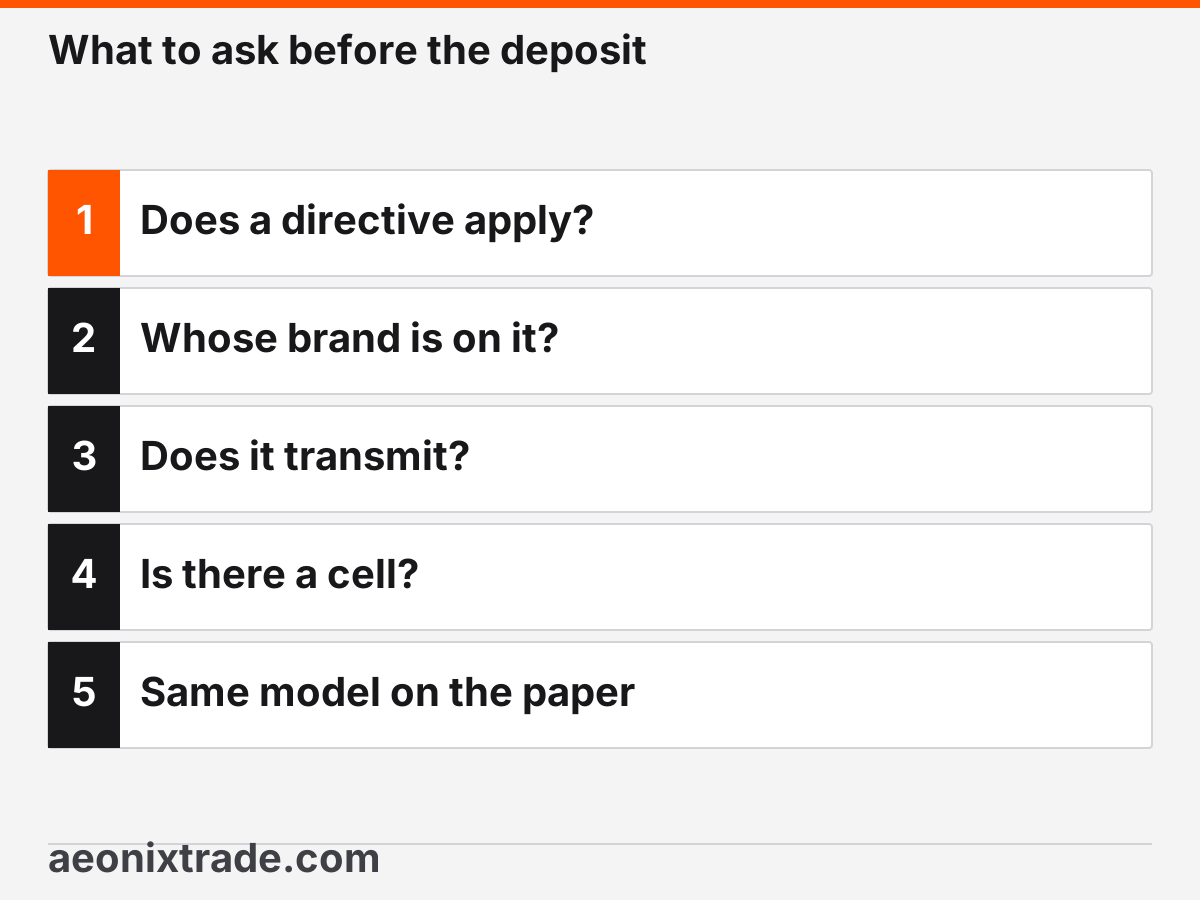
Shenzhen electronics sourcing fails in the paperwork, not in the aisle. A booth can show you a charger, a power bank, or a cable organizer in the same ten minutes. Those are different files. "Shenzhen electronics market what to buy" is the wrong first question. The first question is which rules apply to this model, in the country where you will sell it, and whether a cell inside it can go on the flight you booked.
The market walk, and a worked supplier comparison, is on the Huaqiangbei electronics market page. This page is the certification check buyers attach to the words CE, FCC, and UKCA, plus the air rules for a Huaqiangbei battery. It does not draw the official marks, and it does not say every gadget needs every mark. The phrase "CE FCC certification China supplier" is a search, not a document.
A typical case
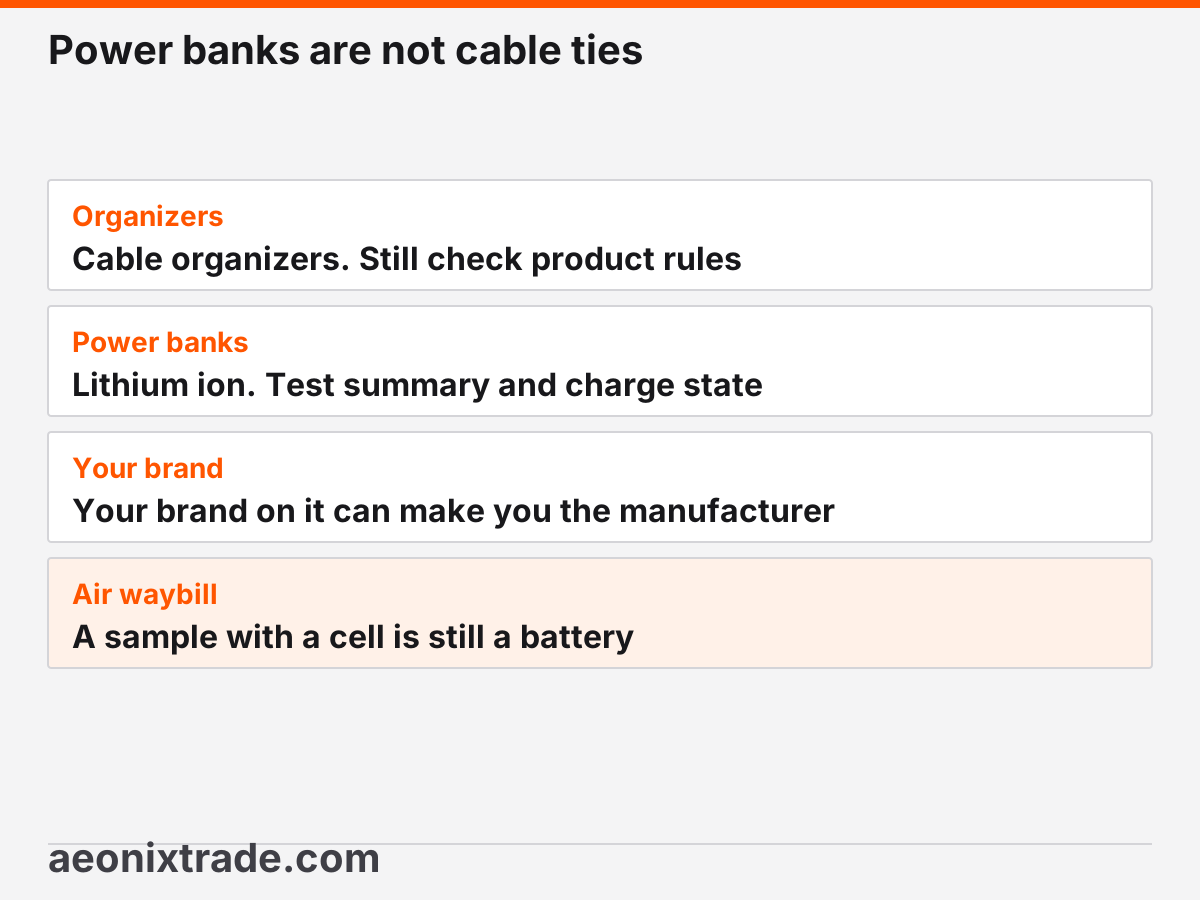
A buyer wants 800 silicone cable organizers and 800 power banks, both picked up around Shenzhen, both destined for a shop that sells into the EU, Great Britain, and the United States. The organizers are a general product. They still need a check of which product rules apply, but they are not a radio and they are not a cell. The power banks are lithium-ion batteries in a case. If the buyer's brand goes on the shell, the buyer may have stepped into the manufacturer's duties. The two cartons should not share one careless air waybill.
CE is a file, then a mark
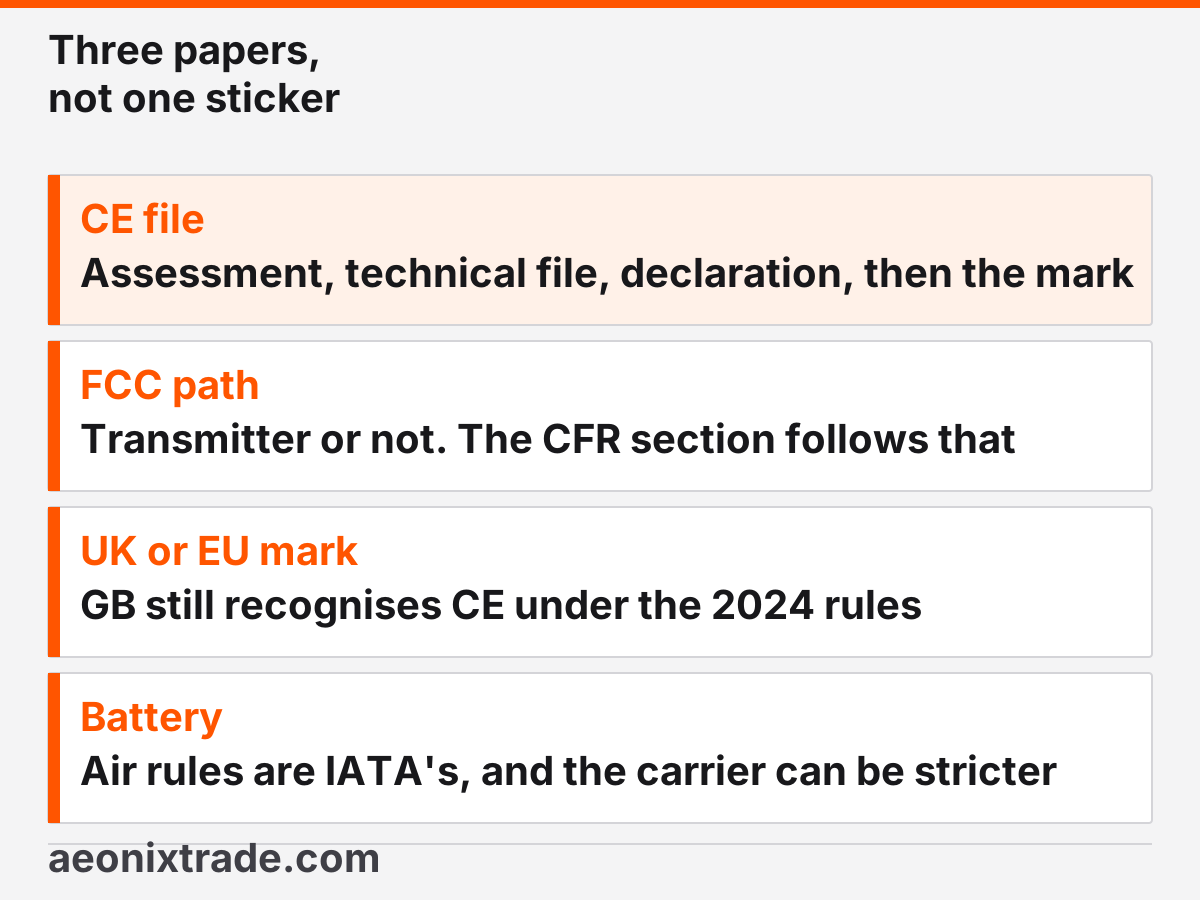
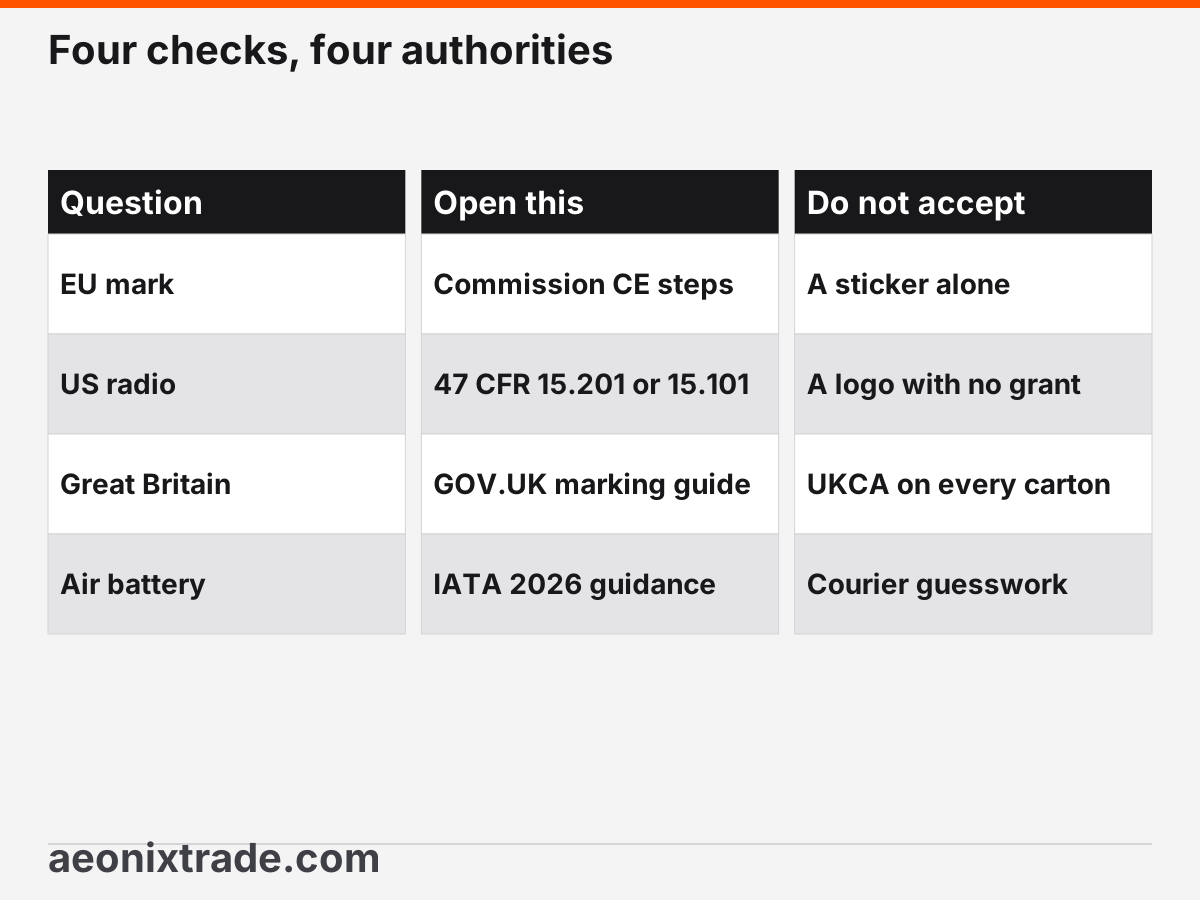
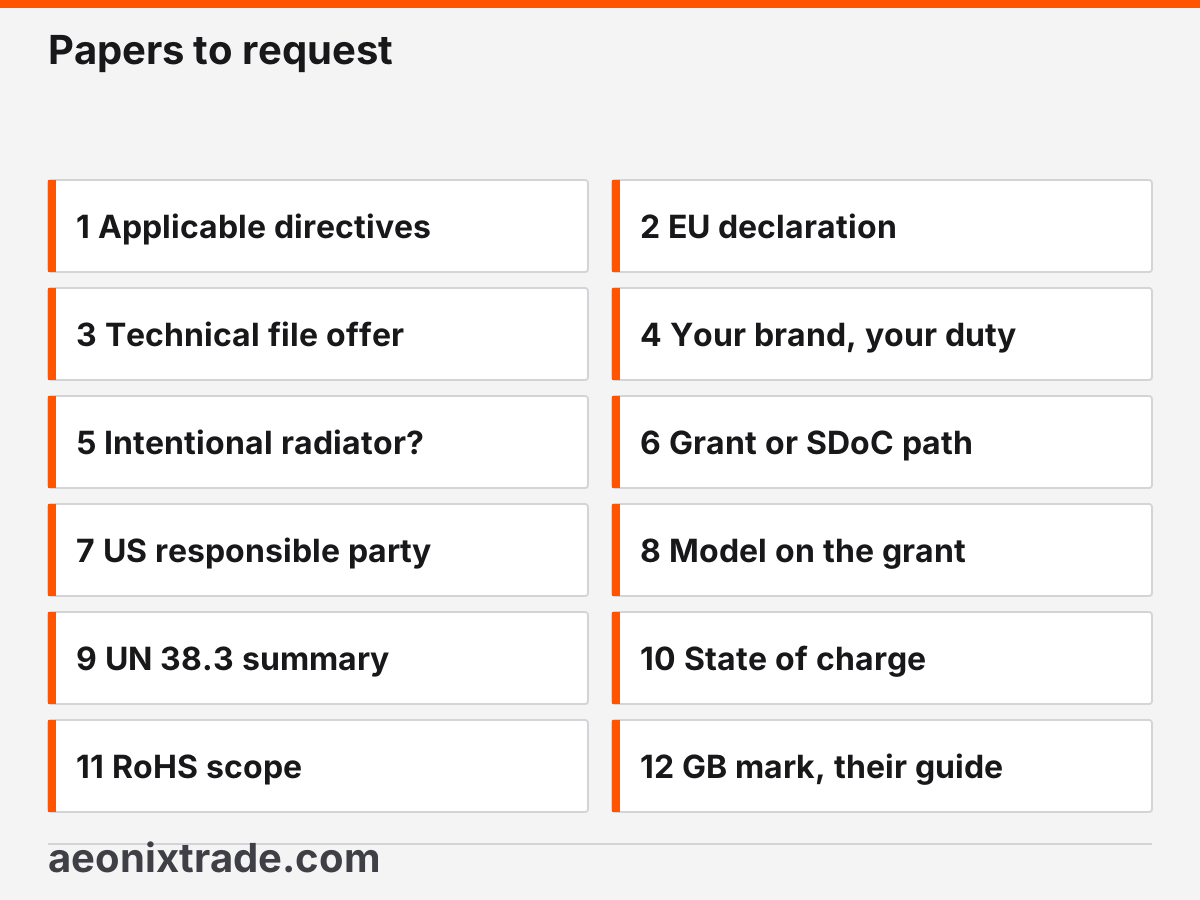
The European Commission's page for manufacturers says the manufacturer checks that the product meets EU safety, health, performance, and environmental requirements, carries out the conformity assessment, sets up the technical documentation, issues the EU declaration of conformity, and only then affixes the CE marking. The same page lists six steps: identify the directive or regulation, verify the product-specific requirements, see whether a notified body is required, test and check conformity, keep the technical documentation, and affix the mark and draw up the declaration. It says the mark goes on the product or, if that is not possible, on the packaging and the accompanying document, and that the initials are not smaller than 5 mm.
Your Europe's product-compliance page says a manufacturer is the person who makes a product, or has it made, and places it on the market under their own name or trademark. The obligations are the same whether that person is inside or outside the EU. If the power bank carries your brand, read that definition before you treat the booth as the only responsible party. The declaration itself is described on Your Europe's declaration page: it is signed after the assessment and the technical file, and by signing it the manufacturer takes responsibility.
Importers have their own duty. The EUR-Lex summary of the EU conformity-marking framework says importers must make sure the manufacturer has followed the conformity assessment and that the product has the documentation and the CE marking. A sticker with no declaration and no offer of a technical file is not that check. Not every product is in scope. Step one on the Commission page is to identify whether a directive applies. Do not print CE because a neighbor's carton has it.
FCC follows the kind of circuit
The rules below are the codified text on eCFR, which displayed Title 47 as current through November 5, 2026, and which was read on November 9, 2026. eCFR's own banner calls that text authoritative but unofficial. Treat it as the regulation text you can open, and ask a US compliance counsel before you rely on it for a product you will sell in the United States.
47 CFR 15.201 says that, except for the cases it lists, intentional radiators operating under that part shall be certified by a Telecommunication Certification Body before marketing. A Bluetooth or Wi-Fi product is in that conversation. A product with no transmitter is not automatically in the same box.
47 CFR 15.101 covers unintentional radiators and sets out a table of whether certification or a Supplier's Declaration of Conformity applies before marketing. Read the row for the device in front of you. Do not summarize the whole table as "all electronics need an FCC certificate."
47 CFR 2.906 defines the Supplier's Declaration of Conformity: the responsible party makes sure the equipment complies, and a sample does not have to be filed with the Commission unless it is asked for. The responsible party may instead use certification. 47 CFR 2.907 says certification is an authorization issued by the Commission or by a Telecommunication Certification Body, based on test data. 47 CFR 2.909 says that for equipment under the Supplier's Declaration of Conformity, the party responsible for compliance must be located in the United States. A PDF that names a different model, or a "certificate" with no grant for a transmitter, is not this section.
UKCA is not a blanket replacement for CE
GOV.UK's guide to UKCA and CE marking, read November 9, 2026, says conformity marking is only necessary if the product rules for that sector require it. Not every product must bear a mark. The same guide says that where UK product rules continue to recognise the CE marking, under The Product Safety and Metrology (Amendment) Regulations 2024, businesses may use CE alongside or in place of UKCA for the Great Britain market. It also says legislation allows the UKCA marking on a label or an accompanying document until 11pm on 31 December 2027, and that the mark is at least 5 mm high unless the sector law sets a different minimum. Northern Ireland is a different regime in that guide. Do not collapse it into the Great Britain sentence. If you place the product on the market under your own name, the guide says you take on the manufacturer's responsibilities.
RoHS is a substance rule, not a logo
The European Commission's RoHS page says the directive restricts ten substances in electrical and electronic equipment unless the equipment is specifically excluded: lead, cadmium, mercury, hexavalent chromium, PBB, PBDE, DEHP, BBP, DBP, and DIBP. Concentration limits and exemptions are in the directive, not restated here. Trade.gov's WEEE and RoHS note adds that member states implement the directives, so national practice is not identical. Ask whether this SKU is in scope, and ask for the declaration that names this model.
A power bank on a plane
IATA's lithium-batteries program page links a Battery Guidance Document. The PDF opened on November 9, 2026 is marked 01/01/2026 and "Revised for the 2026 Regulations." It says it is based on the 2025–2026 ICAO Technical Instructions and the 67th Edition (2026) of the IATA Dangerous Goods Regulations, and that the document is guidance and should not be relied on as the source of regulatory compliance. The program page's blurb still calls the file a 2025 guidance document. Read the PDF, then the airline's current acceptance. The airline can be stricter than the guidance.
In that PDF, lithium-ion batteries are UN 3480 when shipped by themselves and UN 3481 when contained in equipment or packed with equipment. Lithium-ion batteries packed by themselves, under Packing Instruction 965, must be offered at a state of charge not exceeding 30 percent of rated capacity, and cannot be shipped on a passenger aircraft unless approved under Special Provision A201. From 1 January 2026, the guidance's section on lithium-ion batteries packed with equipment says Section I cells and batteries, and Section II cells and batteries with a watt-hour rating above 2.7 Wh, must be offered at a state of charge not exceeding 30 percent of rated capacity unless the states named in the document approve otherwise. Manufacturers and later distributors must make a test summary available under UN Manual of Tests and Criteria, subsection 38.3, paragraph 38.3.5, for cells and batteries manufactured after 30 June 2003, except button cells installed in equipment. A web link can be the way that summary is made available. A sample is not exempt because the carton says "sample." How the three sample bookings differ is on shipping samples from China.
Sea carriage of dangerous goods sits under IMO instruments. IMO's maritime safety page says IMO has developed codes for the carriage of dangerous goods. The detailed IMDG packing text was not the page opened here. Ask the ocean carrier which amendment they apply before a battery goes on a vessel.
Where this goes wrong
- A CE mark printed at the booth, with no EU declaration of conformity and no technical file behind it.
- An FCC PDF for a different model, or a Supplier's Declaration offered for a transmitter that 15.201 says must be certified.
- Assuming every carton for Great Britain must say UKCA, or that CE is refused, when the GOV.UK guide still describes CE recognition under the 2024 regulations.
- Sending power banks as an ordinary courier sample. The cell decides the rule, not the word "sample."
Which city to walk for the non-electronic lines on the same sheet is on Yiwu, Guangzhou, and Shenzhen. Supplier identity, separate from the certificate, is on supplier verification. A first import's wider paper set is on the first-time compliance checklist. Samples of a non-battery line can still move through sample order. Put the model number, the destination countries, and whether there is a cell on the RFQ form.
See also China Wholesale Markets by Product Category.
Official sources
- European Commission: CE marking for manufacturers, read November 9, 2026.
- Your Europe: product compliance, read November 9, 2026.
- EUR-Lex summary: conformity marking, read November 9, 2026.
- 47 CFR 15.201, 15.101, 2.906, 2.907, and 2.909, eCFR text current through November 5, 2026, read November 9, 2026.
- GOV.UK: UKCA and CE marking in Great Britain, read November 9, 2026.
- European Commission: RoHS, read November 9, 2026.
- IATA Battery Guidance Document, revised for the 2026 regulations, PDF dated 01/01/2026 on its pages, read November 9, 2026. Linked from IATA's lithium batteries page.
- IMO: maritime safety, read November 9, 2026.
Submit sourcing request
Can't find what you need?
Start with a product or image link, an approximate quantity and destination. Other details can follow.