Customs Clearance When Importing from China: Step by Step
Published by Aeonix Trade.
Customs clearance is the destination authority deciding the goods may leave its control. You get there by filing an entry in the name of someone who is allowed to file, on documents that describe the goods you paid for.
Last fact-checked: 9 November 2026.
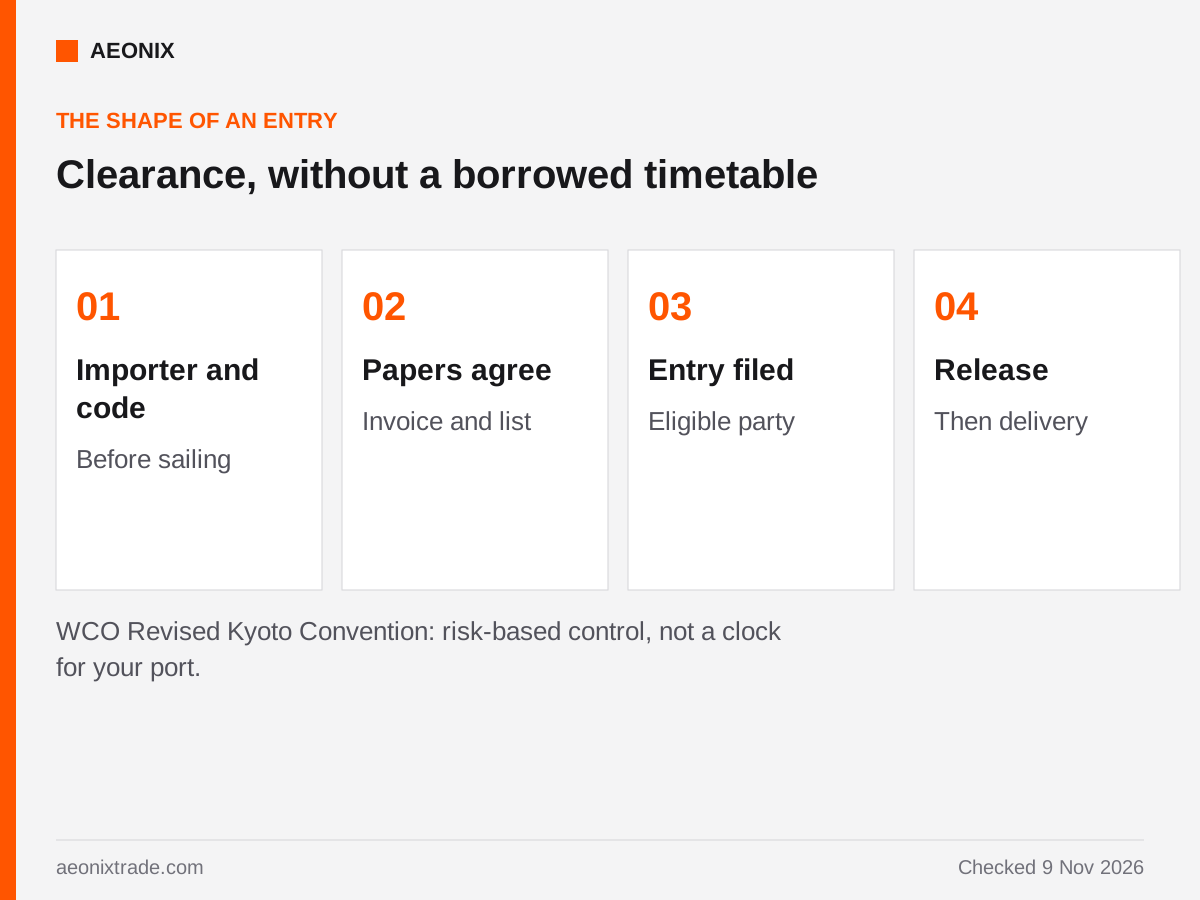
The steps below are the shape of that filing. They are not a timetable. The Revised Kyoto Convention, which the World Customs Organization calls the blueprint for modern customs procedures, and which entered into force on 3 February 2006, asks for procedures that are transparent, for a goods declaration with supporting documents, and for control based on risk rather than on opening every box. It does not set your country's clock. The hour for a pre-arrival filing, the form number, and the duty rate live on that customs authority's own page. This article does not copy them.
Before the factory finishes the goods
Clearance starts while the goods are still in China, because the papers have to be true before they are filed. Name the importer of record, or the equivalent person in the destination country. Classify the goods the way the HS lookup describes, in the destination tariff, not by pasting the factory's export code. Decide whether the product needs a licence, a mark, or a certificate that duty payment will not replace. A preference certificate, where the destination grants one, is Form E and other FTA certificates. Agree the commercial invoice and the packing list against the contract, including the Incoterm.
In the European Union, an EORI number is mandatory for customs operations in the EU customs territory, including import, export and transit. What that number is for a buyer of Chinese goods is an EORI number. The European Commission's page, read 9 November 2026, says economic operators established in the EU need one, and so do operators established outside the EU who lodge customs declarations, entry or exit summary declarations, temporary-storage declarations, or who act as a carrier. A person has one valid EORI at a time. Get that identity in place before the vessel arrives, not the morning the arrival notice lands.
A typical case
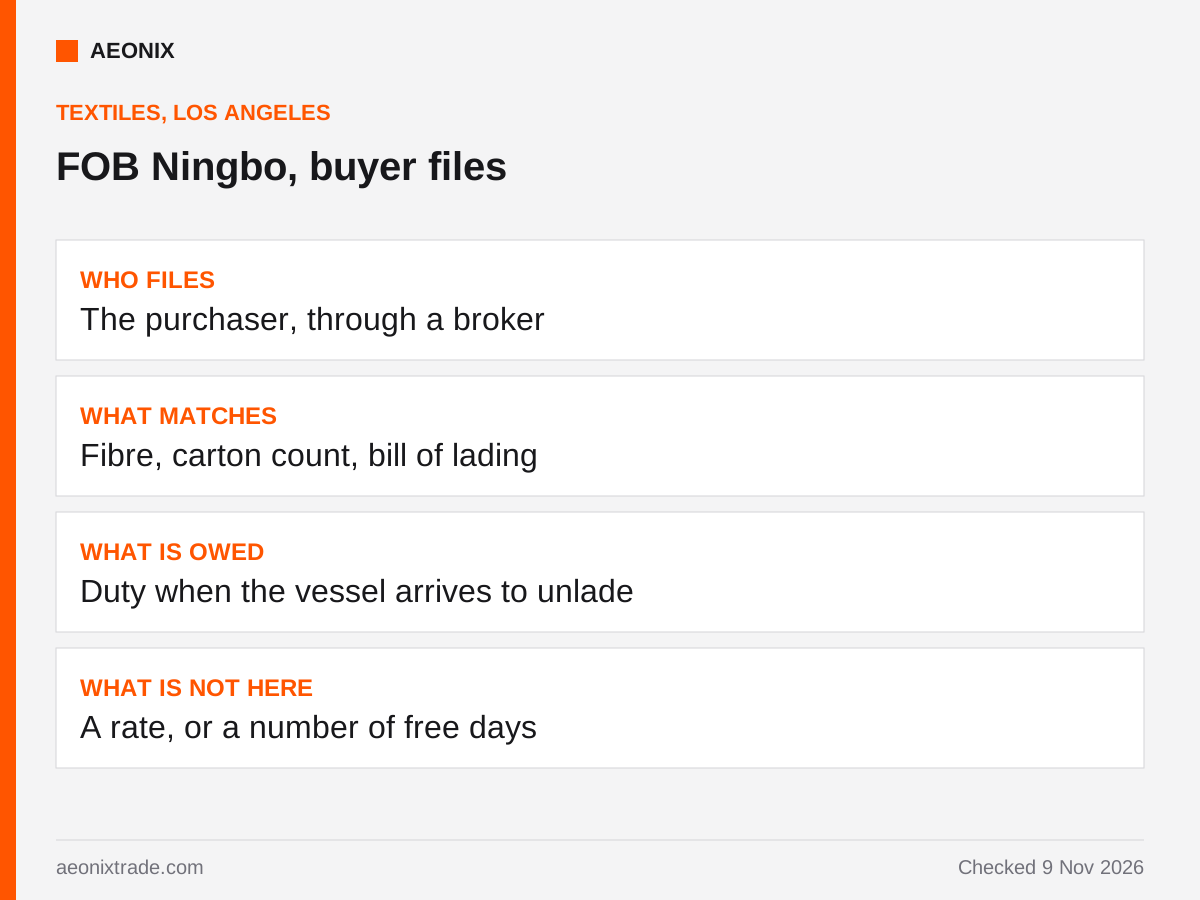
Home textiles, one LCL shipment, FOB Ningbo, sea freight to Los Angeles. The buyer is the purchaser and will be the importer of record. A broker is designated in writing. The invoice describes the textiles by fibre and use. The packing list carton count matches the bill of lading. Nobody has written a duty rate into the purchase order. The broker will read the rate on the Harmonized Tariff Schedule for the line being filed.
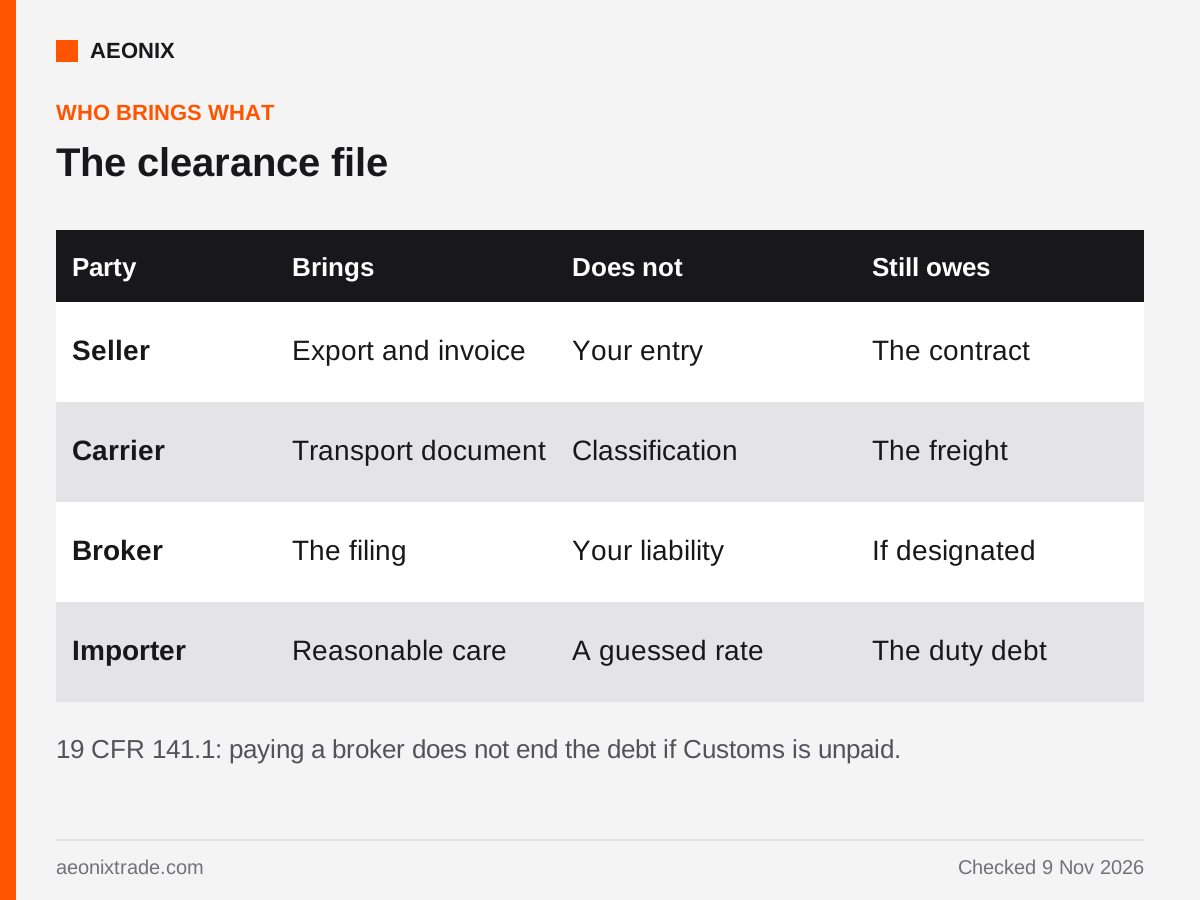
When the vessel arrives, the goods are not yet the buyer's to collect. For merchandise arriving by vessel, 19 CFR 141.1, as displayed on the eCFR on 9 November 2026 (the page stated title 19 was current as of 5 November 2026), says duties and the liability for them accrue on arrival of the importing vessel within a customs port with the intent to unlade. If the goods arrive other than by vessel, liability accrues on arrival within the customs territory. The same section says that liability is a personal debt of the importer to the United States, discharged only by payment in full, unless the law relieves it. Paying the broker does not end the debt if the broker does not pay Customs.
The entry itself is the filing 19 USC 1484 describes, in the 2023 edition of the United States Code served by GovInfo. One of the parties who qualifies as importer of record has to make entry, using reasonable care, and complete it with the declared value, the classification and the rate of duty. The statute says the time periods are what the Secretary prescribes by regulation. This page does not restate an hour. Read the current regulation for the filing you are actually making, including any security filing the destination requires before arrival. A forwarder's recollection of "the day before" is not that regulation.
Arrival, exam, release
After arrival, the carrier's notice tells you the goods are on the terminal. What happens to free time, storage and the equipment is a terminal question, covered on what happens when the cargo arrives. Clearance is the customs decision inside that wait. Most shipments are not opened. The Revised Kyoto Convention's principle is the minimum control needed, using risk management. Some shipments are examined. An exam is not a finding that you did something wrong. It is also not a moment to discover that the invoice says "textiles" and the cartons contain something else.
Release is permission to take the goods from customs control. It is not a promise that a later audit will agree with the entry. Keep the invoice, the packing list, the payment record and the classification notes. The WTO valuation agreement expects the customs value to follow the real transaction. The WCO describes that value as the basis for ad valorem duties. The amount you declare should be the amount you paid, on the Incoterm you actually used.
Product rules sit beside the duty. A textile that is released and then cannot be sold because the labelling is wrong was not "cleared" in any sense that helps the buyer. The compliance checklist is the pass over those rules before the deposit. The US path, including the entry, is outlined on importing from China to the United States. For consumer goods sold in the EU, the extra name on the file is the EU GPSR responsible person. Use that page for the US process. Do not copy a rate out of it.
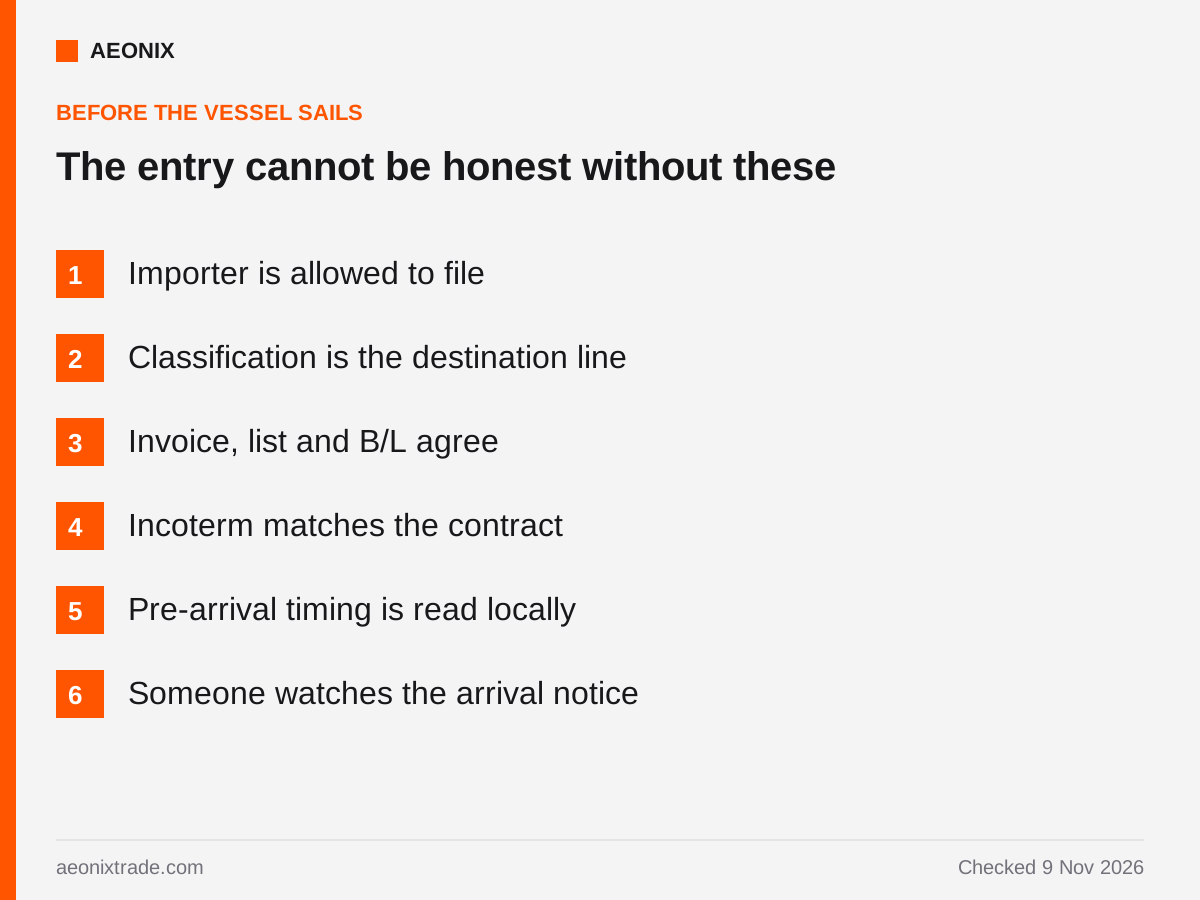
Before the vessel sails
- The importer is a party who is allowed to file in that country, named in writing.
- The classification is the destination tariff line, and any licence is identified.
- Invoice, packing list and bill of lading agree on description, counts and weights.
- The Incoterm on the invoice is the Incoterm in the contract.
- You have read the destination's own page for any pre-arrival filing and its timing.
- Someone is watching the arrival notice so the entry is filed while the cargo is still inside the terminal's window.
If you want the file built with the order rather than after the ship has left, put the importer, the description and the Incoterm on the RFQ. How the documents differ from each other is on the invoice and packing list comparison.
Where clearance stalls
The first miss is documents that disagree. The invoice says 140 cartons, the packing list says 128, the bill of lading says 132. The broker cannot file a single honest entry from three totals. Fix the paper in China.
The second miss is treating the forwarder as the importer because the forwarder said "we will clear it." A forwarder can coordinate. In the United States, the party who files still has to be eligible under 19 USC 1484, and the duty debt described in 19 CFR 141.1 stays with the importer if the broker does not pay. An email is not that designation.
The third miss is paying duty and thinking the product is finished. Duty is one assessment. A licence, a marking, or a safety file is another. The goods can be released and still be unsellable. Read the product rule before the factory packs the cartons.
Frequently asked questions
What are the steps to clear goods imported from China?
Agree the importer and the classification, match the invoice and packing list to the shipment, file the entry the destination requires, pay the duty and tax that authority assesses, and take the goods after release. Some countries also require a security filing before arrival. The timing is on that authority's page.
Who files the customs entry?
The party the destination country allows to file. In the United States, 19 USC 1484 says one of the parties qualifying as importer of record files, using reasonable care. In the EU, customs operations require an EORI number. A forwarder is not automatically that party.
When do US duties become owed?
Under 19 CFR 141.1, on arrival of the importing vessel in a customs port with intent to unlade, or on arrival in the customs territory if the goods do not arrive by vessel. The debt is the importer's. This page does not state the amount. The amount comes from the filed classification and value.
Does every shipment get inspected?
No. The Revised Kyoto Convention's approach is risk-based control, not a physical exam of every consignment. Plan for an exam anyway, by making the documents match the cartons, so an exam is a delay rather than a discovery.
Can I use a transit time from a blog as the clearance time?
No. Sailing time, terminal time and customs time are different clocks, and this page does not state a number of days. Ask the carrier for the schedule they are actually booking, and read the destination's filing rule for the customs clock.
Next steps
Sources
- WCO: The Revised Kyoto Convention. Blueprint for modern customs procedures, in force 3 February 2006. Principles include transparency, a standard goods declaration, and risk-based control.
- GovInfo: 19 USC 1484, United States Code, 2023 edition. Entry by a party qualifying as importer of record, using reasonable care, including classification and rate of duty. Time periods are those the Secretary prescribes.
- eCFR: 19 CFR 141.1. When US duty liability accrues, and that the debt remains the importer's if a broker does not pay. Read 9 November 2026.
- European Commission: EORI. Mandatory identification for EU customs operations, including import. Read 9 November 2026.
Submit sourcing request
Can't find what you need?
Start with a product or image link, an approximate quantity and destination. Other details can follow.