Import from China to South Korea in 2026: Duties, Documents and Landed Cost
Published by Aeonix Trade.
Last fact-checked: November 9, 2026.
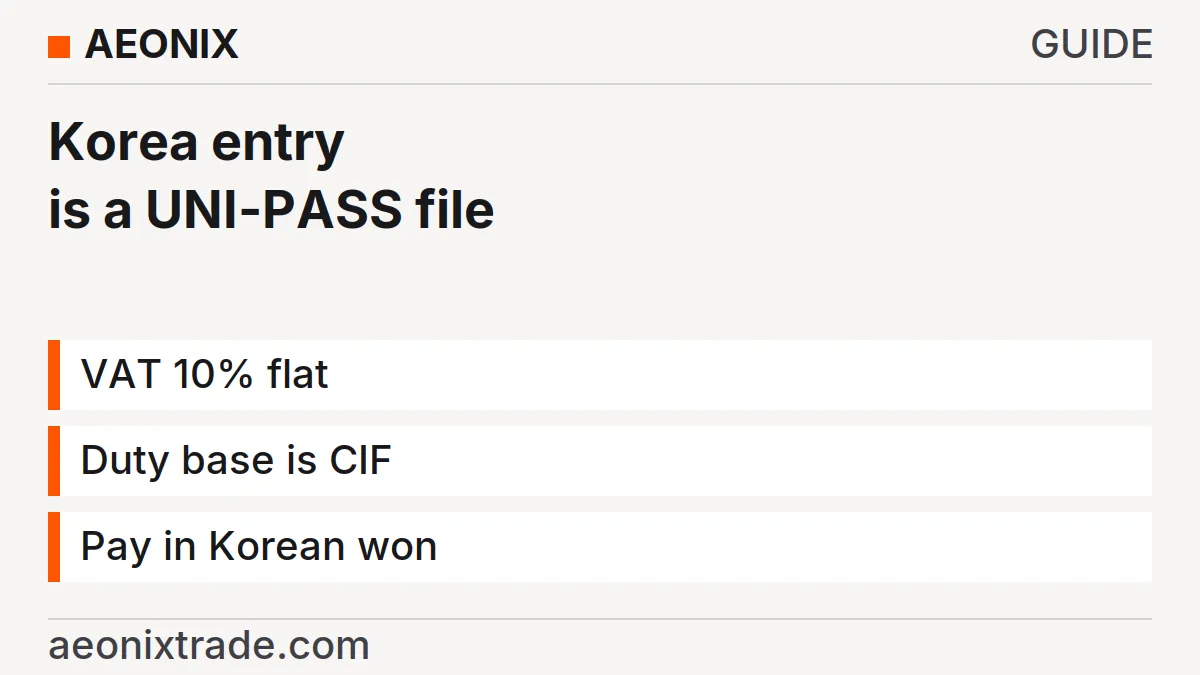
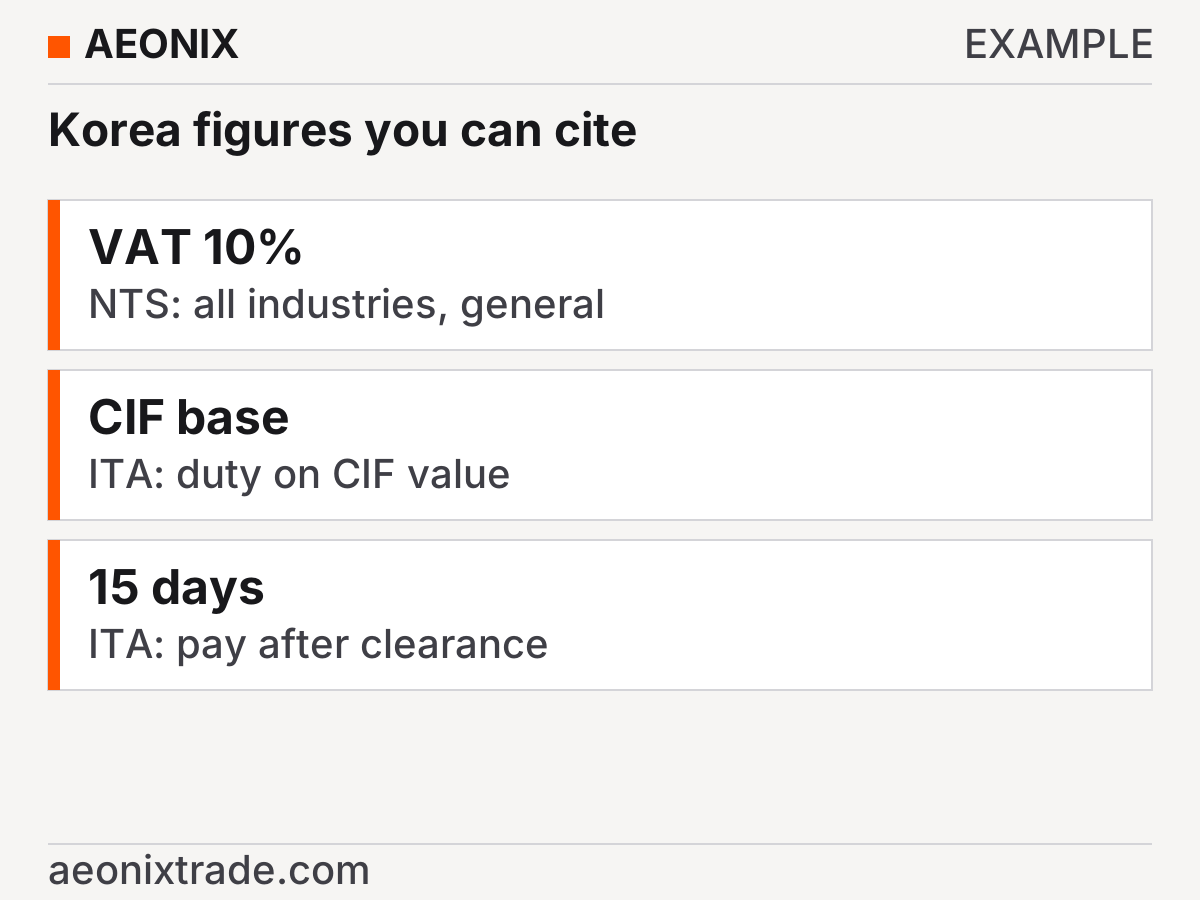
A buyer in Busan orders 5 CBM of phone cases, FOB Yantian, and asks whether "Korea is 10%." The National Tax Service says the VAT rate for a general taxpayer is 10% for every industry. The US International Trade Administration's Korea guide says Korea has a flat 10% VAT on all imports and on domestically made goods, assessed on a CIF value, and that tariffs and taxes are paid in Korean won within 15 days after the goods have cleared. Importing from China to South Korea is still a UNI-PASS declaration, a tariff line, and that VAT. The 10% is not the duty.
A typical case
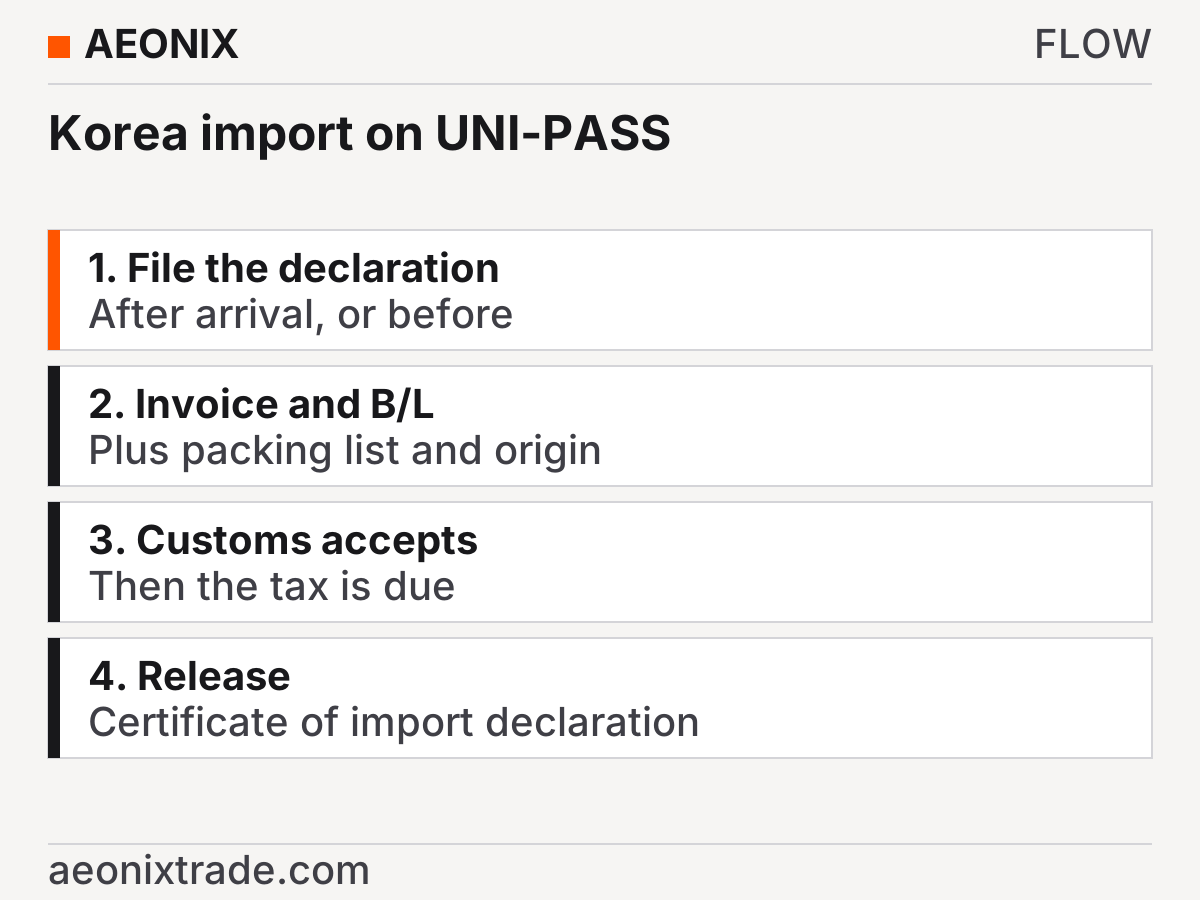
The cases are plastic accessories, not cosmetics and not food. The invoice is FOB Yantian. Freight and insurance are added before anyone can talk about a CIF customs value. The goods move LCL to Busan. Korea Customs Service says import clearance is the declaration to the head of a customs office, accepted if it is legitimate, and closed with a certificate of import declaration. The work is done in UNI-PASS. In principle you declare after the goods arrive. To speed release, you may file before they arrive. The declarant is a customs broker or the owner of the goods.
KCS lists the import declaration itself, then the invoice, packing list, bill of lading, certificate of origin, and an inspection or quarantine certificate where the goods need one. Phone cases usually do not need a food certificate. A case that is also a battery pack might. Read the heading before you assume the accessory file is enough. The packing list and the bill of lading are the two documents that have to agree with the invoice.
Duty, then 10% on a CIF base
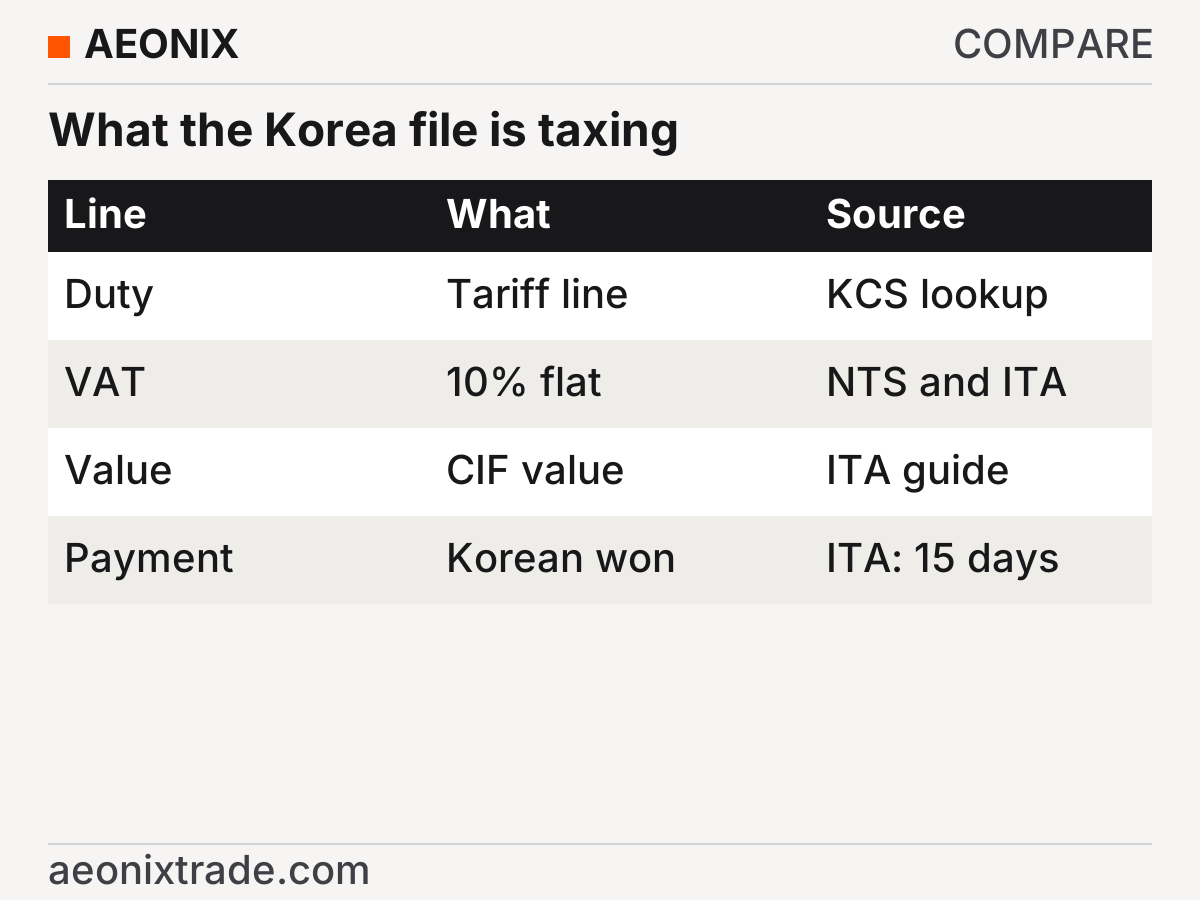
The ITA guide says duties are assessed on a cost-insurance-freight basis, and that the main method is the transaction value. It also says a flat 10% VAT applies to imports, on customs value plus duties. That is a second tax, after duty. It is not a substitute for the tariff line. KCS publishes a tariff lookup. Use it for the heading. This page does not state a duty percent for phone cases, and it does not state a China-Korea FTA rate. A preference is a claim with the origin document the agreement requires, not a sentence in a quote. The certificate of origin is the paper. The HS code is how you find the line.
The NTS rate page is the Korean authority's 10% for a general taxpayer, across industries. It is a domestic rate page, not a printout of your import assessment. The ITA guide is a US government description of the import: 10% on imports, CIF valuation, payment in won within 15 days after clearance. The Korean statute page that would let me read the payment window in the Act returned HTTP 404 on 9 November 2026, and the UNI-PASS tax table returned HTTP 403. So the 15 days stay attributed to the ITA guide. Ask your broker to show the assessment's due date rather than treating a foreign commercial guide as the Korean statute.
The same ITA guide says a special excise tax of 10 to 20 percent is levied on certain luxury items and durable consumer goods. Phone cases are not automatically in that sentence. If the broker says excise applies, ask which law. Do not add 10 to 20 percent because the range exists.
FOB Yantian is not the customs value
FOB stops at the Chinese port. The ITA guide's CIF base means freight and insurance join the customs value before duty, and VAT sits on value plus duty. A buyer who compares the Yantian unit price with a competitor's delivered won price is comparing different stacks. Rebuild it on the landed-cost sheet: goods, origin charges, freight, insurance, duty from the KCS line, VAT at 10% of the base the guide describes, broker, and delivery in Busan. The FOB page and the LCL service page cover the move. Payment of the supplier is a separate rail. The T/T page is how the factory gets paid, not how KCS gets the VAT.
Japan's 10% is a different tax with a local slice. Importing from China to Japan splits 7.8 and 2.2. Do not use that split in Busan. Singapore's GST is a third system: importing from China to Singapore.
After UNI-PASS accepts the entry
KCS says that after acceptance the importer pays the taxes, including customs duties. Some compliant businesses may be allowed to pay after clearance. Do not assume you are in that group because the last shipment was quiet. The certificate of import declaration is the paper that says the declaration was accepted. What you do with the cartons after release, the truck and the warehouse, follows what happens when cargo arrives.
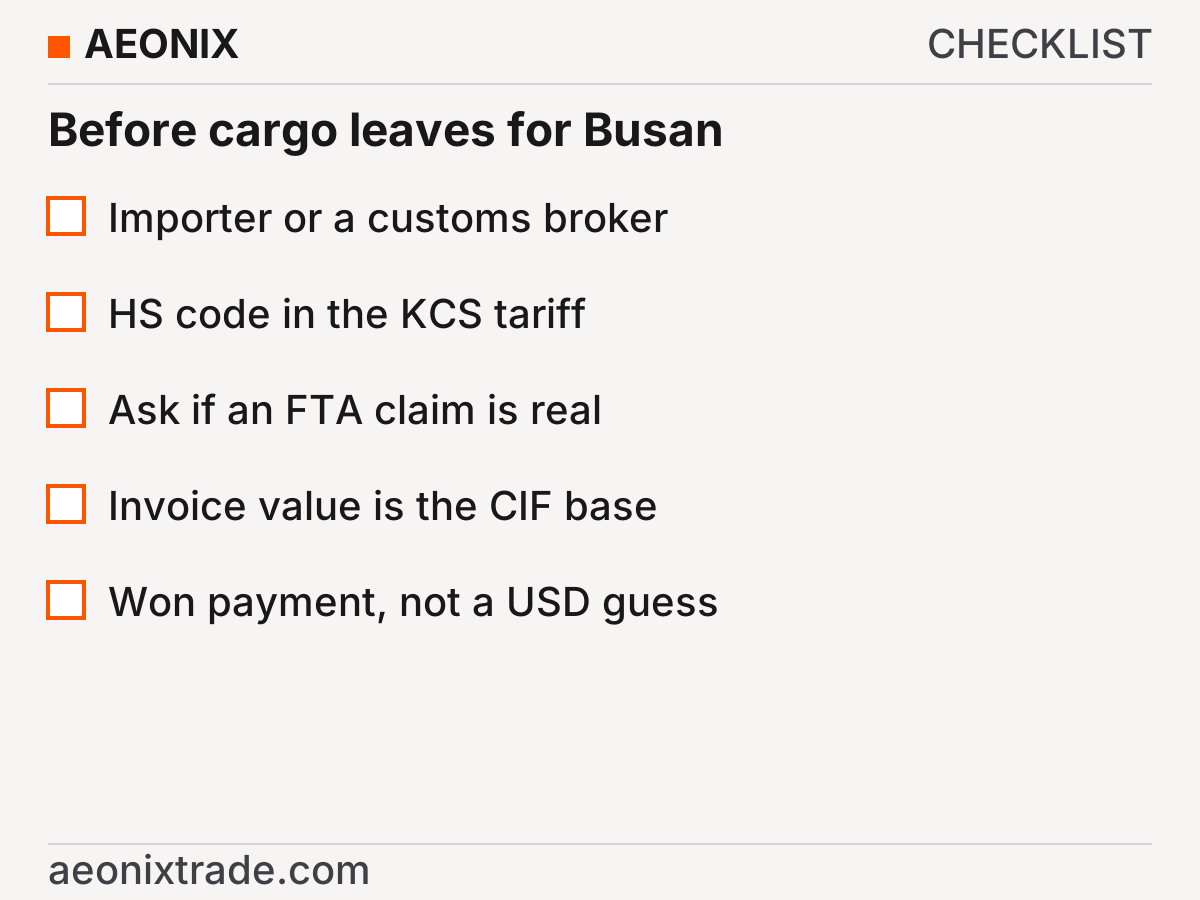
- Name the owner or the customs broker who will declare.
- Look up the heading in the KCS tariff, and write the duty only from that line.
- If someone offers an FTA rate, ask for the origin document before you believe the percent.
- Build the CIF value before you apply 10%.
- Plan to pay in won. The 15-day line is the ITA guide, so confirm the due date on the assessment.
Mistakes
- Hearing "10%" and skipping the duty lookup.
- Using the FOB invoice as the customs value.
- Claiming a China-Korea preference with no origin paper.
- Copying Japan's local-consumption-tax split into a Korean calculation.
- Treating the ITA's 15 days as the Korean statute. The statute page did not load. The assessment will.
Questions buyers actually ask
Is Korean VAT 10% on imports from China?
The NTS general rate is 10% for every industry. The ITA guide says the same 10% applies to imports, on customs value plus duties. Duty is extra and depends on the heading.
Can I declare before the ship arrives?
KCS says the principle is to declare after arrival, and that you may file before arrival to speed the process. Ask the broker which of those your shipment will use.
Do phone cases need a certificate of origin?
KCS lists a certificate of origin among the additional documents. You need it when you are claiming a rate that depends on origin. You do not invent one to decorate the file.
Who pays the VAT?
The importer on the UNI-PASS declaration, unless a contract moves that cost and the person who pays can legally be the importer. Send the Yantian quote through the RFQ form if you want the Korea lines separated before the deposit. The wider map is import from China.
The quote and the entry are covered in which Incoterm to use, the importer of record, and the customs clearance sequence.
Official sources
- Korea National Tax Service: VAT rates. General taxpayer rate 10% for every industry. Read 9 November 2026.
- Korea Customs Service: import clearance. UNI-PASS, declaration after arrival or before, broker or owner, and the document list. Read 9 November 2026.
- Korea Customs Service: tariff lookup. Where the duty line is searched. Read 9 November 2026.
- US International Trade Administration: South Korea import tariffs. Flat 10% VAT on imports, CIF valuation, payment in won within 15 days after clearance, and a 10 to 20 percent special excise on certain luxury goods. A US government guide, not the Korean statute. Read 9 November 2026.
Submit sourcing request
Can't find what you need?
Start with a product or image link, an approximate quantity and destination. Other details can follow.