Which Incoterm Should You Use When Importing from China?
Published by Aeonix Trade.
Last fact-checked: 9 November 2026.
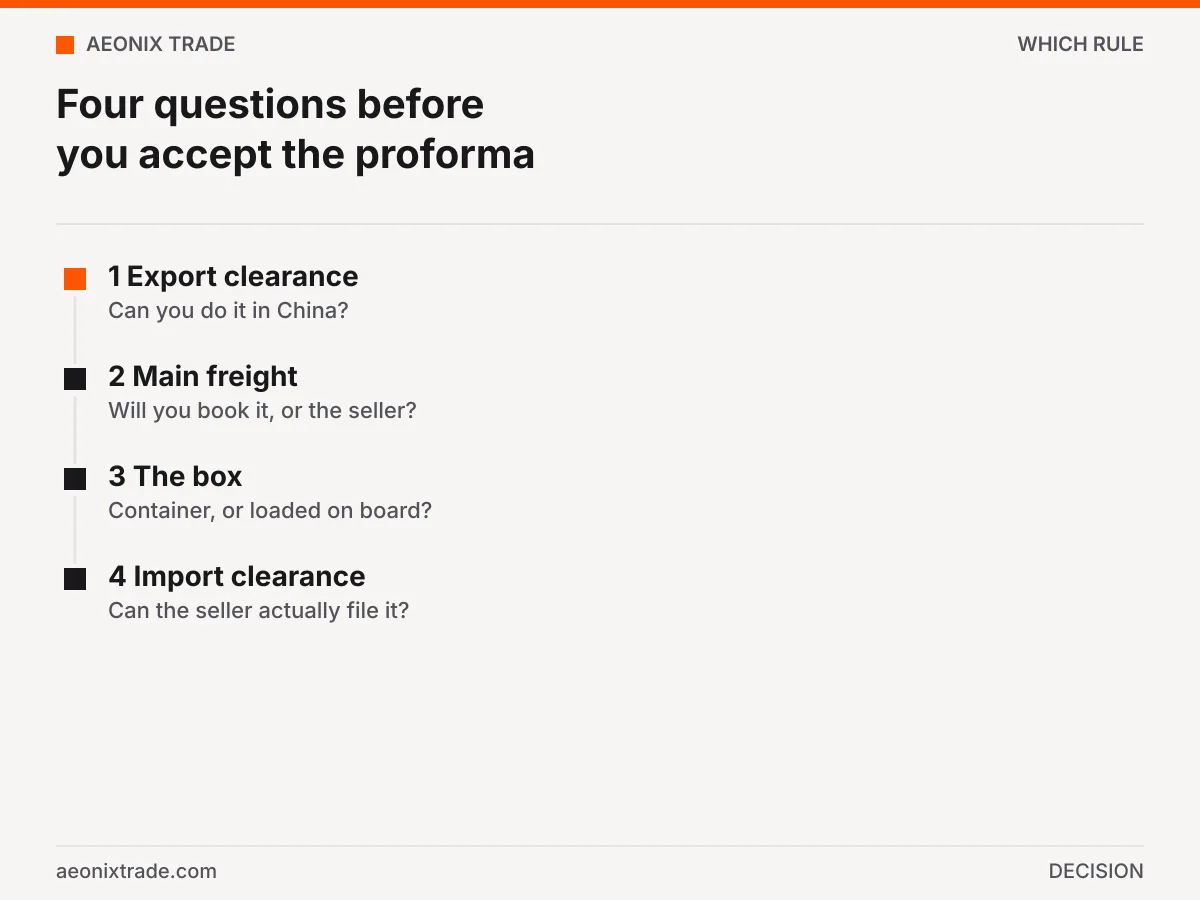
Which Incoterm to use on a China order is four questions: who clears export, who books the freight, whether the cargo is a container, and who can clear import.
The ICC Incoterms 2020 checklist says the rule follows who takes the main transport, and where you want risk to pass. It also says a flowchart is a starting point, not the answer for a particular deal. The full list of the 11 rules is the Incoterms 2020 chart. This page is the buyer's path through that list for goods leaving China.
There is no single best incoterm for importing from China. Incoterms for small importers fail most often when the proforma copies a term the factory always types, and nobody checks whether that party can actually do the clearance the rule assumes.
A typical case
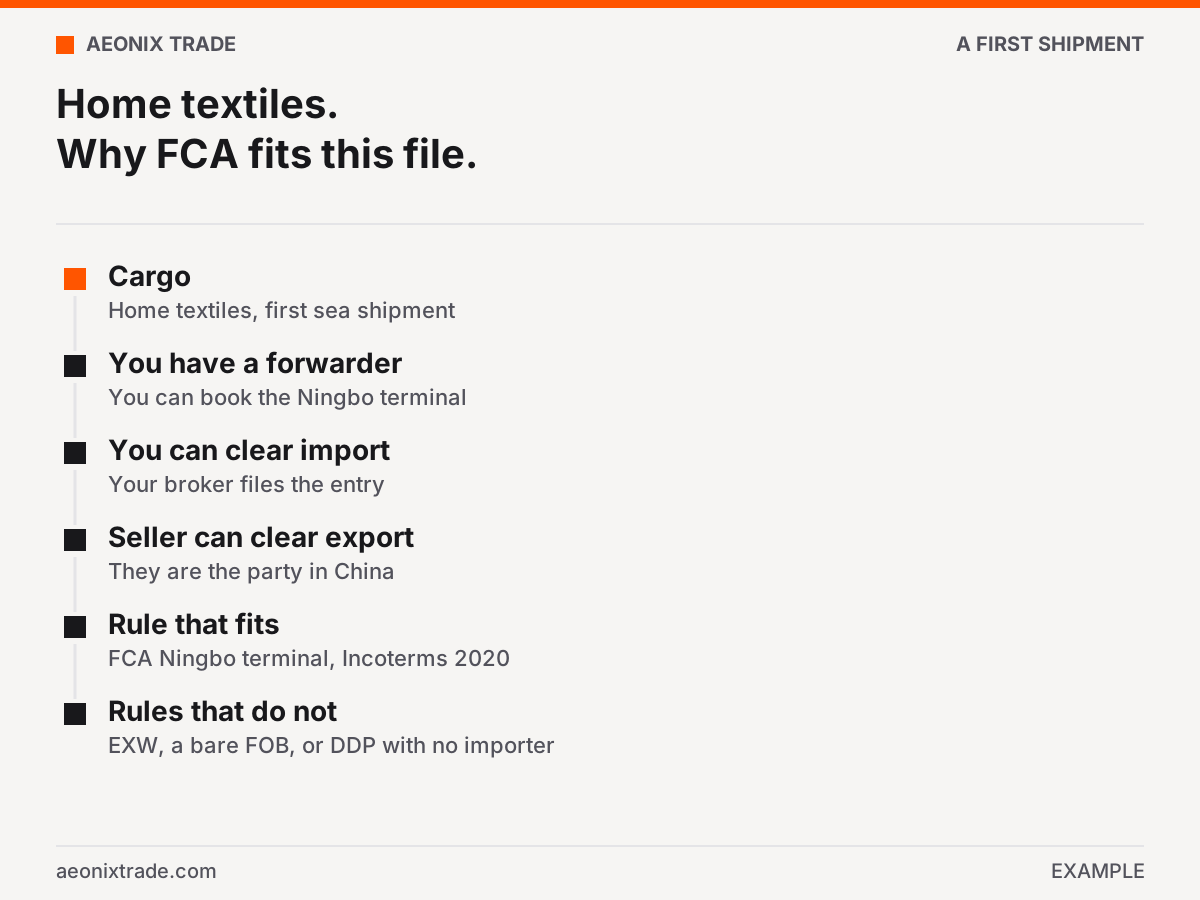
A buyer is placing a first sea shipment of home textiles. The factory is in Zhejiang. The buyer has a forwarder who can take a container at a Ningbo terminal, and a broker at home who can file the entry. The factory can clear Chinese export. The factory cannot be the importer in the buyer's country, and has not said it can appoint one.
On those facts the checklist's path is FCA at the Ningbo terminal, Incoterms 2020. EXW would push Chinese export clearance onto a buyer who has no one in China to do it. A bare FOB would describe an on-board delivery the terminal, not the factory, performs. DDP would hand import clearance to a seller who cannot file it. CIF would put the seller's freight and a minimum insurance cover in the price, and would still pass risk on board at origin. None of those is what this file is.
Question 1: can you clear export in China?
The checklist describes EXW as goods made available at the seller's premises, not cleared for export, and says it suits domestic trade. If your forwarder in China will collect uncleared goods and you can complete export formalities, EXW can match the work. If you cannot answer that, do not take the lower EXW unit price and hope the factory clears anyway.
FCA at the same premises keeps the pickup and moves export clearance to the seller. The checklist says that version of FCA includes loading onto the buyer's vehicle. Loading under EXW is not quietly included. If you need the factory to load, say so, or use FCA. The longer comparison is EXW versus FOB, and the definition pages are EXW and FCA.
Question 2: who books the main freight?
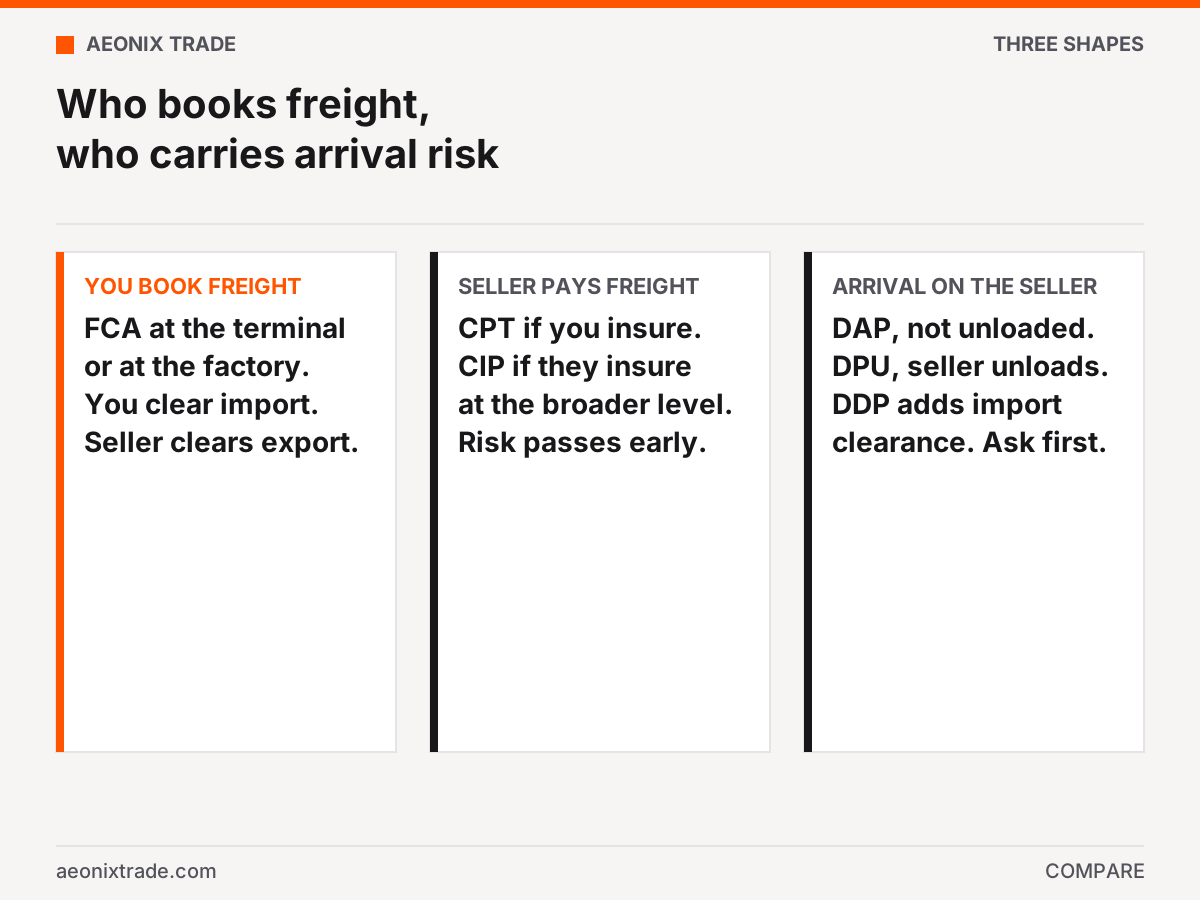
The checklist's practical point is simple. If you will arrange and pay the international carriage, you are in the F rules, and delivery is in the seller's country. If you want the seller's price to include that carriage, and you will still carry the transport risk, you are in the C rules. Delivery is still in the seller's country. The named place after CPT, CIP, CFR, or CIF is the freight's destination, not the moment risk passes.
Buyers often pick the seller's freight because the unit price looks finished. The checklist's economic point cuts the other way when you can book the ship more cheaply or more reliably than the seller can. Then an F rule, with your forwarder, is the smaller all-in, even though the factory's unit price looks higher. You only know that after both quotes are on the same handover. FOB China as a habit is not that comparison.
Question 3: is it a container?
If the goods travel in a container, or by more than one mode, or the handover is at a terminal, the checklist says FCA when you buy the freight. It says CPT when the seller pays the freight and you do not want their insurance in the price. It says CIP when you do want insurance, at the broader level.
The ICC Incoterms 2020 page states the insurance split directly. CIF keeps Institute Cargo Clauses (C) as the default. CIP requires cover compliant with Institute Cargo Clauses (A) or similar. The checklist reserves FOB, CFR, and CIF for goods lifted on board, or for the case where you specifically want the split once the goods are on board. A container handed to a Ningbo terminal is not that case. FOB versus CIF is the sea-rule comparison, including when one of them costs less only after the lines match.
Question 4: who clears import, and can they?
If you want the seller to carry cost and risk until a named place in your country, you are in the D rules. DAP does not require the seller to unload. DPU does. The ICC page says DPU is the old DAT rule, renamed because the place need not be a terminal. On both, you clear import and pay duties.
DDP adds that import clearance to the seller. The checklist tells the buyer to use it with caution, because practical limits can stop a seller from clearing at all, and it asks whether the seller can obtain the import licences and recover import VAT. Those are yes-or-no questions about that seller and that country. They are not a tax rate, and this page will not invent one. If the answer is no, DAP or DPU leaves the transport risk on the seller and the entry on you. Choosing between those arrival terms is choosing DAP or DDP. The definition, including what to ask before you accept the price, is on DDP.
| If this is true | Look here first | Do not start here |
|---|---|---|
| You cannot clear Chinese export. | FCA, with export on the seller. | EXW. |
| You will book a container. | FCA at the factory or at the terminal you name. | FOB or FAS, unless the goods are loaded on board as the rule describes. |
| The seller pays freight on a container, and you accept transport risk. | CPT, or CIP if you want the broader insurance in their price. | CFR or CIF. Those are the on-board sea rules. |
| You want the goods at your door, and you can clear import. | DAP, or DPU if the seller must unload. | DDP, unless the seller can actually clear. |
| The seller can clear your import and has said how. | DDP at a named place, with the entry questions in writing. | A DDP unit price with no named importer and no agreed classification. |
Where the choice goes wrong
- Accepting the factory's default term because the sample price was fine. The term is part of the price. A lower EXW number that leaves export, the truck, and the terminal on you is not a lower shipment.
- Using a C rule and then arguing about damage at your port as if the seller still had the risk. On CPT, CIP, CFR, and CIF, delivery is in the seller's country. Your claim for loss on the water is an insurance claim if cover was bought, not a reason to refuse the balance because the ship was late.
- Letting DDP stand in for product compliance. A seller willing to pay duty has not shown that the goods may be sold in your market. The International Trade Administration is explicit that the rules do not decide conformity, and they do not list your customs documents.
What to write on the proforma
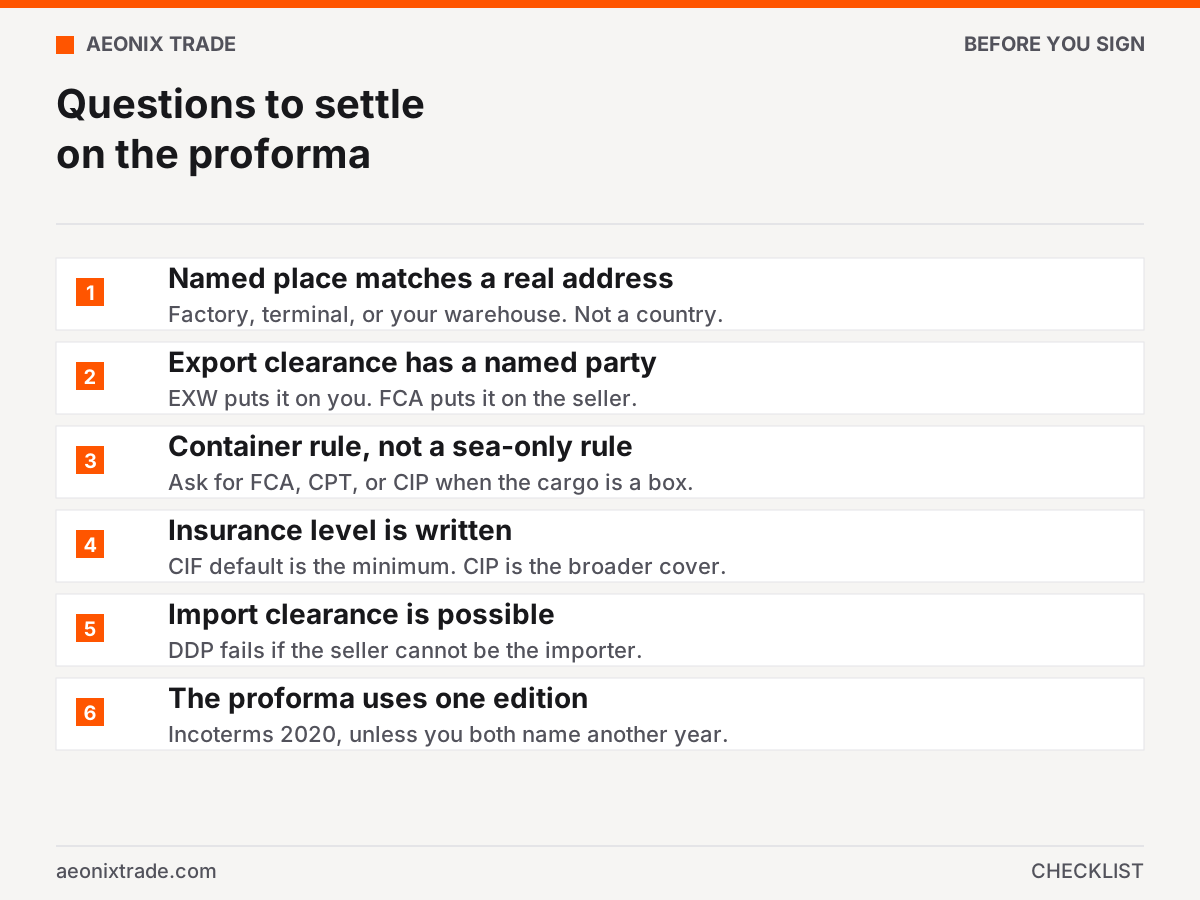
- The rule, the named place, and Incoterms 2020. One edition. The ITA says an older edition is valid only when the contract names it.
- Who clears export, in the words of the rule you picked, not as a favour in a chat message.
- Who books the main carriage, and whether insurance is in the price. What that cover is, when you buy it yourself, is cargo insurance. If it is CIF, say whether you accept the minimum cover or you have agreed more. If you need the broader default, you are looking at CIP.
- For DDP, the name that will appear on the import entry, and a written answer that this seller can clear this product. If they cannot, change the rule before production.
- Payment in a separate clause. The three letters do not say when you wire.
Put the carton count, the named place, and the rule you want priced on the RFQ, and ask for one alternative on the same specification. Two unit prices on two different rules are not a comparison until the missing legs are written back in. How those freight legs are built, without a rate copied from a blog, is how an LCL quote from China is built.
Frequently asked questions
What is the best Incoterm for a small importer buying from China?
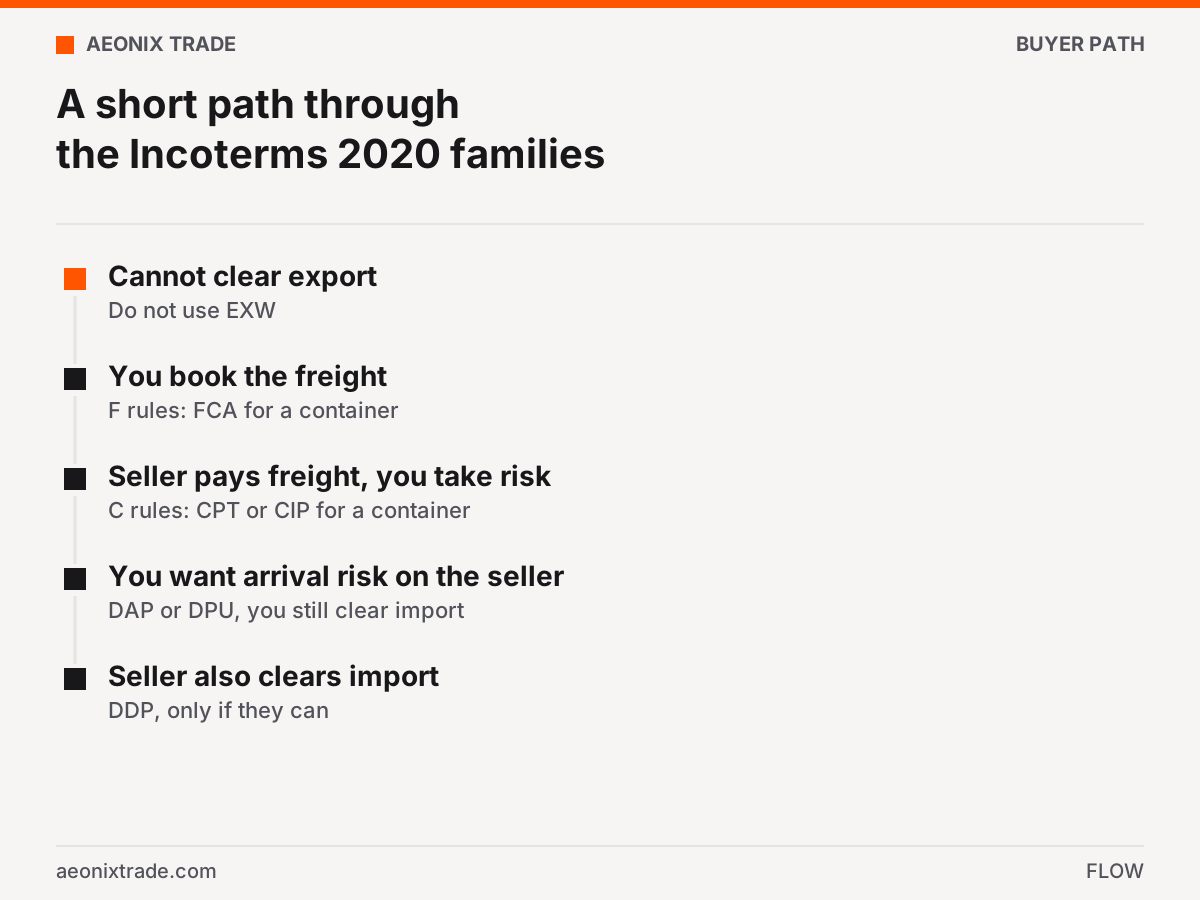
For a container you can give to your own forwarder, FCA at a named terminal or at the factory is the checklist's starting point, with the seller clearing export and you clearing import. Switch to CPT or CIP if you want the seller's freight in the price and you accept that risk still passes early. Switch to DAP or DPU if you want arrival risk on the seller and you can still clear. Use DDP only after the seller shows they can file the entry.
Should I avoid EXW entirely?
No. Use it when your side really will collect uncleared goods and clear export. The checklist's warning is that EXW is a poor default for an international sale, not that the three letters are banned.
If the supplier only offers FOB or CIF, which costs less?
You cannot tell from the two unit prices. Add the freight and the insurance level you actually need to the FOB side, and add the destination lines to both. CIF's default cover is the minimum. The method is on the FOB versus CIF page. This page does not publish a freight rate.
Do Incoterms decide who pays duty?
They decide who is responsible for import clearance. On every rule except DDP, that is the buyer. The rate itself is not in the Incoterm. Look it up with your broker from the official tariff for the classification and the country of import.
Can I use Incoterms 2010 if the factory's form still says 2010?
Yes, if you both mean that edition and the contract says so. Do not leave the year off. The ICC's current rules are the 2020 edition, in force since 1 January 2020.
Next steps
- FCL versus LCL
- 20-foot, 40-foot, and high-cube containers
- A sea waybill versus an original bill of lading
- A customs broker versus a forwarder
Sources
- ICC: Incoterms 2020 checklist. Buyer and seller decision points: EXW and export clearance, FCA for containers, C rules as shipment contracts, D rules as arrival contracts, and the caution on DDP. Checked 9 November 2026.
- ICC: Incoterms 2020. CIF at Institute Cargo Clauses (C), CIP at Clauses (A) or similar, and DPU as the renamed DAT rule.
- U.S. International Trade Administration: Know Your Incoterms. What the rules clarify, what they do not cover, and the option to name an older edition.
- ICC: Incoterms rules. The 2020 edition entered into force on 1 January 2020.
Submit sourcing request
Can't find what you need?
Start with a product or image link, an approximate quantity and destination. Other details can follow.