Incoterms 2020 Chart: All 11 Terms Compared for China Imports
Published by Aeonix Trade.
Last fact-checked: 9 November 2026.
An Incoterms 2020 chart is a list of 11 rules. Your China purchase order needs one of them, written with one named place.
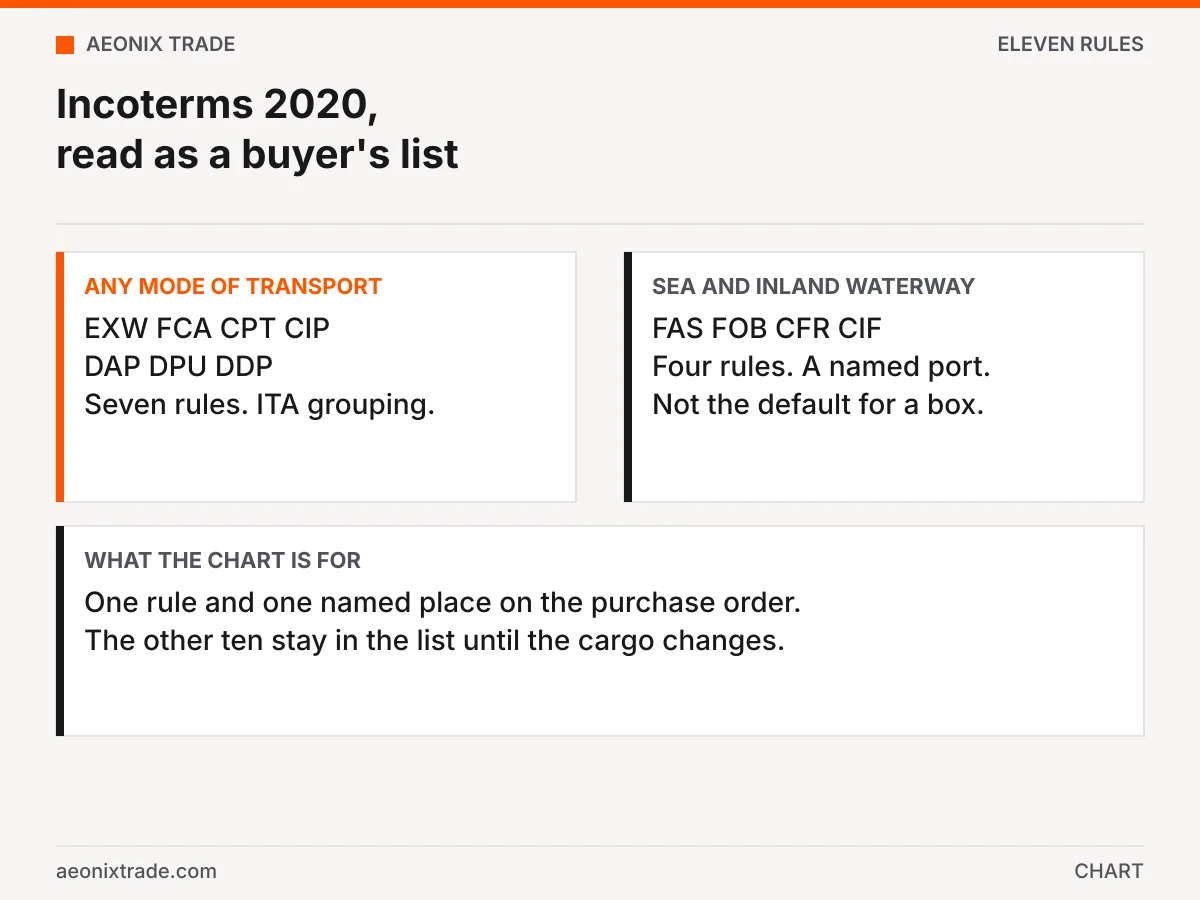
The International Chamber of Commerce describes Incoterms rules as eleven three-letter trade terms for a business-to-business sale of goods. The current set entered into force on 1 January 2020. The U.S. International Trade Administration groups seven of those rules for any mode of transport and four for sea and inland waterway. This page is that Incoterms list, read from the buyer's side of a China order: where the seller's job stops, who books the main freight, and which rules were written for a container.
It is not the rule book. ICC sells the text. The ITA page says its summary is not the official legal definition of each rule. Use this Incoterms chart to see which rule to open, then name that rule and the edition in the contract.
A typical case
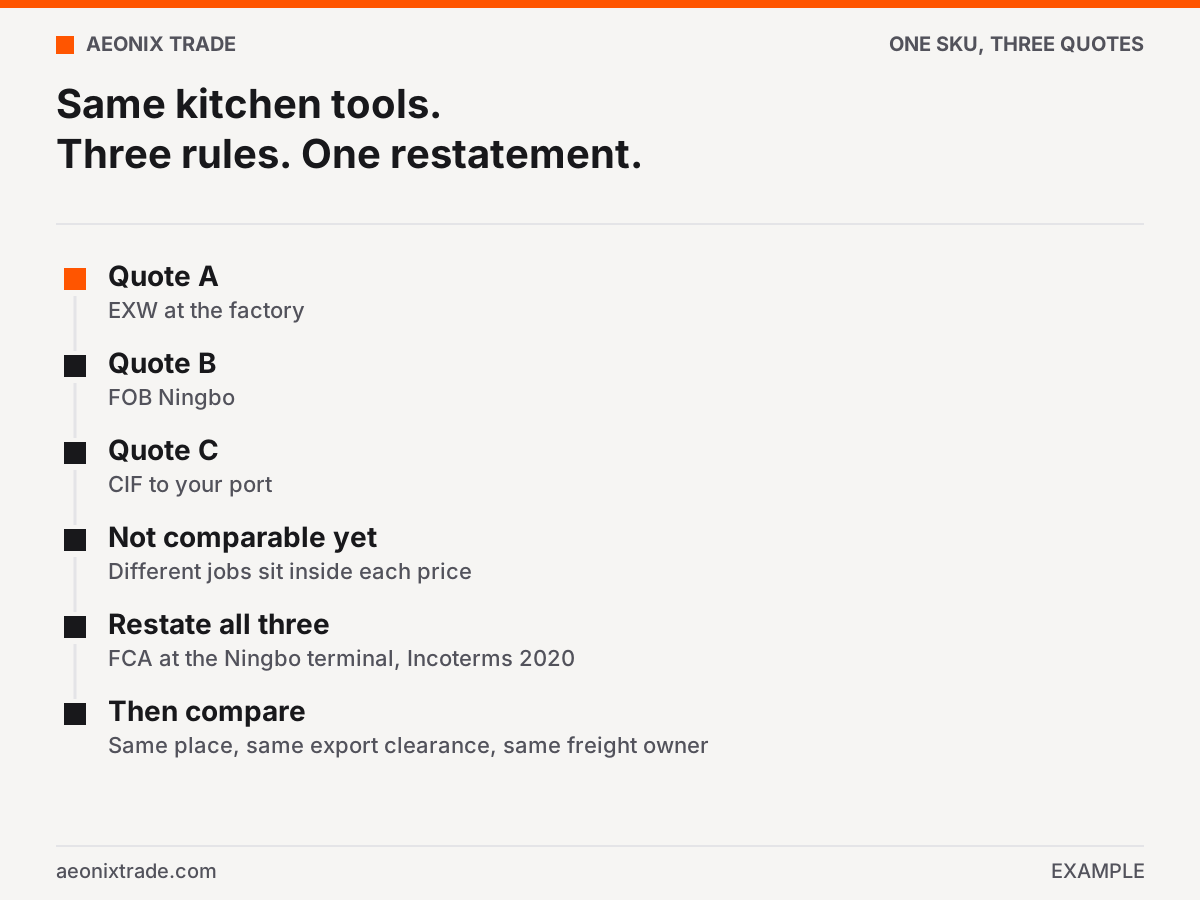
Three factories quote the same stainless kitchen-tool set. One writes EXW at the factory. One writes FOB Ningbo. One writes CIF to your port. The unit prices are not three versions of the same offer.
EXW has not cleared Chinese export. FOB, when it is really FOB, stops once the goods are on board a ship, and you pay the ocean freight. CIF puts freight and a minimum insurance cover inside the seller's price, and the risk still passes on board at the load port, not when the ship reaches you. Until you restate all three on one rule and one named place, the cheapest unit price is the one that left the most work off the page. How to make that choice for a live order is in which Incoterm to use when importing from China.
The Incoterms 2020 list, in two groups
The ITA's split is the one to memorise, because a container out of Ningbo, Yantian, or Nansha is almost never a sea-only handover. The terminal receives the box. The ship loads it later. The ICC Incoterms 2020 checklist sends that pattern to FCA when you are buying the freight, and to CPT or CIP when the seller is paying it.
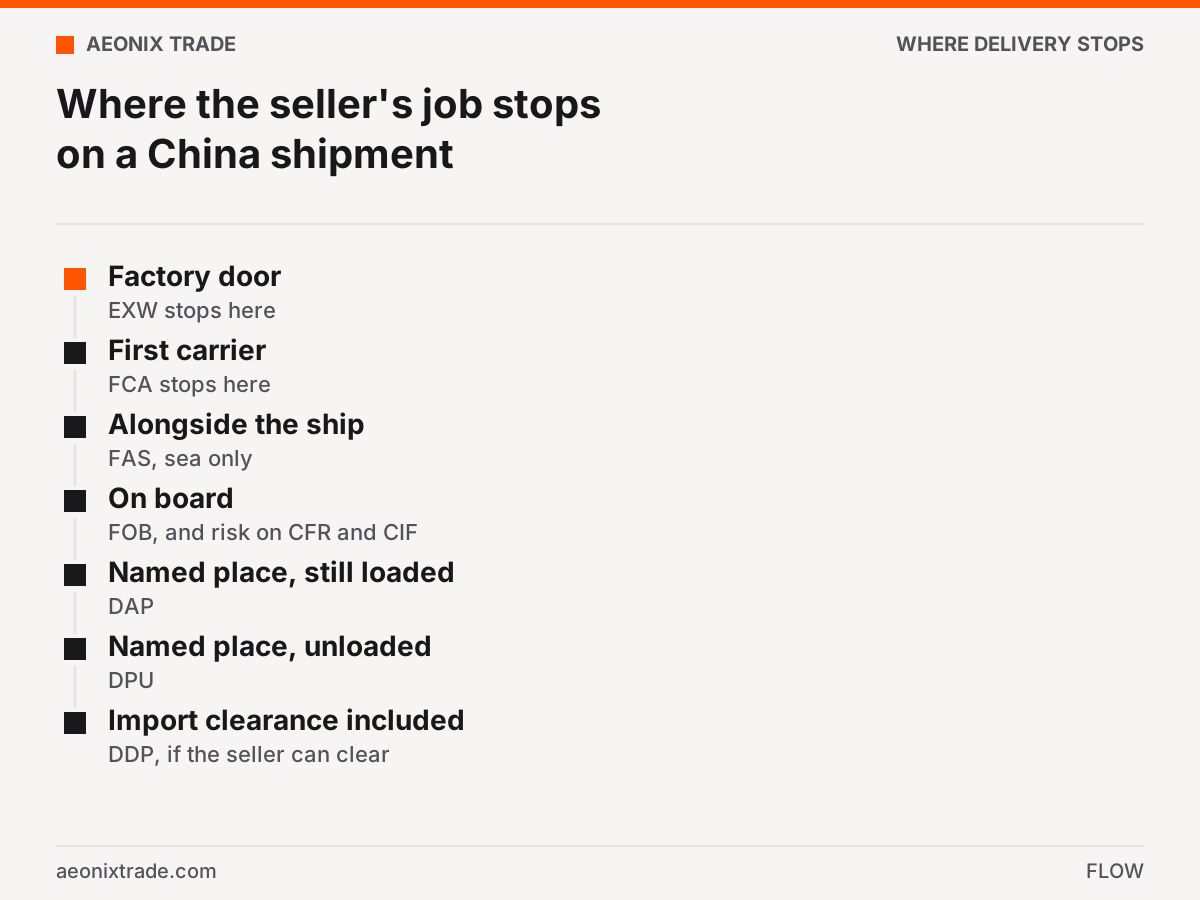
| Rule | Named place | Who contracts the main freight | Where this rule is aimed |
|---|---|---|---|
| EXW Ex Works | Seller's premises | Buyer | Goods made available, not cleared for export. The checklist treats it as suited to domestic trade. |
| FCA Free Carrier | Seller's premises or a terminal | Buyer | Any mode. The checklist's rule for a container or a terminal handover. Seller clears export. |
| CPT Carriage Paid To | Place of destination, for the freight | Seller | Any mode. Seller pays carriage. You do not ask them to insure under the rule. |
| CIP Carriage and Insurance Paid To | Place of destination, for the freight | Seller | Any mode. Seller pays carriage and must provide the broader cover, Institute Cargo Clauses (A) or similar. |
| DAP Delivered at Place | Named place in the destination country | Seller | Arrival. Seller carries risk to that place and does not unload. You clear import. |
| DPU Delivered at Place Unloaded | Named place, unloaded | Seller | The renamed DAT rule. Seller unloads. You still clear import. The ICC page says the place need not be a terminal. |
| DDP Delivered Duty Paid | Named place in the destination country | Seller | Arrival, including import clearance. The checklist says to use it with caution, because the seller may not be able to clear. |
| FAS Free Alongside Ship | Port of loading | Buyer | Sea and inland waterway only. Delivery alongside the ship. Seller clears export. |
| FOB Free on Board | Port of loading | Buyer | Sea and inland waterway. Delivery on board. The checklist keeps it for goods loaded on board, not for a box the terminal loads. |
| CFR Cost and Freight | Port of destination, for the freight | Seller | Sea and inland waterway. Seller pays freight. No insurance obligation in the rule. Risk passes on board at origin. |
| CIF Cost, Insurance and Freight | Port of destination, for the freight | Seller | Sea and inland waterway. Freight plus minimum cover, Institute Cargo Clauses (C), unless you agree more. Risk still passes on board at origin. |
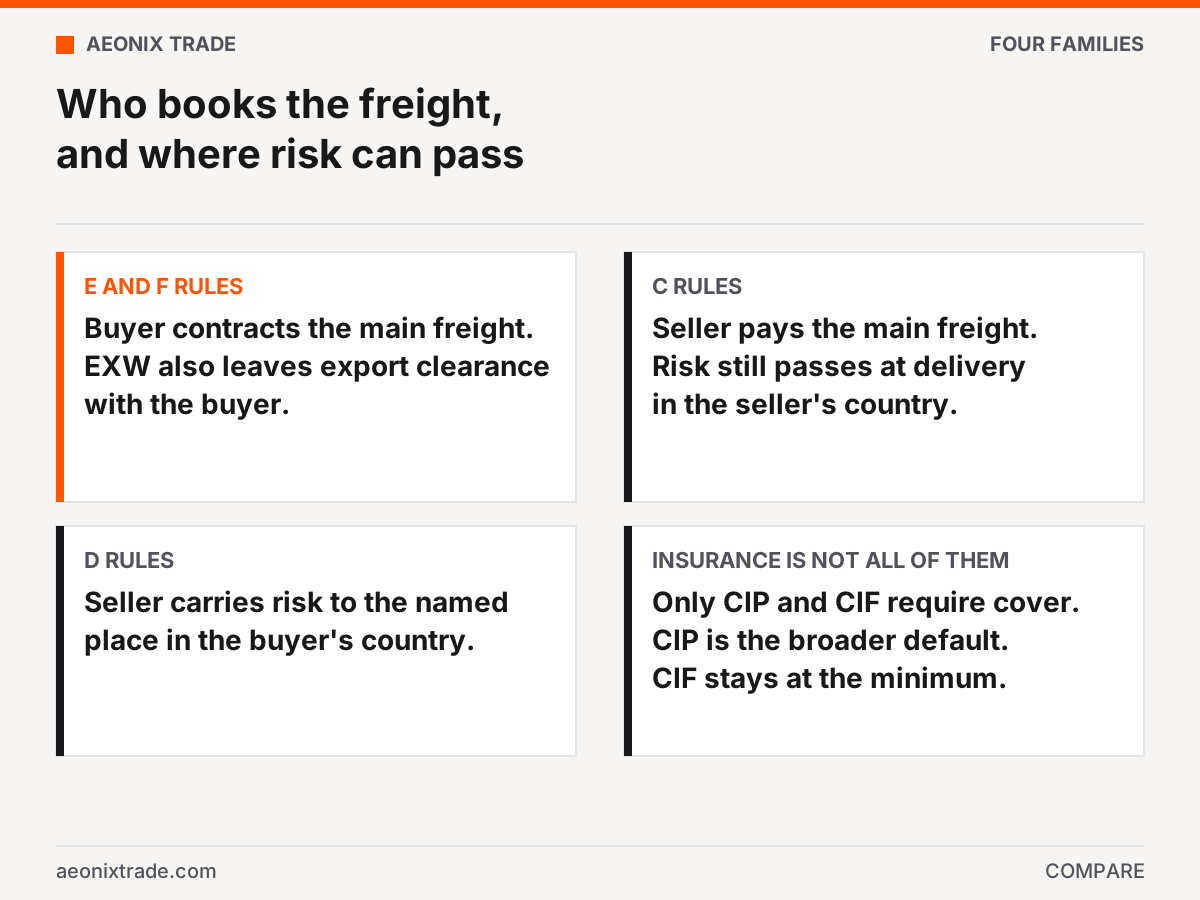
Two points sit on top of that table, both from the ICC Incoterms 2020 page. CIF keeps Institute Cargo Clauses (C) as the default, and the parties may agree a higher cover. CIP requires a higher level, compliant with Institute Cargo Clauses (A) or similar. And the costs that belong to a given rule are gathered in article A9/B9 of that rule, so a seller can show the list instead of hiding it in one number.
The same page says FCA was revised so the parties can agree that the buyer will instruct the carrier to issue an on-board bill of lading to the seller after loading, for tender to the buyer, often through the banks. That is the container answer when a letter of credit wants an on-board bill. FOB is not that mechanism. FOB already treats the on-board moment as delivery.
What the chart does not decide
The ITA lists the gaps in one place. Incoterms rules do not identify the goods or state the price. They do not set the method or timing of payment. They do not say when title passes. They do not list the documents your customs authority will want. They do not decide liability for goods that do not match the contract, late delivery, or how a dispute is resolved.
So "FOB Ningbo, 30 percent by T/T" is two clauses. The three letters place delivery, cost, and risk. The wire is a payment term, covered on its own page against a T/T, letter of credit, and D/P comparison. The booking, FCL or LCL, is a third choice. FCL versus LCL from China is where that one belongs. A service page that pairs the sale term with the file is Incoterms and shipping documents.
Where buyers misread the chart
- Treating the named place after CIF or CPT as the place where risk passes. On those C rules the named place is where the seller's freight contract aims. Delivery, and the risk transfer that follows it, happens earlier, in the seller's country.
- Writing FOB on a container because the email already says FOB. The checklist points that handover to FCA. The price may not change. The moment you start arguing about damage in the yard will.
- Reading DDP as "nothing left to do." The checklist warns that a seller outside your country may be unable to clear the import. If they cannot, the rule was the wrong one, and the cargo is still yours to fix. Duty rates are not in the chart. Take them from the customs authority for the product, on the day you price the order.
How to write one line from the chart
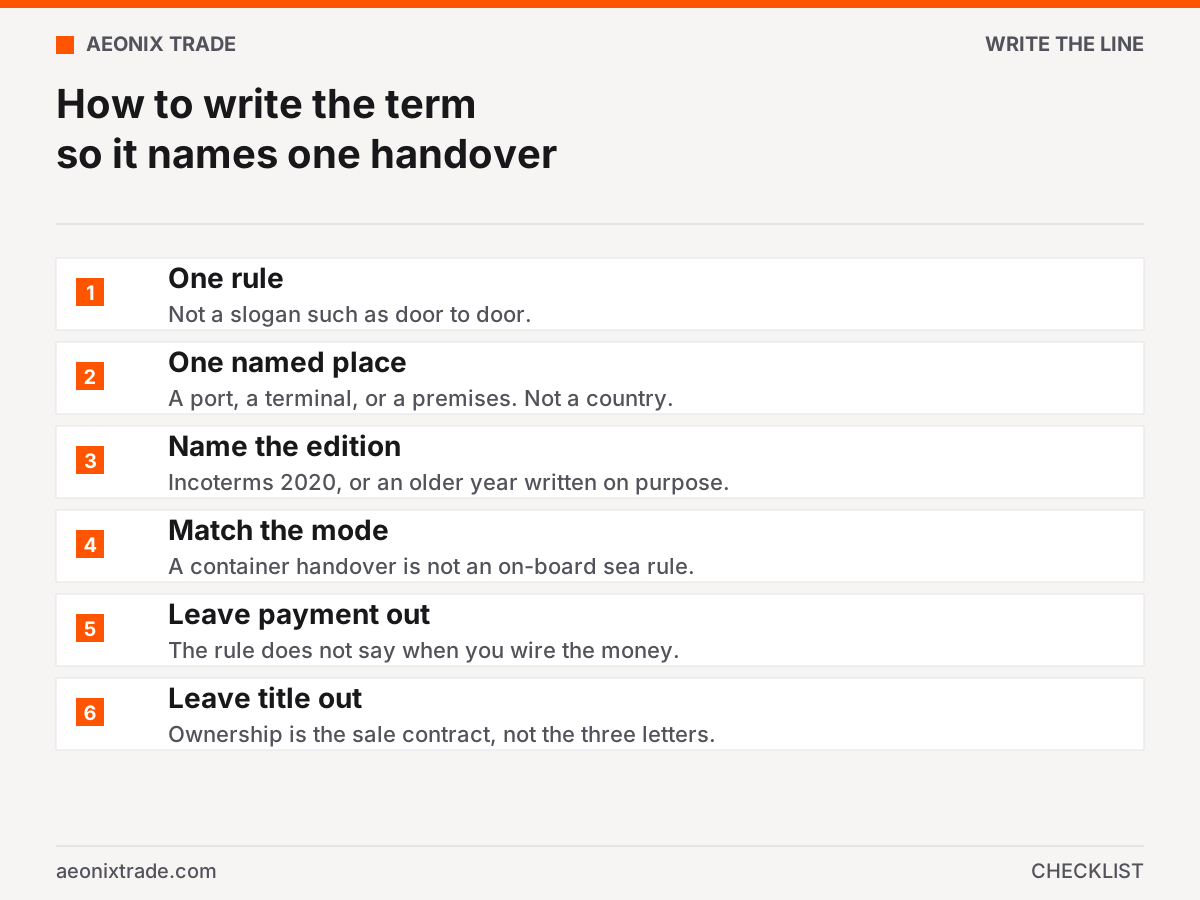
- One rule. "Door to door" is not a rule.
- One named place that the rule actually uses. FOB names a port of loading. CIF names a port of destination for the freight. FCA names the place the carrier receives the goods. A country is not a place.
- The edition. "FCA Ningbo terminal Incoterms 2020" is readable. The ITA says parties may still use an older edition if the contract names it. A silent form is how 2010 and 2020 end up on the same file.
- A container check. If the goods travel in a box, ask for FCA, CPT, or CIP before you accept FAS, FOB, CFR, or CIF.
- Payment, title, and the specification stay in their own clauses.
If the supplier will only quote FOB China as a habit, ask them to restate the container as FCA at the terminal they will actually use, on the same RFQ. Keep FOB for cargo that is genuinely put on board. The difference between those two, and between FOB and CIF, is worked through on EXW versus FOB and FOB versus CIF.
Frequently asked questions
How many Incoterms 2020 rules are there?
Eleven. The ICC states that count, and the ITA splits them into seven rules for any mode and four for sea and inland waterway. DAT is not in the 2020 list. It was renamed DPU.
What does Incoterms 2020 explained actually change for a China container?
The public changes that touch a container order are the FCA on-board bill, the insurance split between CIF and CIP, costs gathered in A9/B9, and clearer security-related obligations in carriage and in export or import clearance. The ICC page is the source for those four. The rest of the choice is still which family fits the handover.
Can a contract still say Incoterms 2010?
Yes, if the parties agree and the documents name that edition. The ITA says so. The ICC's current edition is 2020, in force since 1 January 2020. Name one year. Do not leave it blank.
Which rule is the best incoterm for importing from China?
There isn't one rule for every order. For a container you will freight yourself, the checklist points to FCA. The decision page walks the other cases. This chart is the list those cases come from.
Does the chart include freight prices or duty?
No. A rule allocates who contracts carriage and who clears import. It does not publish a rate. DDP allocates import clearance, including duties, to the seller. The percentage is the destination tariff for the classification you agreed, not a cell in this table.
The paperwork next to this choice is 20-foot, 40-foot, and high-cube containers, a bonded warehouse, cargo insurance, and a customs broker versus a forwarder.
Sources
- ICC: Incoterms 2020. FCA on-board bill, costs in A9/B9, CIF at Institute Cargo Clauses (C), CIP at Clauses (A) or similar, and DPU as the renamed DAT rule. Checked 9 November 2026.
- ICC: Incoterms rules. Eleven terms, recognised by UNCITRAL as the global standard for the common delivery terms, with the 2020 edition in force from 1 January 2020.
- U.S. International Trade Administration: Know Your Incoterms. The seven-and-four split, what each rule clarifies, and what the rules do not cover.
- ICC: Incoterms 2020 checklist. Container and terminal handovers toward FCA, CPT, or CIP, and the caution on DDP and on EXW in international sales.
Submit sourcing request
Can't find what you need?
Start with a product or image link, an approximate quantity and destination. Other details can follow.