Cargo insurance when importing from China
Published by Aeonix Trade.
Last fact-checked: November 10, 2026.
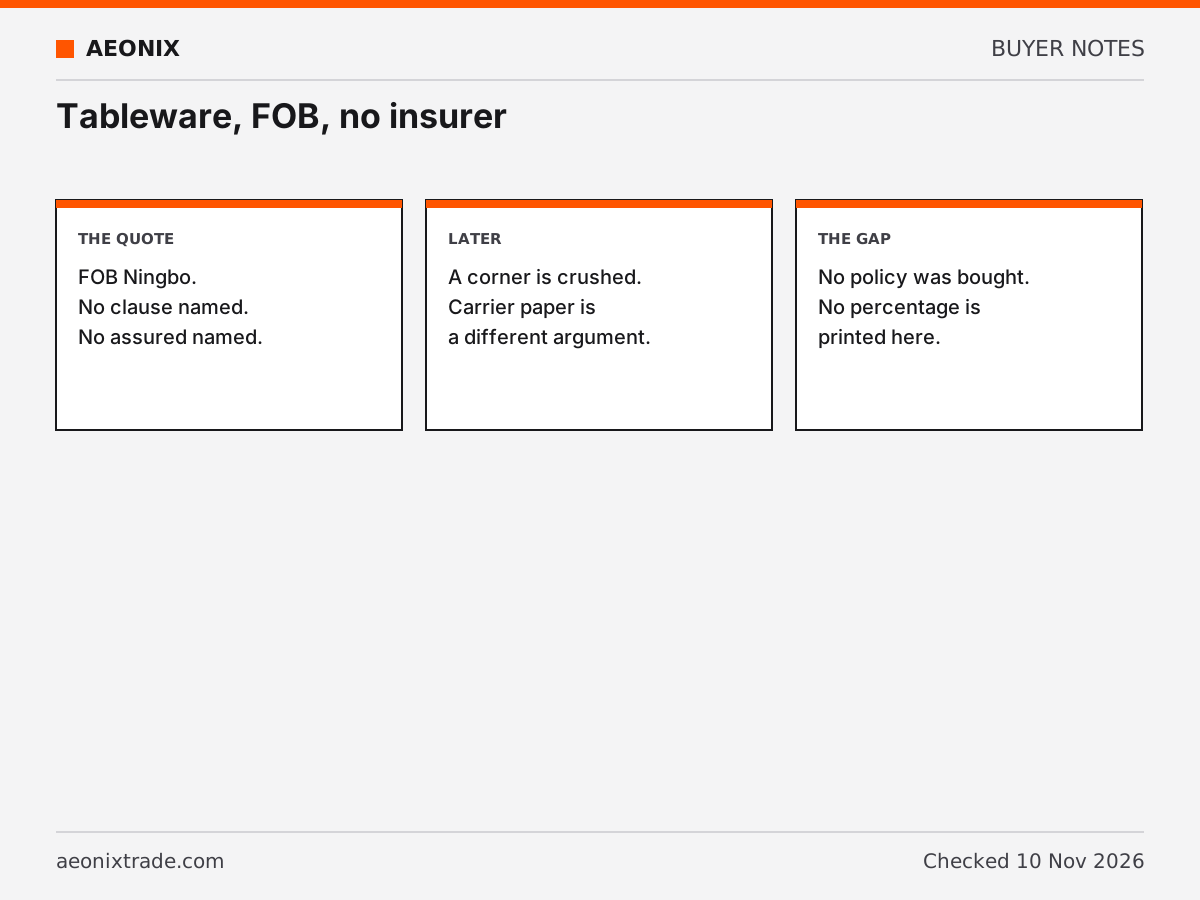
A buyer of ceramic tableware has a quote that reads FOB Ningbo. The seller's number stops where that term stops. Nobody has named an insurer, a clause, or the person who is allowed to claim. The goods are still going on a ship. The policy for that leg is a separate purchase unless the term you actually signed already puts it on the seller. A forwarder's line that says "insurance available" is not that term.
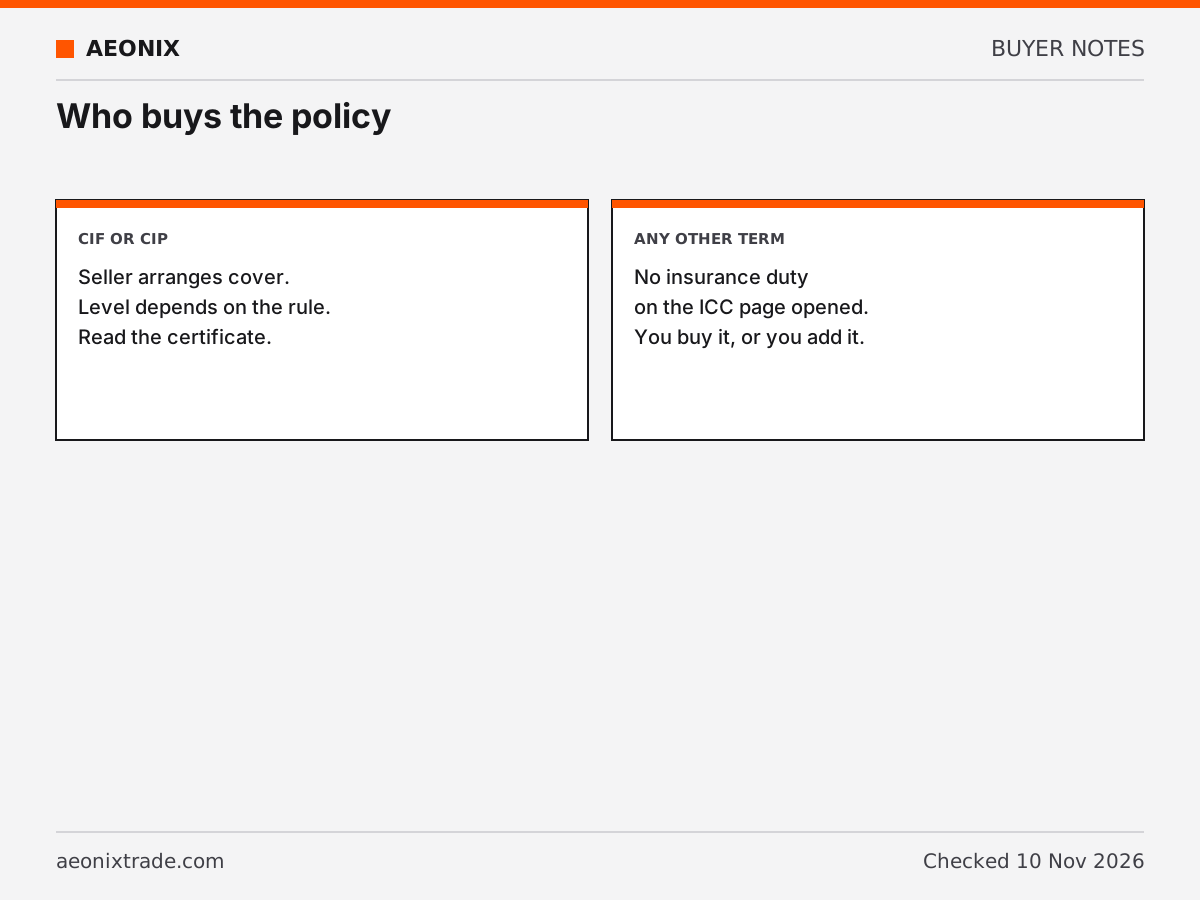
Where a term already places a policy on the seller is what CIF means. The freight you are comparing sits inside landed cost, and the sum you build before a deposit is how to calculate landed cost. The terms and the papers live together on Incoterms and shipping documents. If the quote is a port price with no policy in it, read FOB or FCA before you assume the seller bought cover.
When the seller's price already includes a policy
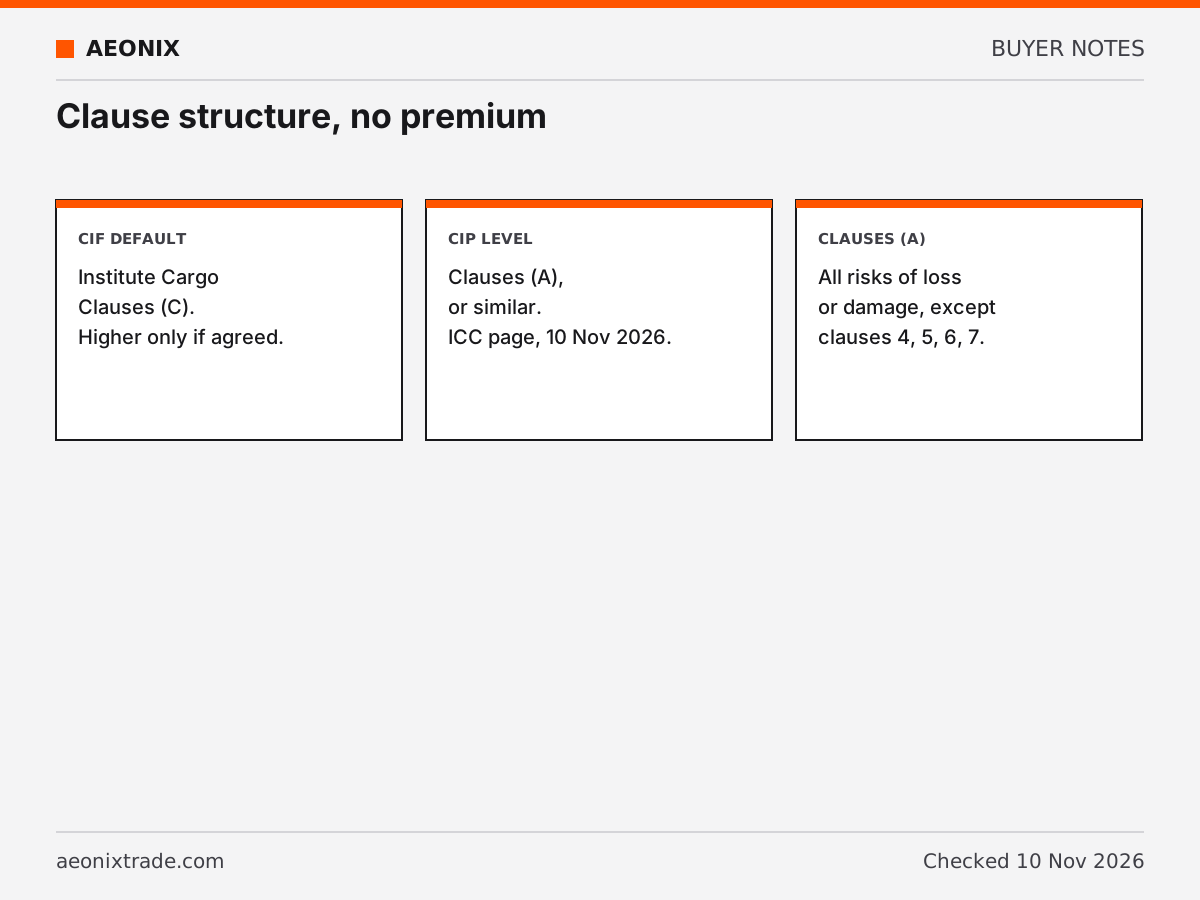
The ICC page on Incoterms 2020, read on 10 November 2026, answers the cover question in one place. Under CIF, which that page reserves for maritime trade and often for commodities, Institute Cargo Clauses (C) remains the default, and the parties may agree a higher cover. Under CIP, the same page says the rule requires a higher level, compliant with Institute Cargo Clauses (A) or similar clauses. That is a difference of wording. No premium is printed there, and none is printed here.
A CIF price can still leave you holding a certificate that names the seller, not you. The CIF page is where that certificate, the insured value, the currency, and the claims point belong. This page only marks the fork. If the term is CIF or CIP, start from the cover that term requires and raise it in the contract if the cargo needs more. If the term is neither, the seller has not promised a policy by talking about "shipping."
| What the opened page says | What this page will not add | |
|---|---|---|
| CIF | Institute Cargo Clauses (C) stays the default. A higher cover is something the parties agree. | A premium, a deductible, or a percentage of the invoice. |
| CIP | The rule requires cover compliant with Institute Cargo Clauses (A) or similar clauses. | A list of every peril inside "similar." |
| Clauses (A), 1/1/09 | Lloyd's wording covers all risks of loss or damage except the exclusions in clauses 4, 5, 6 and 7. Clauses 6 and 7 in that file are war and strikes. | A paraphrase that drops an exclusion. |
| FOB or FCA | Those two rules are not the pair the ICC insurance answer is about. | A guess that the forwarder included a clause. |
Clauses (B) and (C) were not opened as their own booklets on 10 November 2026. Treat (C) as the minimum the Incoterms page names, and read the clause reference on the certificate you were given. "All risks" in clause 1 of the (A) wording is not a promise that every disappointment on the water is paid. The exclusions are in the file.
When you are the one who has to buy it
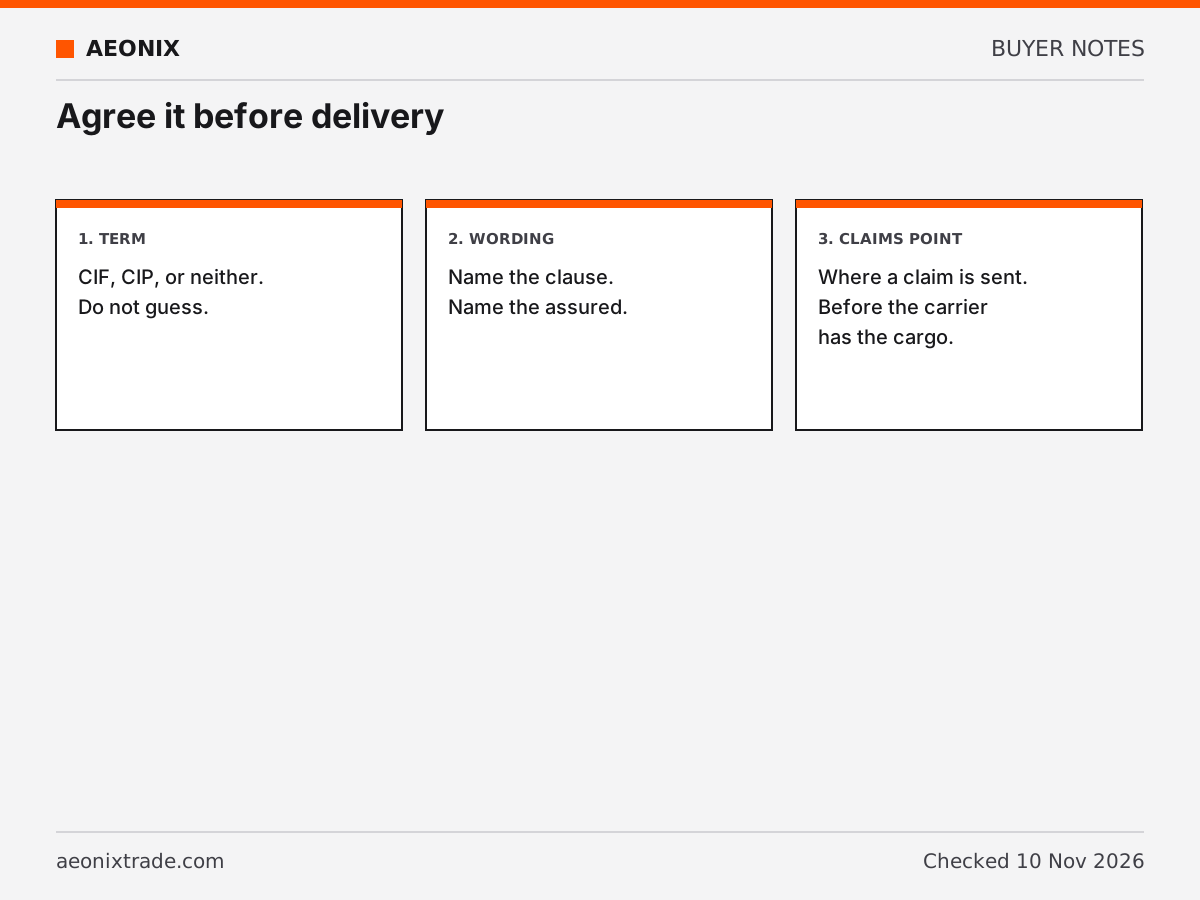
If the quote is FOB or FCA, put the policy on your own list. Ask which institute wording, who the assured is, and where a claim is sent. Write the answers into the booking before the cargo is delivered to the carrier. A tick-box that says insurance is included does not name a clause. War and strikes sit outside clause 1 of the (A) wording that was opened. If you need them, ask for those wordings by name. Do not assume they rode along.
Ceramics, FOB Ningbo, no insurer named
The tableware is packed. The forwarder has a draft transport document and a sailing. The seller's invoice is FOB. You have not bought a policy, and the seller has not offered one, because the term did not make them. Later a corner of the load is crushed. The argument with the carrier and the argument with an insurer are different arguments. The carrier's paper is what a bill of lading is. The insurer's argument exists only if someone bought a policy and named a person who can claim.
Nothing in that scene has a premium or an insured percentage. The Incoterms page that was opened does not state one. If a certificate later shows a figure, the figure belongs to that certificate.
Papers to have if something breaks
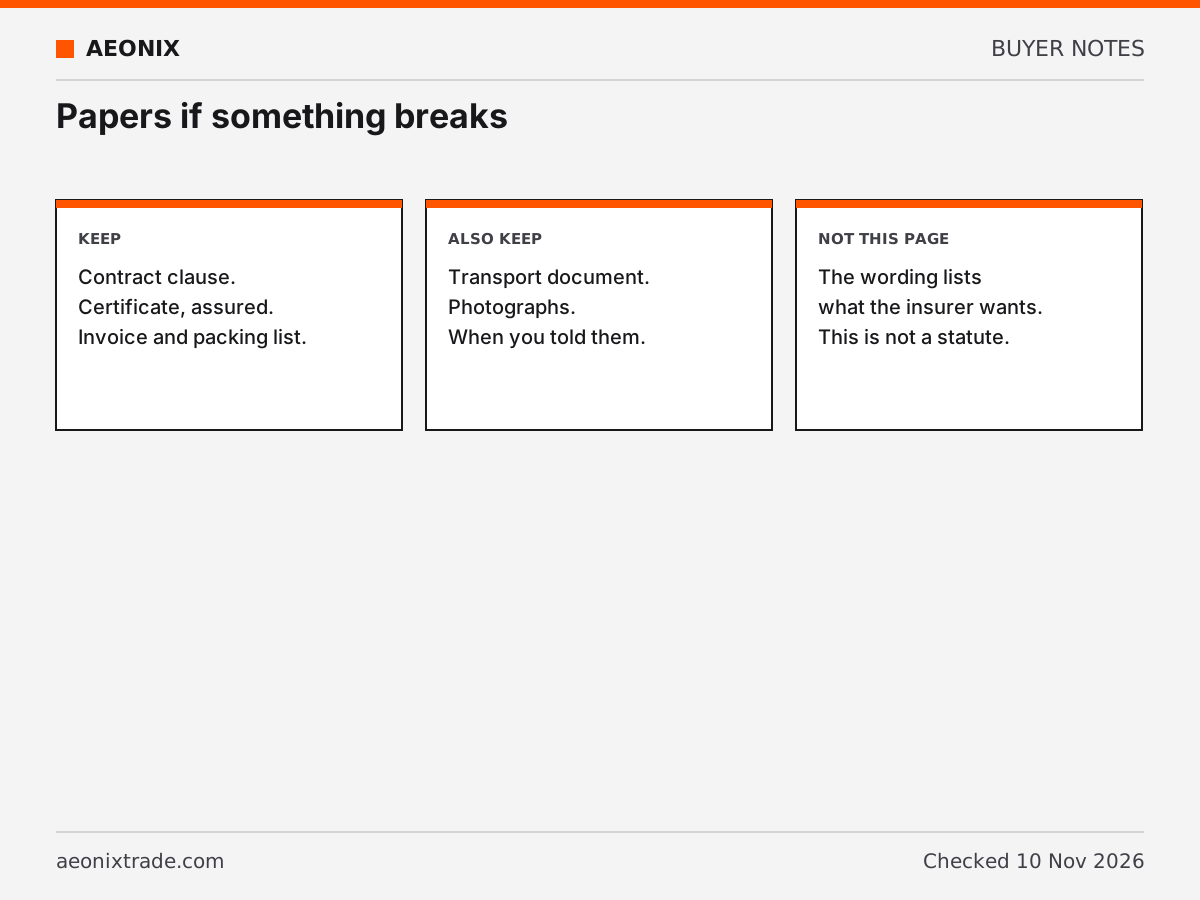
The wording you bought says which papers the insurer wants. Keep this set so you are not rebuilding the file from a chat thread. It is not a statutory form, and it is not a substitute for the clause.
- The contract sentence that names the clause, and the certificate that shows the assured.
- The commercial invoice and the packing list for the same goods.
- The transport document. Which release path you chose is a separate decision.
- Photographs, and a note of when you told the insurer. The wording sets the notice. This page does not.
Does CIF mean the loss is paid?
It means the seller must provide the cover that rule requires. On the ICC page opened 10 November 2026, that default is Institute Cargo Clauses (C), unless you agreed something higher. (C) is not the same sentence as clause 1 of Clauses (A).
Can the forwarder choose the clause?
Only if you asked, and only in writing that names the wording. A line that says the shipment is covered does not name it.
Put the term, the clause you want, and who may claim on the RFQ before the deposit. A port price with the policy kept separate is the job on FOB China.
The paperwork next to this choice is which Incoterm to use, 20-foot, 40-foot, and high-cube containers, a bonded warehouse, and a customs broker versus a forwarder.
Official sources
- ICC, Incoterms 2020, read 10 November 2026. CIF keeps Institute Cargo Clauses (C) as the default. CIP requires cover compliant with Institute Cargo Clauses (A) or similar. No premium is stated.
- Lloyd's, Institute Cargo Clauses (A), 1/1/09. Clause 1 covers all risks of loss or damage except clauses 4, 5, 6 and 7. In that file, clauses 6 and 7 are war and strikes.
- International Trade Administration, Know Your Incoterms, for the term names. The clause levels above are from the ICC page.
Submit sourcing request
Can't find what you need?
Start with a product or image link, an approximate quantity and destination. Other details can follow.