A bonded warehouse when cargo arrives from China
Published by Aeonix Trade.
Last fact-checked: November 10, 2026.
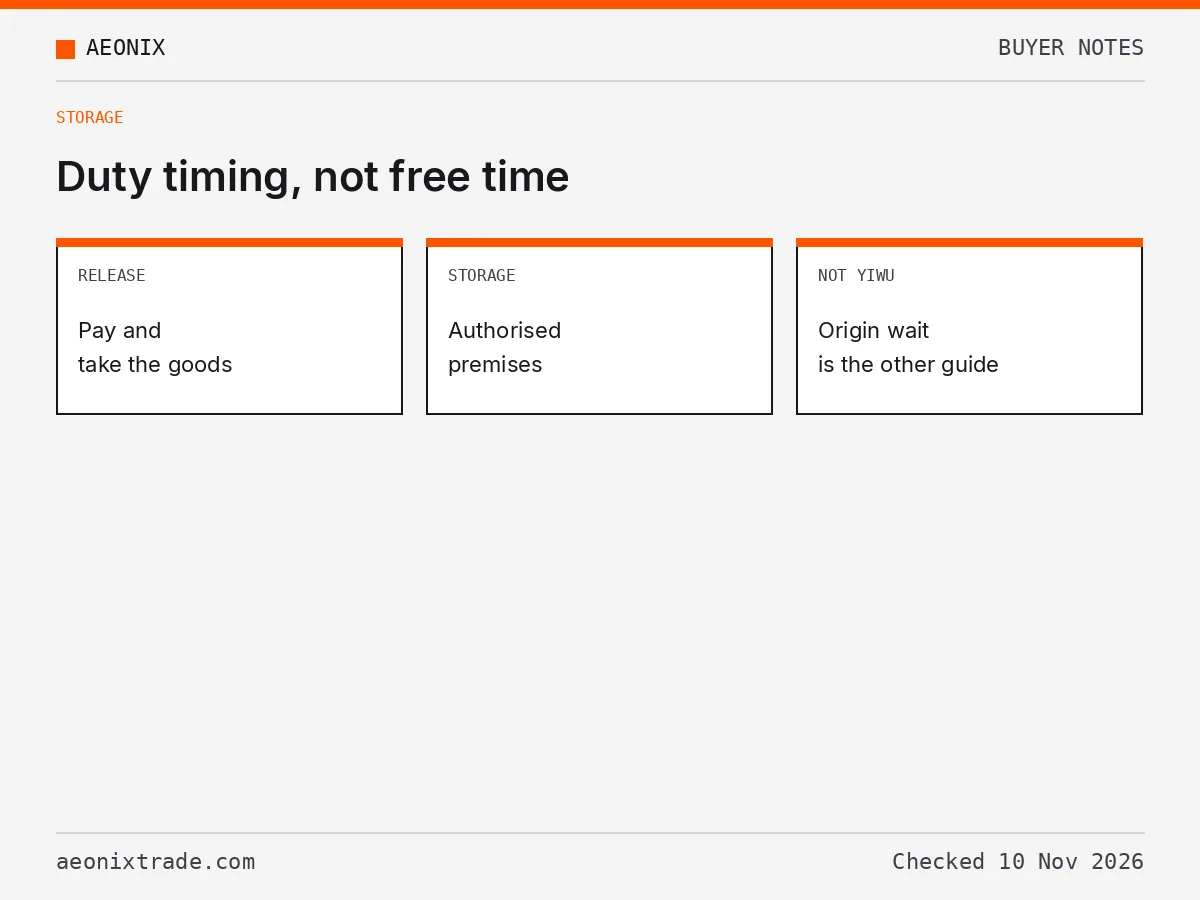
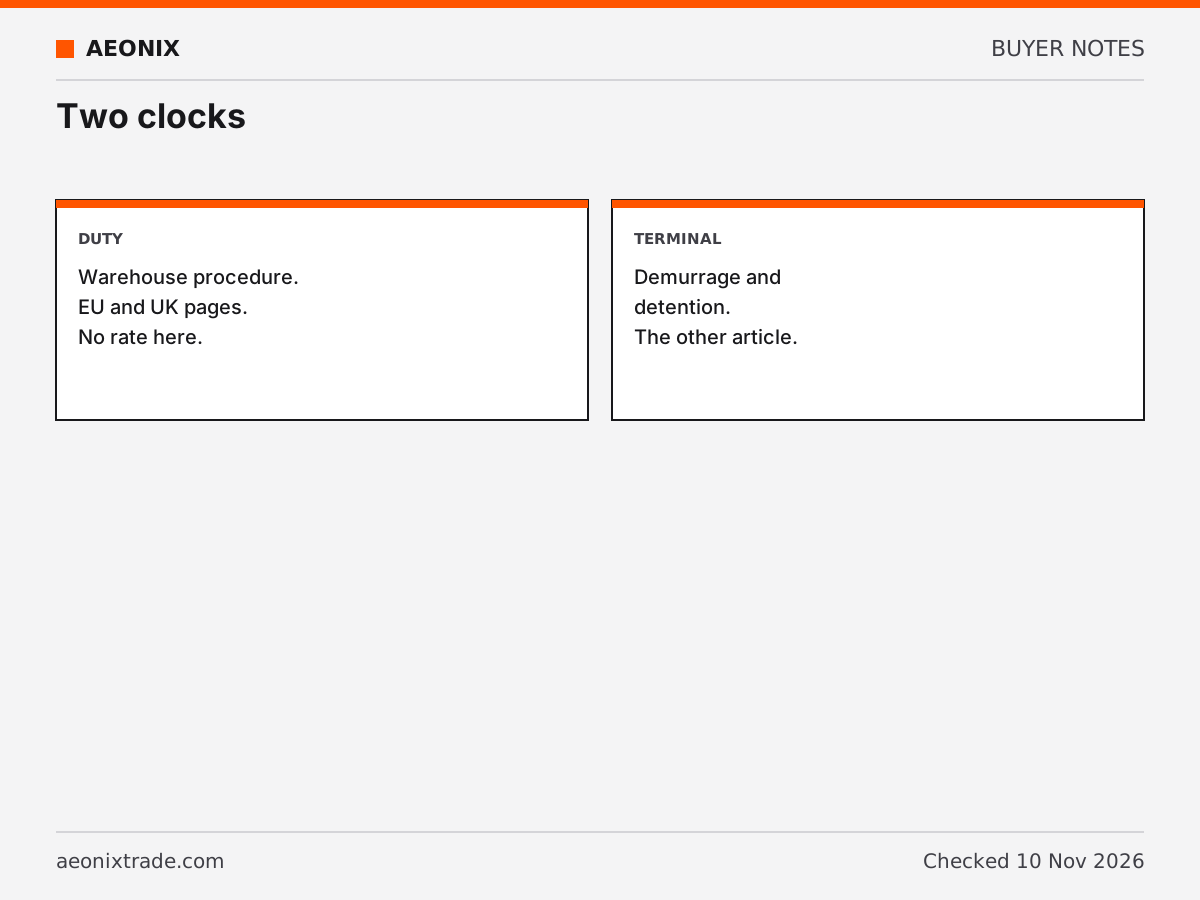
The retail launch slipped. The container from Ningbo is at the terminal, and someone suggests "put it in bond so we don't pay duty yet." That can be a real procedure. It is not the default for a small buyer who wants the goods this week, and it is not the room in China where the cartons sat before they were exported. It also does not, by itself, stop the terminal's clock. Duty and the terminal are different subjects.
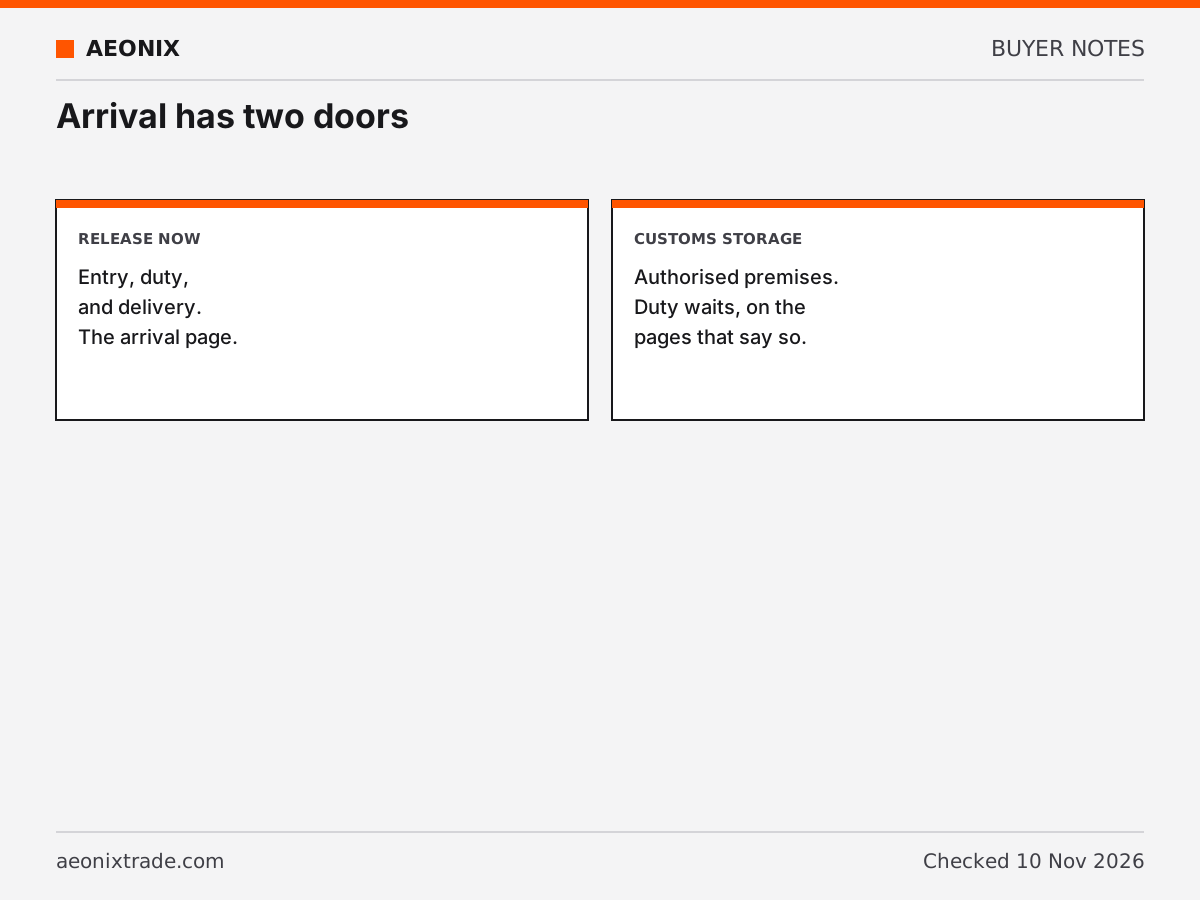
The arrival sequence, from discharge to the empty box going back, is what happens when cargo arrives. Which clock is the terminal and which clock is the equipment is demurrage and detention. Cartons grouped in Zhejiang before export are consolidating goods from many Yiwu booths. That Zhejiang warehouse is not a destination bond, and it is not the Dubai venue that shares the Yiwu name. The import map is importing from China.
What the procedure is for
The European Commission page on storage, read on 10 November 2026, says EU customs storage comprises customs warehousing and free zones. The procedure is there so a business can import non-EU goods before it has decided what to do with them. The page says that as long as the goods remain in storage they are not subject to import duties or other charges, and it gives import licences as its example of those other charges. Customs warehousing, on that page, is storage in premises the customs authorities have authorised. The period may be unlimited unless the goods could threaten health or the environment if kept a long time. While they are there, they are under customs supervision. A public warehouse can be used by any person. A private one can be used only by the authorised person.
Before the goods can be consumed in the EU, the same page says they have to leave the procedure and be released for free circulation, and that import duty and related taxes such as VAT or excise then become due. They can instead go into another procedure. Operating the warehouse requires an authorisation: establishment in the EU, assurance the place will be run properly, and a guarantee where a debt may arise. No fee for that authorisation is printed on the page, and none is printed here.
The United Kingdom page that came up for customs warehousing is titled as an application to operate one. Read on the same day, it says goods imported from outside the UK can be stored in a customs warehouse and duty and VAT delayed until release to free circulation, and that duty or VAT is not due if the goods are re-exported or moved to another procedure other than authorised use. It also says you must be authorised to run the warehouse. A small importer uses someone else's authorised premises, on that warehouse's rules. The page does not price those rules.
In the United States, title 19, part 19 of the Code of Federal Regulations is headed "Customs Warehouses, Container Stations and Control of Merchandise Therein," and the sections opened on 10 November 2026 include proprietor and CBP responsibility. The CBP programme page returned an access error, so this article does not describe a US warehouse class or a US rate from that page.
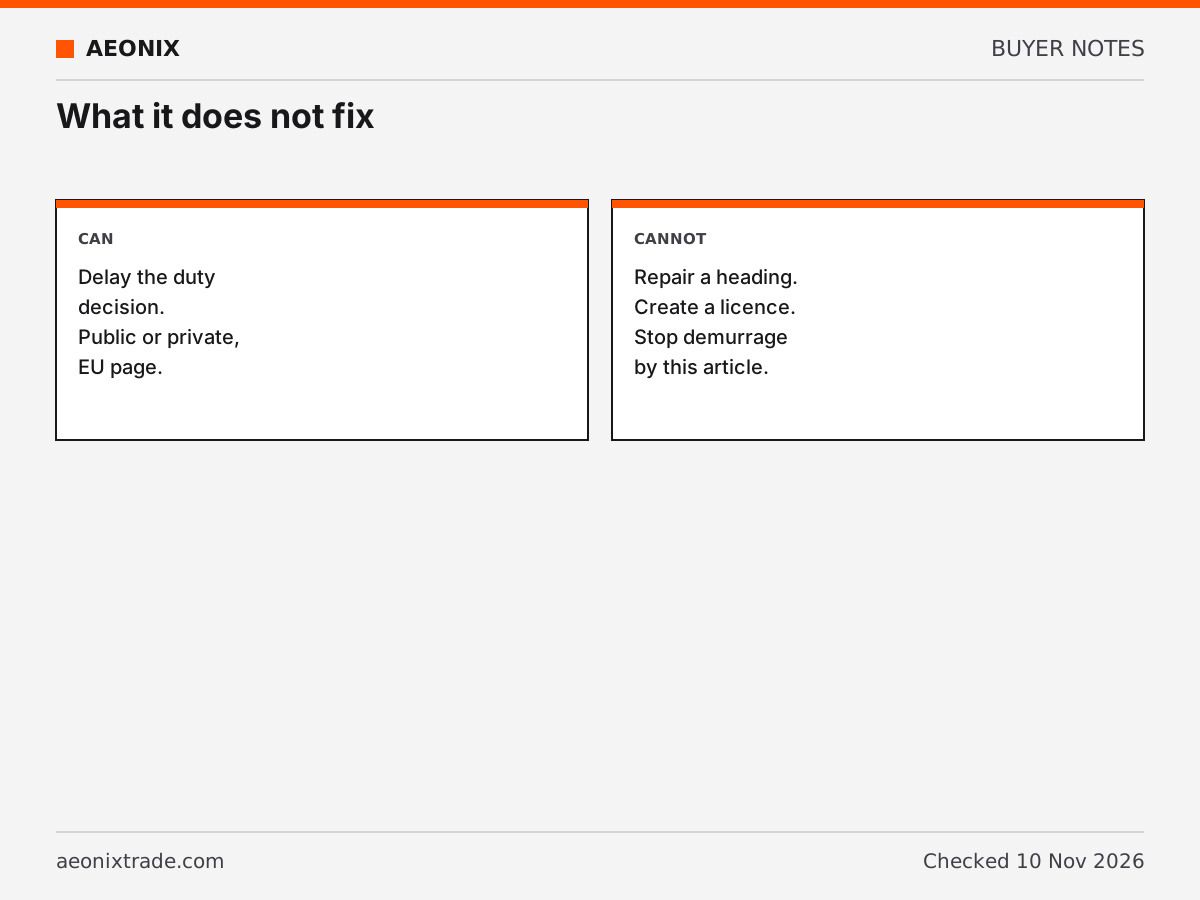
| The procedure can be about | It is not about |
|---|---|
| Delaying the duty decision, in the way the EU and UK pages describe, while you decide whether the goods will be released or re-exported. | A wrong heading. The code is still the code when the goods come out. Read HS codes. |
| Keeping non-EU goods under customs supervision in an authorised premises. | A product that cannot be imported. Supervision is not a licence you failed to get. |
| Using a public warehouse if you are not the person authorised to run a private one. That distinction is the EU page. | The terminal's free time. Demurrage and detention are the other article. This page does not say the bond stops either clock. |
| A destination procedure after arrival. | A commercial store in Yiwu before export. That is the consolidation guide. The Dubai market that uses the same name is a different place. |
The launch slipped, the box did not
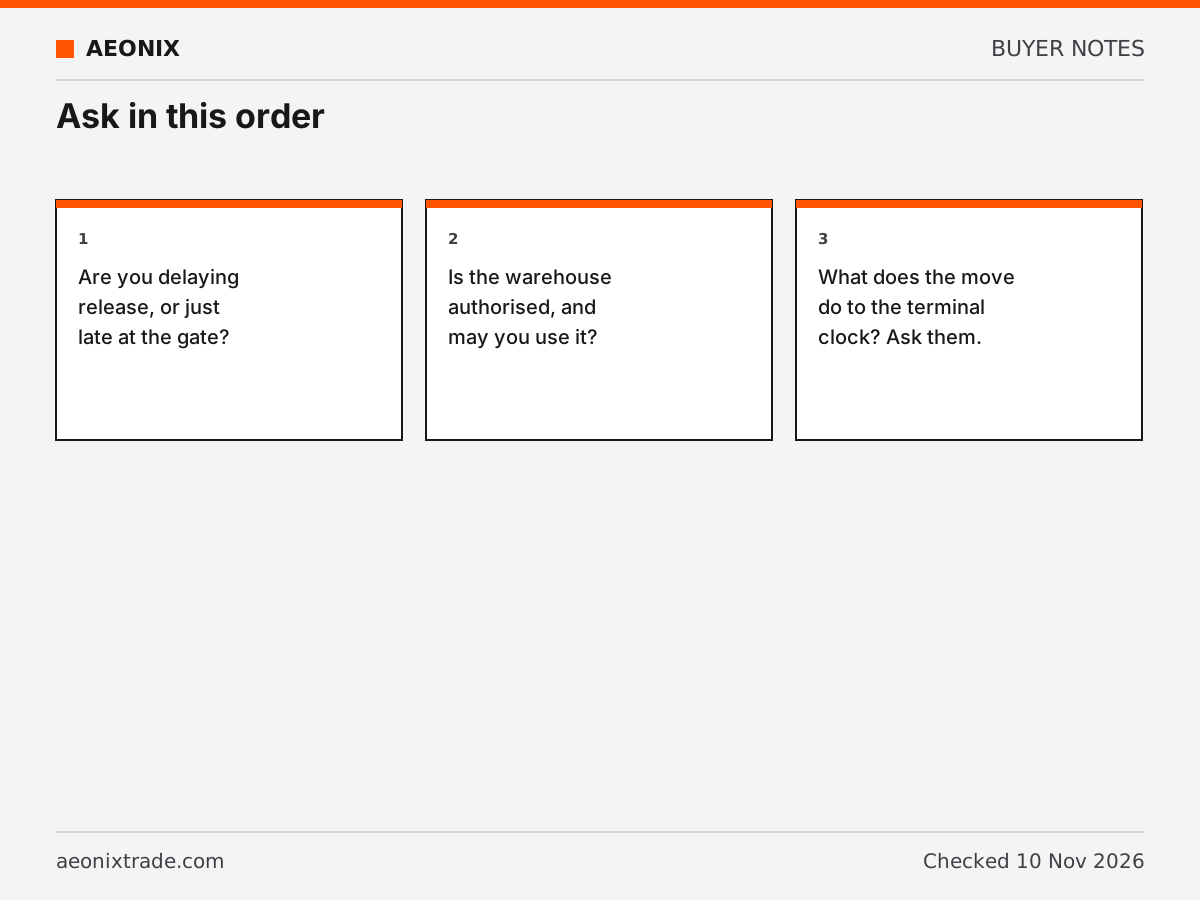
You still want the goods. You do not yet want them released to free circulation, because the shop date moved and you would rather the duty waited with the cartons. That is the shape of case the EU page describes. It becomes a bad case if the container is already past free time at the terminal and you hoped the warehouse would rewind it. Ask the forwarder which clock is running, and read the demurrage page for the definitions. Ask the warehouse whether it is a public customs warehouse you are allowed to use. Then ask what the move from the terminal to that warehouse does to the equipment. Those answers are on their paperwork. They are not on this page, because no tariff was opened.
Before you treat it as the plan
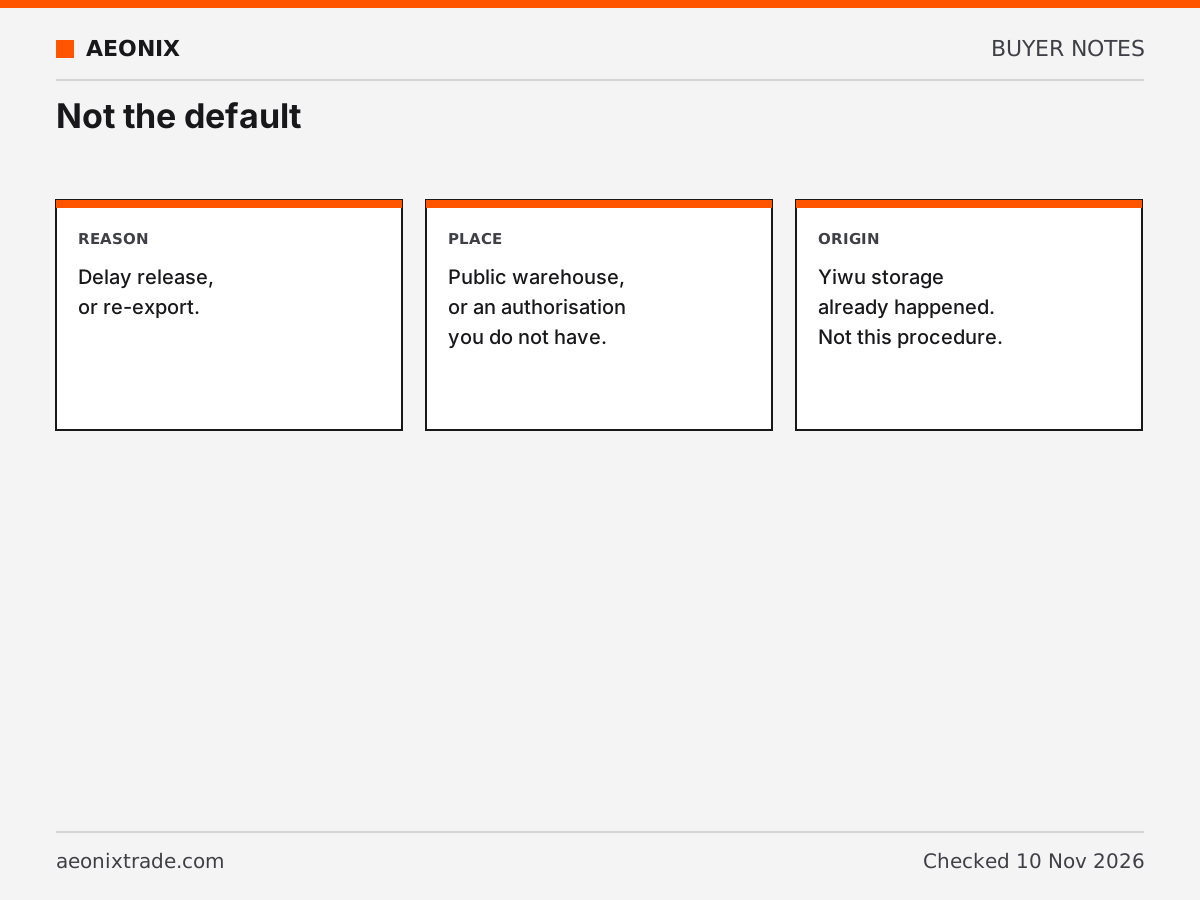
- You have a reason to delay release or to re-export. "We are not ready" is a reason only if the warehouse you mean is authorised for it.
- You know whether you would be using a public warehouse or asking to operate one. Operating one is an authorisation, on both the EU page and the UK page.
- You have asked what the terminal clock does when the box moves. The definitions are the demurrage page. The days and the daily rate are the terminal's tariff.
- The origin warehouse, if the cartons waited in Yiwu, is already behind you. It is not this procedure.
- You are not using the bond to avoid a heading, a licence, or a product rule.
Is this the usual step for a first container?
No. The usual step is the arrival page: notice, release, entry, delivery. A customs warehouse is the extra procedure for goods you are not ready to release. The Commission page describes the flexibility. It does not describe it as the default.
Does storage in bond remove import VAT?
The EU page says duty and related taxes such as VAT or excise become due when the goods are released for free circulation. The UK page says duty and VAT are delayed until that release, and not due if the goods are re-exported or moved to another procedure other than authorised use. Neither page says the tax disappears because the cartons sat.
If the launch date, the release plan, and the terminal are already in conflict, put that on the RFQ before you book the next sailing. The shared-box version of a move that should not have been a whole container is LCL shipping from China.
The paperwork next to this choice is which Incoterm to use, 20-foot, 40-foot, and high-cube containers, cargo insurance, and a customs broker versus a forwarder.
Official sources
- European Commission, Storage, read 10 November 2026. Customs warehousing and free zones. Duty treatment, public and private warehouses, and the authorisation to operate are as summarised above. No fee is stated.
- HM Revenue and Customs, Apply to operate a customs warehouse, read 10 November 2026. Delay of duty and VAT until free circulation, and the requirement to be authorised. The daily rate is not on that page.
- US 19 CFR part 19, customs warehouses and container stations, opened 10 November 2026. The CBP programme page was not readable, so no US class or rate is described.
Submit sourcing request
Can't find what you need?
Start with a product or image link, an approximate quantity and destination. Other details can follow.