Customs broker vs freight forwarder
Published by Aeonix Trade.
Last fact-checked: November 10, 2026.
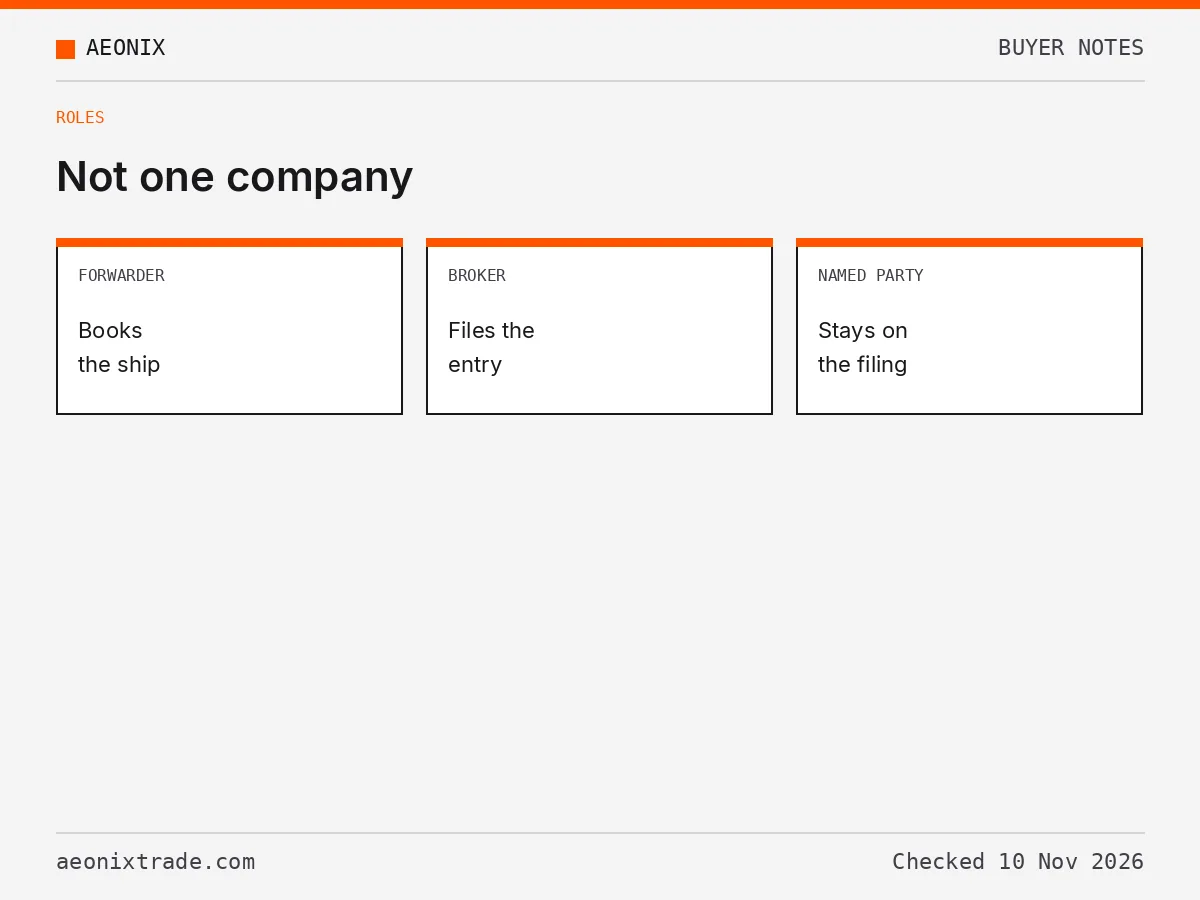
The quote for a container of kitchen tools says the forwarder "handles everything, including customs." The buyer pays one invoice and assumes one company filed the export in China, booked the ship, and filed the entry at destination, in the buyer's name, under a licence the destination requires. Those can be four different jobs. The email signature does not say which of them this company is allowed to do.
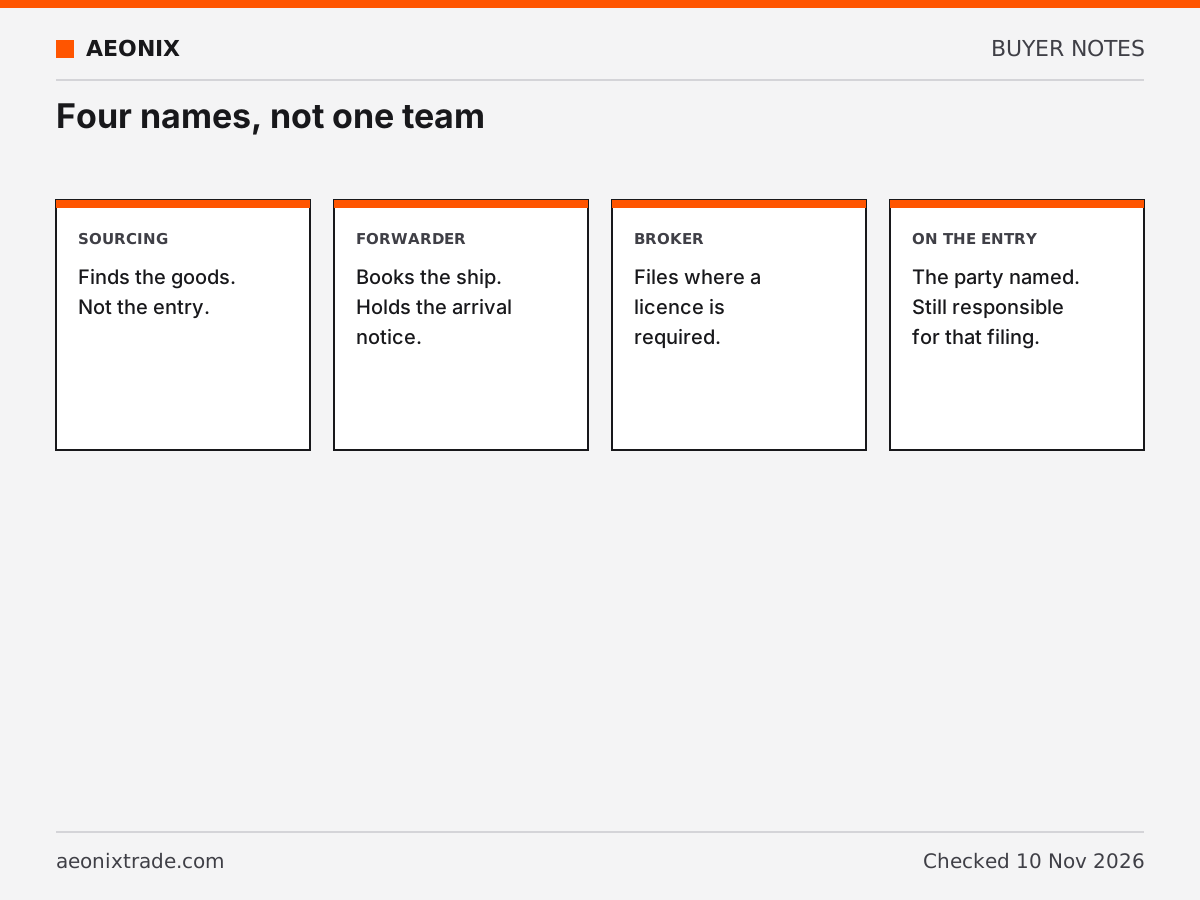
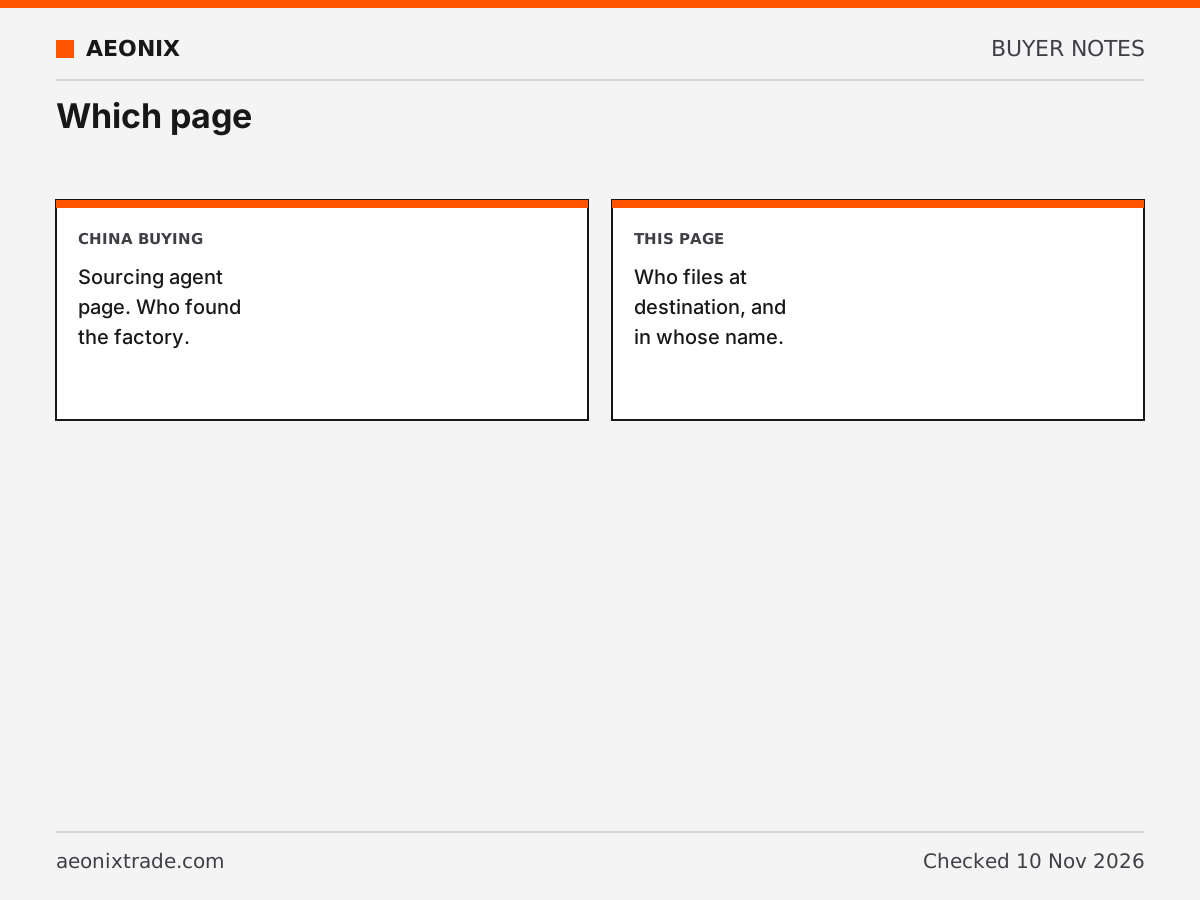
Who buys the goods in China is a different role from who books the ship. That buying role is the China sourcing agent service, and the wider offer is sourcing. What the carrier's paper is belongs on what a bill of lading is. What happens after discharge is what happens when cargo arrives. The heading on the entry is HS codes. The map of the import is importing from China.
The destination licence is not the booking
In the United States, the Code of Federal Regulations, title 19, part 111, is headed "Customs Brokers." The sections listed on that part, opened on 10 November 2026, include "License and permit required" and "Transacting customs business without a license." A company that booked the vessel has not, by booking it, become the person that part is about. The US Customs and Border Protection programme page returned an access error the same day, so this article does not describe a CBP workflow from that page. The regulation heading is the part that was readable.
In the European Union, the recitals of Regulation (EU) No 952/2013, the Union Customs Code, as published on EUR-Lex and read the same day, say persons should continue to have the right to appoint a representative in their dealings with the customs authorities. They also say that, as a general rule, a customs representative should be established in the customs territory of the Union. The operative articles sit further down that regulation. This page is not a substitute for reading them, and it does not describe a fee for representation.
On the China side, the export declaration is filed through China International Trade Single Window. The General Administration of Customs English home was open the same day and did not, on that home page, define a split between a forwarder and a broker. So this article does not invent a Chinese licence name. It only says the company that booked the ship and the company that is allowed to file the declaration need not be the same company.
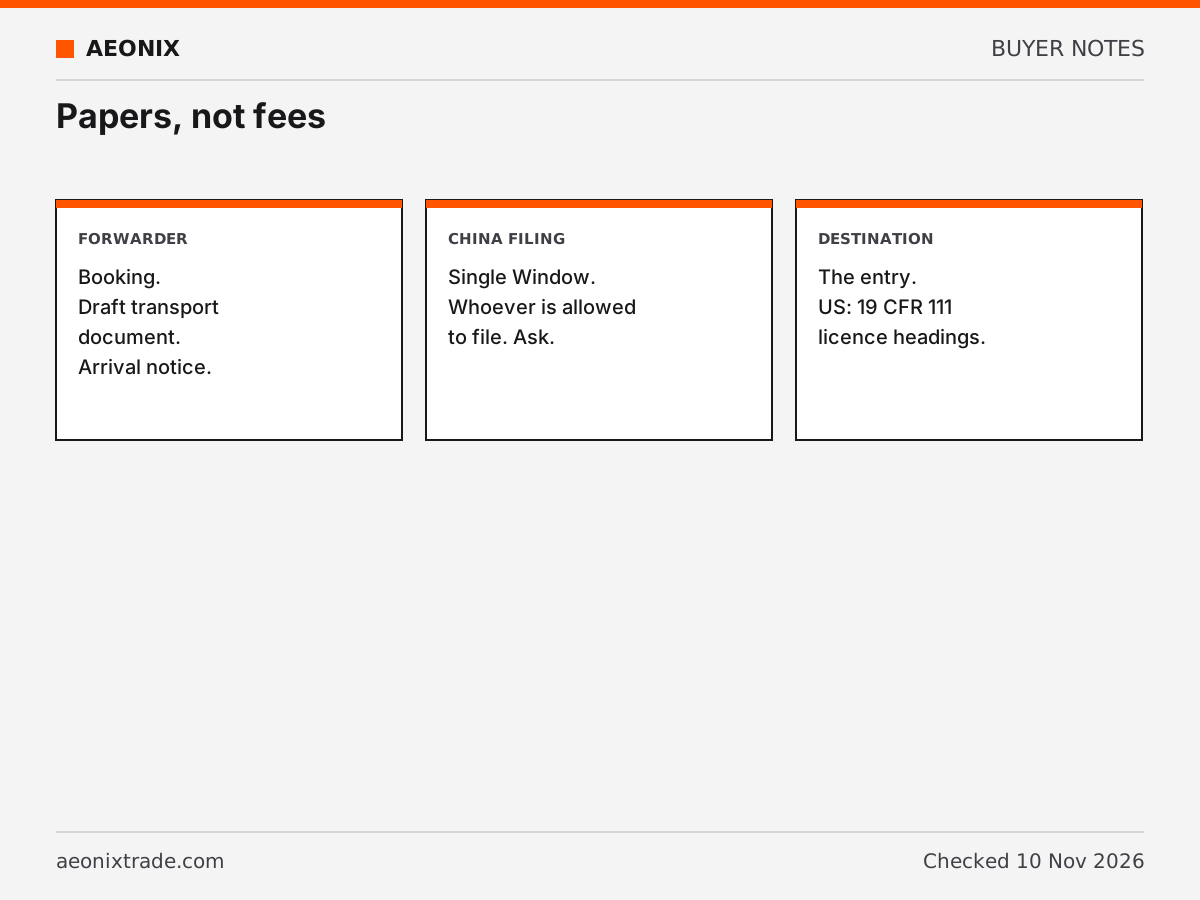
| Usually the forwarder's file | Usually the broker's or declarant's file | |
|---|---|---|
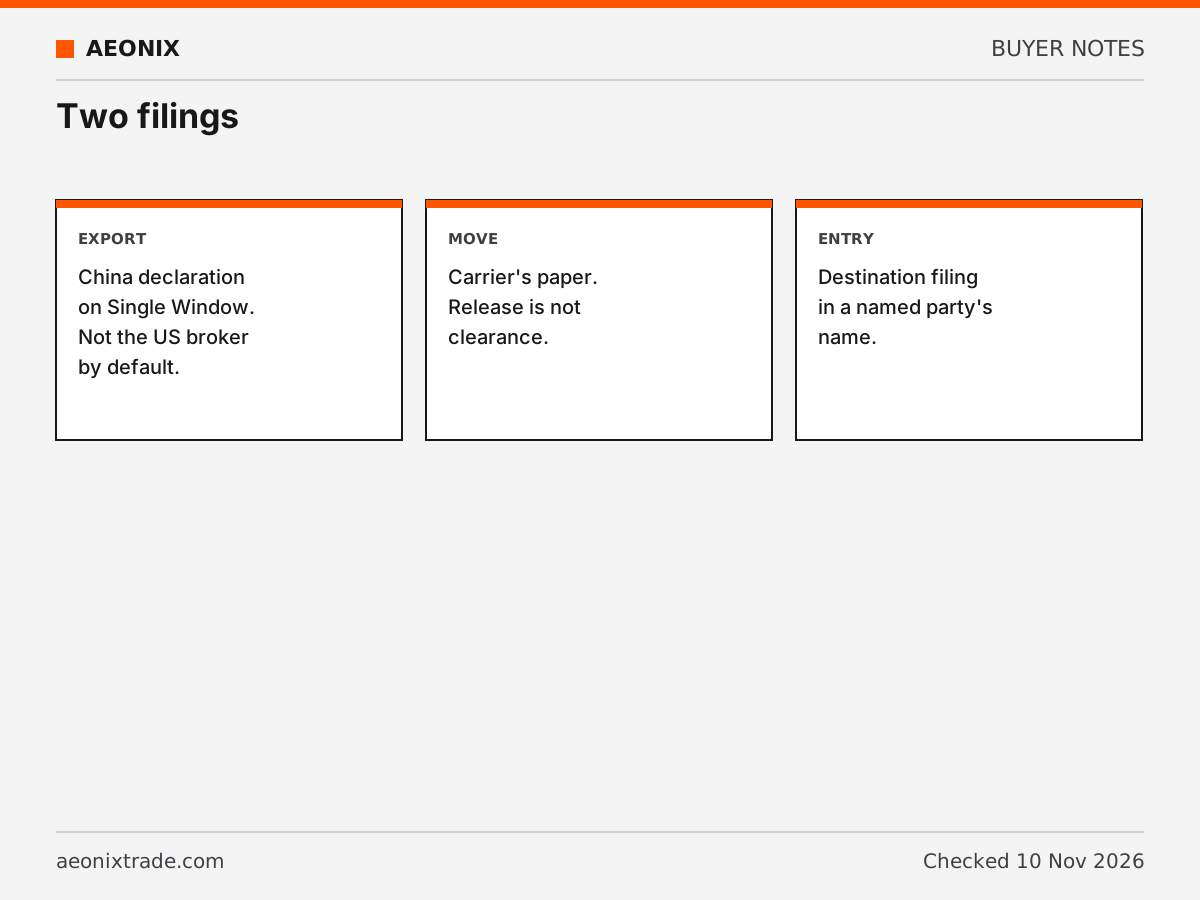
| Before sailing | The booking, the equipment, the draft transport document. | The export declaration in China, filed by whoever is allowed to file it on Single Window. Not automatically the overseas broker. |
| The paper | The bill of lading or the waybill the carrier issued. | The commercial invoice, the packing list, and the heading the entry will use. |
| At destination | The arrival notice, and the release the carrier asks for. | The customs declaration, in the name of the party who is the declarant. A US filing of customs business is the licence in 19 CFR part 111. |
| Money | Not printed here. | Not printed here. Ask which invoice line is which job. |
Who is still responsible for the entry
Appointing someone to speak to customs does not, on the EU recitals, delete the person who made the appointment. In the US part that was opened, customs business is something a licence exists for. The party in whose name the entry is filed is the party the authority is looking at. Call that party the importer of record if your destination uses those words. This page does not supply a US statutory definition, because the statute page was not the one opened. Get the name in writing: who files, in whose name, in which country, under which licence.
"We clear customs" on a kitchen-tool quote
Ask three questions before you accept the single invoice. Which legal entity books the ship? Which legal entity files the Chinese export declaration? Which legal entity files the destination entry, and in whose name? If the answer to all three is one sentence, "our team," you do not yet have an answer. The sourcing agent who found the factory is a fourth name. That person does not become the broker by copying the packing list into an email.
What to pin down
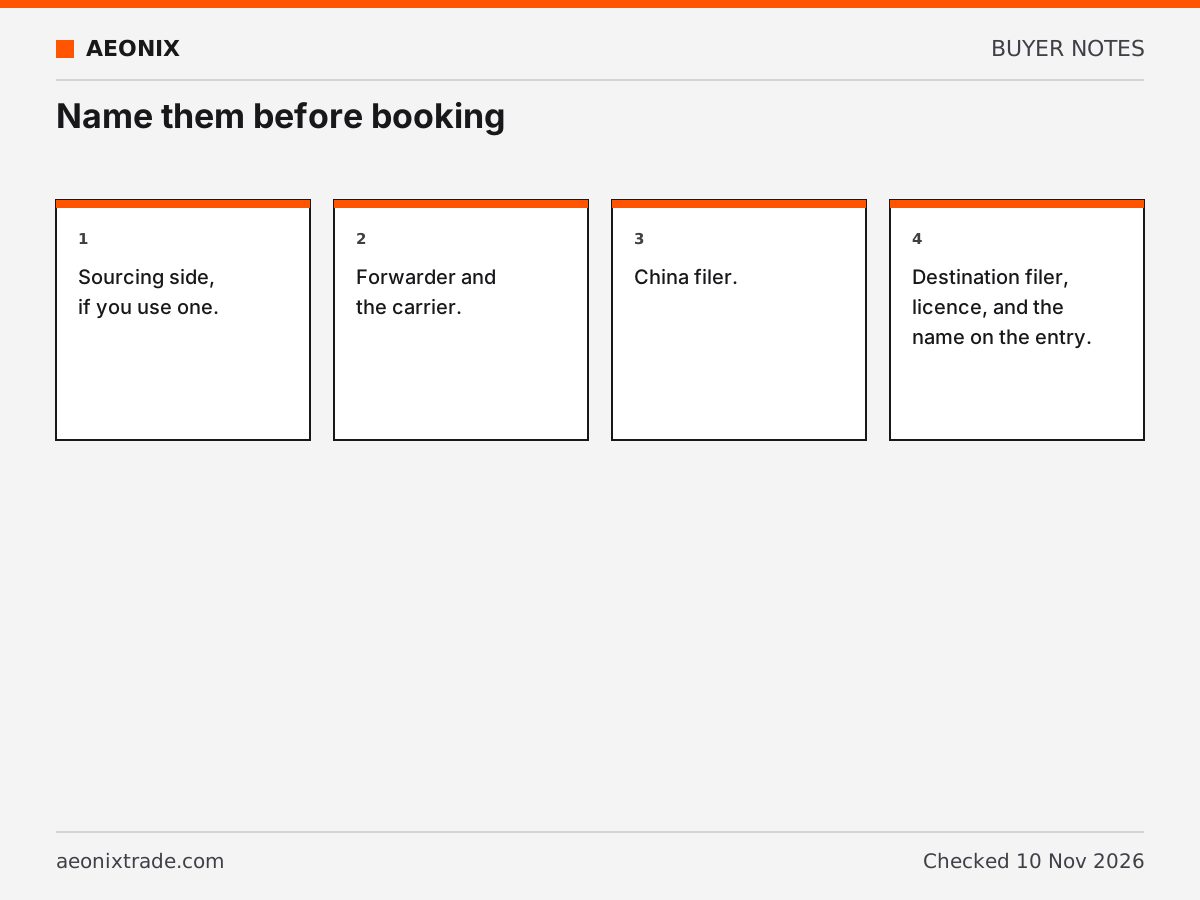
- The sourcing side, if you are using one. That is the sourcing page, not this one.
- The forwarder, and the carrier they will book.
- The party who files in China, on Single Window.
- The party who files at destination, the licence if that country requires one, and the name on the entry.
- One invoice line per job, so a customs bill is not hiding inside a freight bill. No rate is suggested here.
If my forwarder has an office at destination, are they the broker?
Only if that office is the licensed party, or the declarant, for that entry. An office address is not a licence. Ask for the name on the filing.
Does the broker choose the HS code?
The broker files a code. You still have to be able to defend it. The HS page is the distinction between the supplier's six digits and the national line. Do not outsource the decision and then act surprised by the line that was filed.
Name the four parties, and the country of the entry, on the RFQ. A quote that says "customs included" has not named them yet.
The paperwork next to this choice is which Incoterm to use, 20-foot, 40-foot, and high-cube containers, a bonded warehouse, and cargo insurance.
Official sources
- US 19 CFR part 111, Customs Brokers, opened 10 November 2026. The part lists a licence and permit requirement for customs business. The CBP programme page was not readable that day.
- EUR-Lex, Regulation (EU) No 952/2013, the Union Customs Code, read 10 November 2026. The recitals used above are about the right to appoint a customs representative.
- General Administration of Customs of China, English home, and China International Trade Single Window, both opened 10 November 2026. The English home did not define a forwarder-versus-broker licence.
Submit sourcing request
Can't find what you need?
Start with a product or image link, an approximate quantity and destination. Other details can follow.