How to Calculate Landed Cost Before Importing from China in 2026
Published by Aeonix Trade.
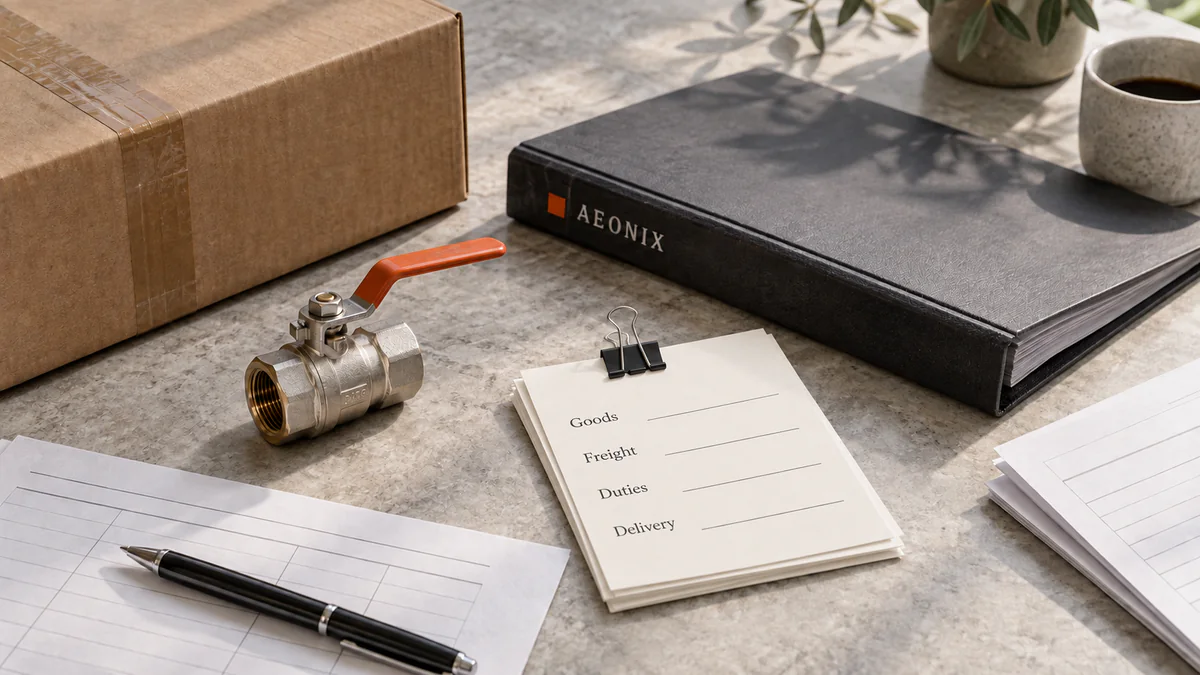
Landed cost checklist
Calculate landed cost before importing from China in 2026
Build landed cost from product price, freight, insurance, duty, VAT/GST, port charges and inland delivery before paying a supplier deposit.
- Start with EXW or FOB product cost, packaging, inspection, sample and bank-fee assumptions.
- Add freight, insurance, fuel, origin handling, destination port charges and inland delivery.
- Classify the product by HS code and estimate customs duty, VAT/GST and anti-dumping exposure.
- Prepare invoice, packing list, origin support, product specifications and customs value evidence.
- Compare landed cost by unit, carton and shipment so MOQ choices do not hide margin risk.
Last fact-checked: April 4, 2026. This guide is based on the official sources listed at the end.
Quick answer: A cheap factory quote can become the most expensive line in the whole import if the landed-cost sheet is weak. A real landed-cost calculation starts before the deposit is paid and includes every cost that stands between the factory quote and sellable inventory in your warehouse.
The planning logic is portable, but the customs, tax, and destination inputs are not. If you do not have current market-specific numbers or broker-backed assumptions before you approve production, you are not comparing suppliers honestly.
If you want help turning this checklist into a live sourcing plan, see our Country sourcing programs.
Why this matters before you pay the deposit
Many bad first imports do not fail because the supplier was expensive. They fail because the buyer compared ex-factory quotes instead of comparing landed inventory. That mistake makes a cheap supplier look attractive until customs, tax, and arrival fees erase the margin.
Landed-cost discipline is also what separates a real importer from a hopeful buyer. The moment you model the full cost stack, you can say no to products that only work on paper and yes to products that can survive release, warehouse intake, and local delivery.
- Factory price is only one layer of the cost stack.
- A good landed-cost model protects you before production starts, not after cargo lands.
- The right question is not 'What is the unit price?' but 'What is the cost per sellable unit after import?'
Build the landed-cost stack in the right order
A clean landed-cost sheet usually starts with goods value and packaging, then adds freight, customs duties, taxes, customs-side handling, destination charges, and inland delivery. Many buyers also need a delay buffer because inspections, storage, or missed free time can wipe out the margin on a supposedly cheap buy.
This is also the stage where Incoterms matter. EXW, FOB, CIF, and DDP are not just freight labels. They change which cost lines are visible, which lines are hidden, and which costs the buyer still carries even when the supplier quote looks simple.

Starter checklist
- Write down the goods value, packaging, carton dimensions, and shipment weight before you ask for freight pricing.
- Get a broker view of classification and likely duty exposure before deposit, not after booking.
- Add tax and customs-side handling based on the destination market, not based on supplier assumptions.
- Include inland delivery, storage risk, and other arrival-stage costs before you approve the PO.
Use a seven-line worksheet before you compare suppliers
A decision-ready landed-cost worksheet should let you compare Supplier A, Supplier B, and a local-wholesale fallback on the same structure. The point is not perfect forecasting. The point is catching the deal that looks cheap only because one quote hides customs, tax, or destination charges.
Treat the worksheet as a commercial control tool rather than a legal ruling. Customs and tax lines still need official destination guidance or broker input, while freight, handling, and warehouse lines need current service quotes from the actual lane.
| Worksheet line | What belongs here | Why buyers miss it | Validate with |
|---|---|---|---|
| Goods + packing | PO value, labels, inserts, cartons, tooling amortization | Factory quotes often hide non-unit packing lines | Supplier file + purchase order |
| Freight + origin | Pickup, export handling, main carriage, insurance | Buyers compare EXW or FOB as if transport were fixed | Forwarder quote |
| Duty + tax | Classification-led duty plus VAT, GST, IGV, or ITBIS equivalent | People copy rates from old chats or the wrong HS direction | CBP entry summary and post-release / Access2Markets |
| Customs-side handling | Entry fees, broker handling, exam or filing costs | These lines are rarely visible in a supplier quote | Broker quote + official customs process |
| Destination charges | Terminal, CFS, document, storage-risk lines | Arrival fees appear after the goods already feel 'bought' | Lane-specific destination quote |
| Inland delivery | Drayage, warehouse receiving, final-mile movement | This is often treated as a warehouse problem, not a buying problem | Warehouse or truck quote |
| Downside case | One realistic delay or inspection scenario | Best-case models hide the first-shipment risk | Internal margin test |

Starter checklist
- Goods and packaging: final PO value, inserts, labels, export-carton cost, and any tooling or sample amortization that belongs in the real unit cost.
- Freight and origin handling: pickup, export handling, main carriage, insurance, and any origin fees that do not sit inside the factory quote.
- Customs and import tax: classification-led duty estimate, VAT or GST or IGV or ITBIS equivalent, customs entry fees, and broker handling.
- Destination charges: terminal, CFS or deconsolidation, document, exam, and storage-risk lines that can appear after arrival.
- Inland delivery: drayage, linehaul, warehouse receiving, and final-mile delivery if the buyer is not self-collecting.
- Delay buffer: one downside case for a customs hold, reweigh, inspection, or revised dimensions so the model survives a realistic first shipment.
- Per-sellable-unit result: total landed spend divided by sellable units after expected damage, sampling loss, or unsellable pieces.
Use landed cost as a go or no-go filter before production
The most useful landed-cost workflow is simple. First, build the base goods and freight model. Second, add customs and tax using official destination guidance or your broker's classification review. Third, add destination handling and inland movement. Fourth, stress-test the margin if the shipment is delayed or if dimensions come in worse than planned.
That last step matters because many first orders look profitable only when the buyer assumes the best-case scenario. A proper landed-cost model should survive a realistic first shipment, not an idealized one.

Starter checklist
- Price the shipment using real dimensions and weights, not estimates from a chat message.
- Check whether the product still works after duty, import tax, and local delivery are added.
- Run one downside case for delay, storage, or valuation friction.
- Approve the supplier only after the landed number still supports the intended selling price.
Red flags that usually destroy margin or delay release
The most common landed-cost red flag is a buyer using one supplier's DDP promise as if it were an objective benchmark. If the DDP quote does not break out duties, taxes, and destination fees, you are comparing a bundled offer rather than a transparent landed-cost model.
The second red flag is modeling tax from memory or from an internet forum instead of from current official guidance and actual classification work. Tax assumptions are expensive when they are wrong.
- Comparing ex-factory quotes without a customs and tax model.
- Using guessed HS codes or skipping broker input before deposit.
- Treating DDP as proof that the total cost is good instead of proof that the cost is hidden.
- Ignoring arrival-stage costs such as handling, storage, and inland delivery.
What a decision-ready landed-cost sheet should show
A decision-ready sheet should let a buyer answer four questions fast: what is the total landed spend, what is the landed cost per unit, what happens if the shipment goes slightly wrong, and does the product still leave margin after local selling costs.
Once that sheet exists, sourcing gets calmer. The importer can reject weak deals earlier, negotiate more precisely, and decide when LCL, FCL, or air actually makes sense instead of using freight mode as a guess.
Starter checklist
- Keep one sheet with goods, freight, customs, tax, destination, and inland lines visible.
- Document who provided the duty and tax assumptions and when they were checked.
- Update the sheet when packaging, weights, or Incoterms change.
- Use the landed number, not the factory number, in your final buy or no-buy decision.
Frequently asked questions
Can one landed-cost template work for every country?
The structure can be reused, but the customs, tax, and destination lines must be localized to the actual import market and product classification.
Should I trust a supplier's DDP quote as my landed cost?
No. It can be a data point, but buyers should still separate and understand duties, taxes, and destination charges instead of relying on one bundled quote.
Which landed-cost lines are most often missing from first import spreadsheets?
The most-missed lines are destination handling, customs entry or broker fees, inland delivery, and a delay buffer for storage, exams, or revised dimensions.
Official sources used in this guide
- CBP entry summary and post-release: Official US customs reference for entry and release obligations that affect the customs side of a landed-cost model.
- Access2Markets: Official EU portal for tariff and formalities checks; useful for the duty and product-formality side of the worksheet.
- Singapore Customs import permit guidance: Official destination-market example for permit and import-process requirements; freight and local service pricing still need route-specific quotes.
Submit sourcing request
Can't find what you need?
Start with a product or image link, an approximate quantity and destination. Other details can follow.