T/T vs L/C vs D/P: Payment Terms Compared for China Orders
Published by Aeonix Trade.
Last fact-checked: 9 November 2026.
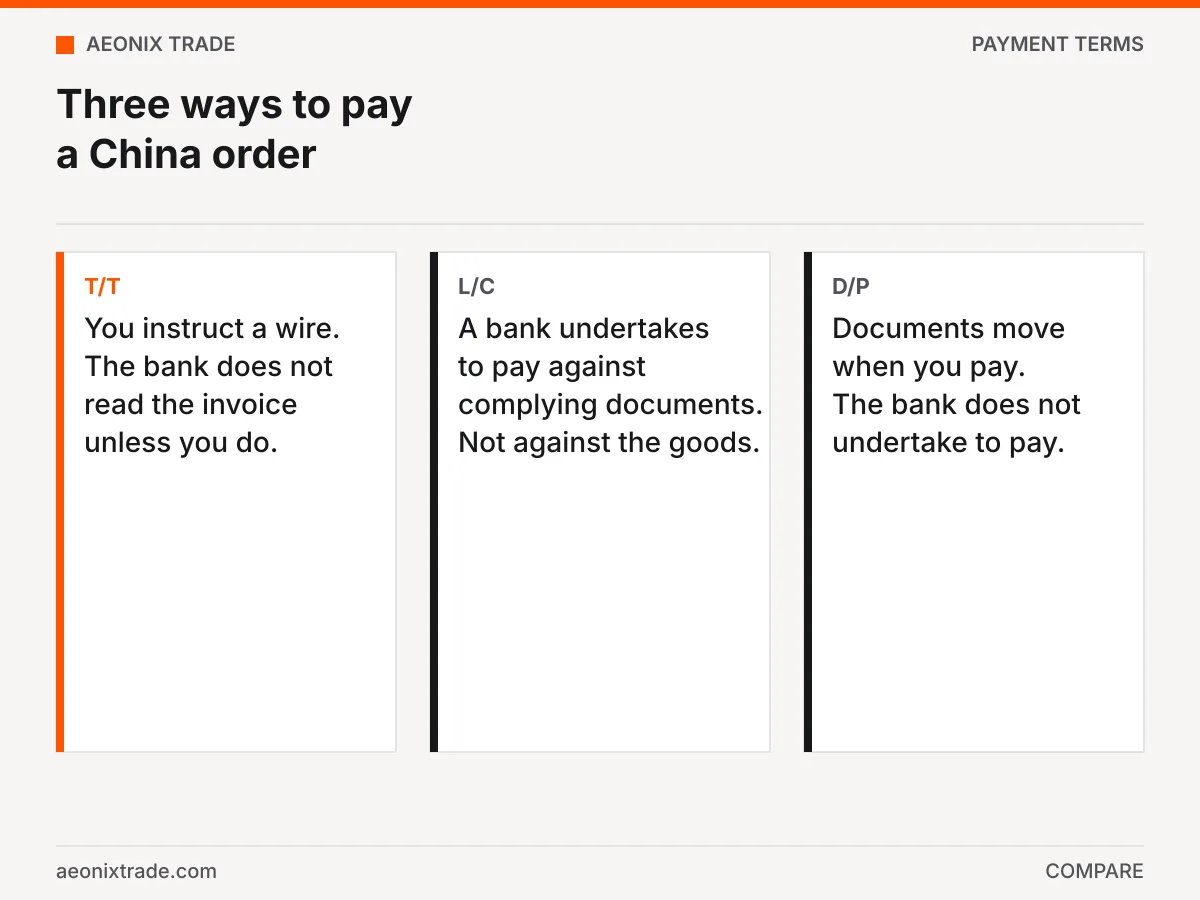
T/T versus a letter of credit versus D/P is a choice about who must pay, and about whether any document still controls the cargo. The bank does not inspect the goods under any of the three.
Buyers type tt vs lc when a China proforma offers a wire, a credit, or documents against payment, and the three labels look like flavours of the same protection. They are not. A telegraphic transfer is an instruction you give your bank. A letter of credit is a bank's undertaking to pay against documents that match the credit. Documents against payment release the shipping documents when you pay, and the bank does not undertake that you will. Payment terms for China orders fail when the clause names the tool and forgets the trigger, the beneficiary, and whether the bill of lading still holds the box.
The definitions are already written: T/T, letter of credit, and D/P versus D/A. This page is the comparison, so you can pick one before the deposit moves.
A typical case
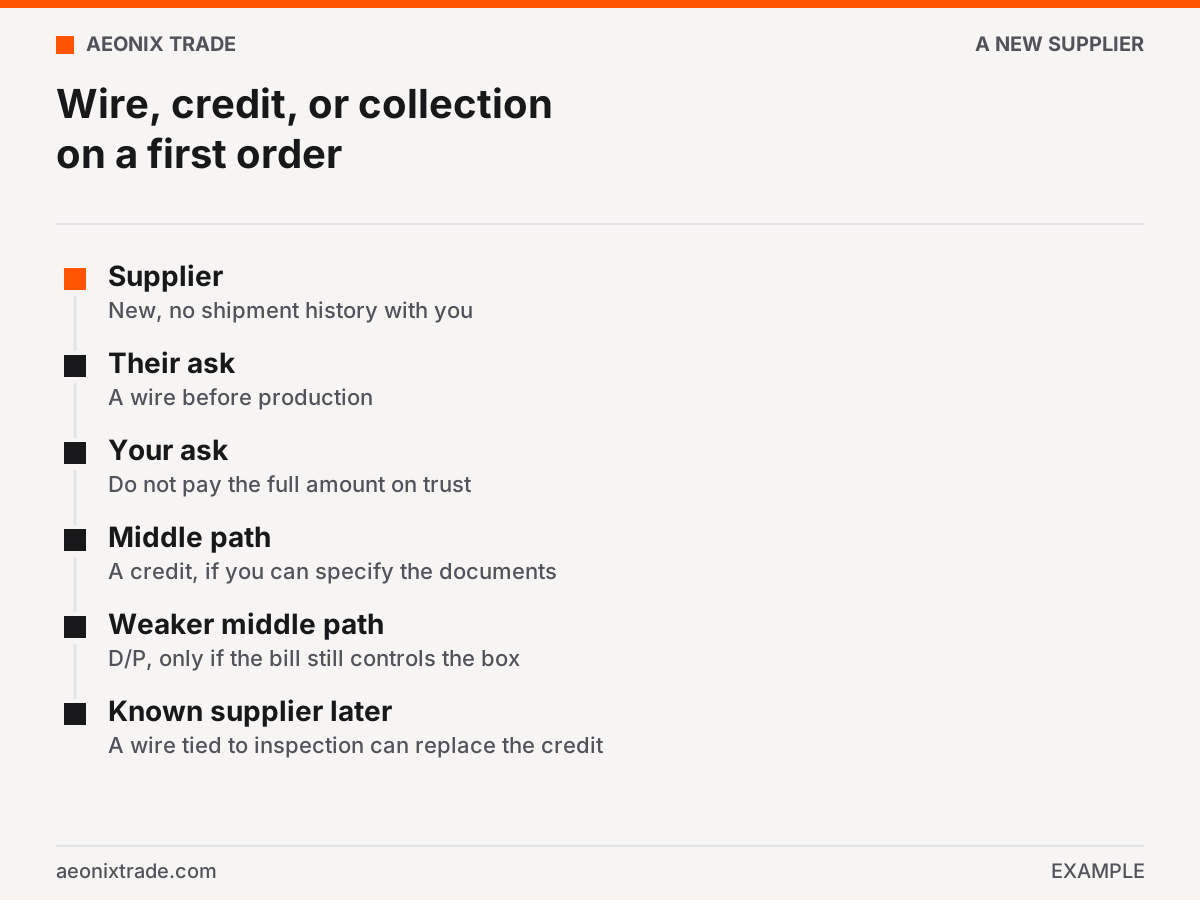
A supplier you have never shipped with wants a wire before production, and the balance against a copy of the bill of lading. You do not want to send the full amount to an account you have not paid before. The supplier does not want to ship on your promise. Someone on the email suggests "just use an L/C," and someone else suggests D/P, as if either one were a setting on the same transfer.
The wire is available today, and it protects the supplier, not you, once the money has left. A credit is available if your bank will issue one and you can describe the documents exactly. D/P is available if the original bill still controls release of an ocean shipment, and you already know the seller well enough that the bank's refusal to guarantee payment is a risk you accept. For a first order, with no shipment history, the credit is the tool the International Trade Administration points at a new relationship. It is also, in that agency's words, labor-intensive and relatively expensive because of bank fees. The fee is the bank's schedule. It is not a number this page will invent.
What each one actually does
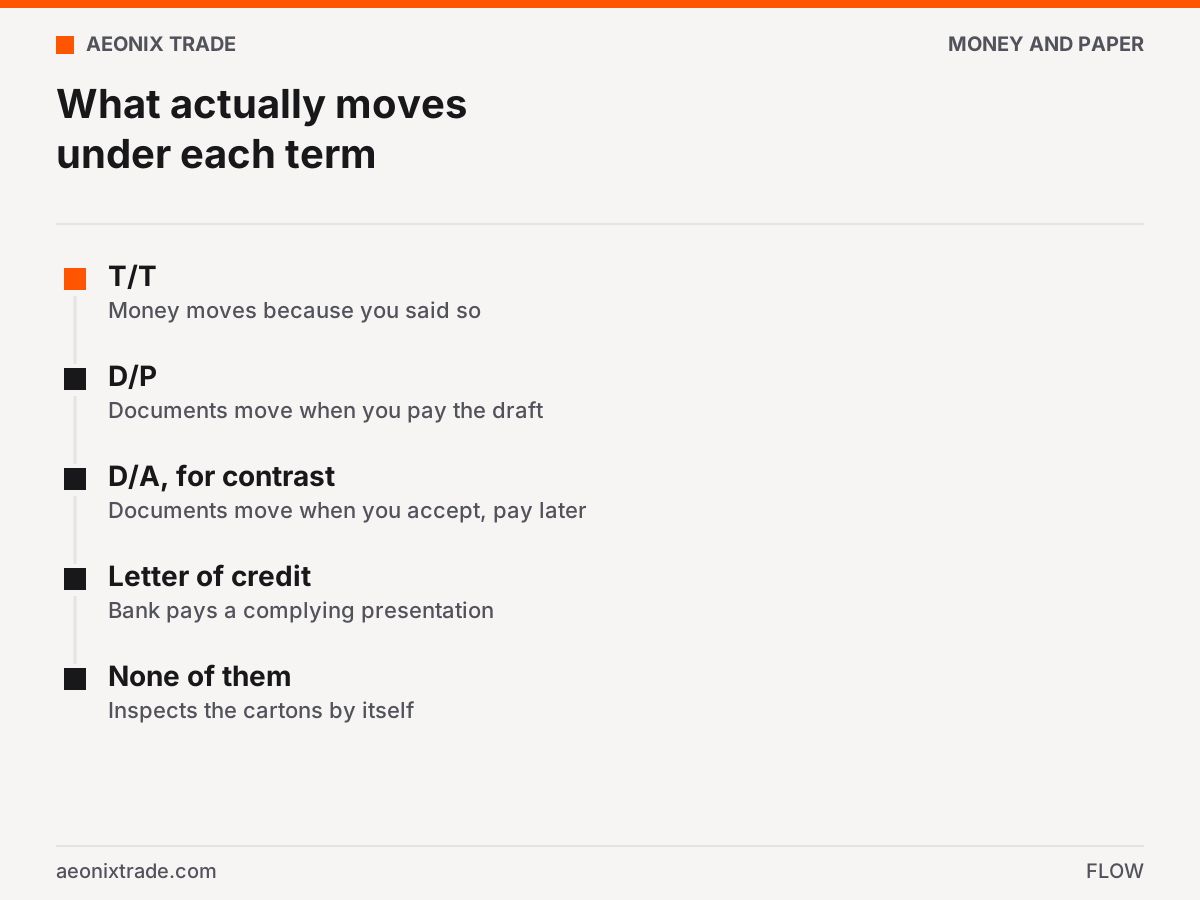
As of the pages checked on 9 November 2026, the ITA's cash-in-advance note describes a wire as payment before the goods are shipped. It calls that the least attractive structure for the buyer, because the cash leaves before the goods do. T/T is the rail. You can also use it later. A deposit, then a balance after inspection, is still a wire. It is not cash-in-advance for the whole price if the contract holds the balance until a document or an inspection you control. "T/T" with no trigger is not a term.
The same agency's letter of credit page describes the importer's bank committing to pay when the exporter presents the required documents. The ICC Academy's guide to documentary credits states the limit that matters: payment is against documents, not against the goods, and a credit is not a guarantee that you receive the goods you ordered. If the documents comply, the bank pays. Inspection still lives in the sale contract. It reaches the bank only when the credit asks for that document, in the form the credit describes.
The ITA's methods of payment page puts documentary collections between the credit and open account. The importer pays the face amount at sight, which is documents against payment, or on a specified date, which is documents against acceptance. Banks facilitate. They do not verify the documents, and recourse if nobody pays is limited. The documentary collections page says the banks do not guarantee payment the way a letter of credit does, and it recommends the method for an established relationship in a stable market. If the importer does not pay, the exporter is left finding another buyer, paying to bring the goods back, or abandoning them.
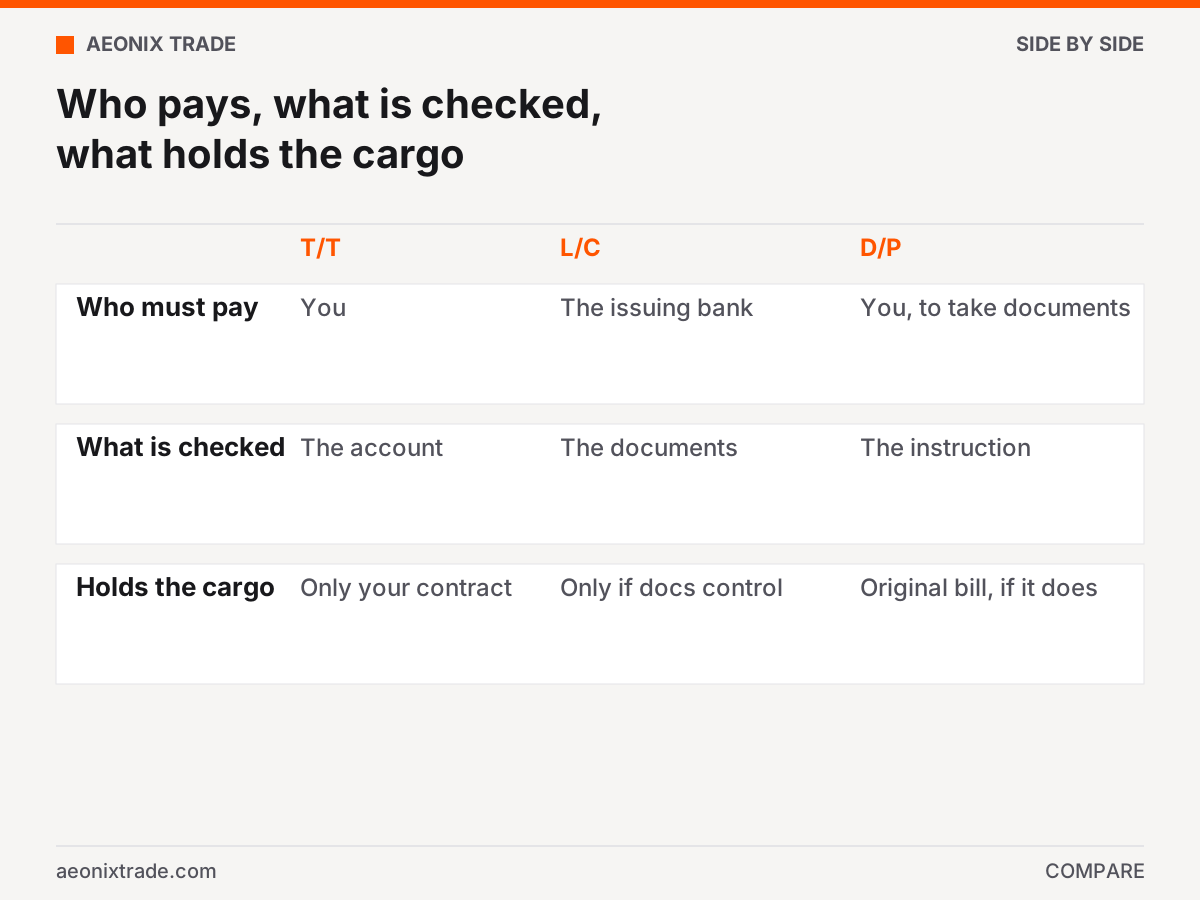
| T/T | Letter of credit | D/P | |
|---|---|---|---|
| Who must pay if the paper is in order | You. You instructed the transfer. | The issuing bank, against a complying presentation. A confirming bank as well, if you asked for one. | You, if you want the documents. The bank does not undertake to pay the seller. |
| What gets examined | The account you named. Not the invoice, unless your contract says you will check it first. | The documents against the credit. Not the goods. | The collection instruction. Not the accuracy of the invoice. |
| When it fits a China order | A supplier you have checked, with each transfer tied to a trigger you can see. | A new or thin relationship, where you will not pay the full amount up front and the supplier will not ship on a promise. | An ocean shipment you already trust, where the original bill still controls release. |
| Where it fails | The beneficiary does not match the seller, or the balance moves before you hold the originals. | A document that does not match. The goods can be right and the bank still waits. | Air freight, a straight consignee, or a release that no longer needs the original bill. |
T/T vs L/C, the same question buyers type as lc vs tt, is not a contest the credit automatically wins. The credit is the stronger tool against a supplier who disappears with a deposit, and it is brittle against a comma in the document list. The wire is simpler, and it is gone once your bank has sent it. D/P sits in the middle only while the bill of lading is the key to the cargo. The ITA's Trade Finance Guide (2022 edition, linked from the guide page) limits documentary collections to ocean shipments where the documents control delivery. It is the wrong tool for air, and for an ocean bill consigned straight to you.
When the collection instruction says the collection is subject to ICC's Uniform Rules for Collections, those are the rules the banks follow. The text is URC 522. "D/P" typed on a proforma is not that instruction. The instruction is the sheet the seller's bank sends. Read it before the ship sails. The sibling page on D/P and D/A walks the parties and the release moment. D/A is not in the title of this comparison because accepting a draft and taking the documents means the seller is waiting on you, with the goods already releasable.
Where the clause goes wrong
- A balance "against copy B/L." A copy shows that a bill exists. It does not stop the supplier, or the forwarder holding the originals, from releasing the cargo. If holding the box matters, the trigger is the originals, or a credit that requires them, not a scan.
- A beneficiary that does not match the seller. The account title on the wire, the beneficiary on the credit, and the chop on the proforma are one name or they are a problem. Check the company before the first transfer. The checks are on verifying a Chinese supplier before payment.
- Treating a platform badge as one of these three. Trade Assurance is a record of an on-platform order and a dispute path for terms that were written into that order. It does not cover a wire you sent to a bank account off the platform, and it does not inspect the cartons. Use it for the order it actually covers. Do not let it stand in for a credit or for a collection.
What to settle before you agree
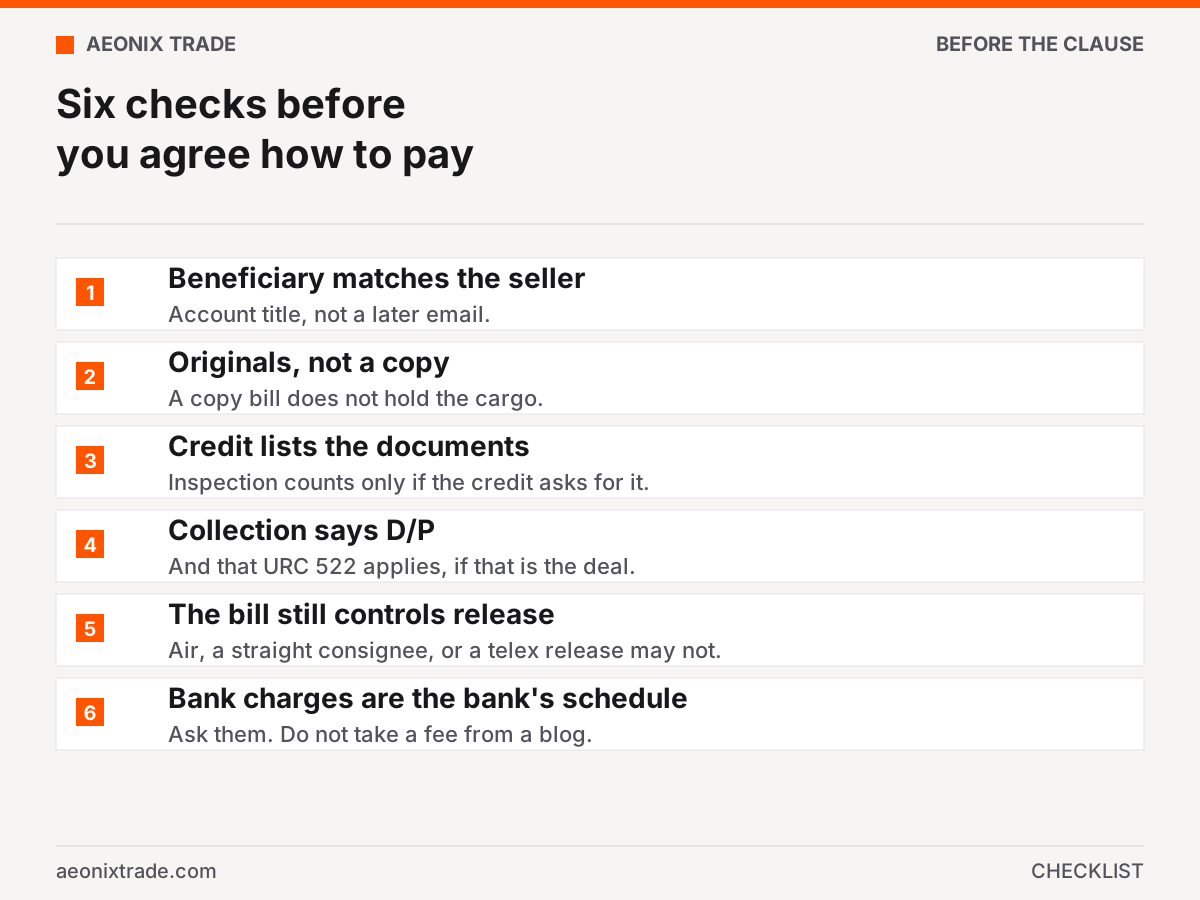
- The beneficiary name matches the seller on the contract, not a personal account introduced later by email.
- Each wire has a trigger: signature, a passed inspection, or originals. "T/T" alone is not a trigger.
- If the tool is a credit, the document list is the one your bank and the supplier can both produce. Inspection counts only if the credit asks for it.
- If the tool is D/P, the collection will say documents against payment, the instruction incorporates the collection rules you agreed, and the original ocean bill still controls release.
- Bank charges come from the bank's schedule, and you have agreed who bears a shortfall if a correspondent deducts a fee. The Trade Finance Guide says fees can be paid by the sender or deducted from the amount. A short credit is not a discount.
- The Incoterm is a separate clause. None of these payment tools says who books the ship. That choice is FOB versus CIF when those are the two quotes, and the bill itself is explained on the bill of lading.
Put the payment trigger you want, and the document that releases the balance, on the RFQ beside the specification. A supplier who will only accept a full wire before production is telling you the relationship they are offering. You can accept it, after the verification, or you can ask for a credit. You cannot get the credit's protection out of a wire by hoping the cartons match.
Frequently asked questions
Which is safer, T/T or a letter of credit?
Against paying a stranger before the goods exist, the credit is the safer of the two, because the bank pays documents rather than your bare transfer. Against a typo in the document list, the wire tied to an inspection you control can be the one that actually releases a shipment. Safer is the risk you are trying to cut. Name that risk first.
Is D/P as strong as a letter of credit?
No. Under D/P you pay to take the documents, and the bank does not guarantee the seller will be paid or that the documents are accurate. The ITA recommends it for an established relationship. A credit is the bank's undertaking, and only against a complying presentation.
Can I use T/T for the deposit and a credit for the balance?
Yes, if the contract says so and the credit's amount is the balance, not the whole price. Write the trigger for the deposit. Do not let the deposit become the full price because the credit was slow to open.
What does t/t versus l/c change about the freight?
Nothing by itself. Payment does not choose FOB or CIF, and it does not choose who is the importer. Keep the sale term in its own clause. A copy of the bill is a weak trigger under either payment tool if someone else holds the originals.
Does any of these check product quality?
No. A wire does not. A collection does not. A credit checks the documents the credit lists. Put inspection in the sale contract, and in the credit only if you want the bank to see that certificate.
The payment path next to this one is How to Pay Chinese Suppliers Safely, Alipay, WeChat, Wise, and a bank transfer, open-account terms, and paying at a Yiwu booth versus by T/T.
Sources
- U.S. International Trade Administration: Methods of payment. Cash in advance, letter of credit, documentary collection at sight or on a date, and open account. Checked 9 November 2026.
- U.S. International Trade Administration: Letter of credit. A bank commitment to pay against the required documents, recommended for a new relationship, and described as labor-intensive because of bank fees.
- U.S. International Trade Administration: Documentary collections. Banks do not verify the documents and do not guarantee payment. Recommended for an established relationship.
- U.S. International Trade Administration: Cash in advance. A wire before shipment is the least attractive structure for the buyer.
- ICC Academy: Types of documentary credit. A credit pays against documents, not against the goods.
- ICC: URC 522. The collection rules that apply when the collection instruction incorporates them.
- International Trade Administration: Trade Finance Guide (2022). Routing fields on a wire, who can bear bank charges, and the limit of collections to shipments whose documents control delivery.
Submit sourcing request
Can't find what you need?
Start with a product or image link, an approximate quantity and destination. Other details can follow.