How to Pay Chinese Suppliers Safely: Deposit, Balance, Wire and Escrow
Published by Aeonix Trade.
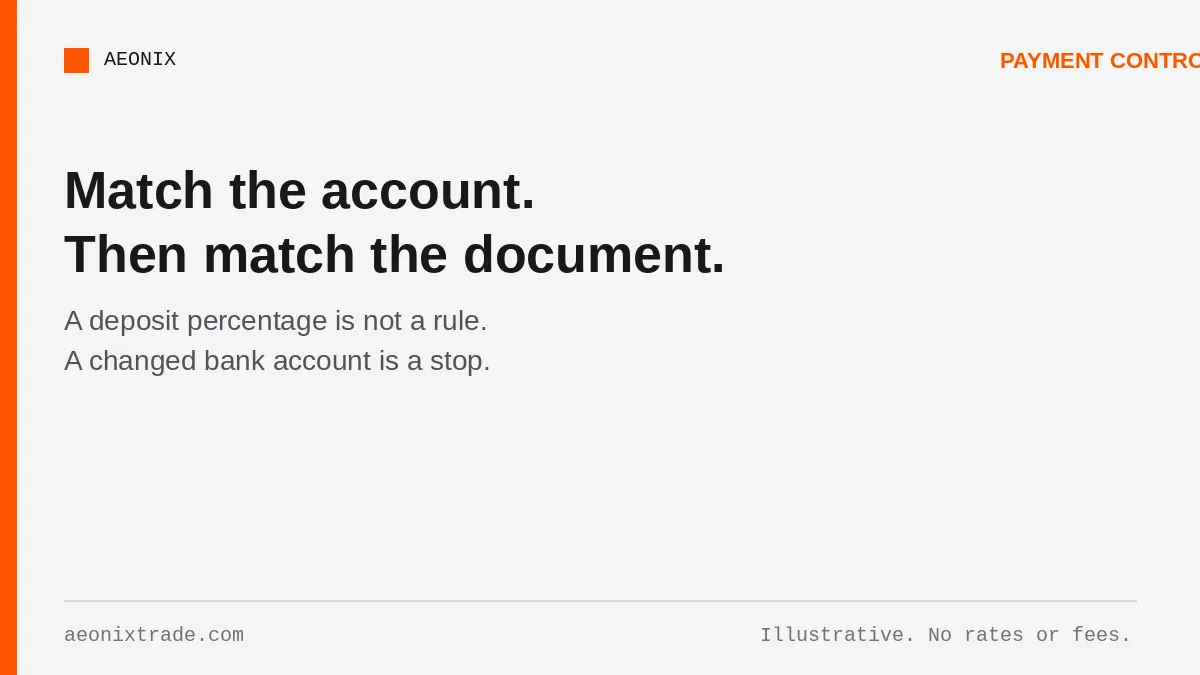
Pay a Chinese supplier against a named party, a named account, and a named document. A deposit before production and a balance before shipment is a contract you write, not a rate set by customs or by the ICC.
Last fact-checked: 9 November 2026.
The sentence buyers search for is "30% deposit, 70% balance." You will see it on proformas. It is that supplier's offer. It is not a Chinese customs rule, and it is not an Incoterm. Write those figures into the contract only after you have agreed them, and do not take the split from a blog. This page will not recommend a percentage. It will tell you what has to be true before any of the money moves.
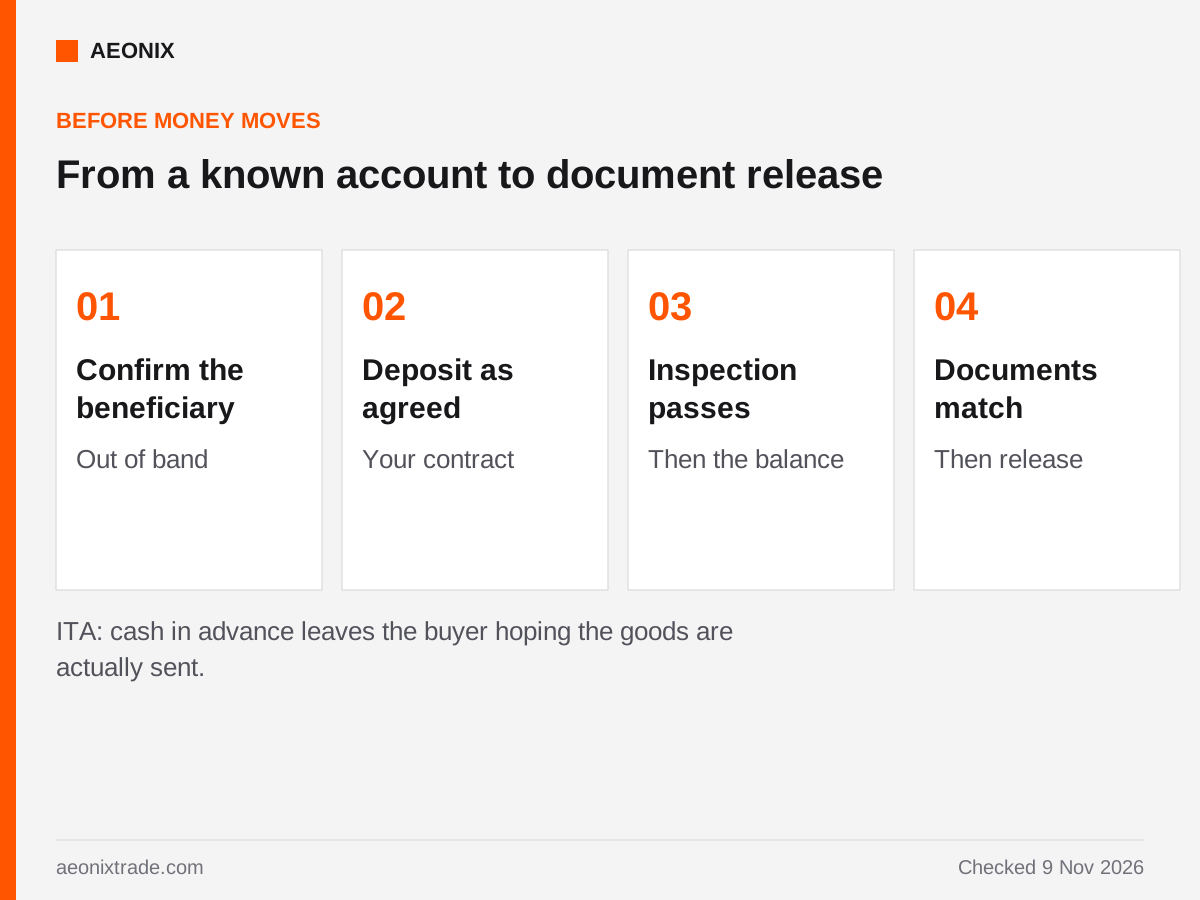
The International Trade Administration describes cash in advance as the buyer paying the full amount, or a significant part of it, before the goods ship. The usual rails are a wire transfer, a card, or an escrow service. The agency points to that structure in higher-risk relationships and in small transactions, where a letter of credit can be a heavy tool. It also says the structure is the least attractive one for the buyer, because the cash leaves before the goods do, and because the buyer is left hoping the goods are actually sent.
Wire, escrow, and the bank that holds the documents
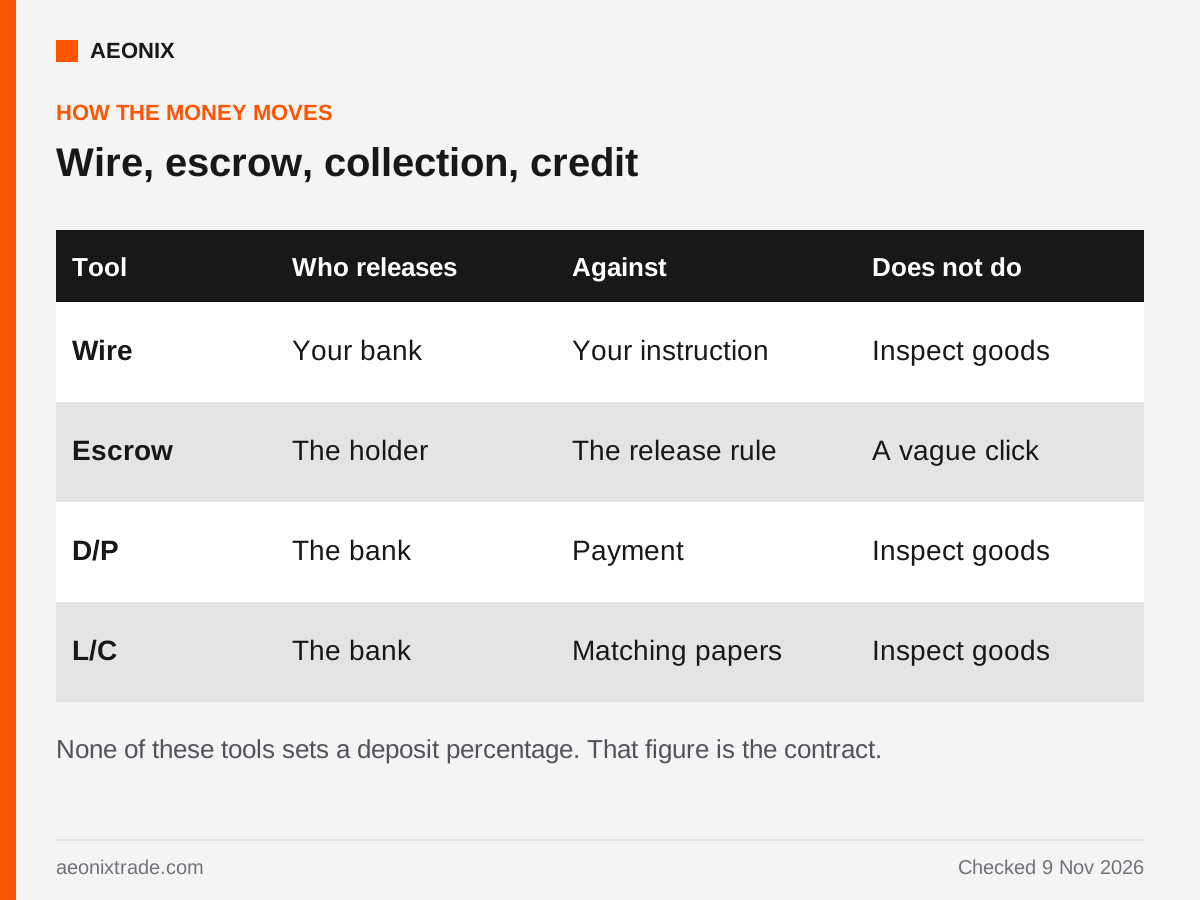
A T/T payment is the wire. The bank moves money. It does not inspect cartons, and it does not know whether the account name matches the factory. Match the beneficiary on the payment instruction to the seller on the contract, character for character. A personal name under a company chop is a stop, not a detail for the accounts clerk to "just process."
The same agency's methods of payment page says escrow has become another cash-in-advance option for small export transactions. Escrow is only as safe as the release rule. Read who holds the money, which document releases it, and whether a passed inspection is one of those documents. A release on "seller marks the order shipped" is a wire with an extra login. The page on this site for the commercial version of that idea is trade assurance. Read the release conditions there the same way you would read a bank's.
A documentary collection is a different machine. The ITA describes it as the exporter asking its bank to send the documents the buyer needs, with instructions that the importer's bank release those documents against payment. You do not pay a personal account in a chat window. You pay to receive the documents. D/P and D/A are the two familiar versions of that release. A letter of credit goes further: the bank pays against documents that match the credit, and the ITA's Trade Finance Guide is the public walkthrough of how those tools sit on a risk line. None of those pages states a bank fee. Ask your bank, and agree who bears a shortfall if a correspondent deducts a charge.
A typical case
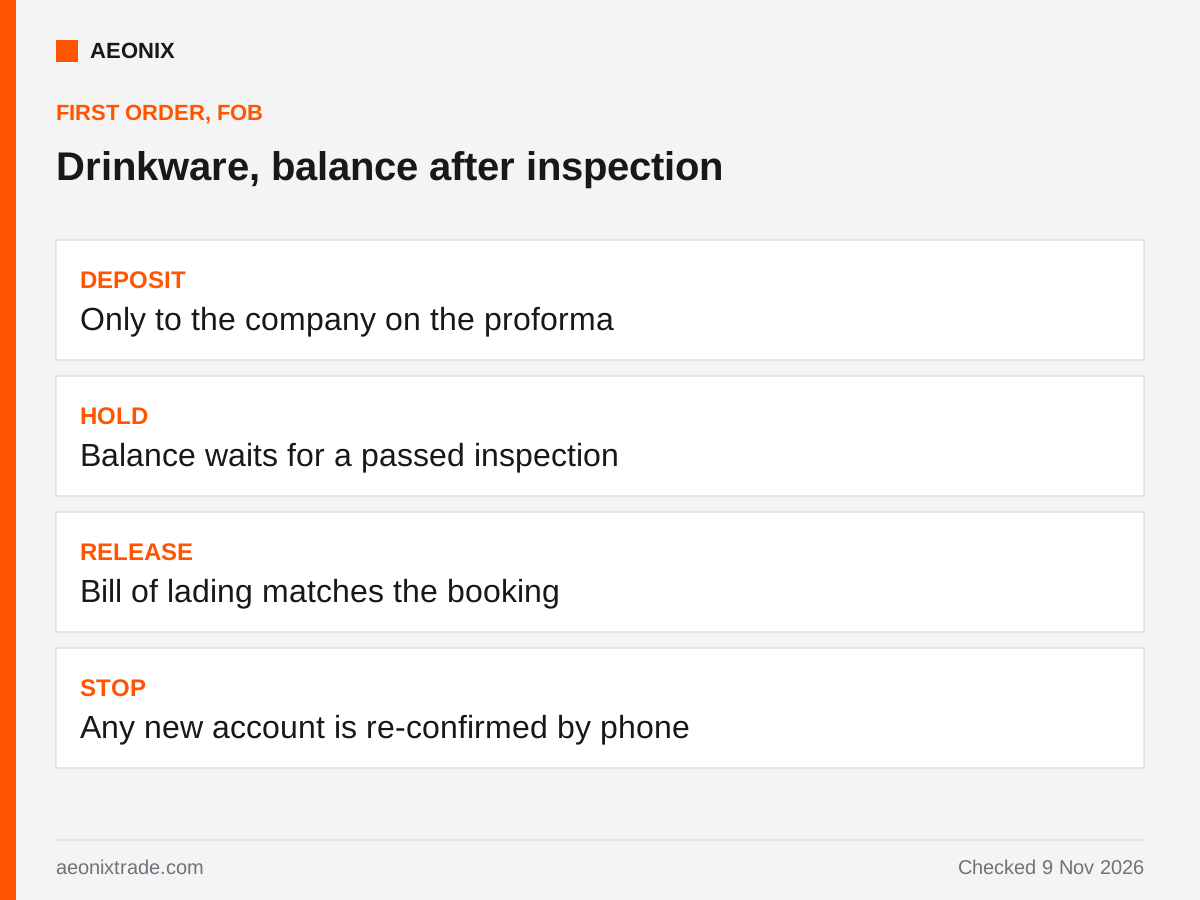
A first order of stainless drinkware, FOB Ningbo, booked by sea. The buyer has never paid this seller. The proforma invoice names a company, an address, and a bank account in that company's name. Before the deposit, the buyer checks that company the way the supplier check describes, and calls a phone number that was on the company's own page, not a number that arrived in the same email as a new account. The deposit is the amount written in the signed contract. The balance is due after a passed pre-shipment inspection and before the forwarder releases the bill of lading. The buyer does not send the balance against a photo of cartons in a chat.
The contract also says what happens if the inspection fails. The balance stays put. A rework is a new date, not a new account. If the seller later asks for the balance to a different bank "because of a tax check," the buyer stops and re-confirms on the original phone number. That pause is the whole control.
The account change is the loss
Most of the money that disappears on a China order disappears into a substituted account, not into a container that sinks. The email looks like the salesperson. The PDF looks like the proforma you already signed, except the bank line. Treat any change of beneficiary, bank, or account number as a new contract. Confirm it out of band, on a number you already had.
If a payment has already gone to an account you did not agree, a buyer in the United States can report it to the Internet Crime Complaint Center. IC3, which is run by the FBI, describes itself as the central hub for reporting cyber-enabled crime, and its own page says a response to every complaint is not guaranteed. Filing is a report. It is not a refund. Call your bank the same day and ask whether the wire can still be recalled. Do not wait for a blog, or for the supplier's chat, to tell you the window.
A trading company on the invoice and a factory on the cartons can both be legitimate. They cannot both be the beneficiary unless the contract says which one you pay, and for what. Pay the party who is selling to you. If that party is not the factory, say so on the purchase order, and keep the factory's name on the inspection report so a later claim has somewhere to land.
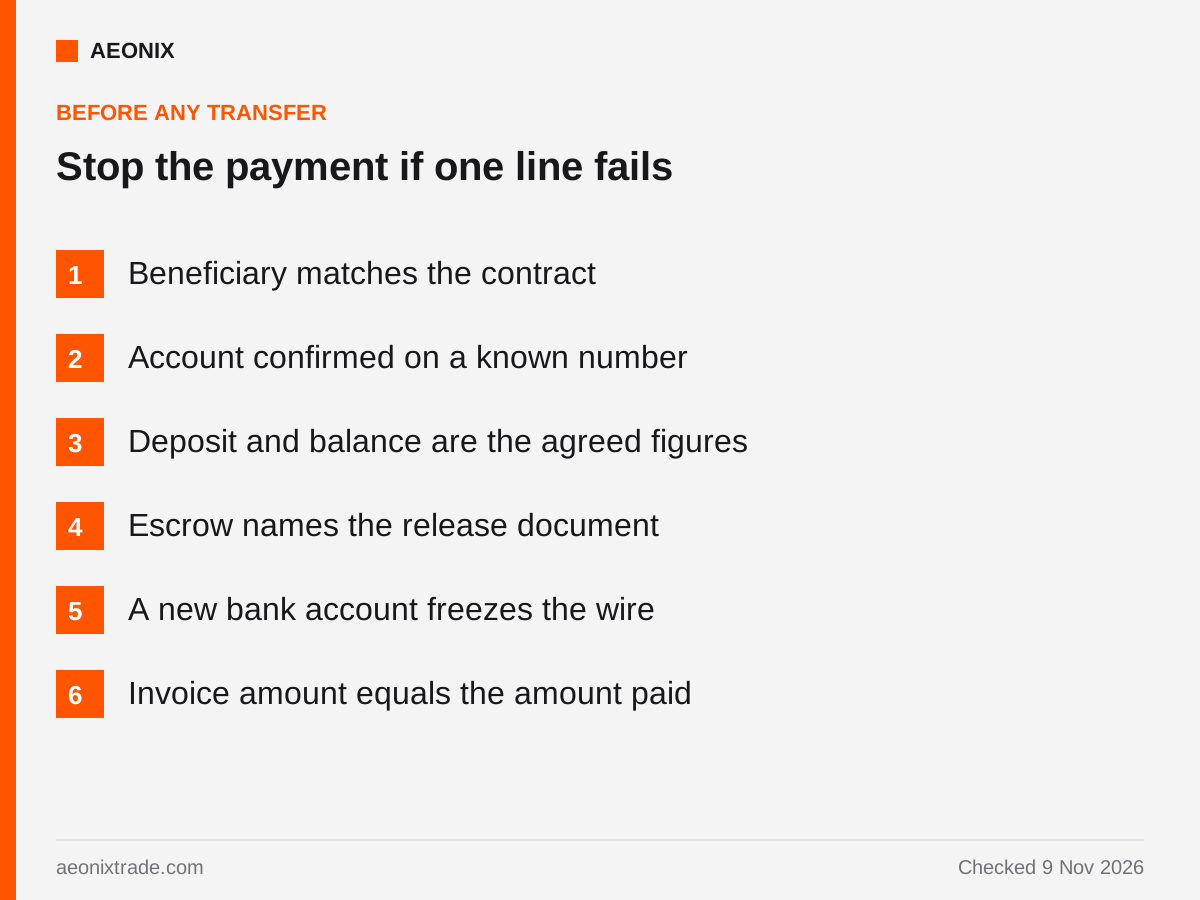
Before any transfer
- The beneficiary name matches the seller on the signed contract.
- The account number was confirmed on a phone number you already had, not in the email that asked for the money.
- The deposit and the balance are the figures you agreed, tied to a document or an inspection, not to a chat message.
- You know what releases an escrow: inspection, bill of lading, or only the seller's click.
- A changed bank stops the payment until it is confirmed out of band.
- The commercial invoice you will later give customs matches the amount you actually paid.
The papers that should match the money are sorted on the proforma, commercial invoice and packing list page. Put the payment trigger, the Incoterm, and the inspection point on the RFQ before anyone asks for a deposit.
Where the payment goes wrong
The first miss is paying the balance because the production photos look finished. Photos are not an inspection, and they are not a bill of lading. If the contract says the balance follows a passed inspection, a friendly album is not that inspection.
The second miss is an escrow that releases on a draft bill of lading nobody matched to the booking. The document should name the shipper, the consignee, the port and the carton count you already agreed. A PDF that does not match the booking is not a release.
The third miss is treating "30% / 70%" as the safe split because it is common on proformas. A large deposit to an unchecked account is not safer because the percentage looks familiar. A small deposit to the wrong account is still gone. The control is the party, the account, and the trigger. The percentage is whatever you negotiated.
Frequently asked questions
How do you pay a Chinese supplier safely?
Agree who you are paying, confirm the account out of band, and tie each transfer to a document you can check. A wire, an escrow with a real release rule, a documentary collection, or a letter of credit can all do that. A chat message with a new account cannot.
Is a 30% deposit and 70% balance the standard?
No. It is a split some suppliers print on a proforma. Use it only if you agreed those figures. It is not an ICC rule and not a customs rate, and this page does not recommend a percentage.
Is escrow safer than a wire?
Only if you know who holds the money and which document releases it. The International Trade Administration describes escrow as a cash-in-advance option for small transactions. Read the release rule before you fund it.
Should the first order be a letter of credit?
The ITA describes cash in advance as less burdensome than a letter of credit, and as the structure with less risk for the exporter than open account. A letter of credit pays against documents, which is useful when you want a bank checking the paper. How that sits next to a wire and documents against payment is T/T, a letter of credit, and documents against payment. It does not inspect the goods. Choose it when the document check is worth the banking work, not because a page said first orders must use one.
What if the supplier changes the bank account?
Stop. Confirm the new account on a number you already had. If you already paid the new account by mistake, call your bank about a recall the same day, and a US buyer can file a report with the Internet Crime Complaint Center. A report is not a refund.
Next steps
Sources
- International Trade Administration: Cash in advance. The buyer pays all or a significant part before shipment, usually by wire, card, or escrow. The structure favours the seller's cash risk and leaves the buyer hoping the goods ship.
- International Trade Administration: Methods of payment. Escrow as a small-transaction cash-in-advance option, and documentary collection as a bank releasing documents against payment.
- International Trade Administration: Trade Finance Guide. The public guide to how the payment tools sit against each other.
- FBI Internet Crime Complaint Center. The central hub for reporting cyber-enabled crime. A response to every complaint is not guaranteed.
Submit sourcing request
Can't find what you need?
Start with a product or image link, an approximate quantity and destination. Other details can follow.