Paying Chinese Suppliers: Bank Transfer, Wise, Alipay and WeChat Compared
Published by Aeonix Trade.
Last fact-checked: November 9, 2026.
A buyer owes the balance on a kitchenware order, about the price of a small LCL shipment, and the supplier says "Alipay is fine, or WeChat, or whatever is cheapest." The commercial invoice is in the factory's company name, in US dollars. Paying a Chinese supplier is a match between that invoice and a rail that can pay a company. A personal wallet is a different product. This page does not state a fee for any of the rails.
A typical case
The deposit was already sent by bank transfer to the company on the proforma. The balance is due against the copy of the bill of lading. The supplier's salesperson now offers a personal WeChat account "so it arrives today," and a cousin's Alipay "because the company account is busy." The International Trade Administration describes a wire transfer as the usual cash-in-advance method, and says the exporter should give clear routing instructions. Cash in advance, which is what a pay-everything-before-shipment wire is, sits at the buyer's risky end of the same agency's methods-of-payment line. Changing the beneficiary at the last minute is how that risk gets worse, not better.
The bank wire is the trade rail
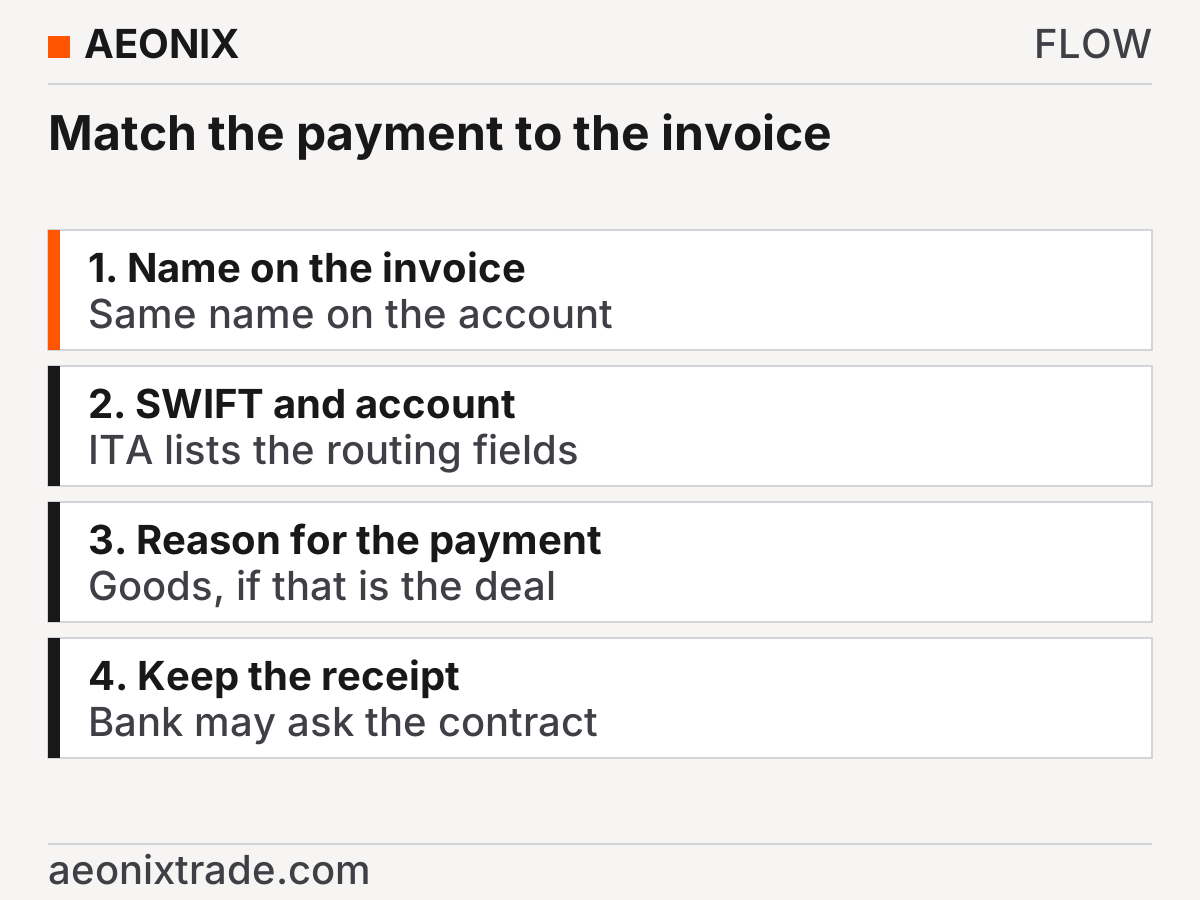
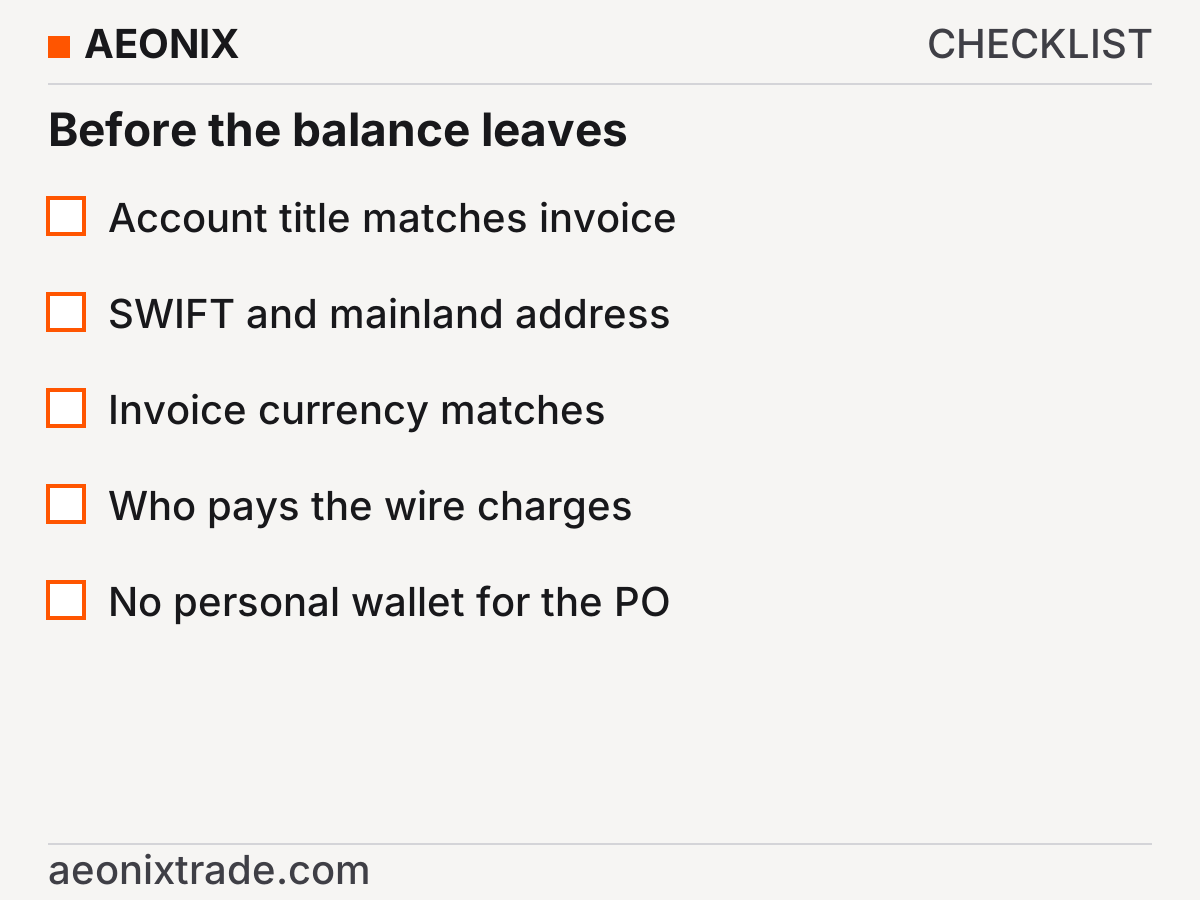
The ITA's Trade Finance Guide, 2022 edition, says routing instructions for an international wire should include the receiving bank's name and address, its SWIFT address, and an ABA number where that applies, plus the seller's name and address, the account title and the account number. Fees can be paid by the sender, or banks can deduct them from the amount. Agree which one. A short credit looks like a short payment, and a factory that is short will not release the documents.
The same guide's home page is the Trade Finance Guide. The methods page lines the tools up by risk: cash in advance, letter of credit, documentary collection, open account. T/T is the rail you can use at any point on that line. "100% T/T before production" is cash in advance. A deposit and a later wire is a split. The T/T page is that split in more detail. A letter of credit is the bank undertaking in the middle of the ITA line, not a wallet. D/P and D/A are the collection terms, documents against payment or acceptance.
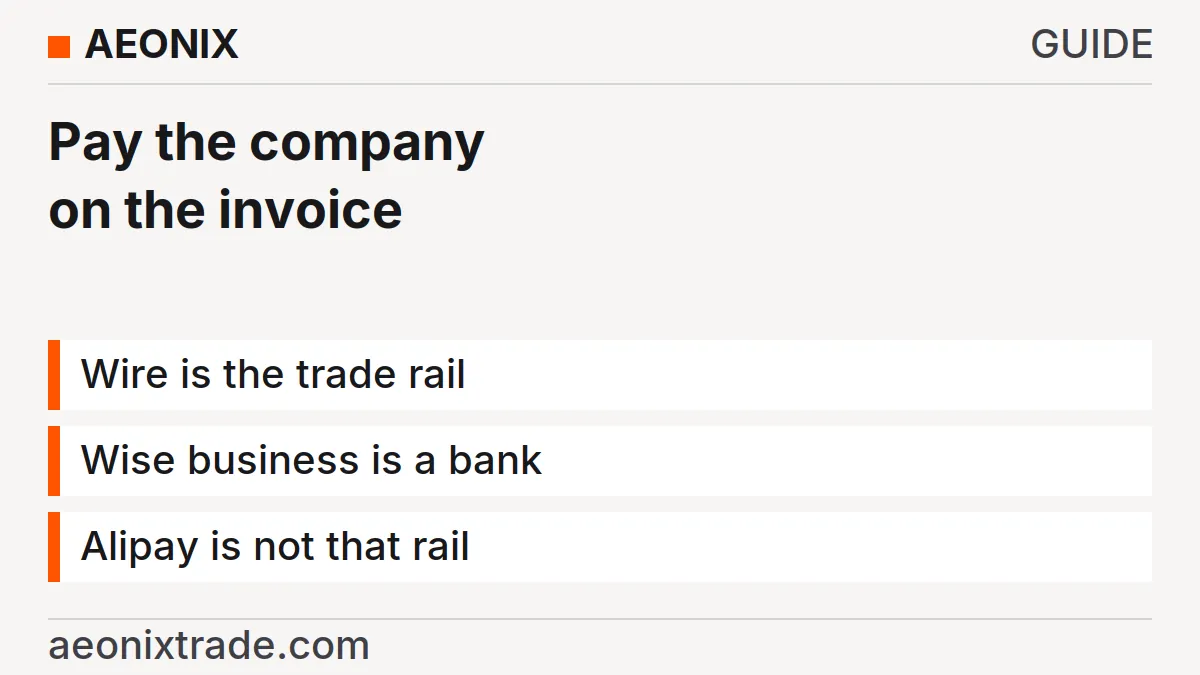
Pay the company on the commercial invoice. The account title should match that company. If it does not, stop. Verify the supplier before the payment, not after the salesperson says the cousin will pass it on.
Wise, as Wise describes it
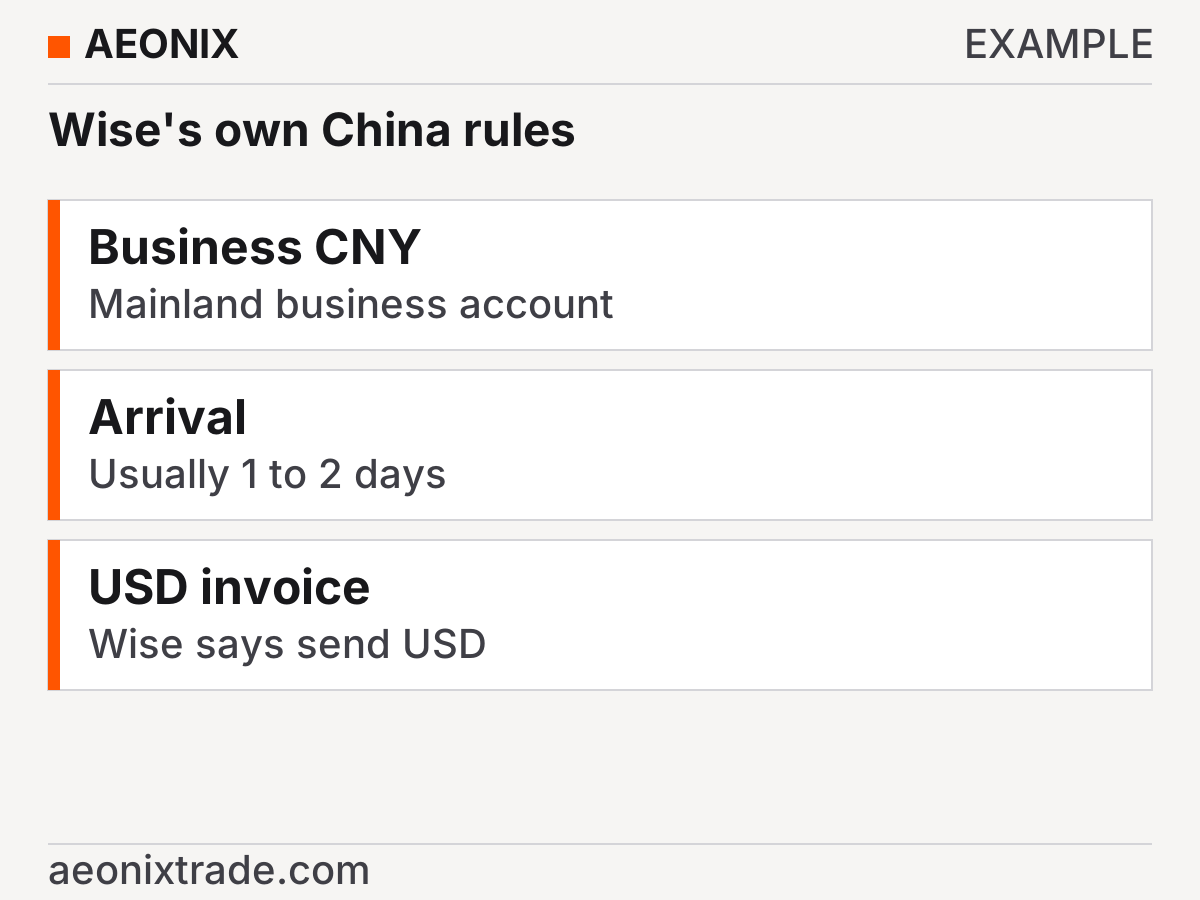
Wise's own help page on sending CNY to a China business, read on 9 November 2026, says a Wise Business user sends to the recipient's full name in Latin characters, a bank account number, a BIC or SWIFT code, and an address in mainland China. The account must be a business account in China denominated in CNY. Wise says you can only send CNY to CIPS member banks. It says the money usually arrives within one to two working days after Wise has it, and that the recipient's bank may ask for the business contract and the invoice. If the invoice and the contract are in US dollars, Wise says to send US dollars instead. It also says Wise supports USD payments to businesses in China.
That is a bank payout to a company. It is not Alipay and it is not WeChat. Wise's CNY transfer guide says a business sender pays a business recipient by local bank account. The Alipay and Weixin columns on that guide are for personal recipients. The guide says an individual sender cannot send to a business recipient at all. A buyer paying a factory is the business-to-business cell. Use the bank account. Do not force the order through a personal wallet because the app shows an Alipay button.
The same guide states personal limits: up to 50,000 CNY per transfer via Alipay, with a yearly band it describes for the recipient, and up to 50,000 CNY per transfer via Weixin, with a yearly figure it states for that recipient. Those are Wise's limits for those personal payouts, not a fee, and not a reason to split a factory invoice across someone's personal QR code. This page does not repeat Wise's fee. The help pages say the cost is shown before you pay. Read it there.
Why the wallet is the wrong rail for this invoice
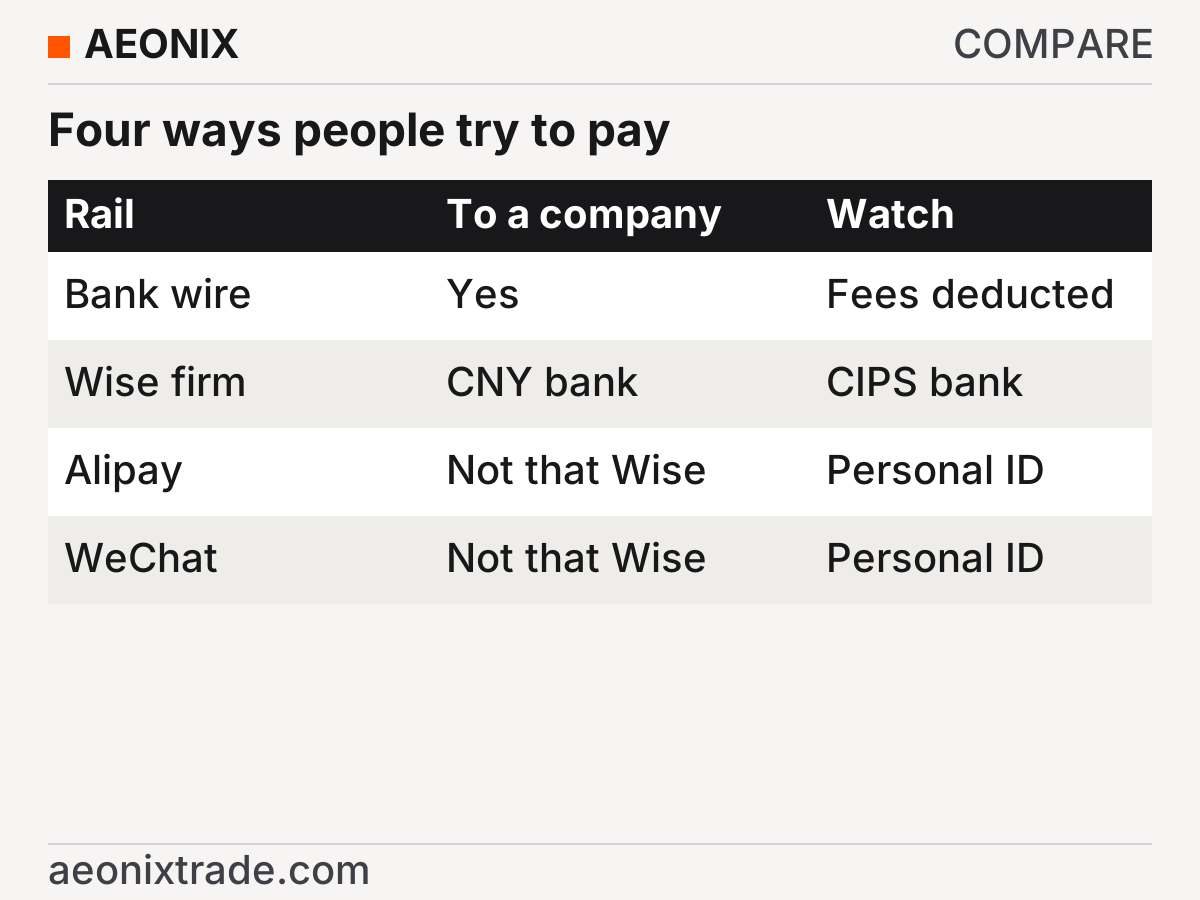
Alipay and WeChat Pay move a lot of money inside China between people. A factory's export invoice is a company receivable. If you pay a personal account, you have paid a person. You may not have paid the seller on the contract, and you will struggle to show customs or your bank a matching beneficiary later. If the supplier insists, the honest version is a company account you can name on the wire, whether that wire leaves your bank or leaves Wise Business into a CNY or USD account as Wise describes.
Escrow and trade-assurance style protection are a different promise again. They are not a wallet. See trade assurance for how that kind of protection is framed, and do not confuse it with a QR code.
| Rail | Pays the company on the invoice? | What to check |
|---|---|---|
| Bank wire | Yes, if the account title matches | SWIFT, account, who bears the charges |
| Wise Business | Yes, to a mainland business account | CNY only if the account is CNY and the bank is CIPS. USD if the invoice is USD |
| Alipay or WeChat via Wise | Not on the business-to-business cell Wise describes | Personal recipient, personal limits |
| A salesperson's personal QR | No | You paid a person |
Mistakes
- Paying the salesperson's WeChat because the company account "is busy."
- Sending CNY against a USD invoice. Wise's own note says to send USD in that case.
- Ignoring a deducted bank charge and then arguing the balance was short.
- Splitting one invoice across several personal Alipay accounts to stay under a limit.
- Assuming a wallet payment creates the same paper as a wire to the seller of record.
Questions buyers actually ask
Can I pay a Chinese factory with Alipay?
Not as the Wise business-to-business rail described on Wise's help pages. Those pages put Alipay and Weixin on personal recipients. Pay the company's bank account.
Is Wise a letter of credit?
No. It is a transfer. The ITA still lists a letter of credit as a different method, with the bank in the middle. Wise does not replace that.
Who pays the wire fee?
The ITA guide says the sender can pay, or the banks can deduct the charge from the amount. Agree it in the purchase order so a short arrival is not a surprise.
What do I attach to the payment?
The invoice number, the contract if the receiving bank asks, and a beneficiary name that matches. If the balance is ready to send and the name does not match, do not send it. Put the order on the RFQ form if you still need the supplier and the payment term checked before the balance leaves.
The payment path next to this one is paying the deposit and the balance, open-account terms, paying at a Yiwu booth versus by T/T, and T/T, a letter of credit, and documents against payment.
Official sources
- US International Trade Administration: cash in advance. A wire is the usual cash-in-advance method, and the exporter should give routing instructions. Read 9 November 2026.
- US International Trade Administration: methods of payment. Cash in advance, letter of credit, documentary collection, open account. Read 9 November 2026.
- International Trade Administration: Trade Finance Guide, 2022. Bank name, SWIFT, account title, account number, and how wire fees can be taken.
- Wise Help: send CNY to a China business. Latin name, CNY business account, SWIFT, mainland address, CIPS banks, usual arrival in one to two working days, and send USD if the invoice is in USD. Read 9 November 2026. No fee copied from this page.
- Wise Help: guide to CNY transfers. Business-to-business is a local bank account. Alipay and Weixin are described for personal recipients, with the limits stated on that page. Read 9 November 2026.
Submit sourcing request
Can't find what you need?
Start with a product or image link, an approximate quantity and destination. Other details can follow.