How to Verify a Chinese Supplier Before You Pay
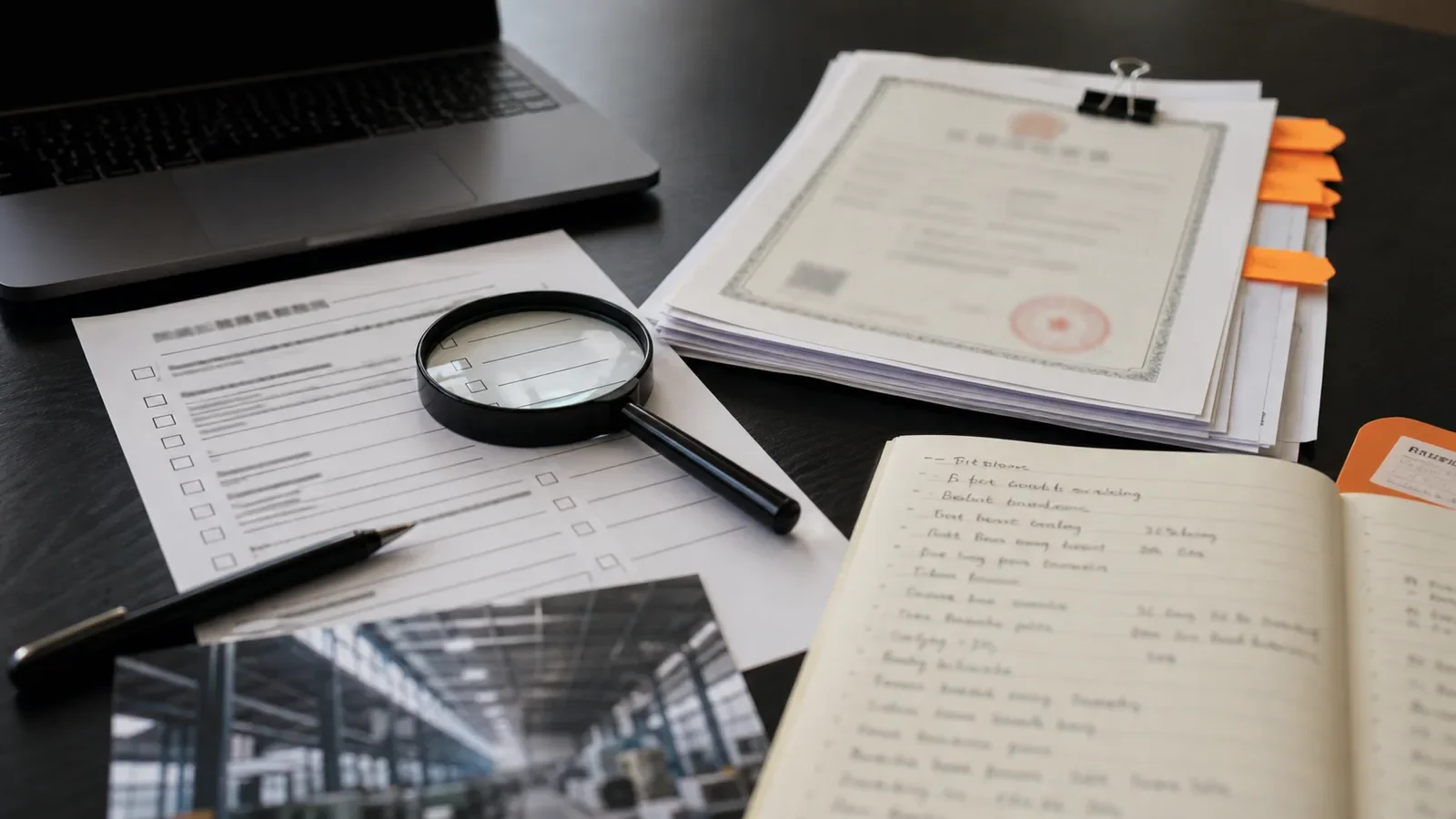
How to Verify a Chinese Supplier Before You Pay
A buyer once sent us a supplier profile that looked almost too clean.
The supplier had factory photos, a short production video, a product catalog, and a confident WhatsApp sales rep. The quoted price was about 12% lower than two other offers. The buyer was ready to send a 30% deposit because the supplier said the production slot would close by Friday.
Nothing looked obviously fake.
But the invoice name did not match the company name on the business license. The factory address in the PDF was in one city, while the video call background showed a different industrial park. When asked to show the production line and the packing area in one live call, the salesperson delayed twice.
The supplier was not necessarily a scam. But it was not verified enough for payment.
That is the point of supplier verification. You are not trying to prove every supplier is bad. You are trying to slow down the deal long enough to understand who will take your money, who will make the goods, and who will be responsible if the order goes wrong.
A Good Quote Is Not Proof
Many buyers treat a low price as progress. In reality, a quote is only a promise written in a spreadsheet.
Before you pay, you need to know:
- Is this company legally registered?
- Is the sales contact working for the company on the invoice?
- Is the supplier a factory, trading company, or reseller?
- Can they actually produce your product specification?
- Are the payment terms normal for this product and order size?
- Does the invoice match the company you checked?
If you skip these questions, the risk does not disappear. It just moves into production, where it becomes more expensive to fix.
Step 1: Check the Company Name Across Every Document
Start with the boring details. They catch a surprising number of problems.
Ask the supplier for:
- Business license
- Proforma invoice
- Company bank account details
- Export license or export company name, if different
- Factory address
- Company website or official storefront
Then compare the names.
The company name on the invoice should match the bank account holder. If the business license shows one company but payment goes to a personal account or a different trading company, stop and ask why.
There are legitimate reasons for a different export company. Some factories use a licensed exporter. But the supplier should explain it clearly and provide documents. A vague answer like "this is our finance partner" is not enough.
Step 2: Confirm What Kind of Supplier You Are Dealing With
Not every trading company is bad. Not every factory is good.
The problem is when you think you are buying from a factory, but the supplier is actually a reseller with no control over production.
Ask direct questions:
- Do you manufacture this product in your own facility?
- Which production steps are done in-house?
- Which steps are outsourced?
- Can you show the raw material area, production line, QC area, and packing area in a live video call?
- Can the invoice include the same specification as the sample?
If a supplier only shows finished goods, a showroom, or catalog photos, they may still be useful. But you should price the risk correctly. A reseller may have less control over lead time, quality correction, and after-sales support.
Step 3: Use a Live Video Call, Not Just Photos
Photos are easy to reuse. Videos are better, but still not enough if they are pre-recorded.
For a meaningful video call, ask the supplier to show:
1. The company sign or entrance 2. The production line 3. The product or similar product currently being produced 4. The packing area 5. The warehouse or finished goods area 6. A close-up of materials, labels, or components
Do not make the call feel like an interrogation. Keep it practical:
"Before we send a deposit, our internal process requires a quick supplier check. Could you show us the production and packing area on a live call?"
Serious suppliers may not love the extra work, but they usually understand. Suppliers who pressure you to pay first and verify later are asking you to carry their risk.
Step 4: Treat Samples as Evidence, Not a Guarantee
A sample proves the supplier can provide one acceptable unit. It does not prove the mass production order will match it.
Before you approve a sample, record:
- Material
- Size
- Color
- Weight
- Packaging
- Labeling
- Logo position
- Function test result
- Any defects you accept or reject
Then ask the supplier to confirm in writing that mass production must match the approved sample and written specification.
For custom products, keep one approved sample with you and, if possible, one sealed sample at the factory. This gives both sides a reference if there is a dispute later.
Step 5: Check Whether the Price Makes Sense
A price that is slightly lower may be normal. A price that is far below the market needs explanation.
Low quotes often come from:
- Different material
- Thinner packaging
- No testing
- No accessories
- Different incoterm
- Shorter warranty
- Missing export cartons
- Misunderstood specification
When one supplier is much cheaper, do not ask, "Can you keep this price?"
Ask:
"Can you confirm this quote includes the same material, packaging, logo, carton, inspection standard, and export requirement as our specification?"
The answer will tell you more than the price.
Step 6: Watch the Payment Red Flags
Payment risk is where small mistakes become expensive.
Be careful if:
- The supplier pushes for urgent payment before verification
- The bank account is personal
- The invoice company and bank account do not match
- The supplier refuses a written proforma invoice
- The supplier avoids product specification details
- The supplier offers a very low price but vague delivery terms
- The supplier changes payment details at the last minute
For a first order, common structures include deposit plus balance before shipment, or smaller trial orders with inspection before final payment. The right structure depends on product, order value, and supplier trust level.
Step 7: Verify Before the Deposit, Inspect Before the Balance
Supplier verification and pre-shipment inspection are different.
Supplier verification happens before payment. It answers: "Should we trust this company enough to start?"
Inspection happens before shipment or before balance payment. It answers: "Did they make what we ordered?"
You need both for higher-risk orders.
A simple workflow looks like this:
1. Define product specification 2. Collect 3-5 supplier quotes 3. Verify the shortlisted supplier 4. Order sample 5. Approve sample and written specification 6. Pay deposit 7. Inspect production before balance 8. Release shipment
This process feels slower at the beginning. It is faster than arguing about defects after the goods arrive.
Supplier Verification Checklist
Use this before paying a deposit:
- Company name matches invoice and bank account
- Business license reviewed
- Supplier type is clear: factory, trading company, or reseller
- Factory or office shown on live video
- Product specification confirmed in writing
- Sample approved with notes
- Packaging and labeling confirmed
- Payment terms are written in the proforma invoice
- Delivery term is clear: EXW, FOB, CIF, DDP, or other
- Inspection plan is agreed before balance payment
If two or more items are unclear, pause the payment.
Final Thought
The goal is not to find a supplier who says "yes" quickly. The goal is to find a supplier who can answer clearly when the order becomes specific.
A reliable supplier does not only give a price. They can explain materials, production, packaging, timing, payment, and quality control without hiding behind vague promises.
Before you pay, make the deal boring. Boring documents, boring checks, boring confirmations. That is how good sourcing stays out of trouble.
Need a second pair of eyes? Send Aeonix your supplier quote, invoice, and product specification. We can help you review the risk before you send a deposit.
FAQ
How do I know if a Chinese supplier is real?
Check the business license, invoice name, bank account holder, company address, and live video evidence. A real supplier should be able to explain its role and show relevant business details before payment.
Is a trading company worse than a factory?
Not always. A good trading company can help with communication, product sourcing, and consolidation. The risk is when a supplier hides its role and pretends to be the factory.
Should I pay a deposit before receiving samples?
For standard products, you should usually review samples before placing a larger production order. For custom products, you may need to pay sample or tooling fees first, but the terms should be written clearly.
What is the safest payment method for a first order from China?
There is no single safest method for every order. The safer approach is to verify the supplier, keep payment tied to written documents, avoid personal accounts, and inspect goods before releasing the balance.
Can Aeonix verify a supplier for me?
Yes. Aeonix can help review supplier documents, quotes, product specifications, and sourcing risk before you commit to production.
Submit sourcing request
Can't find what you need?
Start with a product link or photo, an approximate quantity and destination. Other details can follow.