Open account payment terms on a China order
Published by Aeonix Trade.
Last fact-checked: November 10, 2026.
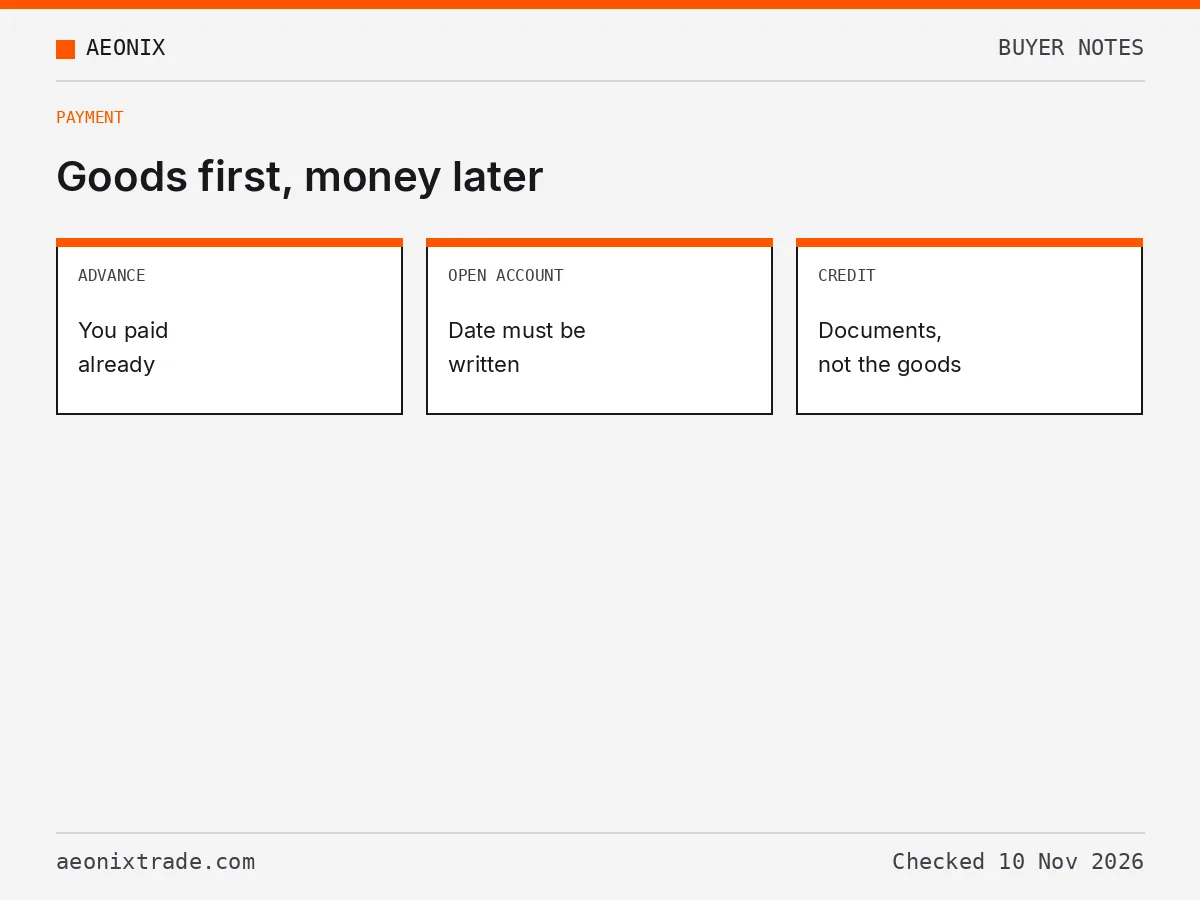
The tools have sailed from Ningbo. The supplier asks for a telex release today and for the balance "in a month or so, the way everyone does it." You have not agreed a date. The originals are in the supplier's hands. What they are asking for is open account: they release the goods now, and they wait to be paid. Your leverage is the balance you have not sent.
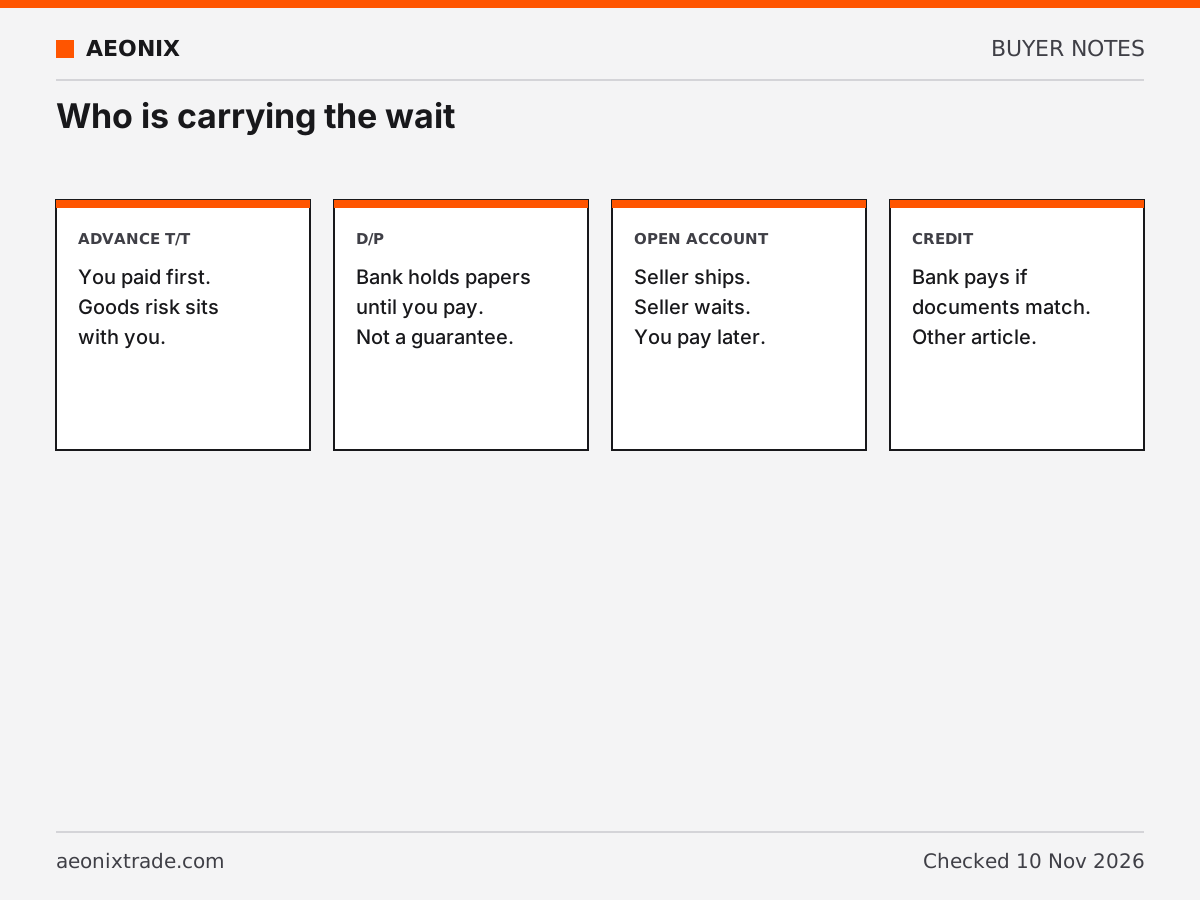
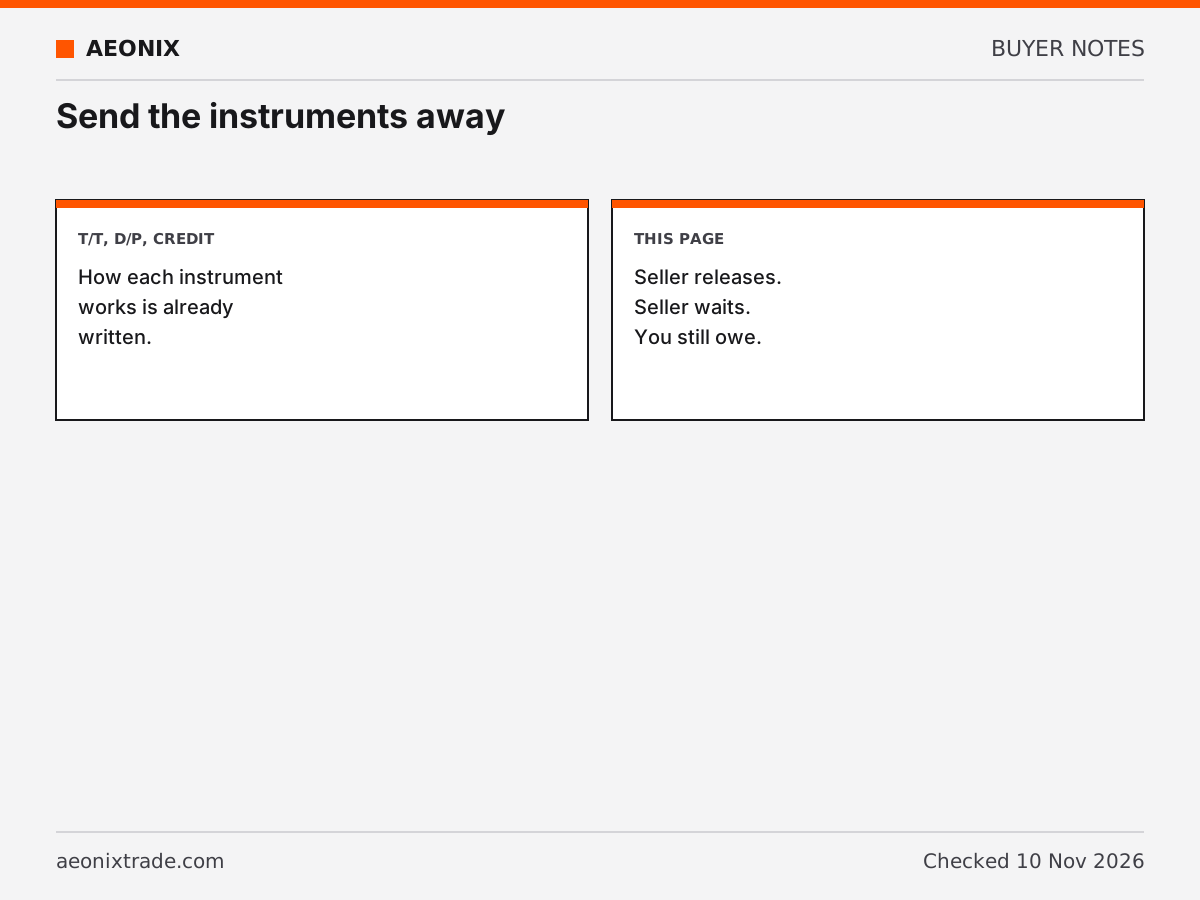
The transfer itself is T/T. A bank that pays if the documents match is a letter of credit. A bank that holds the documents until you pay or accept is D/P and D/A. Whether you know this supplier well enough to be the one who pays later is how to verify a Chinese supplier before you pay. Giving the originals back is telex release. On a balance against documents, that surrender is the seller's step after cleared funds, not something a chat can move onto you.
What the official description actually says
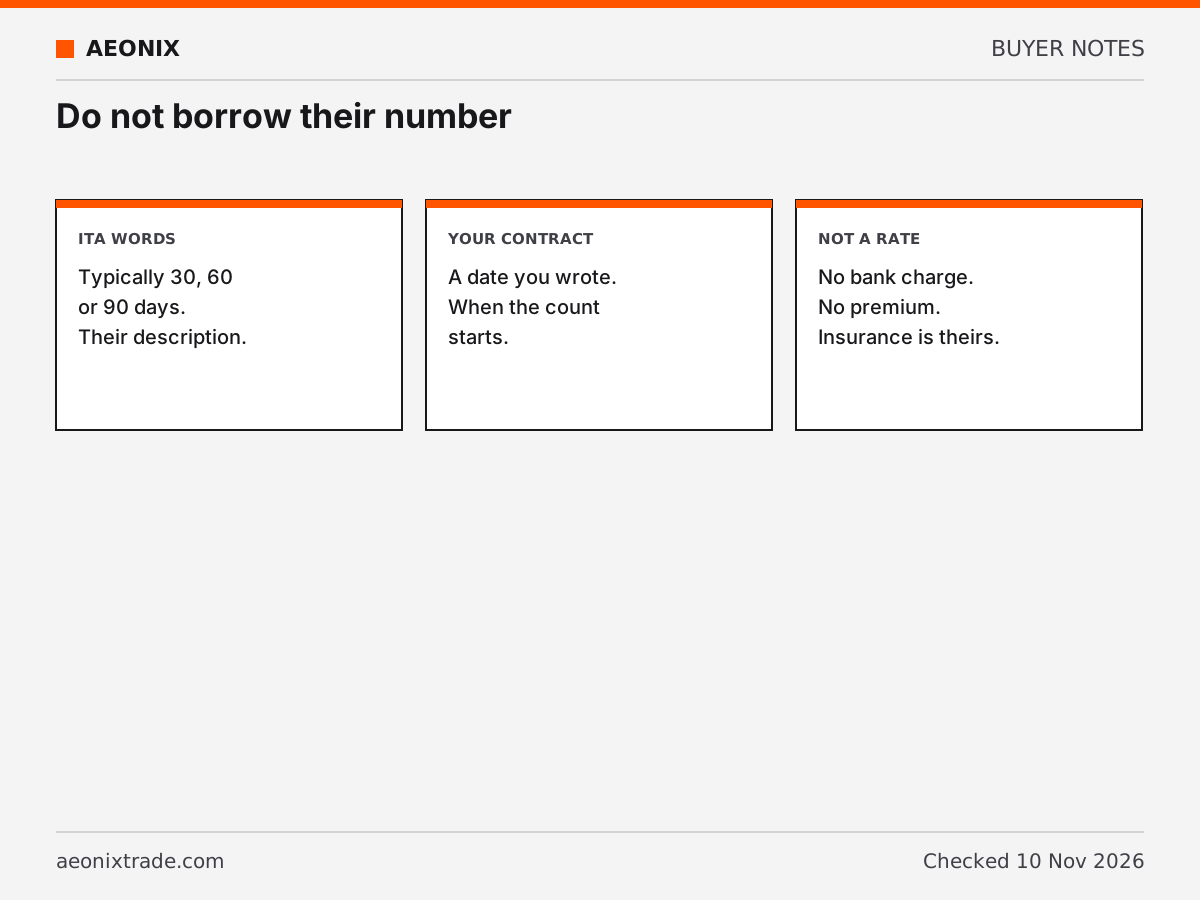
The International Trade Administration's methods-of-payment page, read on 10 November 2026, says an open account transaction is a sale where the goods are shipped and delivered before payment is due, which in international sales is typically in 30, 60 or 90 days. That sentence is their description of what is typical. It is not a Chinese rule, and it is not the number of days in your contract unless you wrote it there. The same page says this option favours the importer's cash flow and is one of the highest-risk options for the exporter, and that an exporter can seek export credit insurance. It does not print a premium. This page does not invent one.
Read the "typically" as a warning, not as a menu. If you want 30 days, write 30 days, and write the date the count starts. If you did not want any of those numbers, do not let a sentence on a US government page become your term by silence.
| Who is waiting | Where the hold is | |
|---|---|---|
| Advance T/T | You have paid before the goods move. The seller's risk on the payment is the smaller one. | Your risk is that the goods are not what you paid for. The verification page is that subject. |
| D/P | The documents sit at a bank until you pay. D/A is the version where you accept a later draft. The other article. | The bank is not a guarantor. The D/P page says so. |
| Open account | The ITA page: goods shipped and delivered before payment is due. The exporter is the one who waits to be paid. | The seller holds the originals and is the one who surrenders them. If they release before your balance clears, they have given up that paper and have not been paid. You withhold the money. You do not hold the bills. |
| Letter of credit | A bank pays if the documents match. It does not inspect the goods. | The credit page. Do not rewrite it into this one. |
The seller's insurance is not your contract
The Berne Union describes itself as the association for the export credit and investment insurance industry. Its members include official export credit agencies and private insurers who cover payment risk. That insurance, when a seller buys it, protects the seller against not being paid. It does not change your due date, and it does not inspect the cartons. UK Export Finance, the UK's official export credit agency, describes its job as finance or insurance so that a viable UK export does not fail for lack of either. That is an exporter's institution. It is an example of the kind of body the ITA page is pointing at. It is not a rate, and it is not a reason for the seller to surrender the bills before your balance clears.
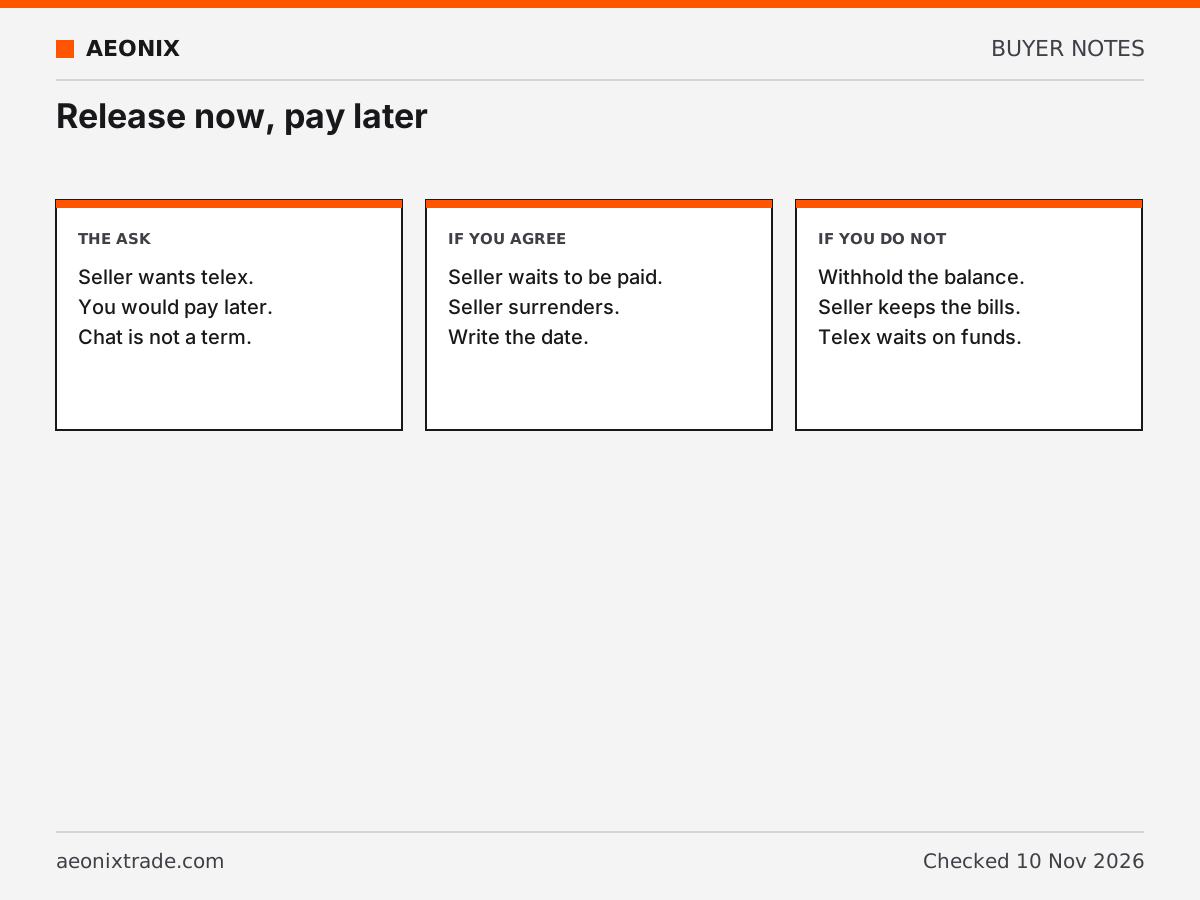
The tools are already on the water
You paid a deposit. The balance was supposed to follow a copy of the on-board bill, by T/T, and the seller would surrender the originals only after that money cleared. The supplier's new message asks to surrender today and to collect the balance later. That is a change of term: they would be extending the credit. If you agree it, write the date, write what "delivered" means, and write what happens if the date passes. If you do not agree it, do not send the balance. The telex page says the seller surrenders after cleared funds when the bargain was payment against documents. Open account is the bargain in which the seller agrees to wait. It is not a favour you do with their paper.
Once they have released, you may have the goods and still owe the money, including for goods you now wish you could reject. Agreeing the term does not waive a quality claim you wrote into the contract. What you give up, if you pay on the new date, is the unpaid balance as a reason for them to keep the originals. What they give up, when they surrender, is the paper.
Before you say yes
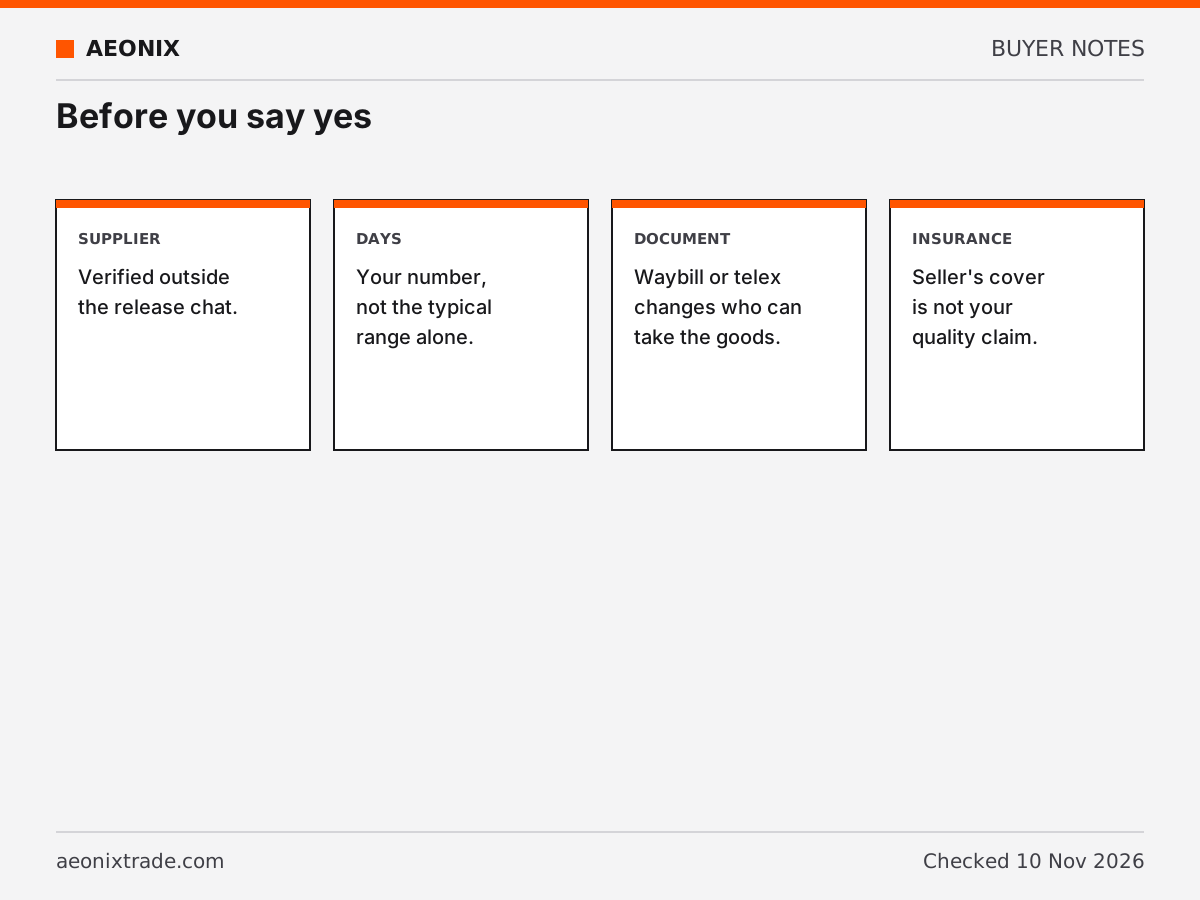
- You have verified the supplier, on the page that is about verification, not in the same chat that asked for the release.
- The number of days is a number you wrote down. The ITA "typically 30, 60 or 90" is their description, not your term.
- The document type still matches the payment. A waybill or a telex changes who can take the goods. Read those pages before you agree.
- You are not calling it D/P. D/P keeps the documents at the bank until payment.
- You know the seller's export-credit insurance, if they mention one, does not insure your quality dispute.
Is open account the same as T/T?
T/T is a way to move the money. Open account is when the money is allowed to move after the goods have gone. You can pay an open-account balance by T/T. You can also pay a deposit by T/T and not be on open account at all.
Should a first order be open account?
The ITA page calls it one of the highest-risk options for the exporter, because the exporter ships before being paid. Agreeing means you are asking that supplier to release the goods and wait. On a first order, verify the supplier, and leave the originals in the seller's hands until the balance clears. This page does not announce an industry standard either way.
Write the due rule you actually want on the RFQ, next to the document type. A note that says "OA, as usual" is how the month becomes whatever the other side prefers. If the price is FOB and the payment is separate, the term page is FOB China.
The payment path next to this one is How to Pay Chinese Suppliers Safely, Alipay, WeChat, Wise, and a bank transfer, paying at a Yiwu booth versus by T/T, and T/T, a letter of credit, and documents against payment.
Official sources
- International Trade Administration, Methods of Payment, read 10 November 2026. Open account is goods shipped and delivered before payment is due, "typically in 30, 60 or 90 days" in their words. Export credit insurance is mentioned. No premium is stated.
- Berne Union, the association for the export credit and investment insurance industry. Their members cover payment risk for exporters and banks. No figure from that site is repeated here.
- GOV.UK, UK Export Finance, the UK official export credit agency, as an example of the seller-side institution. Not a buyer fee.
Submit sourcing request
Can't find what you need?
Start with a product or image link, an approximate quantity and destination. Other details can follow.