Proforma vs Commercial Invoice vs Packing List: Which Document, When
Published by Aeonix Trade.
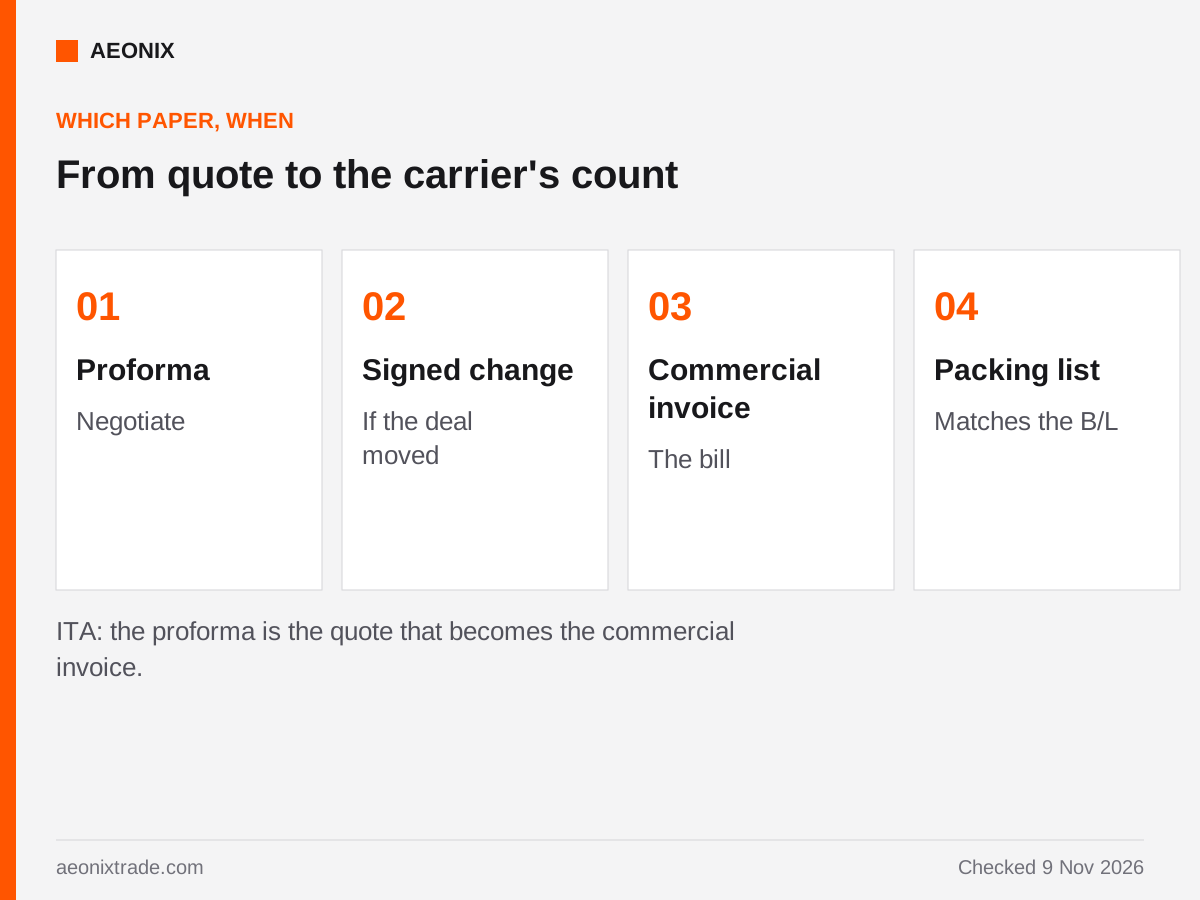
The proforma is the quote you negotiate. The commercial invoice is the bill customs reads. The packing list is the map of the cartons. They are three documents, and they have to agree.
Last fact-checked: 9 November 2026.
The International Trade Administration describes the proforma as a negotiating paper the seller uses to quote before the goods ship. It carries a description, quantity, price and weight, and it is the seller's statement that they will supply at a stated date and price. That quote is what later becomes the commercial invoice the importing customs authority sees. The commercial invoice is the bill between seller and buyer, and governments that rely on it often specify the form, the content, the copies and the language. The packing list is the physical list: seller, buyer, invoice number, shipment date, mode, carrier, package type, package count, and net and gross weight.
Use each one at its own moment. Do not ship on the proforma after the price has changed, and do not ask a warehouse to find carton 14 on a commercial invoice that never counted cartons.
Which document, and when
| Document | When it exists | What it is for | What a mismatch does |
|---|---|---|---|
| Proforma invoice | Before the order is fixed, and often again for a sample or a letter of credit draft | Agree the goods, the price, the Incoterm and the payment trigger | Production starts on a price or a spec you later changed in email |
| Commercial invoice | When the goods are sold and shipped | The bill. Customs uses it for value, description and origin | The entry is filed on a number you did not pay, or on a one-word description |
| Packing list | With the booking and again at the warehouse | Carton count, marks, weights, what is in which box | The bill of lading, the inspection and the warehouse count three different totals |
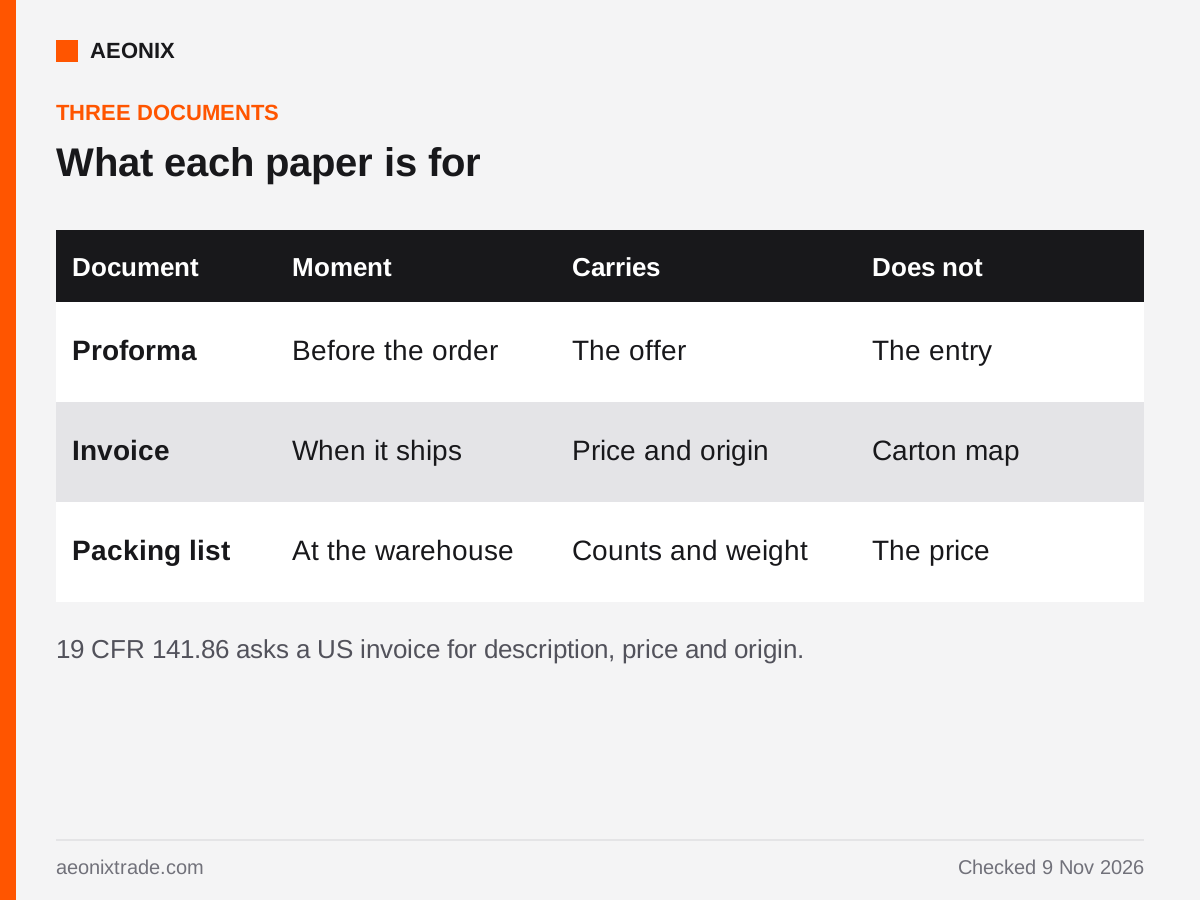
The bill of lading is the carrier's paper, not a fourth invoice. Carton counts and weights on the packing list have to be the counts and weights on the bill of lading. The price does not belong on the packing list, and the carton map does not belong only inside a salesperson's spreadsheet.
A typical case
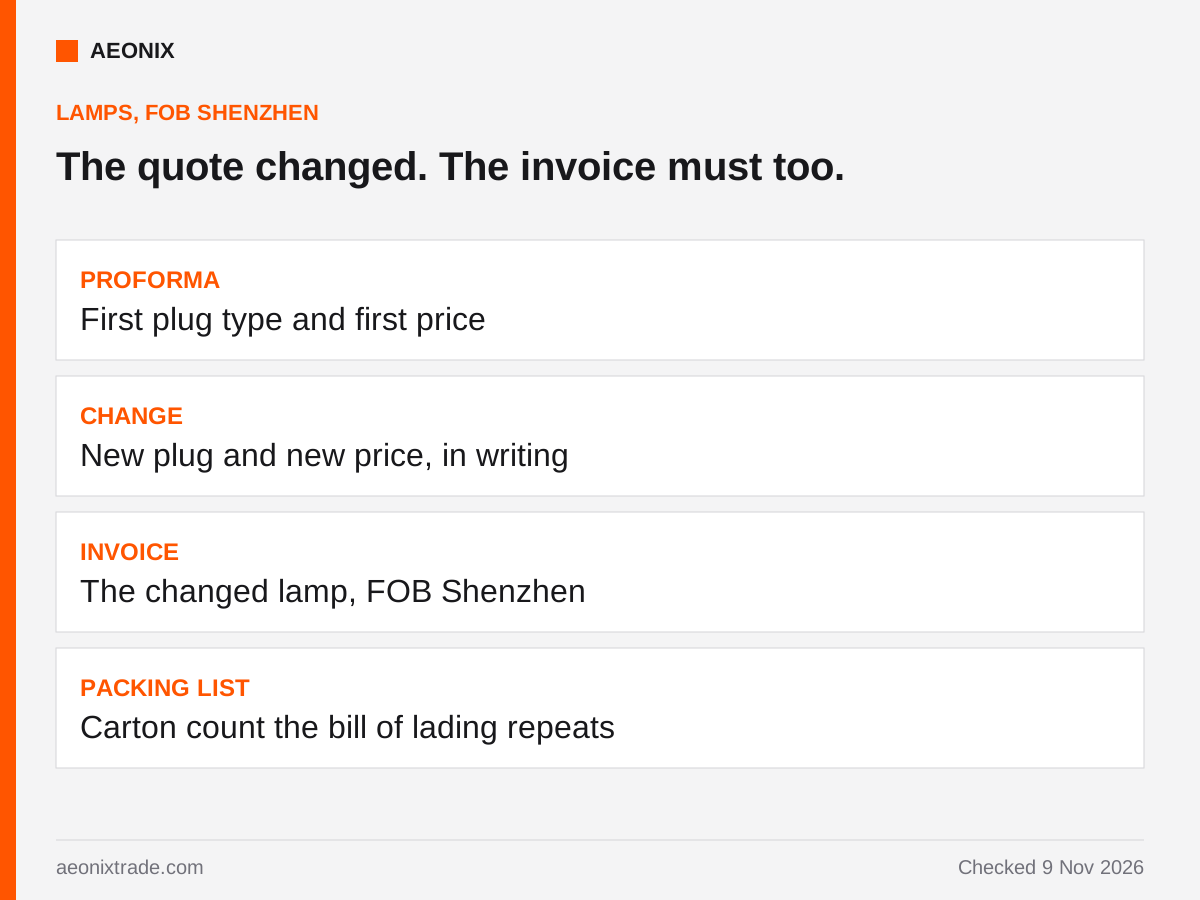
A buyer of LED desk lamps agrees a spec and an FOB Shenzhen price on a proforma. The proforma is the negotiation. It is not the paper the broker will file when the lamps leave. Weeks later the parties agree a small change to the plug type and a different unit price, in writing. The commercial invoice has to carry the changed lamp and the changed price, FOB Shenzhen, with a description a broker can classify: desk lamp, material, voltage, quantity. "LED items" is how the entry stalls. The Harmonized System is how the product is grouped. The destination tariff, not the proforma, is where the duty line is read.
The packing list for the same shipment counts cartons, says which lamp is in which carton, and gives net and gross weight. Those counts are what the consolidation warehouse tallies and what the bill of lading should repeat. If two suppliers share the shipment, each supplier's goods stay on their own invoice lines and their own carton marks. One blended "lamps" line is how a shortage becomes nobody's shortage.
What a US entry expects on the invoice
For cargo entering the United States, 19 CFR 141.86 is the invoice-contents rule. The eCFR text, read 9 November 2026, asks for a detailed description, including the trade name, grade or quality, and the marks and numbers of the packages. It asks for the purchase price of each item in the currency of the purchase, and for the country of origin. It also says every discount from list or other base price that was allowed in fixing the price has to be set out. Match the PDF to the current section before the broker files. If a figure you care about is not in the section, put it on an attachment the broker can see, rather than hoping a proforma column will be read as the invoice.
The price on that invoice is the starting point for a US customs value, not the whole of it. 19 CFR 152.103 says transaction value is the price actually paid or payable when the goods are sold for export to the United States, plus amounts that are not already in that price: packing costs the buyer incurred, a selling commission, the value of an assist, a royalty or license fee the buyer must pay as a condition of that export sale, and proceeds of a later resale, disposal, or use that accrue to the seller. An assist includes materials the buyer supplied, and tools, dies, and molds. Add them only when there is enough information to quantify them. If there is not, transaction value cannot be determined and another method applies. A mold you gave the factory and paid outside the invoice still belongs in the value. Leaving it off is how an entry gets undervalued. The WTO customs valuation agreement is aimed at a system that follows commercial reality and rules out arbitrary or fictitious values. The WCO describes customs value as the basis for ad valorem duties. The Incoterm on the invoice has to be the Incoterm in the contract. An FOB contract invoiced as CIF, or the reverse, changes what is inside the price the broker declares. How the rule and the documents sit together is on Incoterms and shipping documents.
Before the goods move
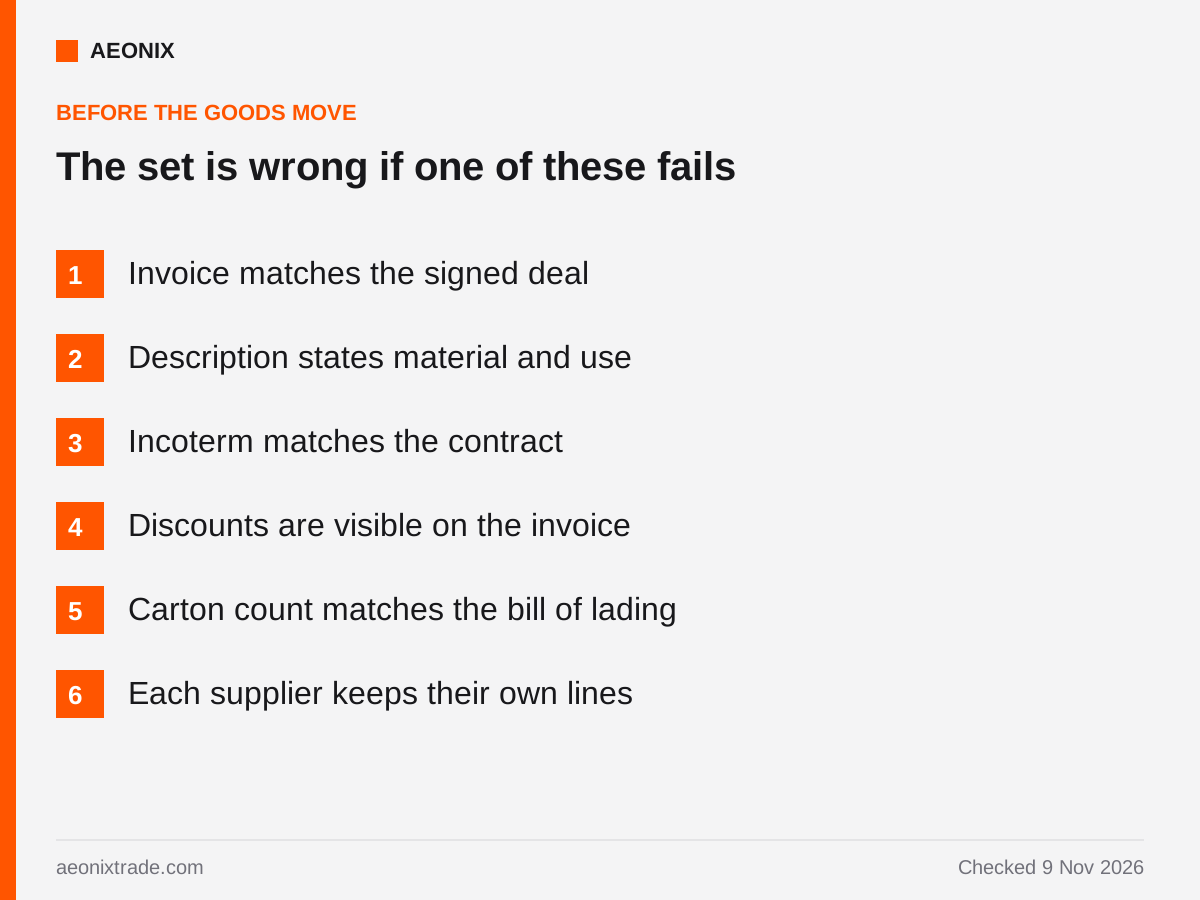
- The commercial invoice matches the signed deal, including any change agreed after the proforma.
- The description names material and function, not a marketplace title.
- The Incoterm and the named place are the same on the invoice and the contract.
- Discounts that changed the price are visible, not buried in a chat.
- For a US entry, packing the buyer paid, selling commissions, assists such as molds or materials, royalties tied to the export sale, and resale proceeds that go back to the seller are on the value if they are not already in the invoice price.
- The packing list carton count, marks and weights match the bill of lading.
- Goods from more than one supplier are not blended into a single line.
The amount on the commercial invoice should also be the amount you paid. How that payment was released is on paying the supplier. If the papers will be filed at arrival, the sequence is on customs clearance. Send the description, the Incoterm and the payment trigger with the RFQ.
Where the set of documents goes wrong
The first miss is shipping on the proforma. The plug changed, the price changed, and the invoice still shows the first quote. Customs is then asked to assess a transaction that is not the one you paid. Fix the invoice before the goods leave, not in a post-entry apology.
The second miss is a packing list that does not match the bill of lading. The warehouse counted 140 cartons. The bill of lading says 128. Someone will be looking for the other twelve while storage time runs. Count at the consolidation warehouse and correct the list before the carrier closes the document.
The third miss is one commercial invoice for a consolidation from several suppliers, with no line per supplier and no carton marks. A shortage, a quality claim, or a classification question then has no owner. Split the lines even when the freight is one shipment.
Frequently asked questions
What is the difference between a proforma invoice and a commercial invoice?
The proforma is the seller's quote before shipment, used to negotiate. The commercial invoice is the bill for the goods sold, and it is a document customs uses for the entry. The International Trade Administration treats the proforma as the paper that becomes that final invoice once the deal is real. If the deal changed, the invoice has to change with it.
What is the difference between a packing list and a commercial invoice?
The invoice states the sale: who sold, what, at what price, on what Incoterm. The packing list states the cartons: counts, marks, package type, net and gross weight. Customs and the warehouse use the list to tally. They use the invoice for value.
Can customs clear goods on a proforma?
Some shipments are presented that way. Do not plan a commercial entry on a quote that is no longer the deal. The document the broker needs is the commercial invoice for the goods actually shipped, with the contents the destination rule requires. For a US entry, start with 19 CFR 141.86 and read the current section.
Does the packing list need prices?
No. Price belongs on the invoice. The packing list needs the physical facts the carrier and the warehouse will check against the freight document.
Which document sets the customs value?
The commercial invoice is where the price starts. For a US entry, 19 CFR 152.103 adds packing the buyer paid, selling commissions, assists, certain royalties, and resale proceeds that accrue to the seller, when those amounts are not already in the price and can be quantified. If they cannot, transaction value is not available and another method applies. The destination authority assesses the value. This page does not state a rate.
Sources
- International Trade Administration: Common export documents. Proforma as the pre-shipment quote, commercial invoice as the customs bill, packing list as the carton-level record.
- eCFR: 19 CFR 141.86. Invoice contents for a US entry, including description, package marks, purchase price and discounts. Read 9 November 2026.
- eCFR: 19 CFR 152.103. Transaction value starts at the price paid or payable and adds packing, selling commissions, assists, certain royalties, and resale proceeds when they are not already included. Checked 10 November 2026.
- WTO: Customs valuation. Valuation that follows commercial reality and rejects arbitrary or fictitious values.
- WCO: What is customs valuation?. Customs value as the basis for ad valorem duties.
Submit sourcing request
Can't find what you need?
Start with a product or image link, an approximate quantity and destination. Other details can follow.