FOB vs CIF: The Difference for Importers and When Each Costs Less
Published by Aeonix Trade.
Last fact-checked: 9 November 2026.
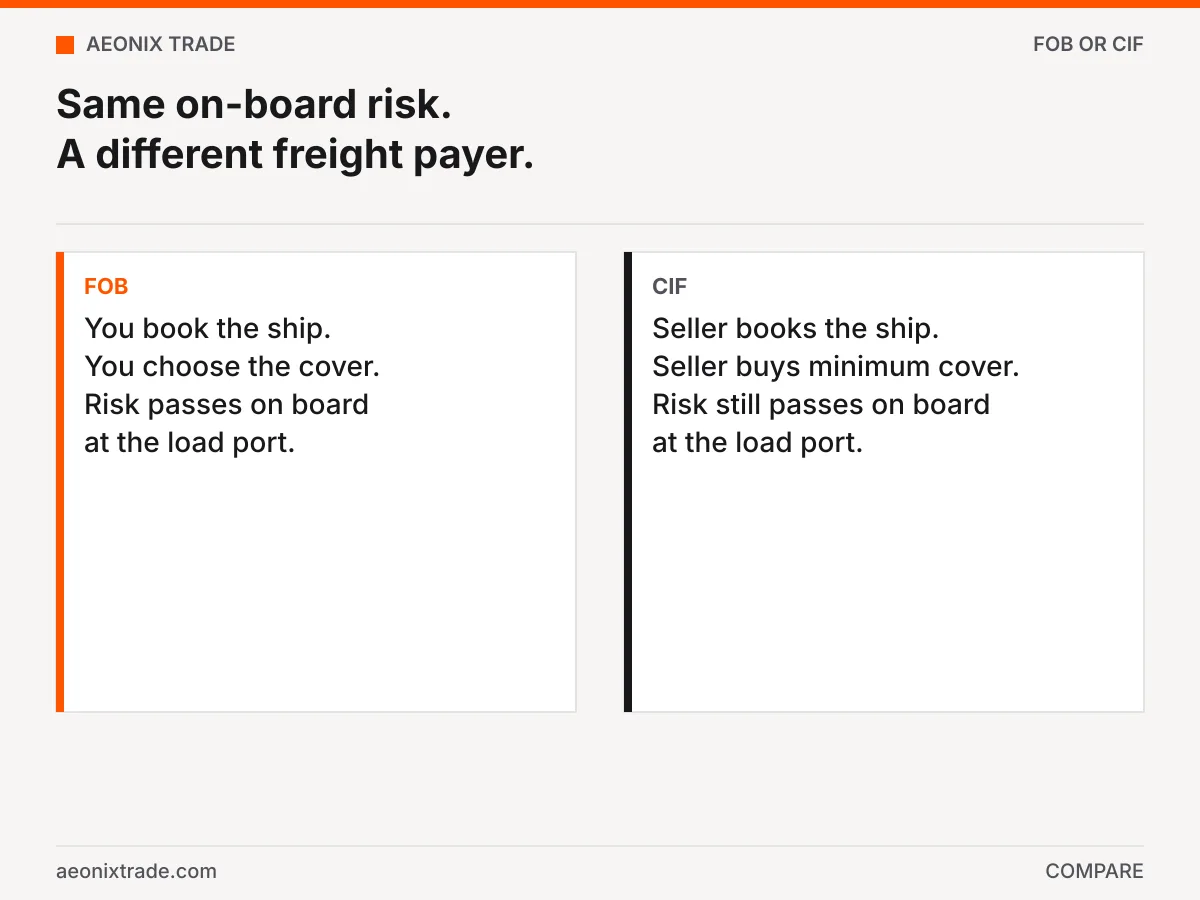
FOB vs CIF is who pays the ocean freight and the insurance. Risk passes on board at the load port under both. CIF vs FOB is the same comparison, typed the other way.
FOB means you book the ship. CIF means the seller's price includes the freight to the named port of destination, plus a minimum insurance cover. CIF versus FOB is not a choice about when the goods become your problem on the water. The ICC Incoterms 2020 checklist calls CIF a shipment contract. Delivery happens in the seller's country. You accept the transport risk. The named port after CIF is where the freight aims, not where risk passes.
The rule pages are FOB and CIF. This page is when each one costs less, once the quotes are the same shipment. No freight rate belongs here. A rate without the lane, the week, and the carrier's tariff is a number you cannot check.
A typical case
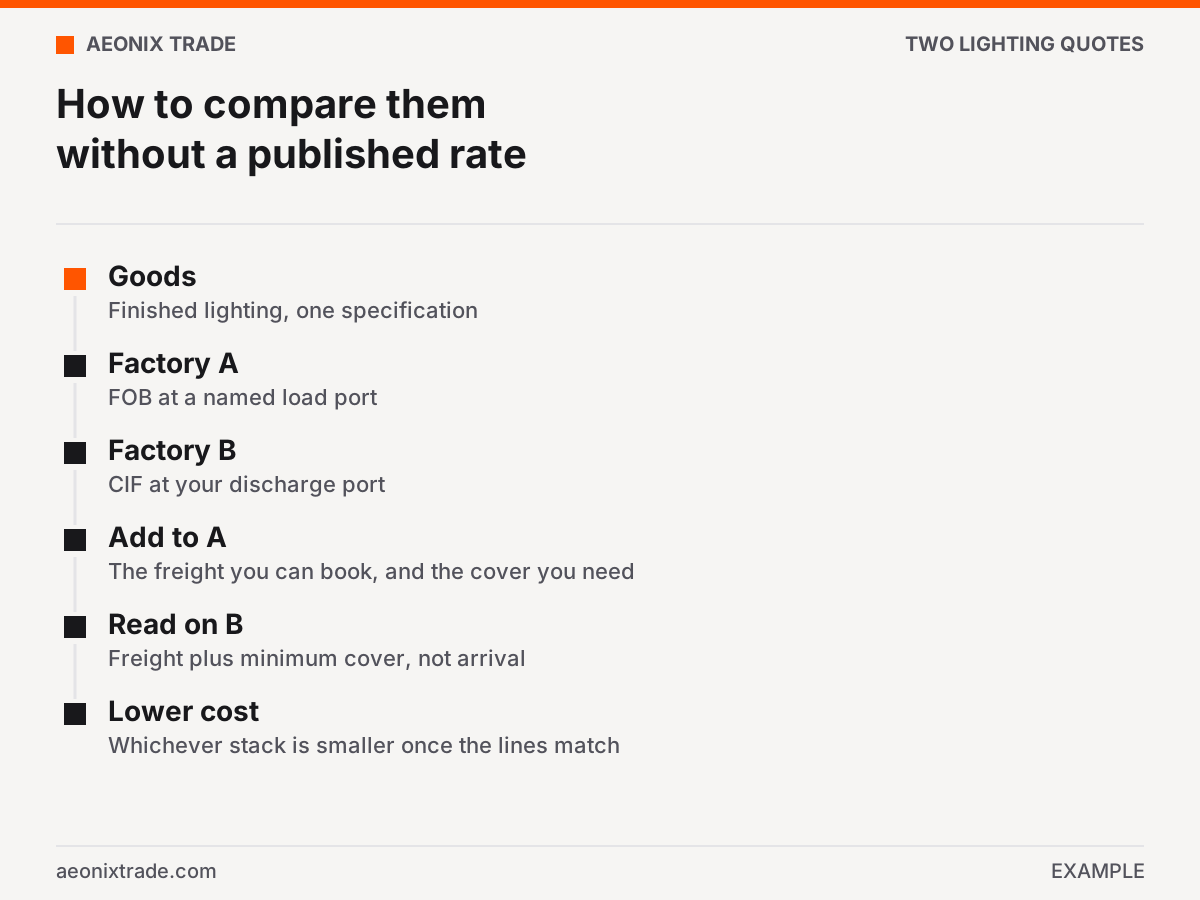
Two factories quote the same finished lighting, same specification, same cartons. Factory A writes FOB and names the load port. Factory B writes CIF and names your discharge port. Factory B's unit price is higher. The buyer wants to know whether that gap is smaller than the freight and insurance they would buy themselves.
The honest comparison adds, to Factory A's price, the ocean freight the buyer can actually book that week and the insurance cover the buyer actually needs. It reads Factory B's price as freight plus the minimum cover the rule requires, not as delivery at the discharge port. Import clearance and duty go on both sides, because CIF does not remove them. Destination unloading does not travel with them. The ICC Academy's note on the C rules puts unloading at the named port on the seller only when the contract of carriage already says that charge is the seller's. If the freight includes it, leave it off the buyer's stack. If the freight does not, it is still yours. Whichever stack is smaller, on the same cover, is the one that costs less. If the buyer needs broader cover than CIF's default, that extra premium sits on the CIF side too, or the rule should have been CIP.
What does not change
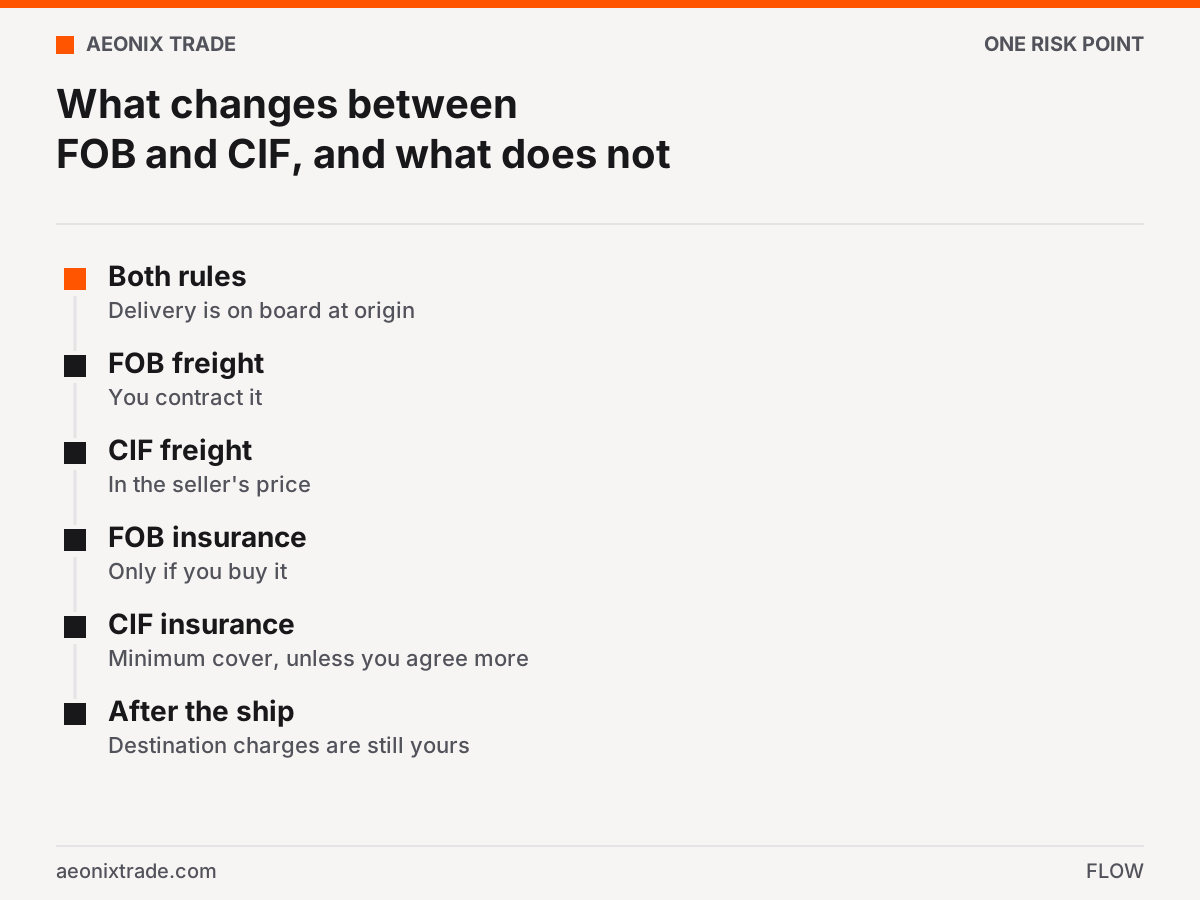
Both rules are in the sea and inland-waterway group. The International Trade Administration lists FOB as Free on Board at a named port of loading, and CIF as Cost Insurance and Freight at a named port of destination. The checklist uses them when the goods are lifted on board, or when you specifically want the split once the goods are on board.
Export clearance is the seller's on both. Import clearance is yours on both. The ICC Incoterms 2020 page says CIF keeps Institute Cargo Clauses (C) as the default, and the parties may agree a higher cover. FOB has no insurance obligation in the rule. If you want cargo insurance under FOB, you buy it. Under CIF the seller buys the minimum, unless the contract says more.
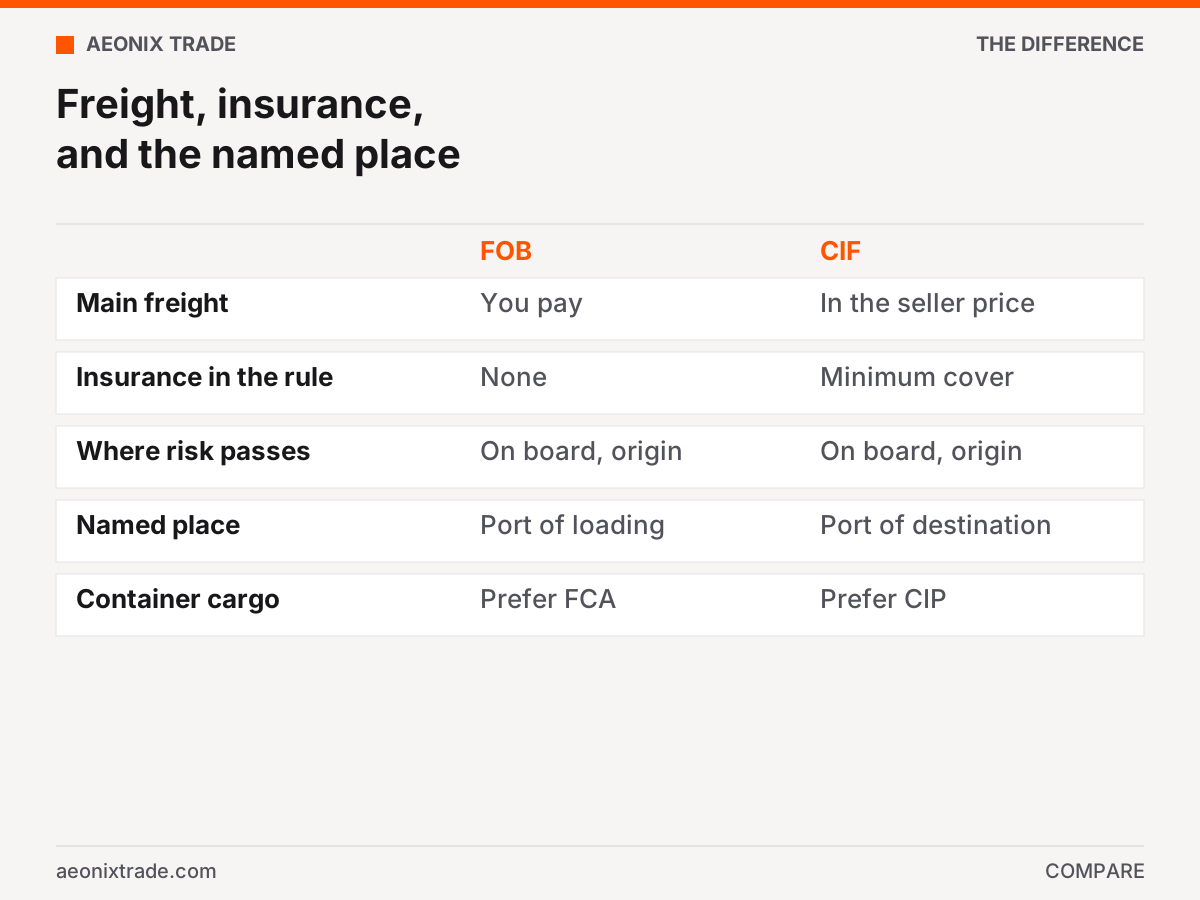
| FOB | CIF | |
|---|---|---|
| Named place | Port of loading. That is where delivery is. | Port of destination. That is where the seller's freight aims. Delivery is still on board at origin. |
| Main freight | You contract it. | In the seller's price. |
| Insurance in the rule | None. | Minimum cover. Institute Cargo Clauses (C), or LMA/IUA Clauses C or similar, in the checklist's words. Agree more in writing if you need it. |
| Where risk passes | On board at the load port. | On board at the load port. |
| Who chooses the ship | You, or your forwarder. | The seller. |
| Import clearance and duty | Yours. | Yours. CIF is not an arrival rule and not a duty-paid rule. |
| Unloading at the destination port | Yours, unless the freight you booked already includes it. | The seller's only when the carriage contract says so. Otherwise yours. Do not add a charge the freight already paid. |
When FOB costs less, and when CIF does
FOB costs less when you can book the freight, and the cover you need, for less than the gap between the two unit prices, after import clearance and duty are on both quotes and unloading is counted only where the carriage contract left it unpaid. That happens when your forwarder has the better sailing, or when the seller's CIF number has a freight leg you would not have chosen.
CIF costs less when the seller's freight-plus-minimum-cover is smaller than the freight and cover you can buy, and you are willing to accept that minimum cover or you have agreed a higher one inside the price. It does not cost less merely because one email looks simpler. A CIF quote that excludes destination handling, while your FOB quote was built door to door by your forwarder, is not the same shipment.
The ICC checklist's economic point is to give the transport to the party who can buy it more efficiently. Run that test on the written quotes for this cargo and this week. Do not borrow a rate from a blog, and do not treat last quarter's gap as this week's gap. If you want the line-by-line shape of a freight quote, without a published figure, see how an LCL quote from China is built. The same discipline applies to a full container.
The container problem, which decides the rule before the price
Most cargo out of a Chinese port is a container handed to a terminal. The seller is not lifting it on board. The checklist tells you to choose FCA, not FOB, when you are buying the freight on that pattern, and CIP or CPT, not CIF or CFR, when the seller is paying the freight and the cargo is containerised. CIP is the any-mode rule that requires the broader cover, Institute Cargo Clauses (A) or similar. CIF's minimum is the wrong default if what you wanted was that broader cover on a box.
If both factories will only type FOB and CIF, ask them to restate the container as FCA and CIP on the same specification, and price those. Comparing two sea-only rules on a box the terminal loads keeps an on-board risk point on a handover that happened earlier, in the yard. FCA is the buyer's freight version of that restatement.
Where importers misread the gap
- Thinking CIF means the seller carries risk until your port. They carry the freight bill. Risk passed on board at origin. A claim for loss on the water goes to the insurance, at the level that was bought, which under an untouched CIF is the minimum.
- Comparing a CIF unit price with an FOB unit price and ignoring who chose the vessel. Under CIF you did not choose the sailing. A cheaper CIF number on a slower or less direct ship is not cheaper once you price the extra days and the cover.
- Forgetting that neither rule touches payment or title. The International Trade Administration lists both gaps. "CIF, pay by T/T against copy B/L" can still leave you without the originals. The payment comparison is T/T versus a letter of credit versus D/P.
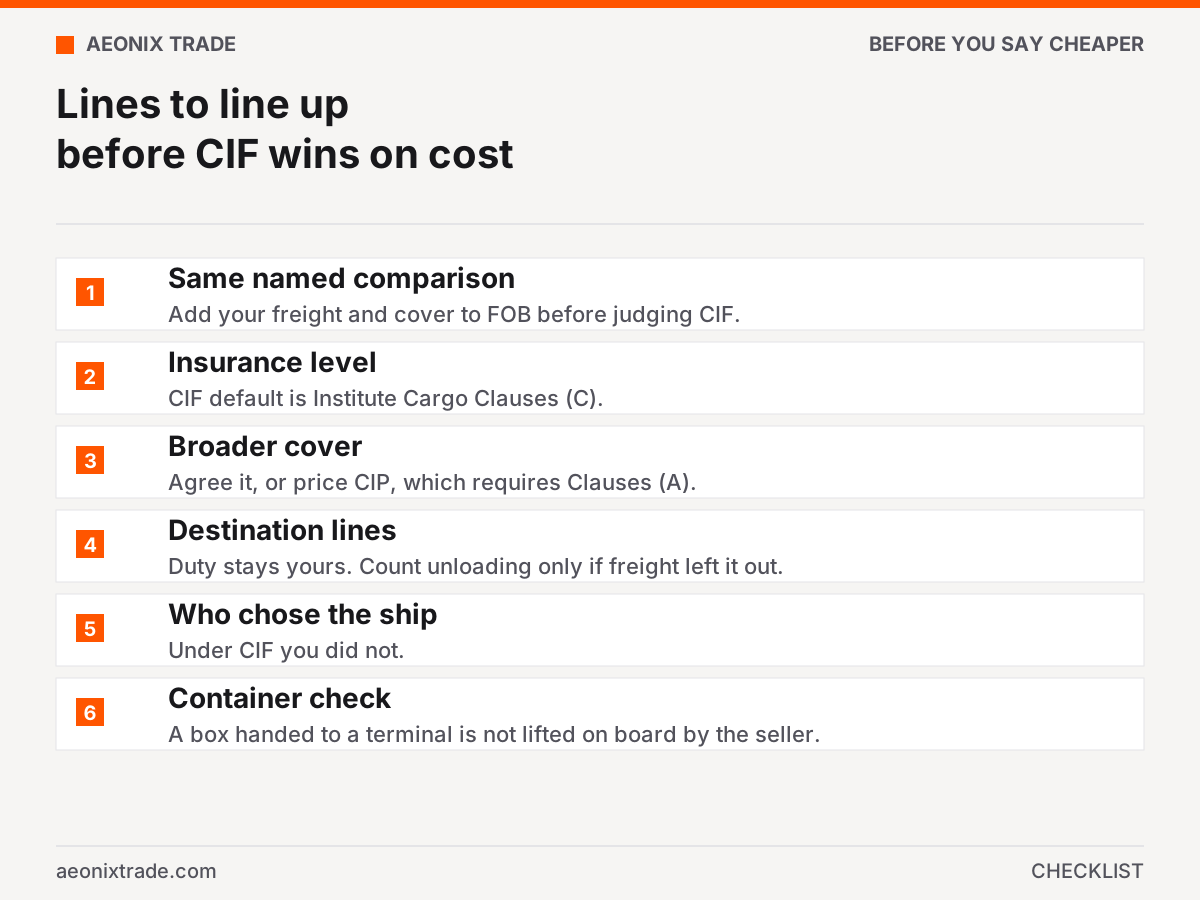
Lines to line up before you say which is cheaper
- Same specification, same cartons, same Incoterms edition.
- Your freight quote added to FOB, dated, for the sailing you would book.
- The insurance level. CIF default is Clauses (C). Write the higher cover in, or move the container to CIP.
- Import clearance and duty on both sides. Unloading at the destination port only where the carriage contract has not already included it. Delivery after the port is yours under both. Duty comes from the official tariff, not from the CIF price.
- Who controls the booking. If the sailing matters, FOB or FCA keeps it with you.
- A container check before you stay on FOB and CIF at all.
Ask for both stacks on one RFQ. If the supplier sells FOB as the only language they will type, the restatement still belongs in the same email. How the families sit around these two rules is which Incoterm to use when importing from China.
Frequently asked questions
What is the difference between FOB and CIF?
Under FOB you contract the main freight and you insure only if you choose to. Under CIF the seller's price includes freight to the named destination port and a minimum insurance cover. Risk passes on board at the load port under both. CIF does not mean the seller delivers to your port.
When does CIF cost less than FOB?
When the seller's freight plus the cover in that price is smaller than the freight and the cover you would buy, after import clearance and duty are on both quotes and any unloading the carriage contract left out is counted once. If you need more than the minimum cover, add that premium to the CIF side or agree it inside the contract. There is no standing gap this page can quote.
Does CIF include duty and delivery to my warehouse?
No. Import clearance and duties are the buyer's on a C rule. Delivery to a named place in your country, with the seller carrying risk that far, is DAP, DPU, or DDP. Those are different rules.
Should a container still be quoted FOB or CIF?
The ICC checklist points container cargo to FCA when you buy the freight, and to CPT or CIP when the seller pays it and insurance is or is not in the price. CIP, not CIF, is the rule that defaults to the broader cover.
Who pays for insurance under FOB versus CIF?
You do, under FOB, if you want it. The seller does, under CIF, at Institute Cargo Clauses (C) unless you agree a higher level. The ICC page and the checklist say the same thing in those words.
The paperwork next to this choice is 20-foot, 40-foot, and high-cube containers, a bonded warehouse, cargo insurance, and a customs broker versus a forwarder.
Sources
- ICC: Incoterms 2020. CIF keeps Institute Cargo Clauses (C) as the default. CIP requires Clauses (A) or similar. Checked 9 November 2026.
- ICC Academy: C rules and D rules, Incoterms 2020. On every C rule the seller pays unloading at the named port only when the contract of carriage says that charge is the seller's. Import formalities stay with the buyer. Checked 10 November 2026.
- ICC: Incoterms 2020 checklist. CIF as an on-board shipment contract with minimum cover, and CIP for containerised cargo when the seller insures at the broader level.
- U.S. International Trade Administration: Know Your Incoterms. FOB and CIF in the sea and inland-waterway group, and the list of what Incoterms do not decide.
Submit sourcing request
Can't find what you need?
Start with a product or image link, an approximate quantity and destination. Other details can follow.