LCL Shipping Cost from China: How a Quote Is Built Line by Line
Published by Aeonix Trade.
Last fact-checked: 9 November 2026.
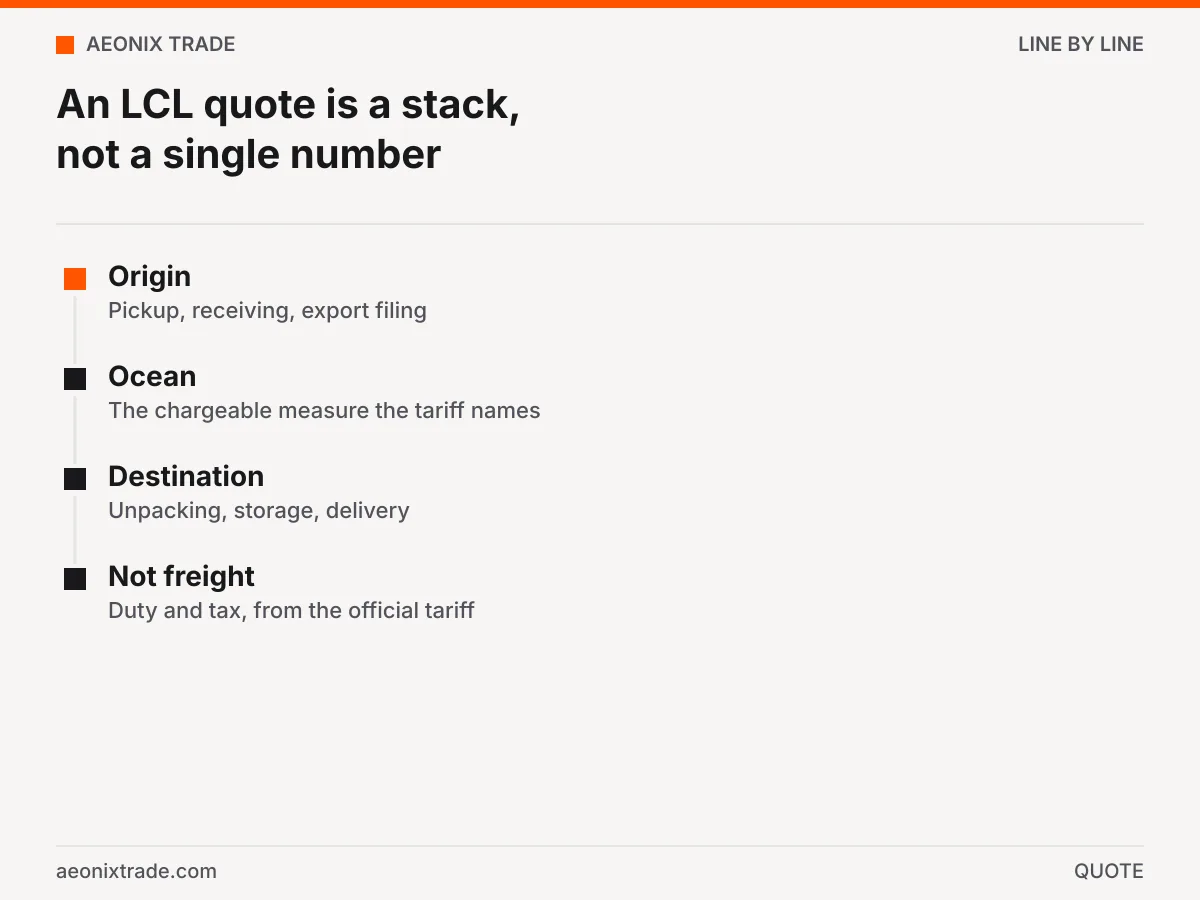
LCL shipping cost from China is a stack of lines, not a single ocean number. A quote you can use names each line, the measure it uses, and the date it was issued.
People searching for an LCL freight rate, or for how much LCL shipping from China costs, usually want a figure they can drop into a margin. This page will not give one. A rate without the lane, the week, the chargeable measure, and the lines it excludes is not a rate you can check later. The Federal Maritime Commission requires an NVOCC in U.S. trades to publish a tariff of all rates, charges, classifications, rules, and practices on its routes. That tariff, and the quote that cites it, is where a U.S.-bound number lives. For any other destination, ask the forwarder for the schedule that names each charge. Do not take the number from an article.
What LCL is, as a booking, is on LCL meaning. When the share stops beating a full box is on FCL versus LCL. This page is how to read the quote before you compare two of them.
A typical case
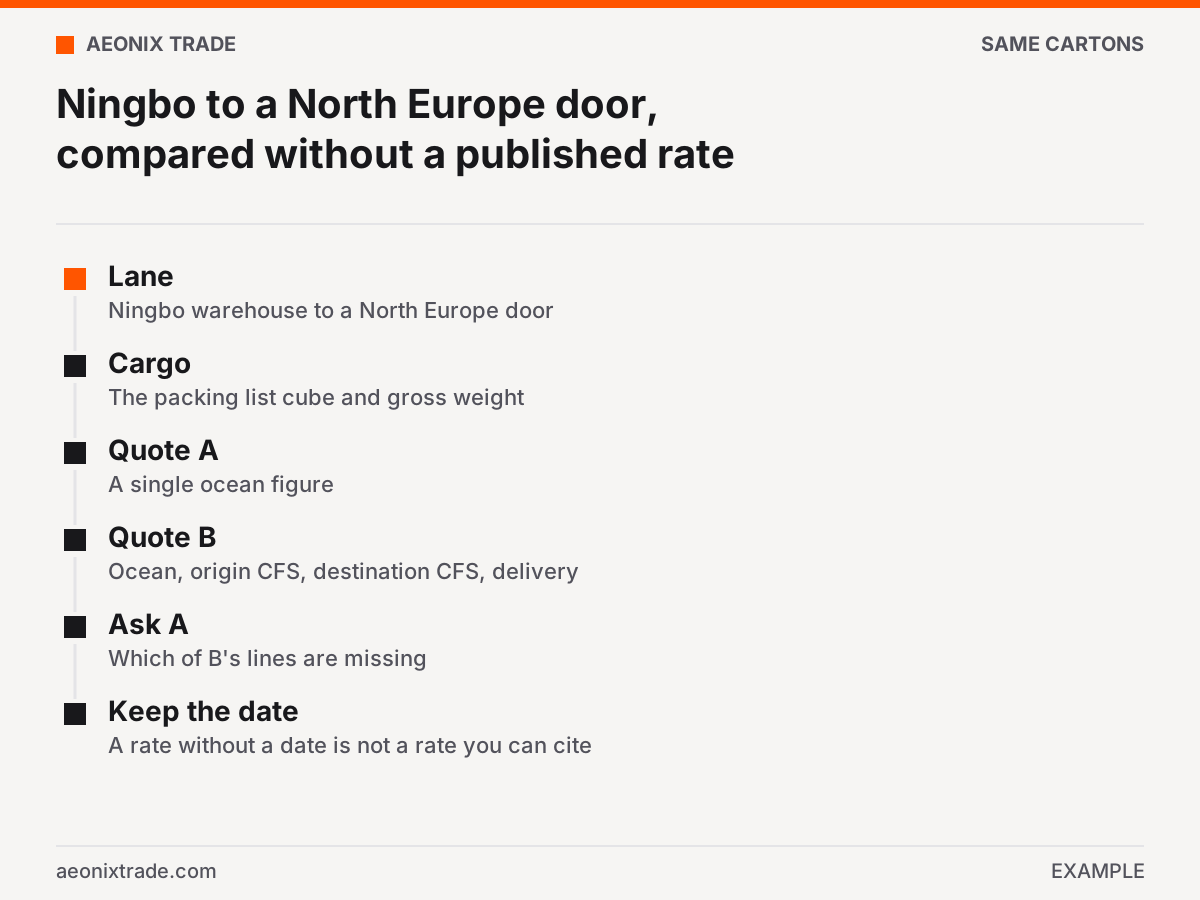
The same cartons are ready at a Ningbo warehouse, booked toward a door in northern Europe. Quote A is one ocean figure. Quote B is higher and lists origin receiving, the ocean line, destination unpacking, and delivery. The buyer is about to accept A.
A is not cheaper until someone writes the lines B showed and marks them included or excluded. If A's ocean figure excludes destination unpacking and the delivery truck, the all-in can cross above B on the day the cartons are pulled from the shared box. Keep the date on both. Next week's tariff is a different quote.
The three groups on a usable quote
Think of the move as three places where someone does work, plus the charges that are not freight at all.
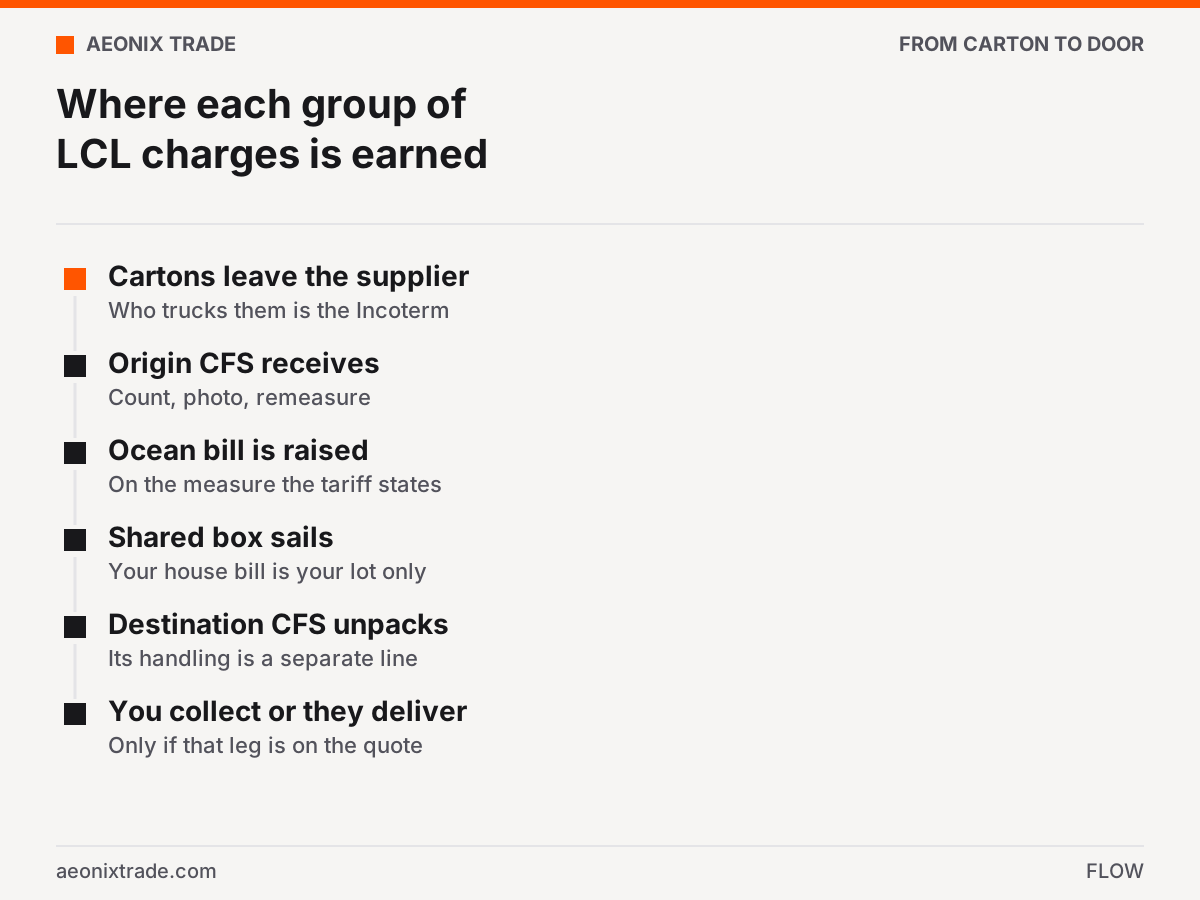
Origin is the truck into the warehouse, receiving, and the export filing. Who pays the truck is the Incoterm, not the booking. The ICC Incoterms 2020 checklist treats EXW as goods at the seller's premises, not cleared for export, and FCA as delivery to the carrier you name, with export clearance on the seller. If the proforma says FCA at the named CFS, the supplier's job includes getting the cartons there. If it says EXW at a market booth, it does not. A shared box packed at a warehouse is not an on-board FOB handover. Settle the term before storage is billed to the wrong side. The buyer's path through the rules is which Incoterm to use.
Ocean is the line people mean by an LCL freight rate. It should say the chargeable measure. Forwarders often compare volume with weight and rate on the greater one, and the minimum, the rounding, and the divisor are whatever that tariff says. The worked comparison, including the convention you still have to confirm in writing, is on the CBM page. Ask for the rule on this quote. A line that only names a currency per cubic metre, with no minimum and no weight comparison, is not finished.
Destination is unpacking at the warehouse named on the house bill, storage if you pass the free time on the arrival notice, and the truck after that. The FMC's demurrage and detention page is about the box on a marine terminal and the equipment, in the trades it covers. Your LCL cartons are often out of that box before you see them. The warehouse clock is the one on the arrival notice. Read it as its own schedule.
Duty and tax are not lines in the freight quote. They follow the product, the classification, and the customs value in the country of import. Add them when you calculate landed cost, from a current official tariff. The calculator that keeps those buckets separate is the landed cost calculator. This article states no duty rate.
Why two quotes for the same cartons disagree
| Line | What to make the quote say | Why it changes the comparison |
|---|---|---|
| Origin pickup | Included, or excluded, and from which address. | A market booth and a port warehouse are not the same truck. |
| Origin CFS receiving | Named, including any minimum. | A small lot can be priced on the minimum, not on the cube. |
| Export declaration | Whose job, matching the Incoterm. | Left unnamed, it appears as a surprise invoice in China. |
| Ocean freight | The measure, the minimum, and the date. | This is the line people compare, and it is not the all-in. |
| Documentation and the house bill | Included or priced. | A missing bill fee is small. A bill in the wrong consignee name is not. |
| Destination unpacking | Named. | Often the line that makes the lower ocean number the higher shipment. |
| Delivery after unpacking | To a named door, or collected by you. | A different truck from the ship. |
| Storage past free time | The free time and the unit, from the arrival terms. | You cannot see it on the sailing quote. Ask for the rule before you book. |
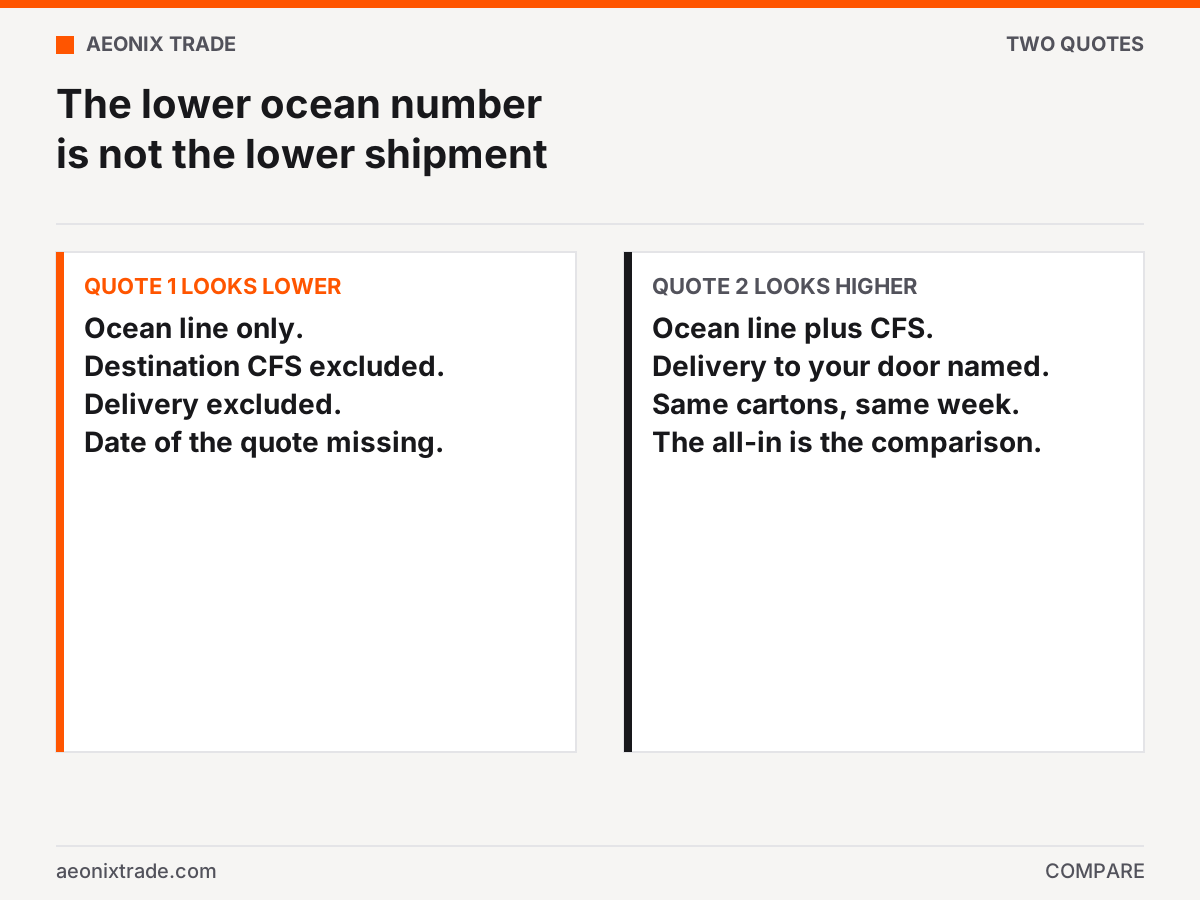
For a shipment into the United States, set the quote next to the NVOCC's published tariff. The FMC says that tariff must be open for public inspection and must show the rates and charges on the route. If a line on your invoice is not in the quote and not in that tariff, ask before you pay it. Outside U.S. trades the same habit still works: every charge on the arrival invoice should trace to a line you accepted, or to a rule you were shown, on a dated sheet. Shipping rates is the page for how to read that sheet. It is not a price list.
Where the cost goes wrong
- Accepting "LCL shipping from China cost" as one number in a chat message. Without the measure, the minimum, the destination CFS, and the date, you cannot tell it from a different shipment.
- Paying the supplier's balance before the warehouse confirms the cube and the weight it will rate. A remeasure changes the ocean line. The packing list you sent is the document you can argue from. A guess is not.
- Leaving several suppliers on one quote without a receiving plan. Each extra city is a pickup. Each missed cutoff is another week. That job is consolidating multiple suppliers into one shipment.
What to demand before you compare
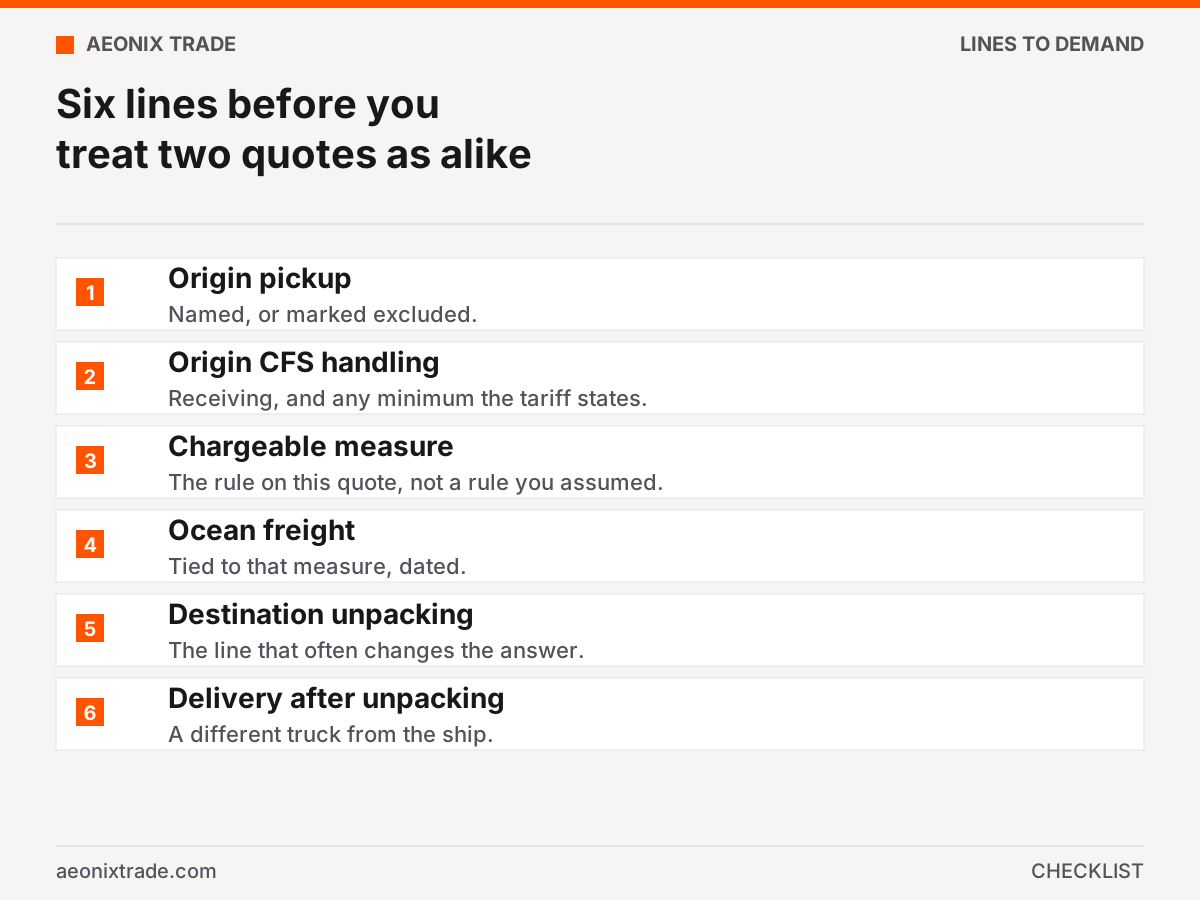
- Origin pickup: included or excluded, and the address.
- Origin CFS handling, and any minimum the tariff states.
- The chargeable-measure rule on this quote, not a rule you assumed.
- The ocean line, tied to that measure, with the date.
- Destination unpacking, named.
- Delivery after unpacking, to a door or as a collection.
- The free-time rule you will be held to, even if the amount is not known until arrival.
Send cube, gross weight, the supplier city, and the destination door on an RFQ if you want two forwarders to build the stack on the same cargo. Ask each of them which lines the other might have left off. The booking path, once the stack is one you accept, is LCL shipping from China.
Frequently asked questions
How much is LCL shipping from China?
It is the all-in of the lines above for your cube, your weight, your lane, and the week the quote was issued. This page does not state a figure. Ask for the stack in writing, and for a U.S.-bound NVOCC shipment check it against the published tariff.
What is an LCL freight rate?
Usually the ocean line, priced on the chargeable measure the tariff names, often with a minimum. It is not origin receiving, not destination unpacking, and not duty. Compare all-in quotes, not that one line.
Why is the arrival bill higher than the rate I accepted?
Because the rate you accepted was missing a line, or the warehouse remeasured, or free time ran out. Match the arrival invoice to the quote line by line. A line with no parent in the quote is the one to question before you pay.
Does a lower quote mean a lower landed cost?
Only after duty, tax, and the destination lines are in both totals. Freight is one bucket. The official tariff for the product is another. Keep them separate.
Who issues the bill I need at destination?
On LCL, your document is the house bill. The FMC describes an NVOCC as the carrier that issues that house bill and does not operate the ship. Release follows the house bill and the arrival notice, not the master bill for the full container.
Sources
- Federal Maritime Commission: Ocean transportation intermediaries. An NVOCC in U.S. trades publishes a tariff showing rates, charges, classifications, rules, and practices, open for public inspection. Checked 9 November 2026.
- Federal Maritime Commission: Detention and demurrage. Terminal free time and equipment free time, which are not the same clock as an LCL warehouse.
- ICC: Incoterms 2020 checklist. EXW and FCA, which decide who trucks cartons to the origin warehouse.
- World Shipping Council: How container shipping works. Shared cargo in one sealed container, separated again after arrival.
Submit sourcing request
Can't find what you need?
Start with a product or image link, an approximate quantity and destination. Other details can follow.