CBM Meaning in Shipping: Formula, Worked Examples and Freight Rating

Mike Liu contributes to AeonixTrade's buyer-education library by researching trade terminology, checking source references, and turning shipping, logistics, and quality-control concepts into practical examples.
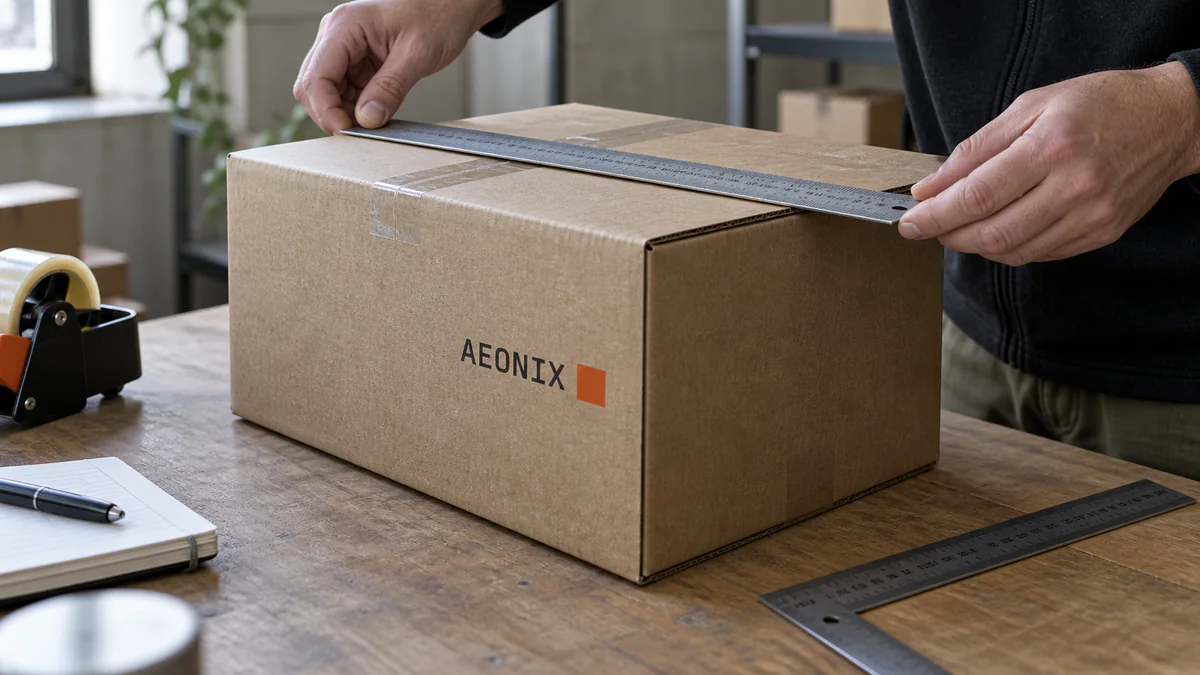
CBM means cubic metre, a unit of volume equal to one metre × one metre × one metre. In shipping, CBM is used to describe how much three-dimensional space cargo occupies. For cartons, calculate length × width × height in metres, then multiply by the carton quantity.
CBM helps plan container space and quote less-than-container-load freight, but CBM alone is not always the chargeable quantity. Carriers and forwarders may compare volume with weight, apply minimums or rounding, and use service-specific rules.
CBM formula
Use the outside dimensions of the packed shipping unit:
CBM = length (m) × width (m) × height (m) × quantity
If measurements are in centimetres:
CBM = length (cm) × width (cm) × height (cm) × quantity ÷ 1,000,000
If measurements are in millimetres, divide the product by 1,000,000,000. Keep units consistent and do not mix centimetres and metres in the same equation.
Worked carton example
An order contains 80 identical master cartons. Each packed carton measures 60 cm × 40 cm × 35 cm.
- Convert to metres: 0.60 m × 0.40 m × 0.35 m.
- Volume per carton: 0.60 × 0.40 × 0.35 = 0.084 CBM.
- Total shipment volume: 0.084 × 80 = 6.72 CBM.
The packing list should show the carton count, dimensions, gross and net weight, and total volume. If the supplier rounds every carton before multiplying, the result can be overstated. Keep the unrounded calculation and round only the final total according to the forwarder's quotation rule.
Mixed-carton example
| Carton type | Outside dimensions | Quantity | Calculation | CBM |
|---|---|---|---|---|
| A | 50 × 40 × 30 cm | 40 | 0.50 × 0.40 × 0.30 × 40 | 2.40 |
| B | 70 × 50 × 45 cm | 12 | 0.70 × 0.50 × 0.45 × 12 | 1.89 |
| C | 35 × 25 × 20 cm | 60 | 0.35 × 0.25 × 0.20 × 60 | 1.05 |
| Total | All carton types | 112 | Sum of unrounded type totals | 5.34 |
Calculate each distinct pack size separately. An average dimension can hide the effect of large cartons and produce a poor booking estimate.
CBM and LCL weight or measure
LCL shipping often uses a weight-or-measure basis: a quotation can compare a volume unit with a weight unit and charge the greater rating quantity. A frequently seen convention is one revenue ton per 1 CBM or 1,000 kg, but the actual conversion, minimum, rounding, density rule, origin and destination charges, and tariff basis are carrier- and route-specific.
Illustrative rating only: if a quoted rule compares 1 CBM with 1,000 kg, cargo measuring 5.34 CBM and weighing 2,100 kg would rate on 5.34 volume units because 5.34 is greater than 2.10 weight units. If the same cargo weighed 6,000 kg, it would rate on 6.00 weight units. This is not a freight quote; confirm the written tariff.
A rate such as “USD 45 per CBM” is incomplete without the minimum charge, rating basis, chargeable measurement, included services, currency, and origin/destination fees. Ask whether the forwarder will remeasure at the warehouse and how disputes are documented.
CBM vs dimensional weight
CBM is physical volume. Dimensional or volumetric weight converts package dimensions into a weight-equivalent using a divisor. Airfreight, courier, parcel, and some road services compare dimensional weight with actual gross weight and charge the greater value.
| Measure | What it expresses | Typical calculation |
|---|---|---|
| CBM | Physical volume in cubic metres. | Length × width × height in metres. |
| Gross weight | Goods plus immediate and shipping packaging. | Measured on a scale. |
| Dimensional weight | A service-specific weight equivalent for occupied space. | Dimensions divided by the carrier's stated divisor. |
| Chargeable weight or measure | The rating quantity selected under the tariff. | Comparison and rounding under the quoted service rules. |
Do not use an internet divisor without confirming it in the quotation. Divisors and measurement units differ. A forwarder's airfreight chargeable weight is not obtained by merely copying an LCL CBM figure.
Pallets irregular cargo and usable container space
When cartons ship on pallets, book the outside dimensions of the completed palletized unit, including pallet, overhang, corner boards, and top protection. Adding carton CBM alone can understate the space if the pallet footprint creates voids.
For cylinders, machinery, or irregular shapes, carriers commonly rate the smallest rectangular space the cargo occupies, not the material volume inside the object. Non-stackable cargo can consume effective space above it, and a forwarder may apply a special rule. Oversized, dangerous, fragile, or out-of-gauge cargo requires a route-specific plan.
The published internal volume of a container is not a guaranteed usable packing volume. Door dimensions, weight distribution, carton orientation, pallets, bracing, axle limits, and operational safety reduce what fits. Use a loading plan for close-capacity FCL shipments.
An illustrative packaging redesign story
Illustrative example: A buyer orders 4,800 boxed desk organizers. The first packaging proposal uses 120 master cartons measuring 62 × 48 × 42 cm, totaling about 15.00 CBM. The product cartons leave large air gaps inside each master carton.
The supplier and buyer test a stronger arrangement with internal partitions and a master carton of 58 × 44 × 38 cm. At the same 120-carton count, the new total is about 11.63 CBM. The 3.37-CBM reduction may lower an LCL rating, but the team approves it only after drop testing, compression review, moisture protection, label checks, and confirmation that retail packs are not damaged.
The decision is based on delivered cost and product protection, not volume alone. This story is illustrative, is not a real AeonixTrade transaction, and is not a promise of freight savings.
Common CBM mistakes
- Using product dimensions instead of packed shipping dimensions.
- Forgetting to multiply by the number of cartons or pallets.
- Mixing centimetres, millimetres, metres, or inches.
- Adding dimensions instead of multiplying them.
- Ignoring pallet height, overhang, or non-stackable space.
- Rounding every package before calculating the total.
- Treating supplier estimates as final warehouse measurements.
- Assuming CBM is automatically the invoice quantity for every transport mode.
Quote and packing-list checklist
- Request final outside dimensions for every carton or pallet type.
- Record quantities, gross weight, net weight, and total CBM on the packing list.
- Confirm whether cargo is stackable and note any orientation or handling limits.
- Ask the forwarder for the weight/measure conversion, divisor, minimum, and rounding rule.
- Separate main freight from pickup, warehouse, documentation, customs, terminal, delivery, and other charges.
- Confirm who may remeasure cargo and what evidence supports an adjustment.
- Compare the revised shipping estimate in the landed cost, not just the headline freight rate.
For a comparable freight and sourcing quotation, submit an RFQ with carton-level dimensions, weights, count, stackability, Incoterm, origin, destination, and target ship date.
Frequently asked questions
How many litres are in one CBM?
One cubic metre equals 1,000 litres. Shipping CBM still uses the outside volume of the packed unit rather than its liquid capacity.
How do I calculate CBM from centimetres?
Multiply length × width × height × quantity in centimetres and divide by 1,000,000.
Is CBM the same as weight?
No. CBM measures volume. A tariff may convert or compare volume with actual weight to determine a chargeable quantity.
Should I round CBM?
Retain precise package calculations and apply the rounding method stated by the forwarder or tariff to the final rating quantity.
Can carton CBM tell me whether an order fits a container?
It is a first estimate, not proof. Carton orientation, door dimensions, weight, pallets, bracing, and voids require a loading plan.
Sources
Submit sourcing request
Can't find what you need?
Start with a product link or photo, an approximate quantity and destination. Other details can follow.