Consolidating Multiple Chinese Suppliers into One Shipment
Published by Aeonix Trade.
Last fact-checked: 9 November 2026.
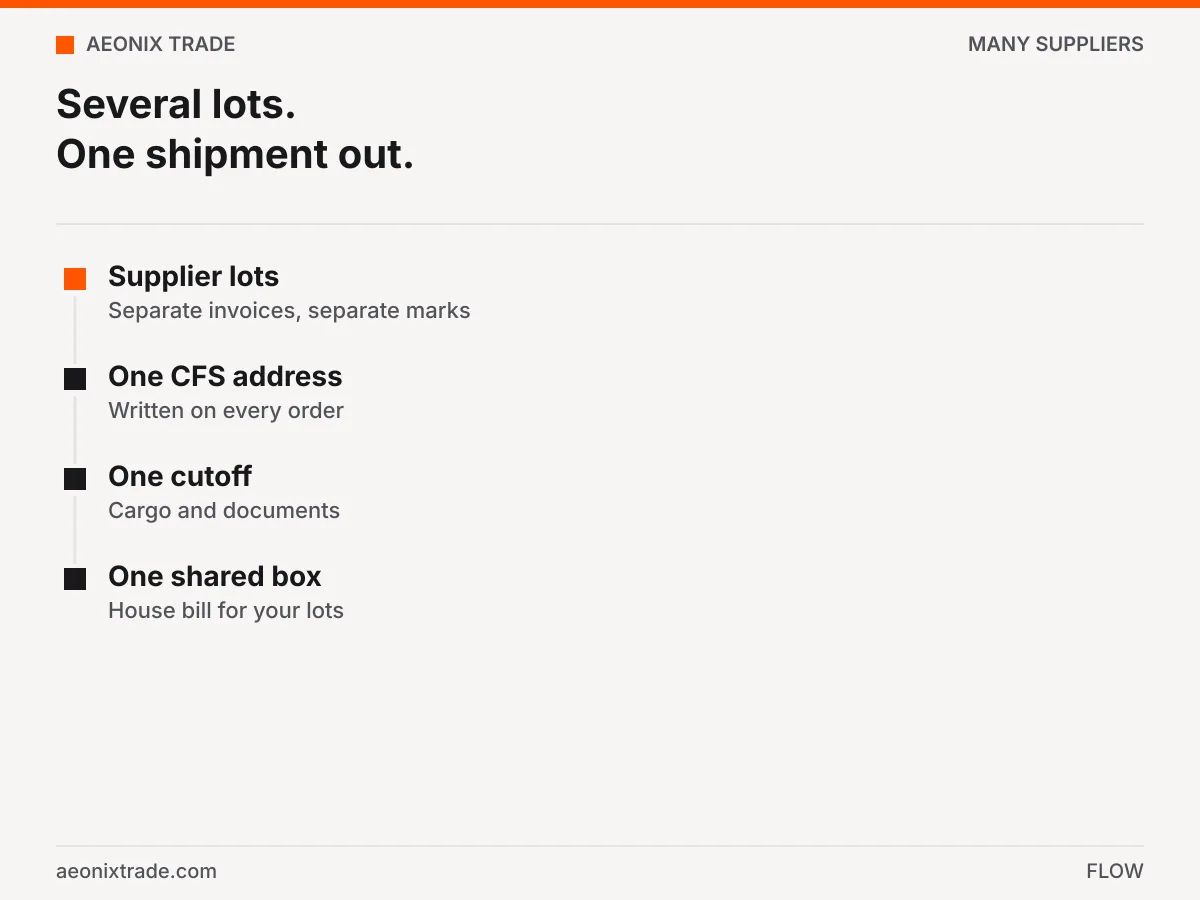
To consolidate shipments from China, every supplier's cartons have to reach one warehouse before one cutoff, with a packing list the warehouse can check, and leave as one shipment under a bill that names you.
Consolidation shipping from China is how a multi-supplier shipment becomes a single box, or a single share of a box. The suppliers do not have to sit in the same city. They do have to meet. A container freight station, the CFS, is the usual meeting point: the warehouse that receives the lots, checks them, and stuffs the container. If you skip the receiving plan and only tell a forwarder "ship it together," the lots miss each other and you pay for storage, a second sailing, or both.
Whether that one box should be yours alone or a share is FCL versus LCL. The lines inside the share are how an LCL quote is built. This page is the handoff among the suppliers. The service that runs the warehouse plan is consolidation shipping.
A typical case
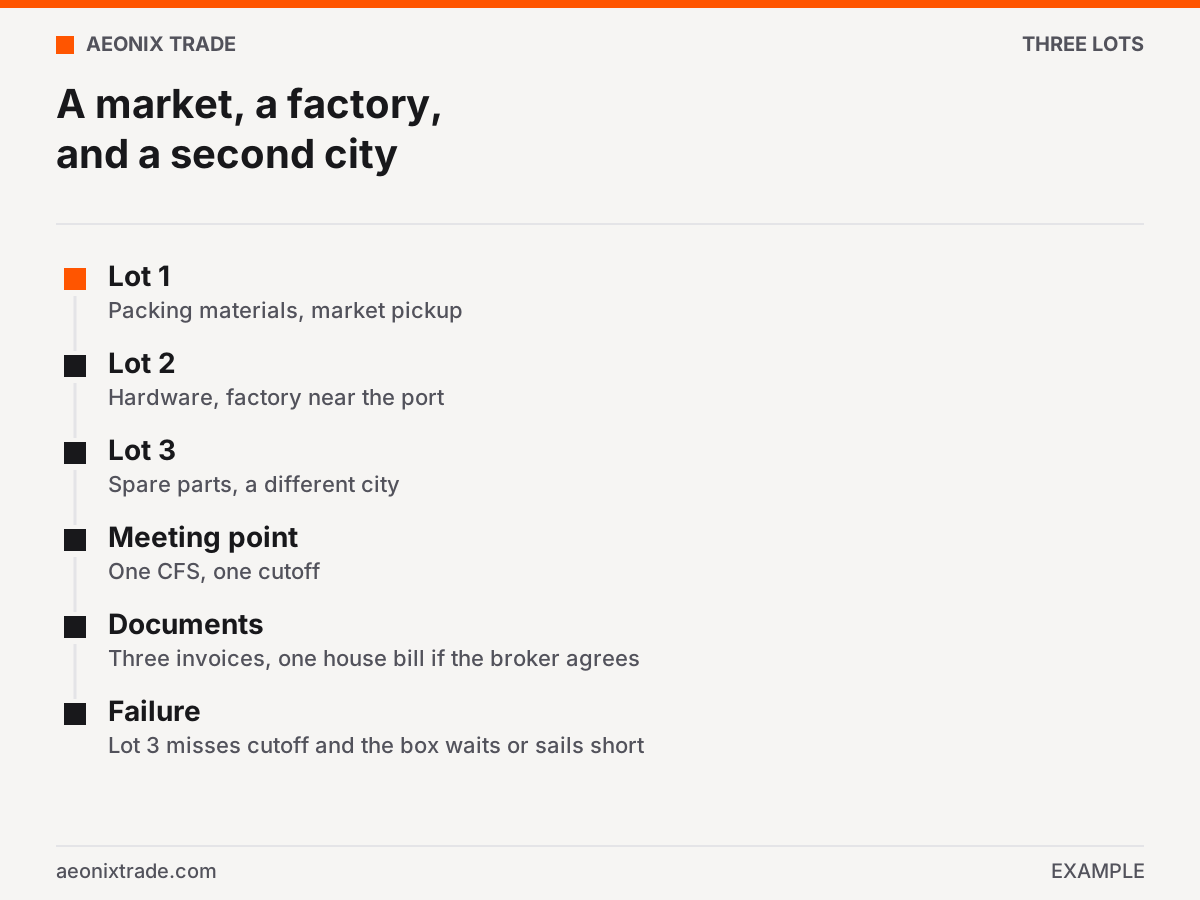
A buyer has three lots. Packing materials from a market booth. Hardware from a factory near the port. Spare parts from a supplier in another city. None of the lots fills a container. All three are meant for one customer delivery.
The workable version writes one CFS address and one cutoff on all three orders. Each lot keeps its own commercial invoice and packing list. Carton marks match those lists. The warehouse receipts each lot with a count and photos before anyone is told the balance can be paid. The consolidator then stuffs what actually arrived. If the spare parts miss the cutoff, the box either waits or sails with two lots, and the third lot is a new shipment. "We will combine it later" is how the third lot pays storage.
What has to be true before anyone shares a container
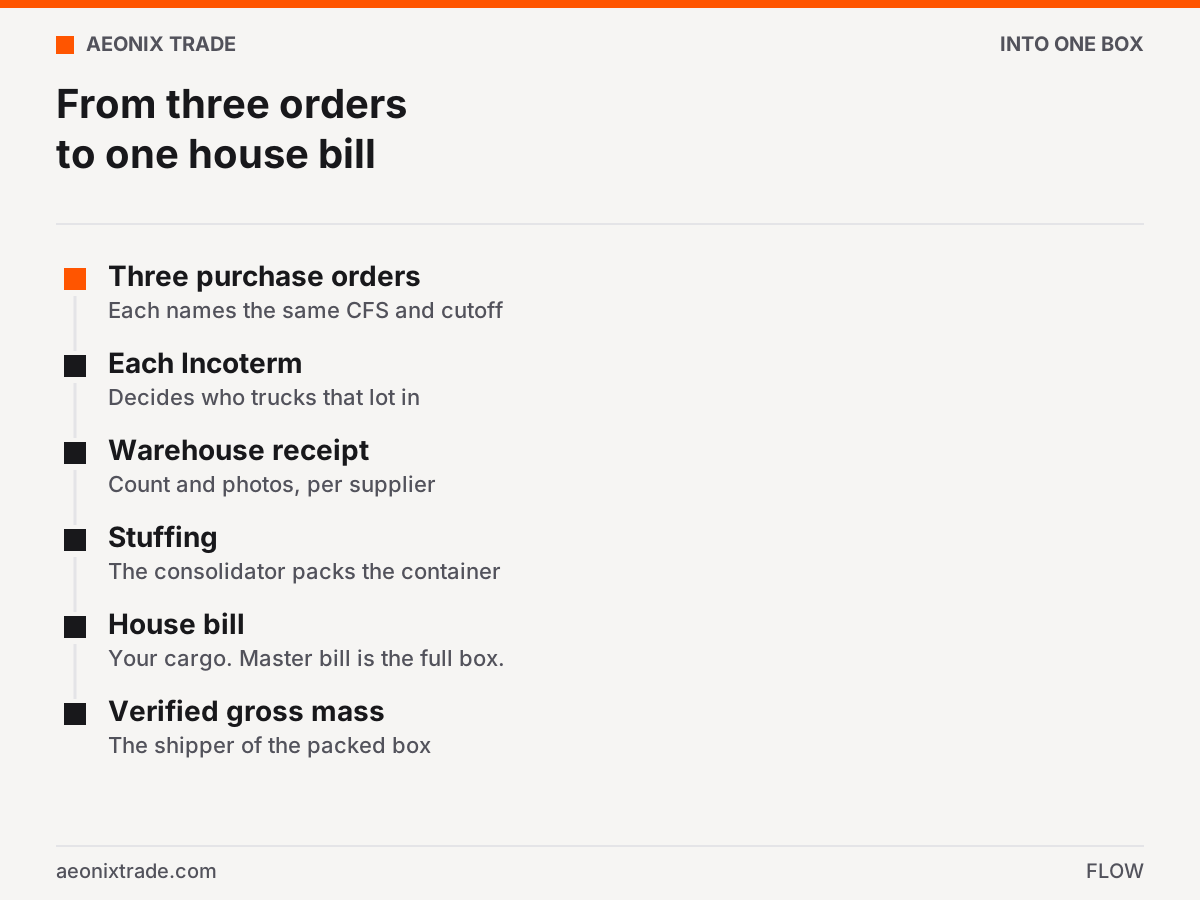
One address. Every proforma names the same CFS, not "Ningbo" and not the forwarder's company name without a street. A second city is a second truck. Price that truck in the quote. It is not absorbed by the ocean line.
One cutoff, in writing, for cargo and for documents. Miss it and the cartons wait for the next box. There is no universal closing rule to quote. The warehouse's sheet is the rule for this booking.
One Incoterm per supplier, because each lot may move differently. The ICC checklist puts export clearance on the buyer under EXW and on the seller under FCA. A market booth on EXW means you arrange the run to the CFS. A factory on FCA at that CFS means they deliver and clear export. Mixing those without writing them is how receiving charges land on the wrong party. Which Incoterm to use is the choice. Do it per order, not once for the whole container.
One party who can issue your bill without operating the ship. The Federal Maritime Commission defines a non-vessel-operating common carrier as a common carrier that issues its own house bill of lading or equivalent, does not operate the vessels, and, toward the vessel operator, is itself a shipper. That split is the one you want to see on the file: a house bill for your lots, a master bill for the full container in the consolidator's name. In U.S. trades the same page says the NVOCC publishes a tariff and, if U.S.-based, holds a licence. Those licence and tariff duties are U.S.-trade rules. They are not a description of every warehouse in Ningbo. The document split, house bill against master bill, is still the split to ask for wherever the box is going.
Papers per supplier, and papers per shipment
| Keep it per supplier | It becomes one shipment | |
|---|---|---|
| Commercial invoice | Yes. One seller, one invoice, matching the order. | Ask your broker before anyone merges them into a single invoice. |
| Packing list | Yes. Carton count, marks, gross weight. | The warehouse adds a receiving tally. It does not replace the supplier's list. |
| Who trucks the lot in | Yes. The Incoterm on that order. | The CFS address is shared. The truck is not, unless you booked one pickup run. |
| House bill | Only if you asked for separate bills. | Often one house bill for the lots that made the cutoff, if the consignee is you. |
| Verified gross mass | Your lists are the input. | One figure for the packed container, from the party who can weigh it. |
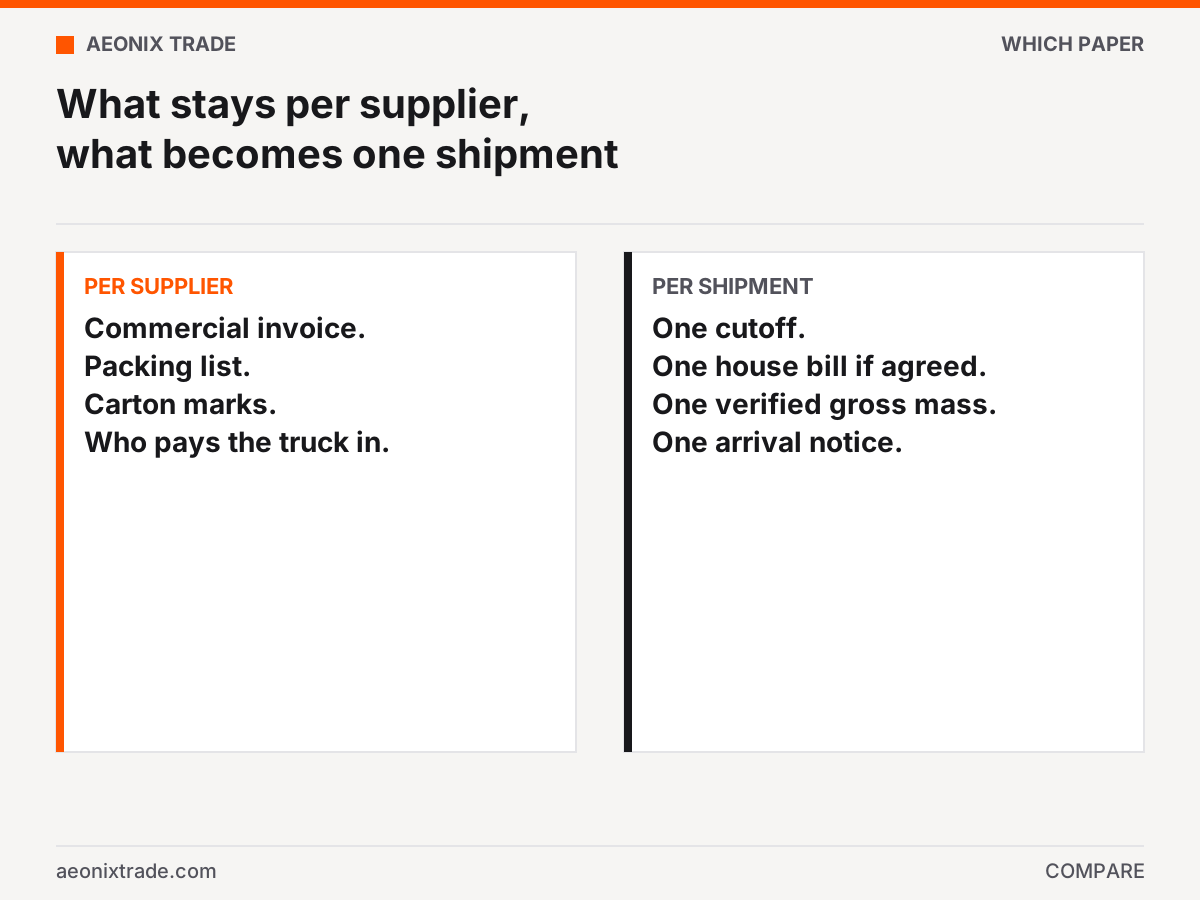
The invoice and the packing list have their own pages: commercial invoice and packing list. Do not collapse three sellers onto one invoice because it feels tidy. Your broker has to classify and value what arrives. A hidden seller is a document the entry cannot explain. Ask the broker, for this destination, whether the entry wants the invoices separate or itemised together. This page will not invent that rule.
The packed container needs a verified gross mass before it is loaded. IMO MSC.1/Circ.1475 puts that duty on the shipper of the packed container. The party who stuffs the box is the one who can weigh it. You still owe gross weights that add up. A list without weights leaves the figure unsupported, and a guessed weight is how a booking rolls. The short page is VGM.
Where a multi-supplier shipment breaks
- Paying a supplier's balance when the factory says "shipped," before the CFS receipt matches the carton count. Shipped from a booth is not received at the warehouse. The receipt is the document that says your lot is in the shipment.
- One late lot holding the others, or sailing without it, with no written rule for which of those you chose. Decide before the cutoff. Waiting is a storage charge. Sailing short is a second shipment later.
- Cargo the warehouse will not put in the same box. Ask, in writing, what they refuse to co-load. Do not discover it when a lot is turned away on the closing day. The World Shipping Council describes shared cargo being separated again at the other end. That only works if the lots were allowed into the box in the first place.
Checks before the warehouse closes
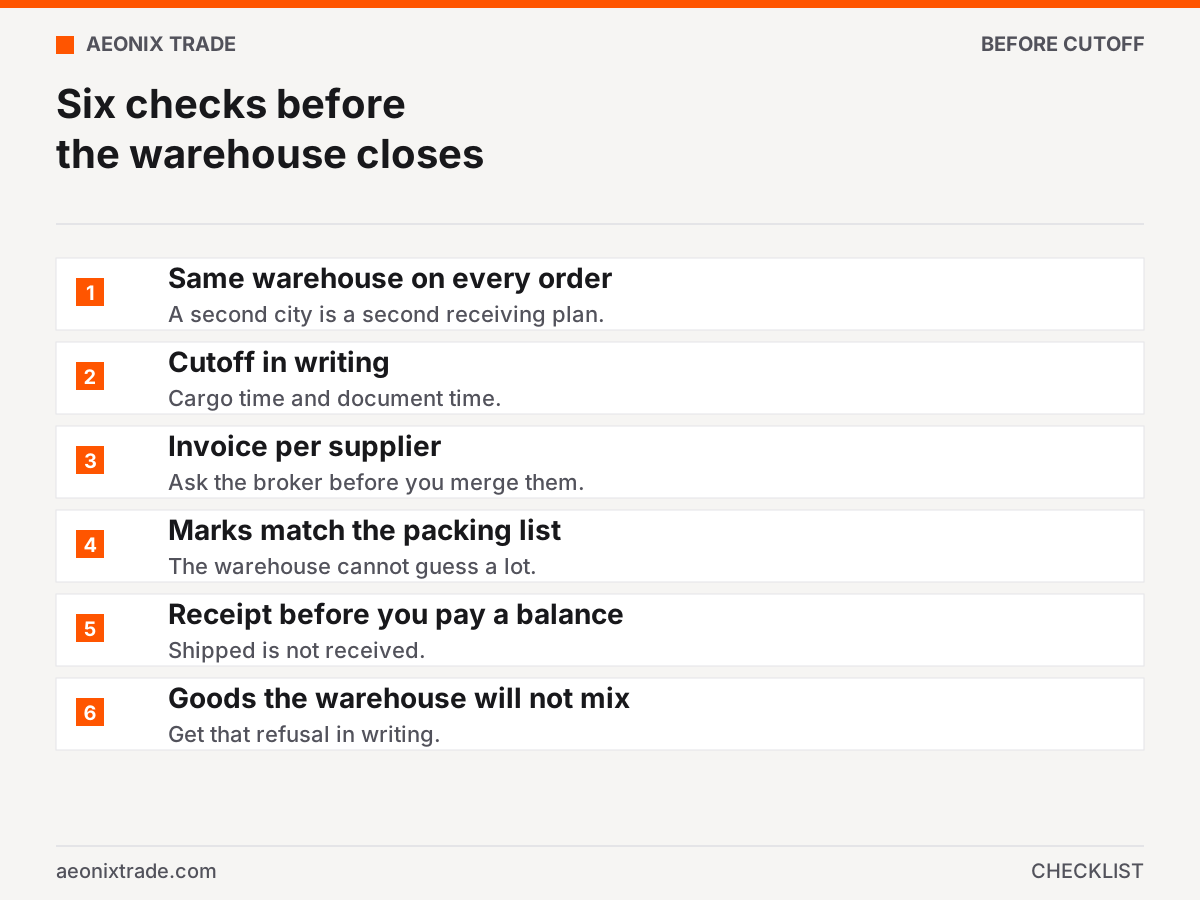
- The same CFS address on every order, and a priced plan for any lot that is not in that city.
- Cargo cutoff and document cutoff, both in writing.
- A commercial invoice and a packing list per supplier, marks that match, gross weights filled in.
- The Incoterm on each order, so the truck and the export filing have an owner.
- A warehouse receipt, with count and photos, before you pay a balance tied to shipment.
- A written answer on goods they will not mix, and on whether a late lot holds the box or misses it.
- The consignee on the house bill. If that name is not you, or a forwarder you have instructions from, you do not control release.
Send the three packing lists, the cities, and the door on one RFQ if you want the pickup plan and the sailing plan on the same sheet. How full the resulting box is, and whether a share is even the right booking, comes back to FCL versus LCL. The booking page for the share itself is LCL shipping from China.
Frequently asked questions
Can I consolidate shipments from several Chinese suppliers into one container?
Yes, if the lots reach one warehouse before the cutoff the warehouse gave you, with documents the warehouse can check. Different cities are allowed. Unpriced trucks between those cities are not.
What is CFS consolidation?
It is receiving at a container freight station, checking the cartons, and stuffing them into one container. Your record of the lots is the house bill and the receiving tally. The full box moves on a master bill that usually names the consolidator.
Do I need a separate invoice for each supplier?
Keep one until your broker says the entry can take them another way. Merging sellers to save a page hides the party who sold the goods. Ask before you merge. Do not guess a format.
Who files the verified gross mass on a consolidated box?
MSC.1/Circ.1475 puts it on the shipper of the packed container. That is normally the party who stuffed and can weigh the box. Your packing lists still have to carry real gross weights.
Does combining suppliers lower the freight by itself?
Only after every lot has reached the same warehouse in time, and you compare the all-in, including the extra pickups, with shipping the lots separately. A second city and a missed cutoff are extra lines. The ocean line is not a rebate for having more suppliers.
Sources
- Federal Maritime Commission: Ocean transportation intermediaries. An NVOCC issues its own house bill, does not operate the vessel, and is a shipper toward the vessel operator. Licence and tariff duties on that page are for U.S. trades. Checked 9 November 2026.
- IMO: MSC.1/Circ.1475. The shipper verifies the gross mass of a packed container and passes it on in time for the stowage plan.
- ICC: Incoterms 2020 checklist. EXW and FCA, which decide who brings each supplier's lot to the warehouse and who clears export.
- World Shipping Council: How container shipping works. More than one shipper's goods in one sealed container, separated again after arrival.
Submit sourcing request
Can't find what you need?
Start with a product or image link, an approximate quantity and destination. Other details can follow.