FCL vs LCL from China: Which to Choose and When the Break-even Moves
Published by Aeonix Trade.
Last fact-checked: 9 November 2026.
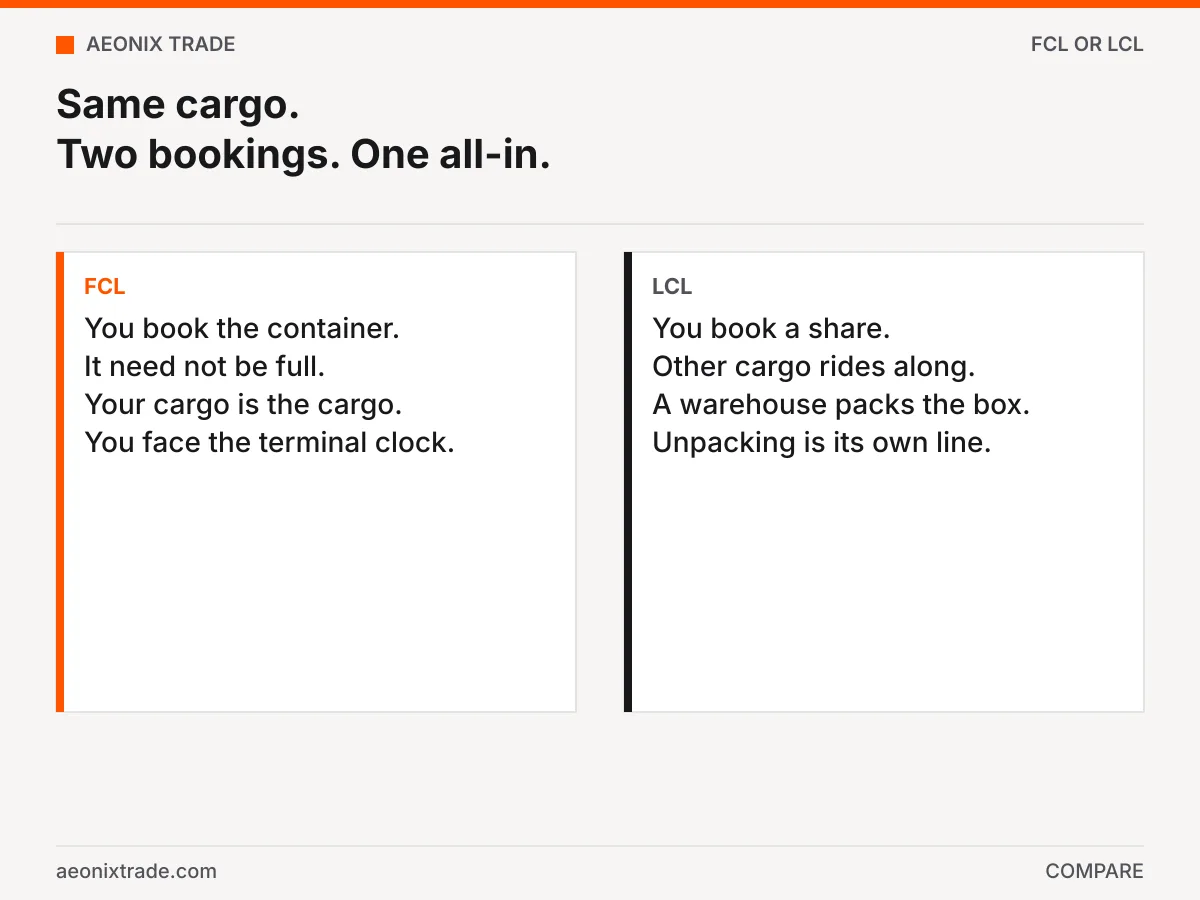
FCL vs LCL from China is a choice between booking the container and booking a share of one. LCL vs FCL is the same choice. The break-even is the measure where those two all-in quotes are equal, and it moves when either quote moves.
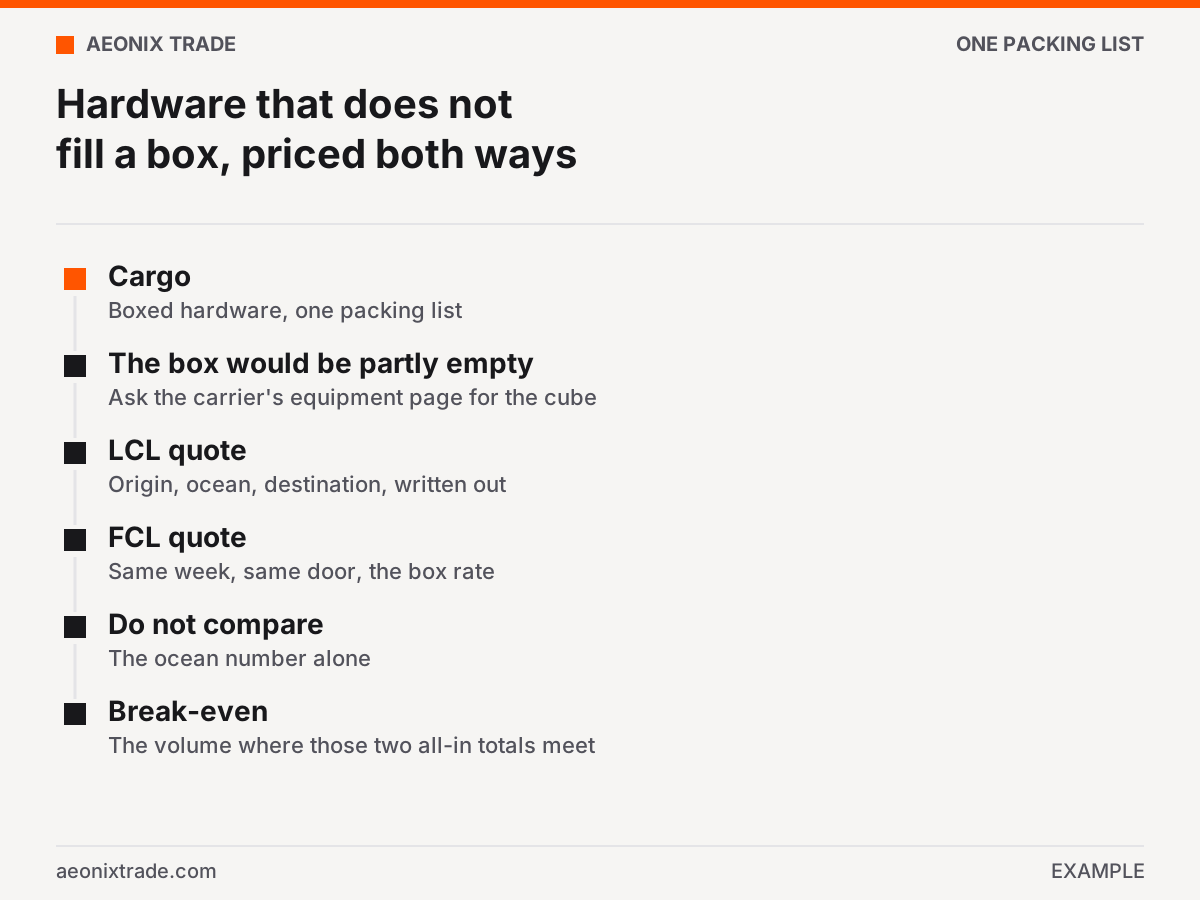
FCL means the container is booked for your cargo. It does not have to be full. LCL means your cartons share a box with other shippers. The World Shipping Council describes that shared pattern: goods from more than one retailer go into one container, the box is sealed, and it is opened again so the orders can be separated. LCL versus FCL is that split. Neither booking is an Incoterm. The definitions are on FCL and LCL. How a shared box actually leaves a Chinese warehouse is on how LCL shipping from China works.
This page does not give a cubic-metre cutoff. No customs authority publishes one. LCL or FCL for a small order is a pair of quotes for that cargo, that week, with the lines that are not the ocean freight written out.
A typical case
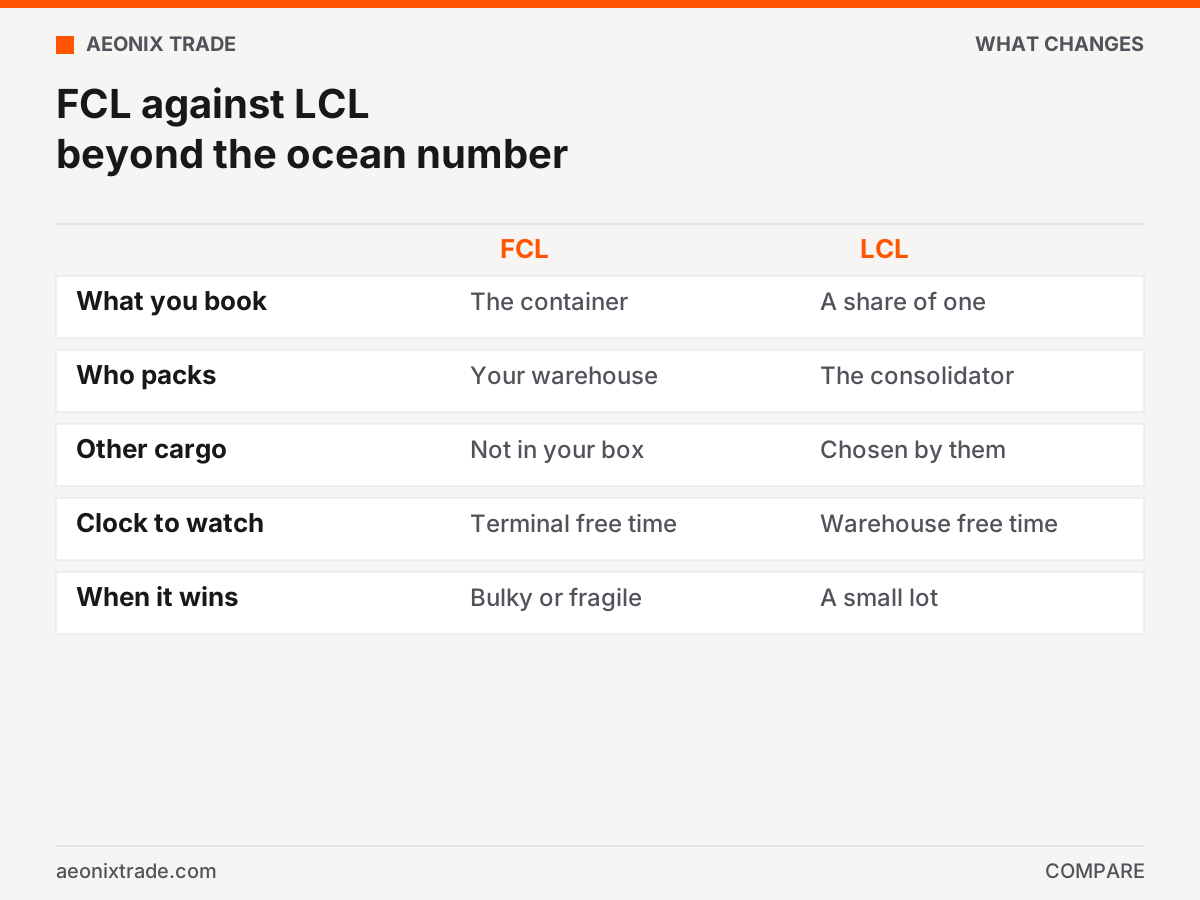
A buyer has one packing list of boxed hardware. The cartons will not fill the container the forwarder would book. The ocean number on an LCL quote looks smaller than the box rate. The buyer is about to book the share.
Before that, the same cargo needs an FCL quote for the same week and the same door, and the LCL quote needs its other lines on the page: origin receiving, destination unpacking, and delivery after the warehouse. Those lines are often where the share stops being the smaller shipment. If the cartons cannot take a second handling, the LCL option can be wrong even when its all-in is lower. The service page for booking the share is LCL shipping from China. The comparison you are reading is the decision in front of that booking.
What you are actually choosing
| FCL | LCL | |
|---|---|---|
| What you book | The container, for your cargo. | A share, usually on the measure the tariff names. |
| Whose cargo is in the box | Yours. | Yours and other shippers, chosen by the consolidator. |
| Who stuffs and seals | Your supplier, or a warehouse you name. | The consolidator's warehouse. |
| The bill that is yours | Often the ocean bill, if you are the shipper of the box. | A house bill for your cartons. The master bill is the full container. |
| The clock that hurts | Free time on the marine terminal, then equipment if you keep the box. | Free time at the destination warehouse, written on the arrival notice. |
The Federal Maritime Commission uses two words for the FCL clocks in U.S. trades. Demurrage accrues when a container exceeds free time on a marine terminal. Detention is charged for extended use of intermodal equipment. Those definitions are not your LCL warehouse tariff. The how-LCL page makes that distinction: the shared cartons are often unpacked first, and that warehouse writes its own free time. Read the arrival notice. The glossary is demurrage versus detention.
On a booking into the United States, a non-vessel-operating common carrier is the party that can issue the house bill without operating the ship. The FMC's page on ocean transportation intermediaries says an NVOCC holds itself out to provide ocean transportation, issues its own house bill or equivalent, and does not operate the vessels. In U.S. trades it must publish a tariff showing its rates, charges, classifications, rules, and practices. That tariff is where a U.S.-bound quote should be traceable. It is not a rate this article will copy. FIATA is the forwarders' federation. It is not your rate sheet either.
How the break-even is built, and why it moves
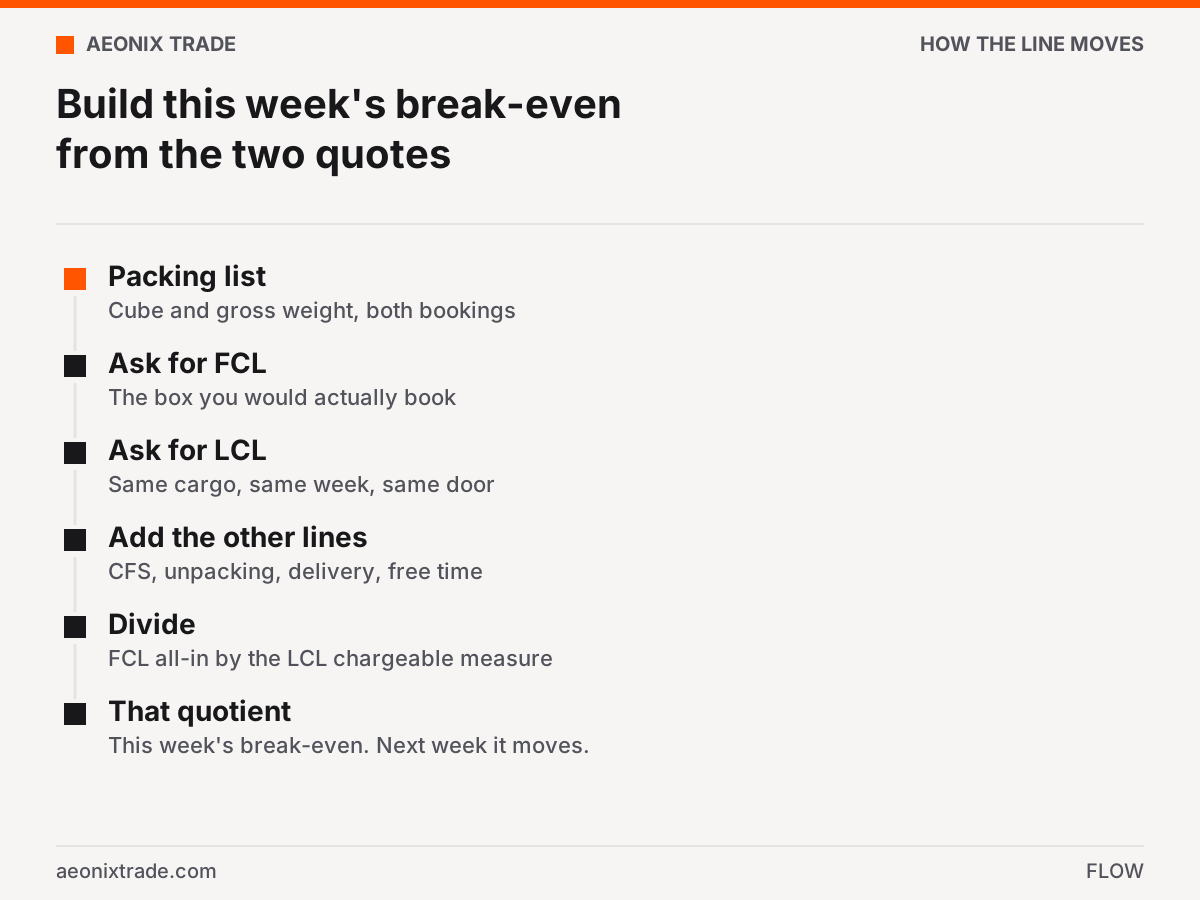
Price the cargo as FCL and as LCL, all-in, for the same door and the same week. The break-even is the chargeable measure at which those two totals are equal.
A pure per-unit LCL rate, with no flat lines, would let you divide the FCL all-in by that per-unit figure. Real quotes are not pure. Origin receiving, documentation, destination unpacking, and a minimum are flat or stepped. Dividing the box rate by the ocean-only LCL number ignores the lines that usually decide a small order. Price the packing list you have. If you are close, price one larger measure and one smaller measure on the same tariff. The measure where the totals cross is this week's break-even.
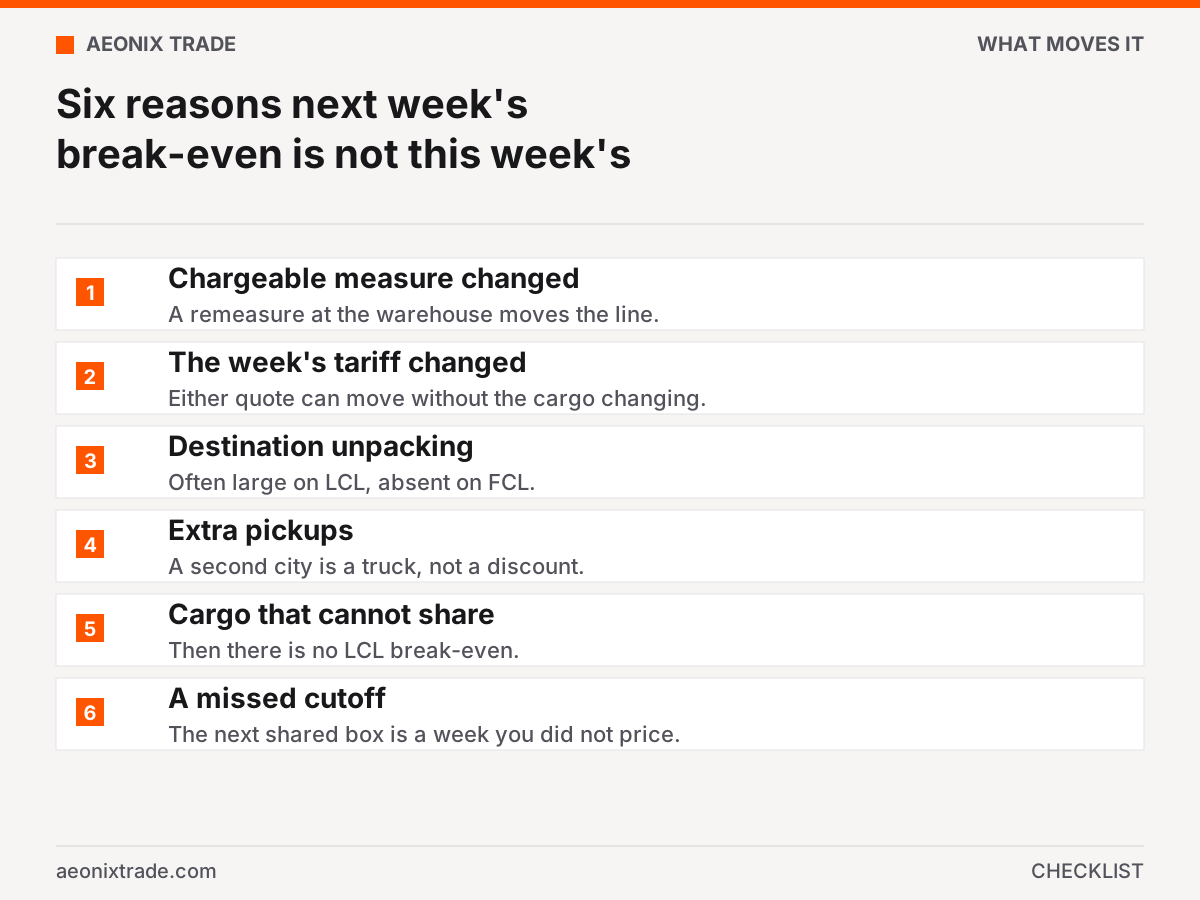
It moves, without the cargo changing, when any of these change:
- The chargeable measure. A warehouse remeasure, or a weight-versus-volume rule you had not been given, changes the LCL side. The arithmetic of cubic metres is on the CBM page. Confirm the divisor on the quote. Do not assume one.
- Either tariff. Next week's box rate, or next week's LCL unit and minimum, moves the crossing point. A quote without a date is not a point you can reuse.
- Destination unpacking and delivery. They sit on LCL and are often absent, or shaped differently, on FCL.
- A second pickup. Hardware from one city and parts from another are two trucks into the warehouse. That cost is not a discount for sharing a box. Several suppliers in one shipment are a separate job: consolidating multiple suppliers.
- Cargo the warehouse will not mix, or cartons that cannot take a second handling. Then there is no LCL break-even. The choice is FCL, or a different packing plan.
- A missed cutoff. The next shared sailing is time you did not price. FCL has its own cutoff, but it is not waiting on other people's cartons.
Where the choice goes wrong
- Comparing the ocean freight alone. The LCL ocean line is the number that looks helpful. The arrival invoice is where small orders go over budget.
- Waiting until the container would be full before asking for an FCL price. Unused space is still your booking, and it can be the cheaper all-in while the box is only partly used. Ask while you still have the choice.
- Treating LCL as the Incoterm. You can book either mode under more than one rule. The rule decides who trucks the cartons to the warehouse or who delivers the container to the terminal. Settle it before storage is billed to the wrong party. Which Incoterm to use is that decision. The line items inside the LCL number are how an LCL quote is built.
The packed container still needs a verified gross mass. Under IMO MSC.1/Circ.1475, the shipper verifies the gross mass of a packed container. On FCL, know who is named as that shipper. On LCL, the party that stuffs the shared box is the one who can weigh it. Your part is a packing list whose weights are real. The short definition is VGM.
Put cube, gross weight, the door, and both bookings on one RFQ if you want the crossing point rather than a single ocean number. Published expectations for how a rate sheet is read, still without a figure copied into this article, sit on shipping rates.
Frequently asked questions
Is LCL or FCL better for a small order from China?
LCL fits a lot that would leave a container mostly empty, if the cartons can take another handling and the all-in quote, including destination unpacking, is the smaller one. FCL fits when the all-in box rate has already crossed below the share, or when the cargo should not be mixed. Price both. There is no official cubic-metre switch.
What does FCL versus LCL mean if the container is not full?
FCL still means you booked the box. Empty space is yours. LCL means you booked a share and other cargo will be in the container. Fullness is not the definition.
Why does the break-even move?
Because the quotes move. A remeasure, a new minimum, a different destination CFS line, a second pickup, or next week's box rate all change the measure where the two all-in totals meet. Recalculate on the quotes in front of you. Do not reuse a cutoff from a different lane or a different month.
Does the Incoterm change FCL or LCL?
No. The Incoterm decides who pays to reach the handover. The booking decides whether the box is yours alone. You can move a container or a share under more than one rule. Write both on the proforma.
Where do I see the real charges?
On the quote, dated, with each line named. For an NVOCC in U.S. trades, the FMC requires a published tariff of rates and charges. Read that tariff against the quote. This page does not reprint one.
The paperwork next to this choice is 20-foot, 40-foot, and high-cube containers, a bonded warehouse, cargo insurance, and a customs broker versus a forwarder.
Sources
- World Shipping Council: How container shipping works. A container loaded with more than one retailer's goods, sealed, and separated again at destination. Checked 9 November 2026.
- Federal Maritime Commission: Detention and demurrage. Demurrage as time past free time on a marine terminal, detention as extended use of intermodal equipment.
- Federal Maritime Commission: Ocean transportation intermediaries. An NVOCC issues its own house bill, does not operate the vessel, and in U.S. trades publishes a tariff of rates and charges.
- IMO: MSC.1/Circ.1475. The shipper verifies the gross mass of a packed container.
Submit sourcing request
Can't find what you need?
Start with a product or image link, an approximate quantity and destination. Other details can follow.