EXW vs FOB: Which Is Better for Orders from China?
Published by Aeonix Trade.
Last fact-checked: 9 November 2026.
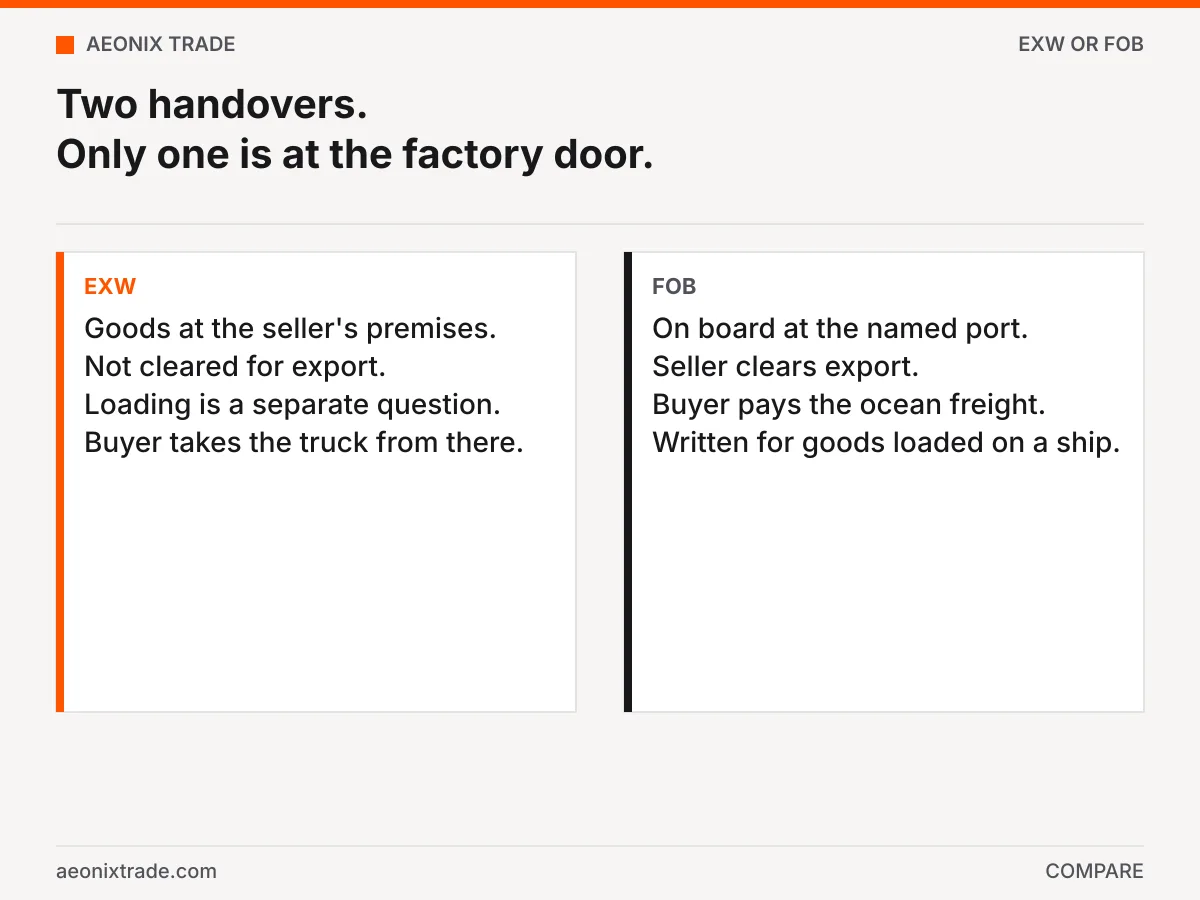
EXW vs FOB is a choice between a handover at the seller's premises, not cleared for export, and a handover on board a ship at a named port, with export clearance on the seller.
Ex works versus FOB is the comparison buyers run when one China quote looks much cheaper. It usually looks cheaper because EXW has left the truck, the export filing, and the port on you. FOB, when the letters mean the Incoterms rule, has the seller carry the goods to on-board delivery. You still pay the ocean freight under both. Neither rule is the ordinary container handover. The ICC Incoterms 2020 checklist points a container to FCA.
Ex works vs FOB is the long form of the same question, and FOB vs EXW is how the search is often typed the other way around. The definitions, with the loading question and the on-board split, are on EXW and FOB. This page is only the choice between them for an order from China. The wider list is the Incoterms 2020 chart.
A typical case
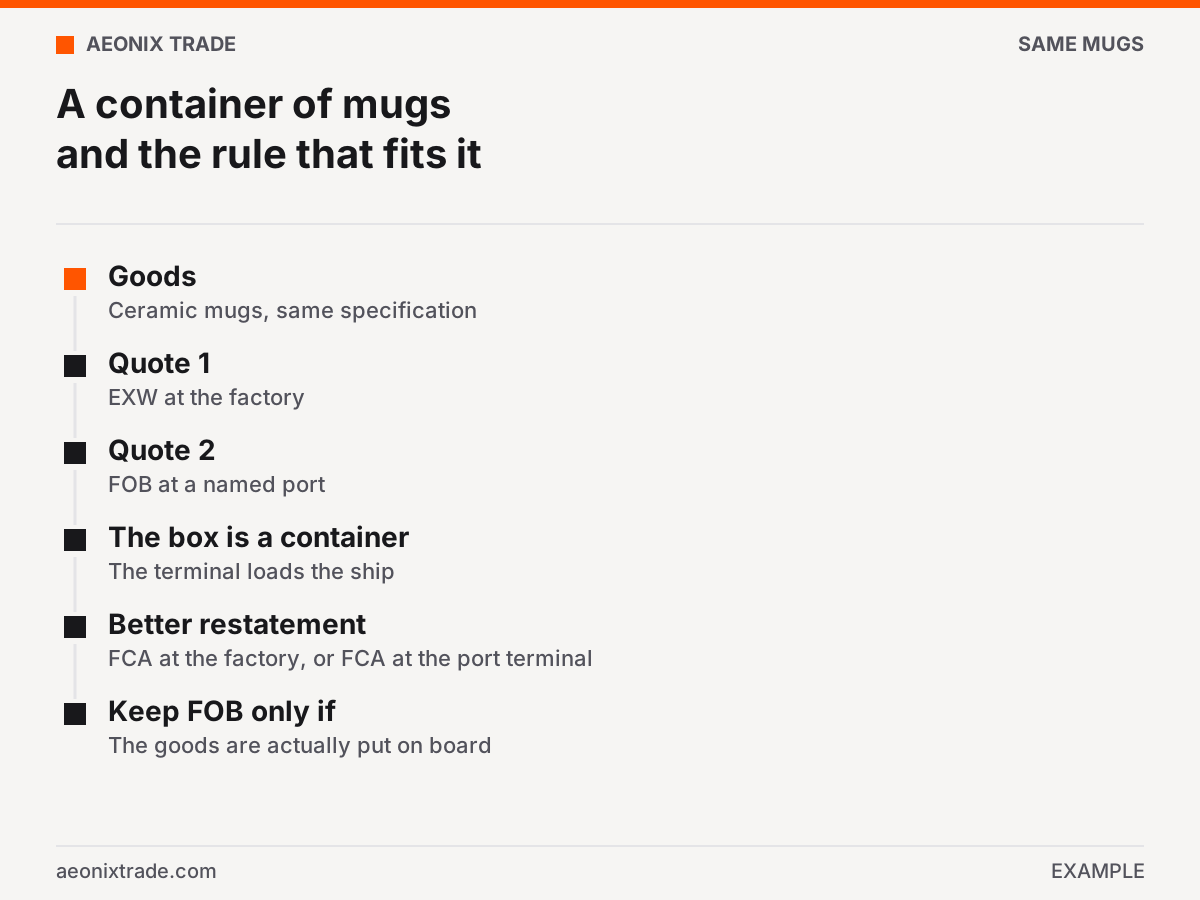
Two factories quote the same ceramic mugs, same decoration, same carton. One writes EXW at the factory. The other writes FOB and names a port. The EXW unit price is lower. The buyer has no company in China that can file an export declaration, and the mugs will leave in a container the terminal loads onto the ship.
On those facts neither line is the rule the checklist would start from. EXW asks the buyer to clear export. FOB asks for an on-board delivery the seller is not performing when the box only reaches the yard. The useful restatement is FCA at the factory, if your truck collects and the seller loads and clears export, or FCA at the port terminal, if the seller delivers the container there. FOB stays available if the goods really are put on board as general cargo or bulk. Mugs in a container are not that shipment.
What each rule actually hands you
The checklist, from the buyer's side, puts EXW at the seller's premises. Costs and risks pass once the goods have been placed at your disposal. They are not cleared for export. The same pages say EXW suits domestic trade, and they send the international difficulties to the explanatory note in ICC publication 723E. Loading is a question you have to answer. It is not a silent part of the price. If you cannot load at the seller's warehouse, do not assume the factory will.
FOB is in the sea and inland-waterway group. The International Trade Administration lists it as Free on Board at a named port of loading, beside FAS, CFR, and CIF. The checklist uses it when the goods are general cargo or bulk loaded on board, or when you specifically want risk and cost to divide once the goods are on board. Export clearance on FCA, FAS, and FOB is the seller's. You contract the main freight.
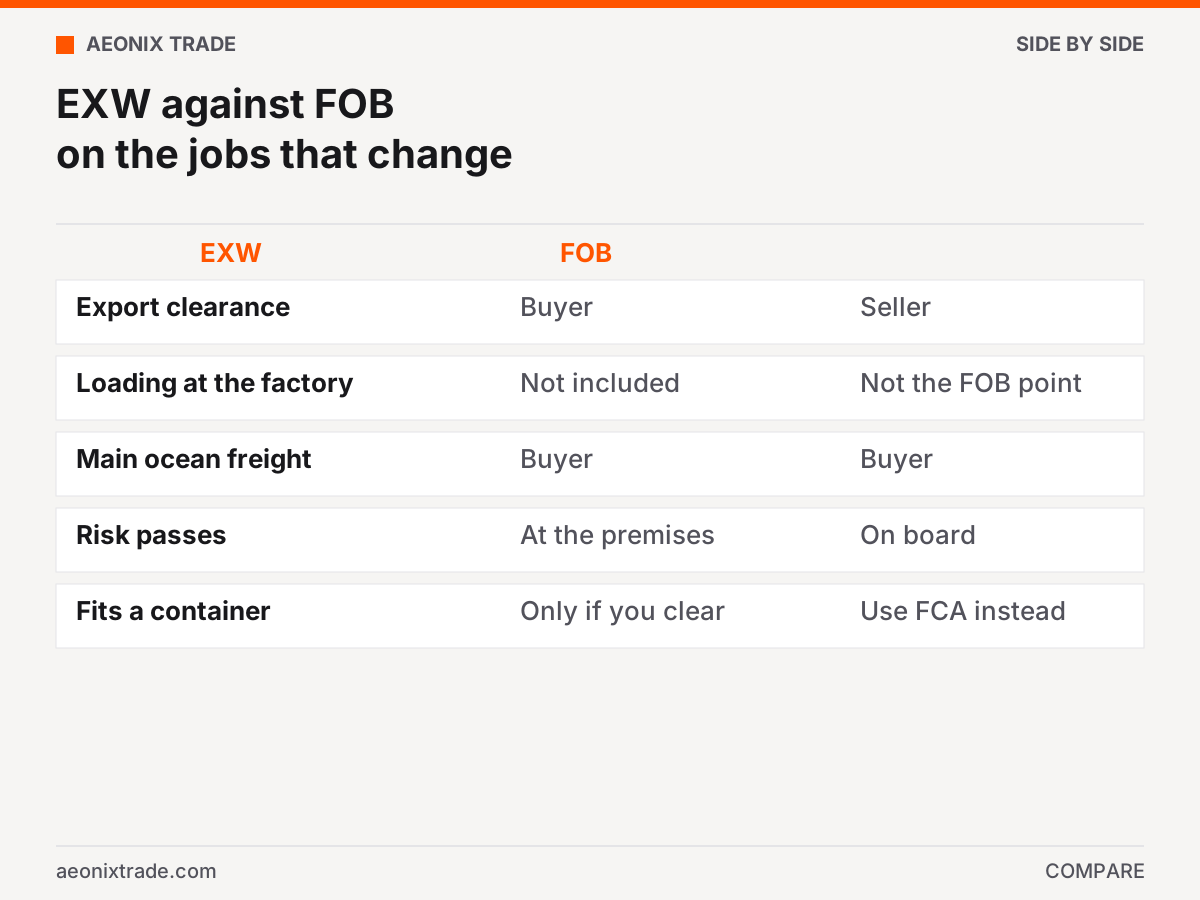
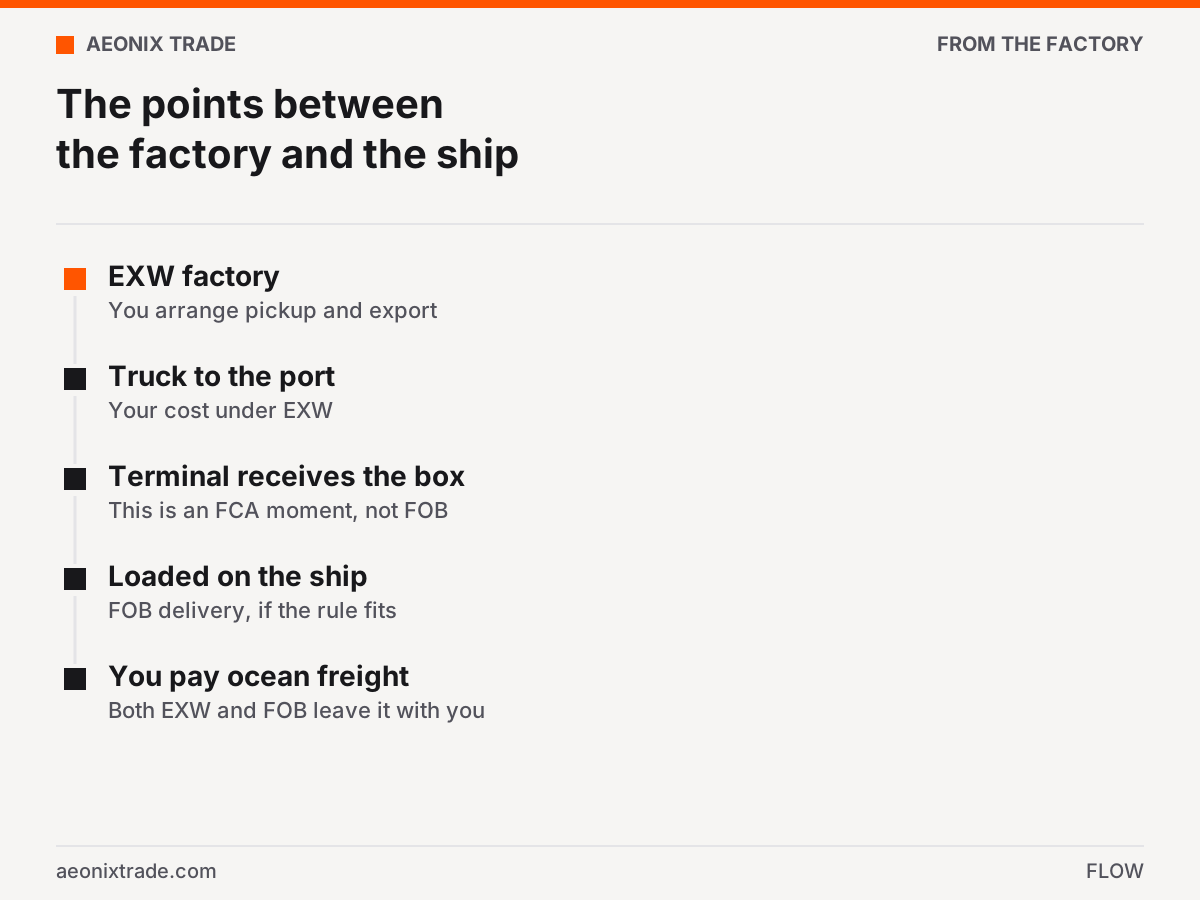
So FOB versus EXW China is not "FOB includes shipping and EXW does not." Ocean freight sits with the buyer on both. The gap is export clearance, the move from the factory to on-board delivery, and the moment risk passes. An EXW unit price should be lower than FOB for the same goods if the seller has priced those legs honestly. If the two numbers are close, someone has left a leg out or used the letters as a habit.
| EXW | FOB | |
|---|---|---|
| Named place | Seller's premises. | Port of loading. |
| Export clearance | Buyer. The checklist is direct about this. | Seller. |
| Loading at the factory | Not included unless you write it in. The alternative is FCA at the premises, where the seller loads your vehicle. | Not the delivery point. Delivery is on board. |
| Main ocean freight | Buyer. | Buyer. |
| Risk passes | When the goods are at your disposal at the premises. | When the goods are on board at the named port. |
| A container the terminal loads | Only if you can collect and clear export. | The checklist points this cargo to FCA, not FOB. |
Why "which is better" depends on who can do the export
EXW is the better fit only in a narrow case: your forwarder in China collects uncleared goods, you can complete export formalities, and you have answered the loading question. Then the lower unit price is a real saving, because you were going to do that work anyway.
FOB is the better fit when the seller will clear export and the cargo is actually loaded on board, and you want to buy the ocean freight yourself. It is a poor fit for the container that only reaches a yard, which is why the ICC Academy's FOB note points that handover to FCA. If the contract is FOB Incoterms 2020 and you named the vessel and the loading point in time, the seller keeps the risk of loss or damage until the goods are on board. A container damaged in the origin yard before loading is still the seller's. That risk moves to you earlier only if you miss the nomination, the vessel does not arrive in the agreed window, or the ship closes for cargo before the goods can be loaded. Ask for FCA at the named terminal when the box stops at the gate. The seller still clears export. You still buy the freight. The handover matches the photograph of the container at the gate.
If what you wanted from FOB was "the seller pays the ship," you are not comparing EXW and FOB anymore. You are comparing an F rule with a C rule. That comparison, including when CIF costs less only after you add your own freight and cover, is FOB versus CIF. How to choose among the families, not just these two, is which Incoterm to use.
Where the comparison goes wrong
- Subtracting the EXW unit price from the FOB unit price and calling the difference "the freight." Freight is one leg. Export clearance, the truck, the terminal, and the loading onto the ship are others. Some of them are knowable from your forwarder. None of them is a number this page can honestly publish, because they move by lane and by week.
- Ignoring who can sign the export declaration. A buyer outside China who cannot clear export does not have an EXW shipment. They have a stuck shipment with a cheap unit price.
- Leaving "FOB China" or "FOB warehouse" on the proforma. FOB names a port of loading, and delivery is on board. A warehouse is the EXW place, or an FCA place. It is not on board a ship. The service page that buyers land on for the FOB habit is FOB China. Use it for the responsibilities. Use this page for the choice against EXW.
Checks before you pick
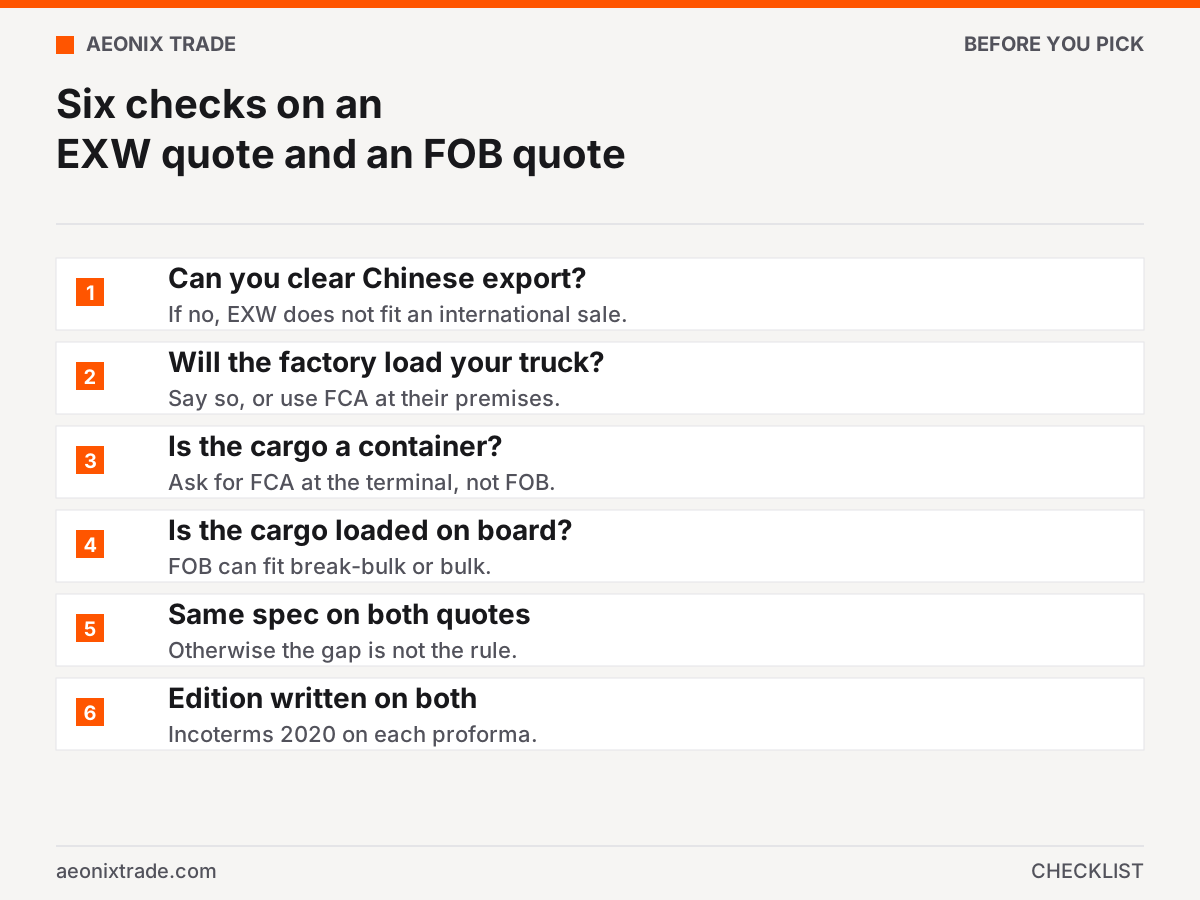
- Can you clear Chinese export? If no, do not use EXW.
- Will the factory load your truck? If you need that and you are still at the factory, use FCA at their premises rather than a silent EXW.
- Is the cargo a container the terminal will load? Ask for FCA at that terminal. Keep FOB for goods put on board.
- Are both quotes the same specification, the same carton, and the same edition? The ITA says an older Incoterms edition is valid when the contract names it. "EXW Incoterms 2010" against "FOB Incoterms 2020" is not one comparison.
- Have you priced the legs EXW leaves out, from your forwarder, before you call EXW cheaper?
Send both wordings on one RFQ if the supplier will price them. Ask for FCA beside them whenever the cargo is a container. The rule that survives is the one whose handover you can point to on a map.
Frequently asked questions
Is EXW or FOB better for orders from China?
FOB is the better of the two when the seller will clear export and the goods are loaded on board, and you will buy the ocean freight. EXW is better only when you can collect uncleared goods and clear export yourself. For a container, FCA is usually better than either.
Does FOB include shipping and EXW does not?
No. Under both rules the buyer contracts the main freight. FOB has the seller deliver on board at the named port. EXW stops at the seller's premises. The ocean bill is yours in both cases.
Why is the EXW price lower?
Because the seller has not priced export clearance or the move to the ship. Add those legs before you treat the lower unit price as the lower shipment. If you cannot perform the export leg, the lower price is not available to you.
What does FOB versus EXW China mean on a container?
It usually means the supplier typed a sea rule onto a box the terminal will load. Ask them to restate it as FCA at the terminal, or FCA at the factory if your truck collects there. The FCA page is the handover that matches.
Do either of these rules say when I pay?
No. The International Trade Administration says Incoterms do not set the method or timing of payment, and they do not say when title passes. Pay under the payment clause. Deliver under the rule.
The paperwork next to this choice is 20-foot, 40-foot, and high-cube containers, a bonded warehouse, cargo insurance, and a customs broker versus a forwarder.
Sources
- ICC: Incoterms 2020 checklist. EXW as goods at the seller's premises, not cleared for export, and FOB for an on-board split. Container and terminal cargo pointed to FCA. Checked 9 November 2026.
- ICC Academy: FOB and FAS, Incoterms 2020. The seller delivers loaded on board and keeps the risk until then, if the buyer named the vessel in time. Container handovers at a terminal are pointed to FCA. Checked 10 November 2026.
- U.S. International Trade Administration: Know Your Incoterms. EXW in the any-mode group, FOB in the sea and inland-waterway group, and what the rules do not cover.
- ICC: Incoterms 2020. The FCA on-board bill, which is the container alternative when a credit needs that document.
Submit sourcing request
Can't find what you need?
Start with a product or image link, an approximate quantity and destination. Other details can follow.