CFR Meaning in Shipping: Cost and Freight Explained
Published by Aeonix Trade.
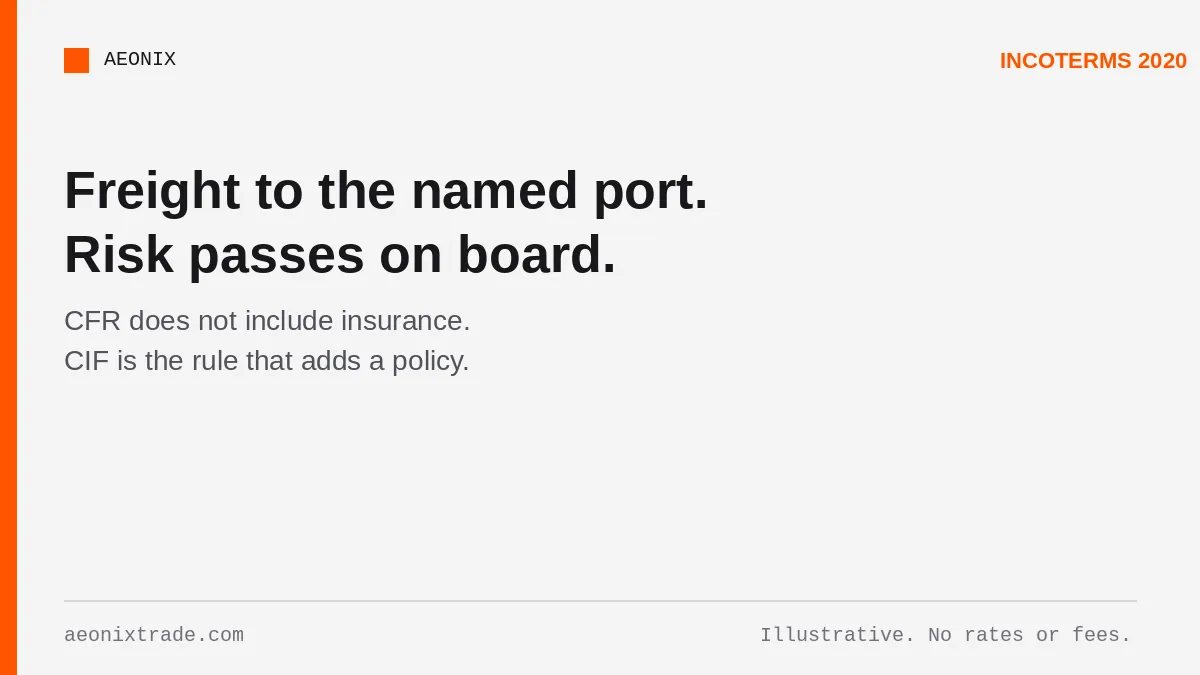
CFR means Cost and Freight: the seller pays the freight to the named port of destination, and the risk passes to the buyer once the goods are on board the vessel at origin.
Last fact-checked: 9 November 2026.
The freight payment and the risk are two different clocks. Buyers read "cost and freight" as "the seller owns it until the destination port." That is not the rule. The International Trade Administration lists CFR with the four sea and inland-waterway rules, as "CFR - Cost and Freight (insert named port of destination)," next to CIF. FAS and FOB sit in the same group. CPT, CIP, DAP and DDP do not.
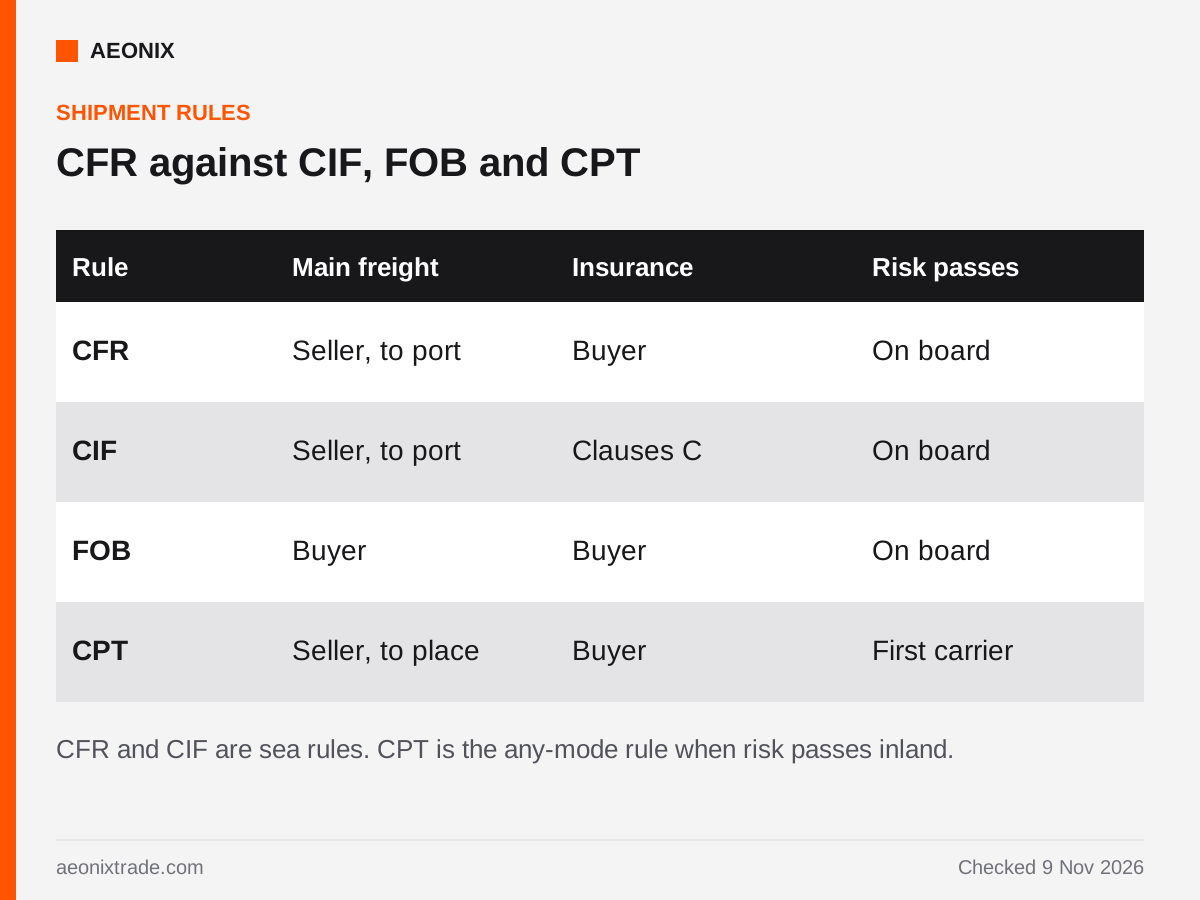
The ICC checklist (PUB817E, checked 9 November 2026) calls CFR a shipment contract. The seller includes the main freight in the price. The risk of loss still transfers at delivery in the seller's country, when the goods are on board. Choose CFR when you do not want the seller to include insurance. Choose CIF when you do, and even then the seller's insurance obligation under CIF is limited to minimum cover, Institute Cargo Clauses (C) or similar. The ICC Incoterms 2020 page says the same about CIF: Clauses (C) stay the default, and the parties may agree a higher cover. CFR itself does not buy that policy.
On board at origin, freight paid to a named port
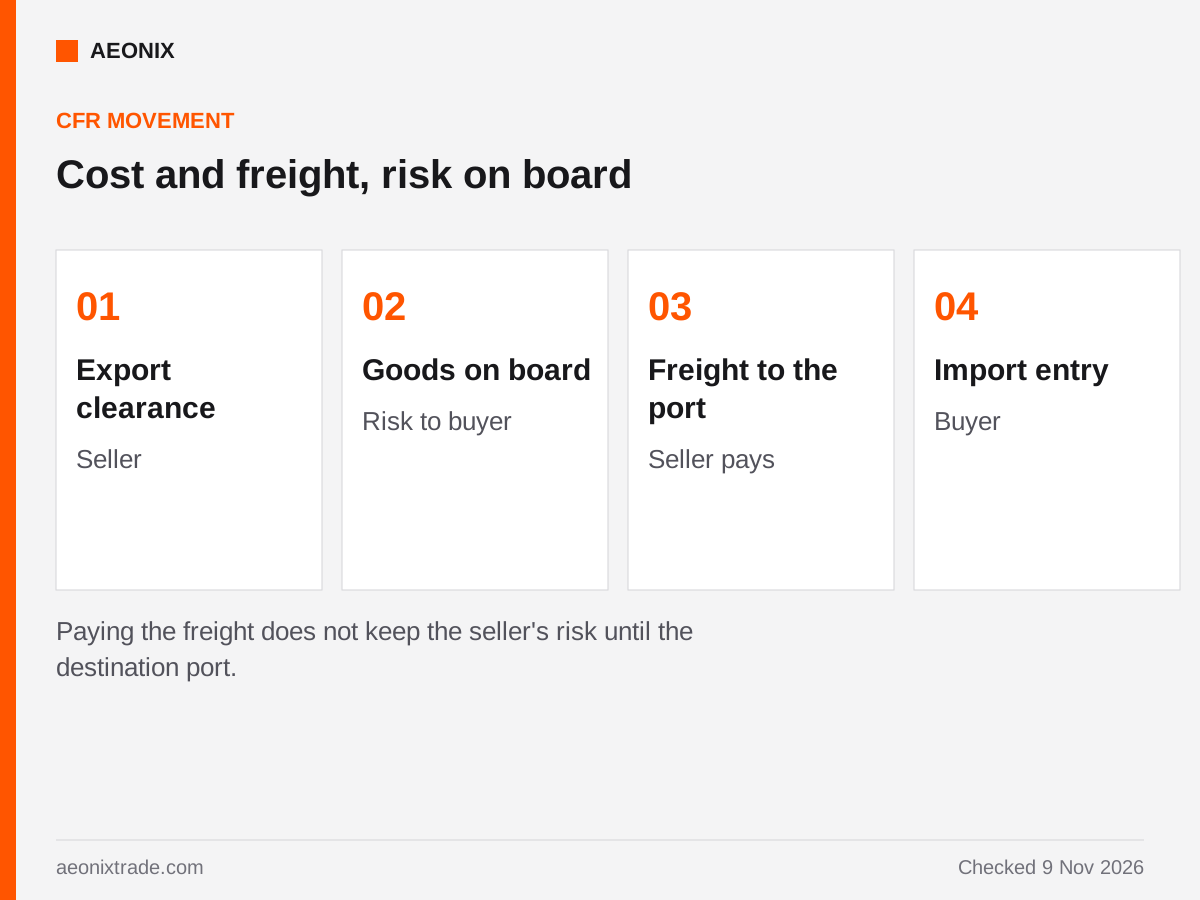
Write the port of destination into the rule. "CFR Los Angeles" is a port. "CFR your warehouse" is not a CFR place, and the letters will not carry the truck that finishes the job. The seller clears export. You clear import. The seller pays the ocean freight to that named port. You carry the risk of the voyage from the moment the goods are on board at the load port.
That is why a damaged container at sea is your claim, not a reason to withhold the freight the seller already paid the line. If you wanted the seller to carry risk until the goods arrived, you wanted an arrival rule. DAP is that fork. CFR is the fork where you accept the voyage risk in exchange for a price that already includes the main freight.
Container and multimodal cargo is the other fork on the same checklist. If the goods travel in a container, or delivery is to an inland or port terminal, the checklist points to CPT or CIP, not to CFR or CIF. CFR is for traditional commodities lifted on board, or for the case where you deliberately want risk to divide once the goods are on board, including a container the seller loads in that older way. A container handed to a terminal before it is on the ship has already left the seller's hands. CFR's on-board point does not describe that handover. FCA is the any-mode rule when you, not the seller, will pay the main freight from that terminal.
A typical case
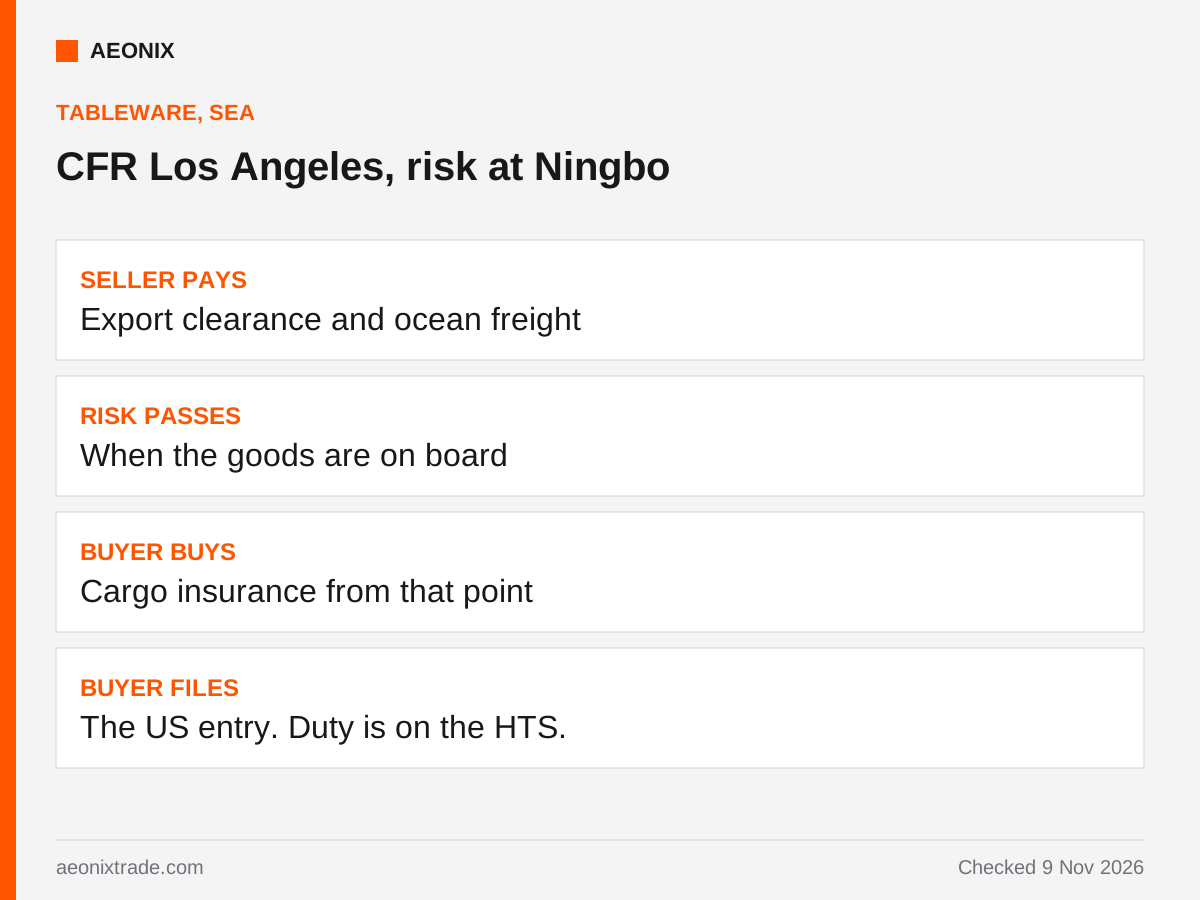
A buyer of ceramic tableware books a full container from Ningbo. The seller can load the container and the contract says the risk divides once the goods are on board, so the quote is CFR Los Angeles, not CPT. The seller pays the ocean freight to Los Angeles and clears the Chinese export. The buyer arranges cargo insurance from the on-board point, because CFR does not include it. The buyer is the importer at Los Angeles and pays duty from the US tariff for the line the broker files. This page does not state that duty, the freight, or an insurance premium. Those are on the carrier's quote, the insurer's quote, and the Harmonized Tariff Schedule.
The same seller's CIF Los Angeles number is higher by whatever premium the seller put in. Ask which cover that premium bought. The ICC default for CIF is minimum cover, Clauses (C), not the wider Clauses (A) that CIP now requires. A CIF quote that does not name the clauses can be a thin policy with a thick label. If the ceramics are fragile, minimum cover may exclude the damage you actually fear. Agree the clauses, or buy your own policy from the on-board point and stay on CFR.
What the price is not telling you
CFR does not make the seller unload the ship. The charge for that unloading is a different question. The ICC Academy's note on the C rules says the seller pays unloading at the named port only when the contract of carriage already makes that charge the seller's. If the freight includes it, do not add it again. If the freight leaves it out, it is still yours. The terminal charge after arrival, the truck to your warehouse, import duty, and insurance are not in CFR. The ICC checklist says disputes over loading, unloading, terminal handling and container rental survive a clearly named rule, because the rule is general. Read the carriage contract before you budget the discharge. The ICC lists costs for each rule in articles A9 and B9 so the seller can show what the number contains.
A CFR unit price also cannot be subtracted from an EXW unit price and called "the freight." Export clearance, the load, the ocean freight and the seller's margin sit in the gap. Insurance, if you buy it, sits outside both numbers. Landed cost is the stack after you add the lines CFR left with you.
Put the named port, who buys the insurance, and the on-board point on the RFQ. The document set that has to match this rule, invoice and packing list included, is mapped on Incoterms and shipping documents.
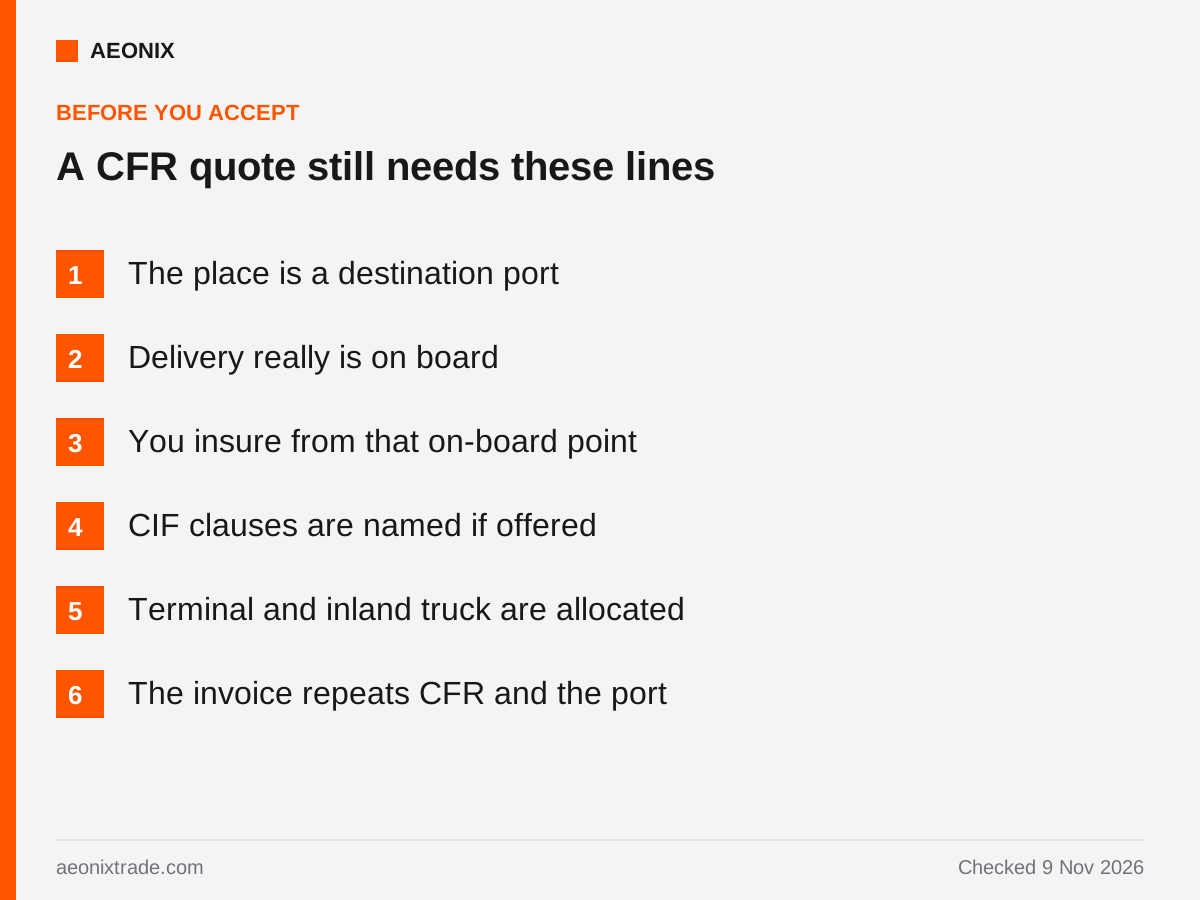
Before you accept a CFR quote
- The named place is a port of destination, not a warehouse and not an airport.
- The goods really will be delivered on board, not only handed to a terminal.
- You have cargo insurance from that on-board point, in your name or with you as the claimant.
- If the seller offered CIF instead, the clauses are named, and you know they are the minimum cover unless you agreed more.
- Destination terminal charges, unloading and the inland truck are written down, and unloading is not added twice if the carriage contract already includes it.
- The commercial invoice states CFR and the same port, so the customs value is not built on a different rule.
Where CFR goes wrong
The first miss is treating CFR as CIF. The only letter that buys insurance is the I. A CFR shipment with no policy of your own is an uninsured voyage that you are paying the seller to arrange.
The second miss is using CFR for air, or for a container the seller only delivers to a CY. The trade.gov list keeps CFR in the sea and inland-waterway group. The checklist sends container and multimodal cargo to CPT or CIP unless you truly want the on-board split. A rule that does not match the handover is a rule that will be argued after something breaks.
The third miss is hearing "freight paid" and believing risk rides with the freight all the way to the named port. It does not. The seller can pay the line and still have transferred risk at loading. If the claim sits with you, the freight invoice is not the document that pays it.
Frequently asked questions
What does CFR mean in shipping?
Cost and Freight. The seller pays freight to the named port of destination. Risk passes to the buyer when the goods are on board at the origin port. The seller does not have to insure the cargo.
What is the difference between CFR and CIF?
Both are sea and inland-waterway rules, and both put freight to the named port in the seller's price. CIF adds an insurance obligation. Under Incoterms 2020 that obligation defaults to Institute Cargo Clauses (C), or similar minimum cover, unless the parties agree more. CFR adds no insurance.
Does CFR mean the seller carries the risk until the destination port?
No. Paying the freight is not the same as carrying the risk. The ICC checklist treats CFR as a shipment contract: risk transfers at delivery in the seller's country, on board. Arrival risk is a DAP, DPU or DDP question.
Can I use CFR for air freight or for a normal container handover?
CFR is not an any-mode rule. The International Trade Administration groups it with FAS, FOB and CIF. For containerized or multimodal cargo, or delivery at a terminal, the ICC checklist points to CPT or CIP when the seller is paying the main carriage.
Who clears customs under CFR?
The seller clears export. The buyer clears import and pays duties and taxes. The rate is on the destination tariff for the agreed classification. This page does not state one.
The paperwork next to this choice is which Incoterm to use, 20-foot, 40-foot, and high-cube containers, a bonded warehouse, and cargo insurance.
Sources
- ICC: Incoterms 2020. CIF keeps Institute Cargo Clauses (C) as the default cover. CIP requires a higher cover. CFR is the freight rule without that insurance obligation.
- ICC Academy: C rules, Incoterms 2020. The seller pays unloading at the named port only when the contract of carriage says that charge is the seller's. Checked 10 November 2026.
- ICC: Incoterms 2020 checklist and flowcharts, PUB817E. CFR when risk divides on board and insurance is not included. CPT or CIP when the cargo is containerized or multimodal.
- International Trade Administration: Know Your Incoterms. CFR in the sea and inland-waterway group, with the named port of destination written into the rule.
Submit sourcing request
Can't find what you need?
Start with a product or image link, an approximate quantity and destination. Other details can follow.