DAP Meaning in Shipping and How It Differs from DDP
Published by Aeonix Trade.
DAP means Delivered at Place: the seller carries cost and risk to the named place in the buyer's country, and stops before unloading and before import clearance.
Last fact-checked: 9 November 2026.
That split is the one buyers miss when a quote says "DAP warehouse." The goods can arrive at the door and still be your entry, your duty, and your forklift. ICC Incoterms 2020 puts DAP with the rules that work for any mode of transport. The seller does not unload. The International Trade Administration lists it as "DAP - Delivered at Place (insert named place of destination)," beside DPU, where the seller does unload, and DDP, where the seller also clears the import.
The ICC checklist (publication PUB817E, checked 9 November 2026) treats DAP as an arrival contract. On the seller's side of that checklist, DAP is the choice when the seller will carry cost and risk to the destination, will not unload, and will not pay duties or run import formalities. On the buyer's side, DAP is the choice when you will clear the import yourself and you still want the seller to carry the transport risk up to the named place. The checklist says its chart is not a substitute for the Incoterms 2020 rule book, ICC publication 723E. Use the chart to see the fork, then read the rule you write into the contract.
Where DAP ends, and where DDP starts
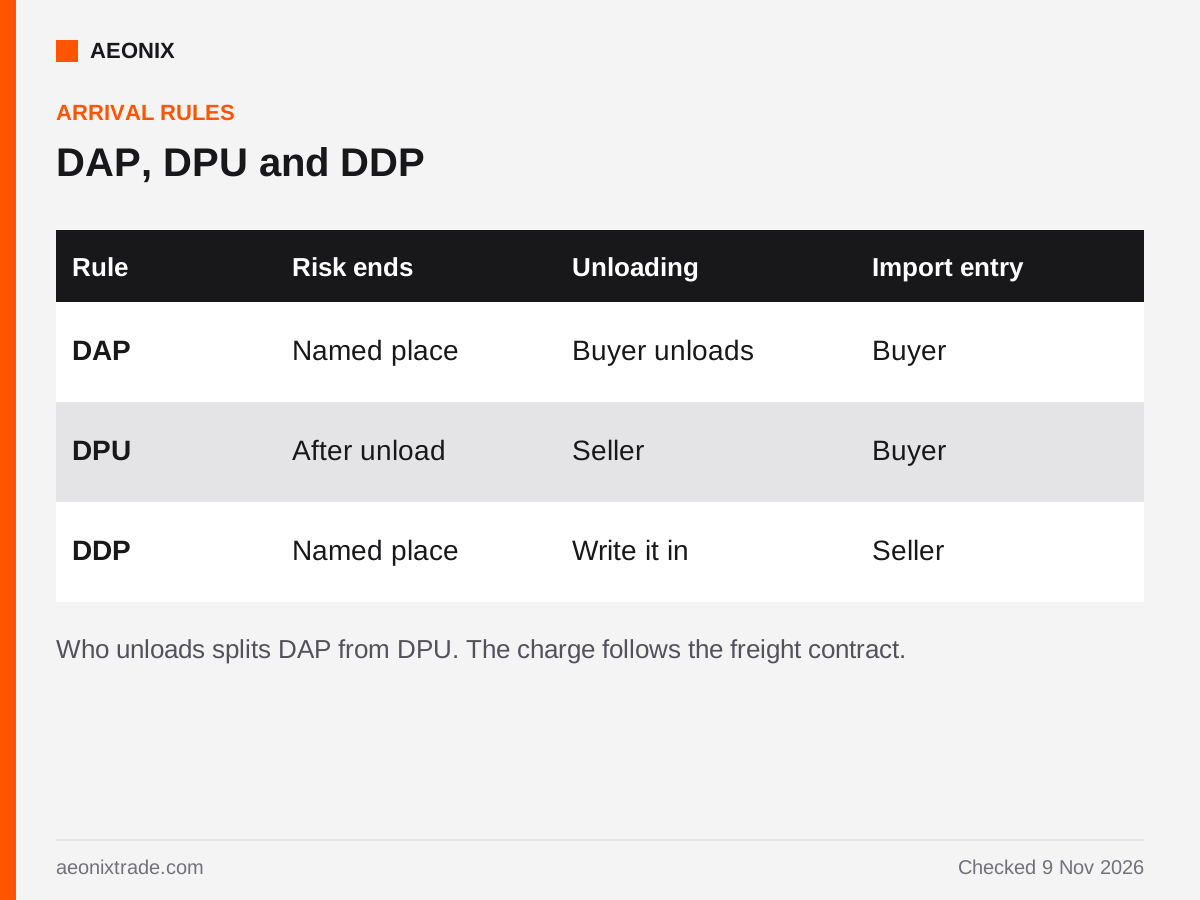
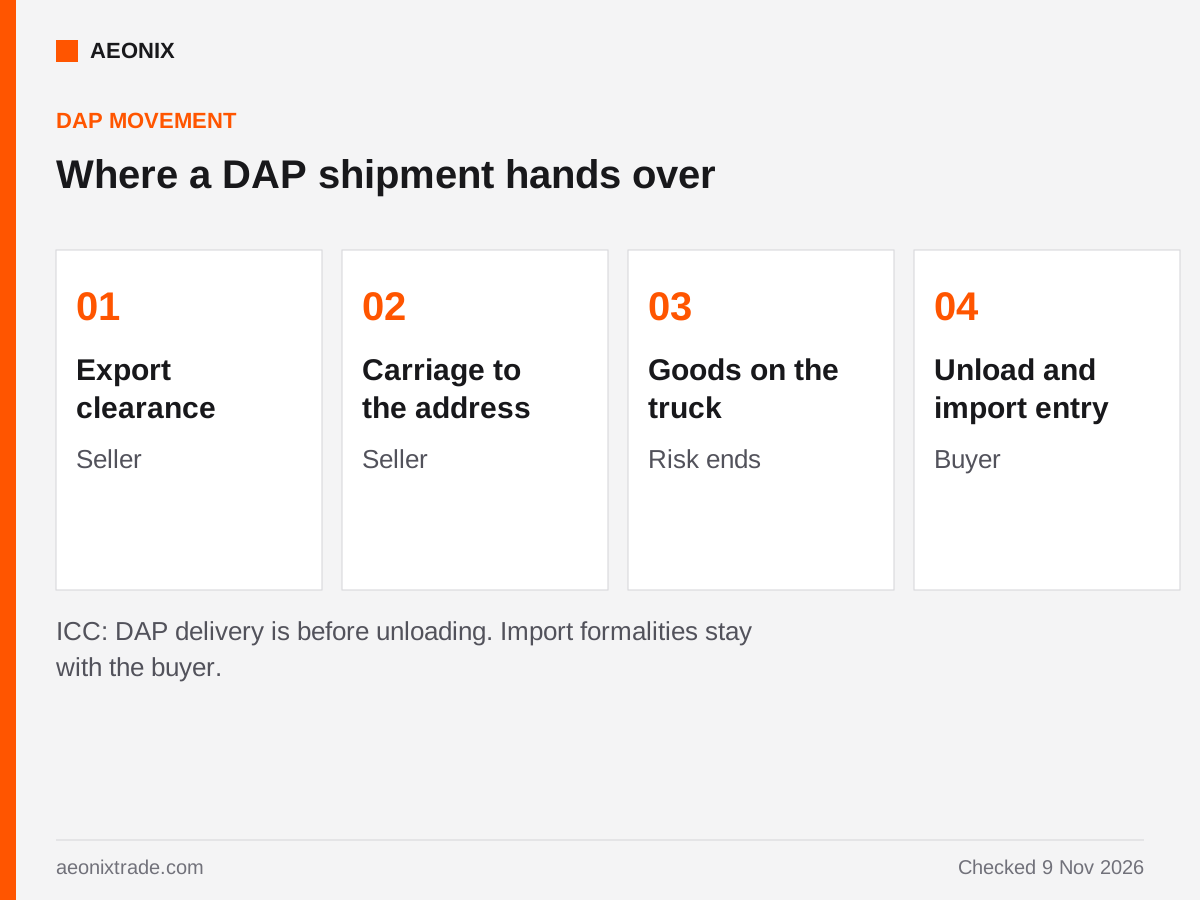
Three arrival rules sit next to each other, and only one of them pays the duty. Under DAP the seller delivers when the goods are placed at your disposal on the arriving means of transport, ready for unloading, at the named place. Unloading is not part of that delivery. Import clearance is not part of it either. DPU is the sibling that adds unloading. DDP is the sibling that adds import clearance, including duties and taxes, and the checklist warns that a seller may be unable to clear at all.
The ICC page on Incoterms 2020 says the unloading line in fewer words: under DAP the seller does not unload the goods; under DPU the seller does. Delivery under DAP happens before unloading. If your warehouse needs the cartons off the truck and inside the door, that work is a contract line, not a silent part of the three letters.
A DAP price and a DDP price are not two ways of writing the same freight. The gap is the import entry: who may file it, whose tax identity is on it, and which duty and tax the seller thinks they can pay and recover. Those amounts come from the destination tariff for the classification you agreed. This page does not state a rate. The importer of record page is where the US and EU filing roles are spelled out. If the seller cannot be that person, DAP with you as the importer is the cleaner contract. The checklist asks whether the seller can obtain import licences and recover import VAT before anyone chooses DDP.
Read the named place before you read the unit price. "DAP Rotterdam" can mean a terminal, a CFS, or your receiving door. The ICC checklist notes that disputes still arise over terminal handling, container rental and customs processing charges even after a rule is named, because the rule is general. Add the address, who unloads, and who pays the terminal, in the contract, on top of the rule.
A typical case
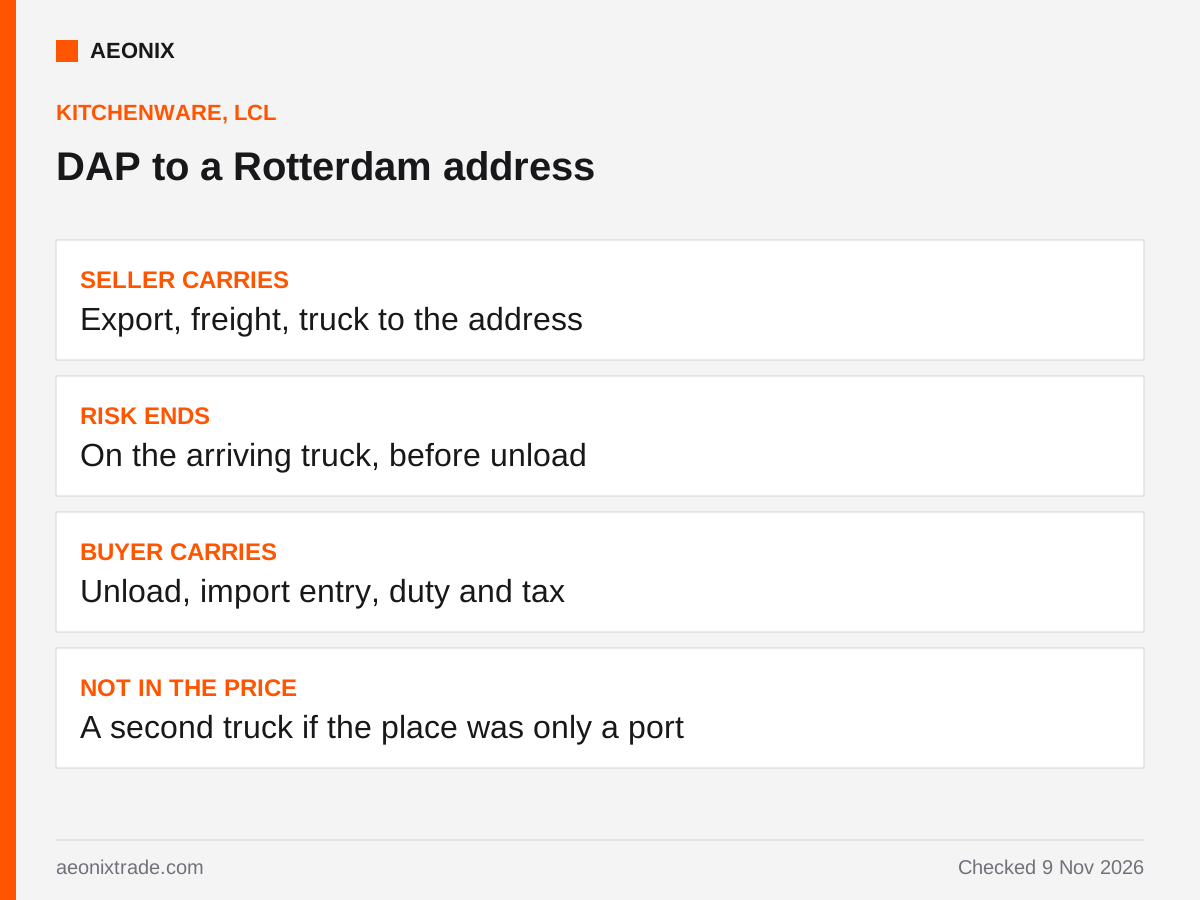
A buyer of stainless kitchenware consolidates several Ningbo factories into one LCL shipment. The quote says DAP, and the named place is the buyer's receiving address in Rotterdam, not "the port of Rotterdam." The seller books the sea freight and the truck to that address. Risk stays with the seller until the goods are at the buyer's disposal on the arriving truck, before anyone unloads them. The buyer holds the EU customs registration, files the import, and pays duty and tax from the EU TARIC measure for the line the broker classifies. The buyer also books the forklift. None of those import amounts belong inside the DAP definition, and none of them are printed here.
The same factories also offer DDP to that address. The DDP number is higher, and the attachment does not show the duty line. That is the quote to slow down. Ask whose name will be on the Dutch entry, and whether that party can clear kitchenware that needs a food-contact file. If the answer is a freight forwarder's email and not a named importer, you do not have a DDP contract yet. You have a DAP movement with an extra number on the proforma.
CFR and CPT and CIP are the neighbouring shipment contracts, where the seller may pay the main freight and the risk still moves in the seller's country. DAP is an arrival contract. The checklist draws that line before it draws the insurance line.
What still sits with you
DAP does not classify the goods, and it does not make them legal to sell. The seller's willingness to truck them to your door does not answer labelling or a product rule. Agree the description on the commercial invoice before production, and look up the duty on the destination tariff the day you price the order. Landed cost is your stack, whoever pays the freight invoice. Under DAP the seller's price may cover carriage to the named place. It does not cover duty or tax, and it does not cover a second truck if the named place was a terminal. Unloading is not the seller's job. DPU is the rule where the seller unloads. The ICC Academy's note on the D rules still puts the unloading charge on the seller when the contract of carriage already says that charge is the seller's. If it does, do not budget the forklift a second time.
Container cargo often changes hands at a terminal before it is on a ship. DAP can still be the right arrival rule for that cargo, because DAP is an any-mode rule. The sea-only rules are a different fork, which the FCA page and the checklist both flag when the goods move in a container. Do not rewrite a DAP quote into FOB just because the cartons will cross an ocean.
The ICC says each rule lists its costs in articles A9 and B9, so a seller can show which costs they took. A single DAP number with no attachment is how a terminal charge appears after the vessel has sailed. Ask for that list. The place to send the named place, the unloading line, and who files the entry is the RFQ. How these rules sit next to the shipping papers is on Incoterms and shipping documents.
Before you accept the quote
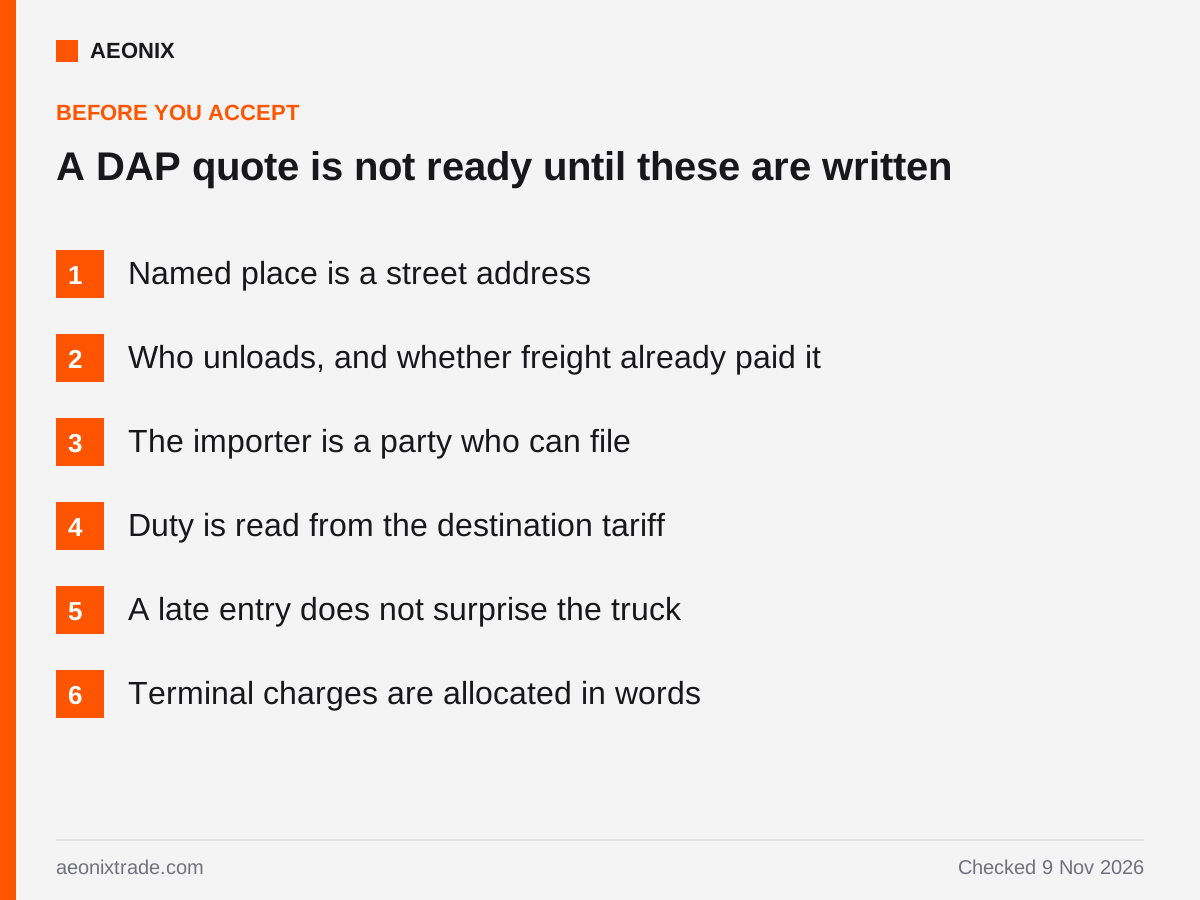
- The named place is an address, not a city and not "the port."
- Unloading is written in, or it is yours.
- You know who files the import entry, and that party can legally do it.
- Duty and tax are taken from the destination tariff, not from the seller's memory.
- The contract says what happens if the truck arrives and the entry is not ready.
- Terminal, container and customs-processing charges are allocated in words, not left to the three-letter rule.
Where DAP goes wrong
The first miss is treating DAP as a duty-paid price. The letters do not say duty. DDP does. If the proforma says DAP and the salesperson says the factory will "take care of customs," those two sentences disagree. Write down which one the contract will use.
The second miss is a named place that is a port terminal when you priced a door. You then pay a local truck the quote never showed, and you may also pay storage while that truck is booked. The rule did not fail. The place was vague.
The third miss is assuming the driver unloads. DAP delivery is on the arriving means of transport, ready for unloading. A warehouse that cannot unload on the day the truck arrives is holding goods the seller has already delivered. Put the appointment and the unloading party in the contract.
Frequently asked questions
What does DAP mean in shipping?
Delivered at Place. Under Incoterms 2020 the seller delivers at the named place of destination, on the arriving means of transport, ready for unloading. The buyer unloads, unless the contract adds that work, and the buyer clears the import.
What is the difference between DAP and DDP?
Both can deliver to a named place in your country. DAP leaves import clearance, duties and taxes with the buyer. DDP gives that clearance to the seller, and the ICC checklist says to use DDP with caution because the seller may be unable to clear. Unloading is a separate question: DAP does not include it.
Does DAP include unloading?
The seller is not obliged to unload. The ICC's Incoterms 2020 page uses that job as the line between DAP and DPU. The charge is separate: on DAP it is the seller's only when the contract of carriage already includes it. Read that contract before you add the cost again. If you need the seller to do the unloading, write it into the contract or use DPU, and name the place precisely.
Is DAP only for sea freight?
No. The International Trade Administration groups DAP with the any-mode rules, together with EXW, FCA, CPT, CIP, DPU and DDP. The sea and inland-waterway group is FAS, FOB, CFR and CIF.
Who pays duty under DAP?
The buyer. The amount is whatever the destination customs authority assesses on the classification and value. This page does not state a rate. Read it on that authority's tariff on the day you price the order.
See also DDP vs DAP.
Sources
- ICC: Incoterms 2020. Under DAP the seller does not unload; under DPU the seller does. Delivery under DAP happens before unloading.
- ICC Academy: D rules, Incoterms 2020. On DAP and DDP the seller pays the unloading charge only when the contract of carriage says it is the seller's. On DPU the seller unloads. Checked 10 November 2026.
- ICC: Incoterms 2020 checklist and flowcharts, PUB817E. DAP as an arrival rule without import clearance and without unloading. DDP adds import clearance, with the caution that clearance may be impossible.
- International Trade Administration: Know Your Incoterms. DAP in the any-mode group, with the instruction to insert the named place of destination.
Submit sourcing request
Can't find what you need?
Start with a product or image link, an approximate quantity and destination. Other details can follow.