Importer of Record Explained: Who Is Legally Responsible for Your Shipment
Published by Aeonix Trade.
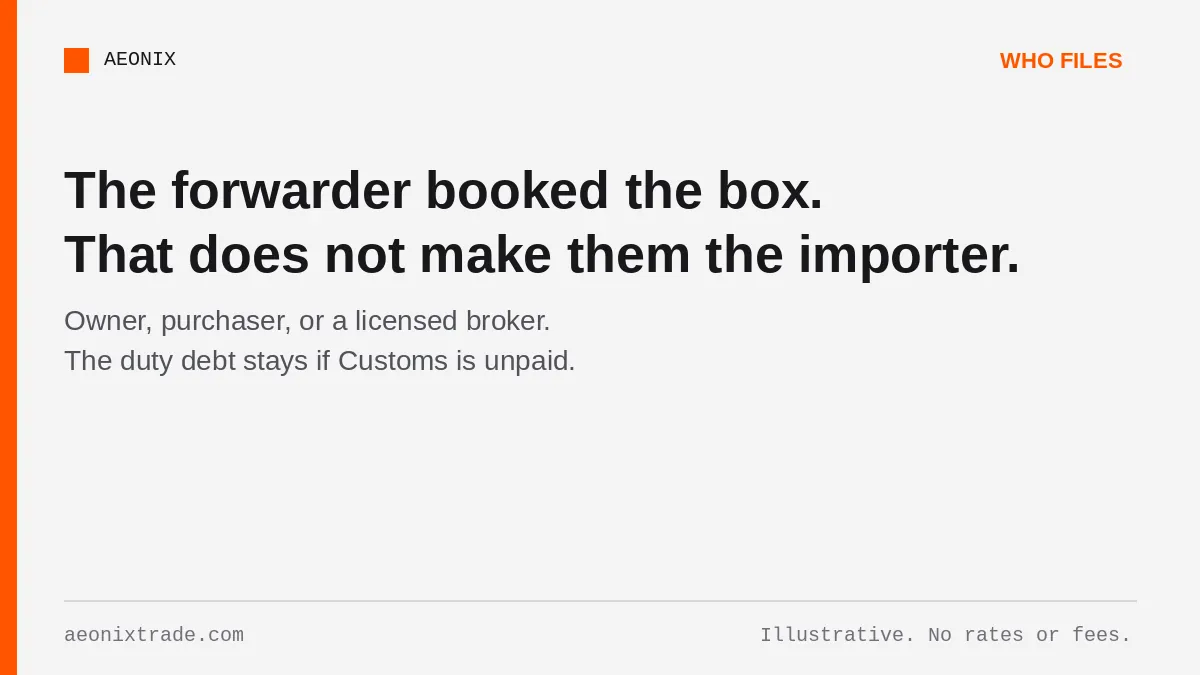
The importer of record is the party who files the customs entry and who is on the hook for the duty. On a shipment from China, that party is not "the forwarder" unless the law of the destination country says so, and in the United States it usually does not.
Last fact-checked: 9 November 2026.
Small buyers meet this phrase on a freight quote: "we can be your IOR." The sentence is a service offer. It is not the statute. Before you accept it, read who the destination country allows to file, and who still owes the duty if that service does not pay.
Who may file a US entry
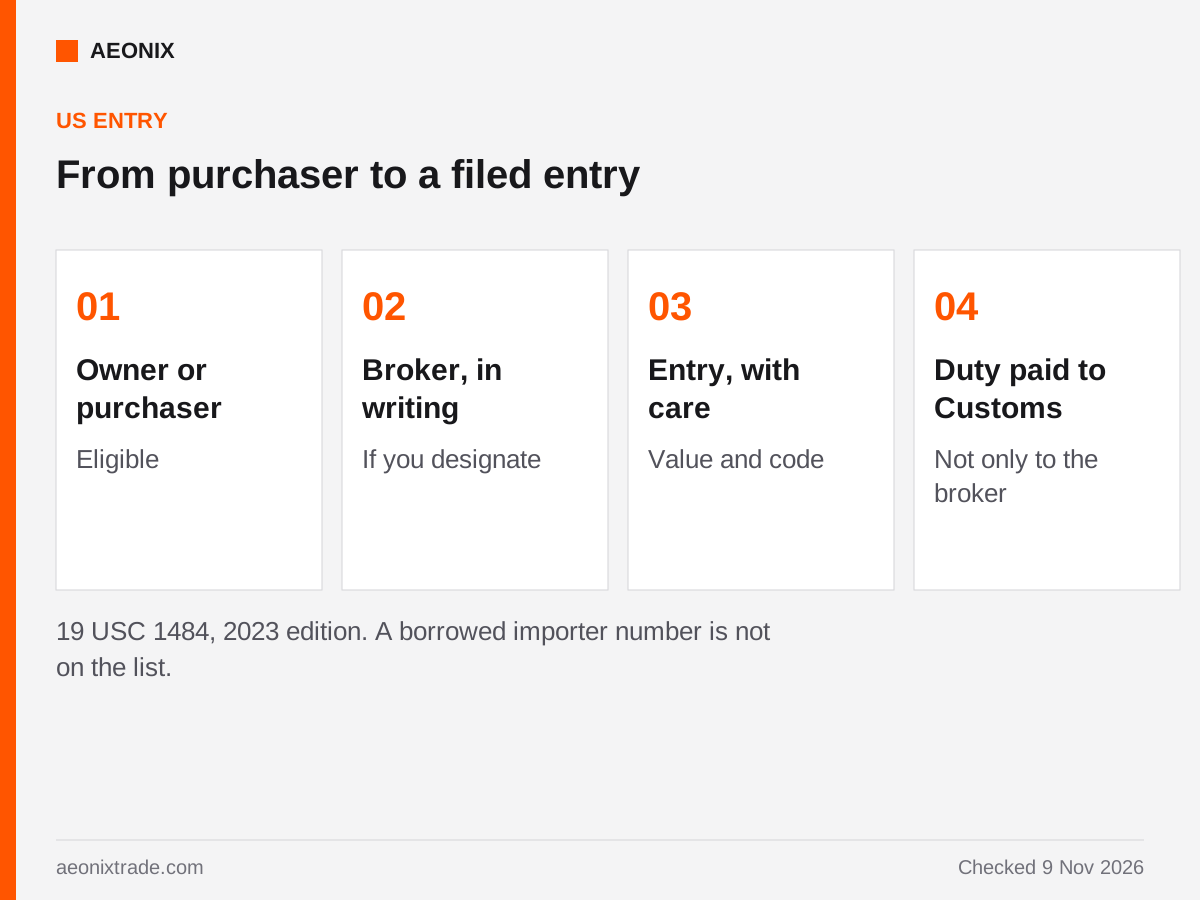
The 2023 edition of the United States Code, which is the edition GovInfo served for 19 USC 1484 on 9 November 2026, says one of the parties qualifying as "importer of record" shall, using reasonable care, make entry and then complete it. Completing the entry means filing the declared value, the classification and the rate of duty, plus whatever else Customs needs to see that other laws are met.
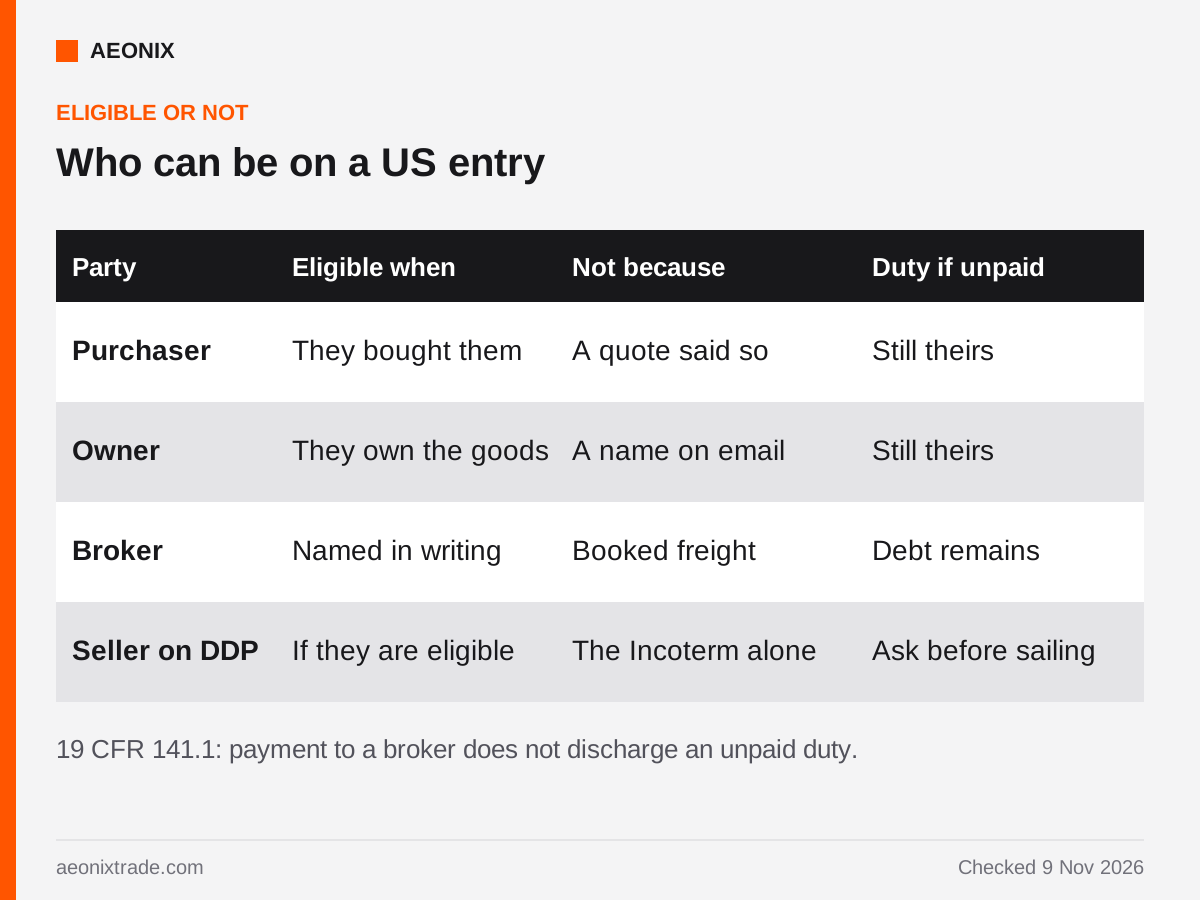
The same section says who is eligible to file those documents. They are filed by the owner or the purchaser of the merchandise or, when designated by the owner, purchaser, or consignee, by a person holding a valid customs-broker licence. The importer of record has to be one of the parties eligible to file. A consignee who declares that they are the owner or purchaser may be accepted. A friend with an importer number, a marketplace seller who is not in the contract, or a forwarder who was never designated, is not on that list.
19 CFR 101.1, read on the eCFR on 9 November 2026 and checked against the 2025 annual edition, defines "importer" as the person primarily liable for the duties, or an authorized agent. The importer may be the consignee, the importer of record, the actual owner if an owner's declaration and a superseding bond have been filed, or a warehouse transferee in the case the regulation describes. "Importer of record" and "importer" are used carefully in that regulation. Do not collapse them into "whoever's name is on the email."
Duty is not a courtesy charge. 19 CFR 141.1, read on the eCFR on 9 November 2026, says the liability for duties is a personal debt of the importer to the United States, discharged only by payment in full unless the law relieves it. Payment to a broker does not relieve the importer if the broker does not pay Customs. A bond does not relieve it either. The section says the bond protects the revenue. It does not retire the importer's liability.
A typical case
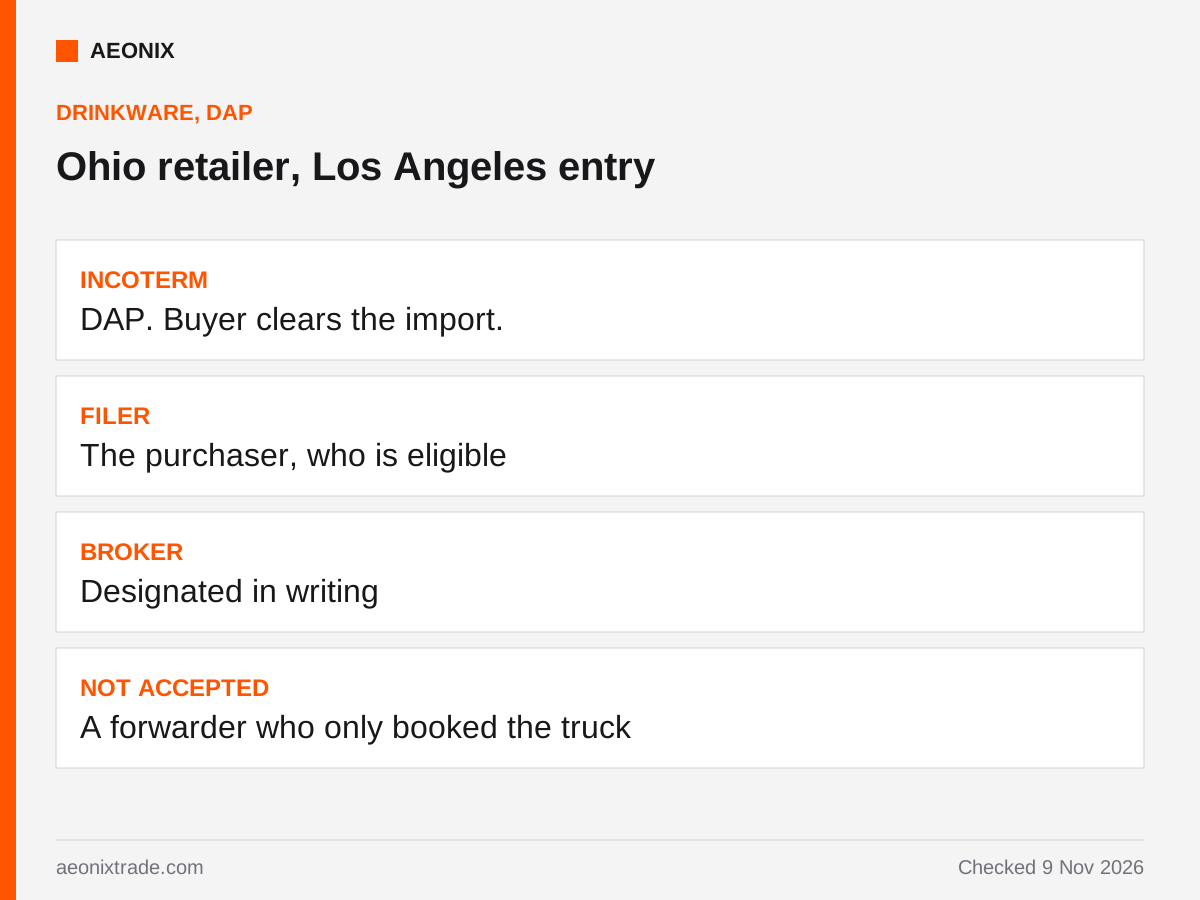
A retailer in Ohio buys drinkware from Ningbo under DAP to a Los Angeles warehouse. DAP leaves import clearance with the buyer. The retailer is the purchaser. Under 19 USC 1484, the purchaser is eligible to file. The retailer designates a licensed broker in writing, and the entry is made in the retailer's name, with the classification taken from the Harmonized Tariff Schedule for the goods actually shipped. The retailer pays the duty the entry assesses. This page does not state that amount.
The forwarder on the same shipment offers to "act as IOR for a small fee." The retailer asks two questions in writing. Is the forwarder a licensed broker designated by the purchaser, or is the forwarder proposing to be the importer of record itself? If the forwarder is not the owner or the purchaser, the statute does not make the forwarder eligible merely because it booked the truck. And if the broker will pay the duty and then invoice it, the retailer still reads 19 CFR 141.1: if that payment does not reach Customs, the debt is the importer's.
DDP does not appoint an importer by itself
DDP is the Incoterm under which the seller takes on import clearance. The ICC checklist warns that a seller may be unable to do it. The US statute adds a second problem. The party who files still has to be eligible. A foreign seller who is not the owner or the purchaser, and who has not got the owner, purchaser, or consignee to designate a licensed broker, does not become eligible because the proforma says DDP. Ask, before you accept the price, whose name will be on the entry and which paragraph of the statute that person fits. If the answer is vague, DAP with you as the purchaser and the importer of record is the contract that matches the law you can actually use.
Reasonable care, which 1484 requires of the party filing, reaches the classification and the value. The HS lookup is how you arrive at a line you can defend. The commercial invoice has to show the price you paid. Handing a broker a factory code and a round number, and calling that care, is how an entry looks finished until someone compares it with the purchase order.
The EU asks for an identity number, which is not the US job title
An EORI number is the European Union's identification for customs operations. The Commission's page, read 9 November 2026, says it is mandatory for clearance in the EU customs territory, including import, export and transit. Economic operators established in the EU need one. So do operators established outside the EU who lodge customs declarations, entry or exit summary declarations, temporary-storage declarations, or who act as a carrier. One person, one valid number. EORI identifies the operator. It does not copy the US phrase "importer of record," and a US importer number does not clear a shipment into Rotterdam.
Other countries have their own name for the person who may declare. Use that country's customs page. Do not carry a US IOR arrangement into a destination that has not adopted it. The filing sequence, once the person is named, is on customs clearance. The US process around the entry is on importing from China to the United States.
Before you let anyone "be the IOR"
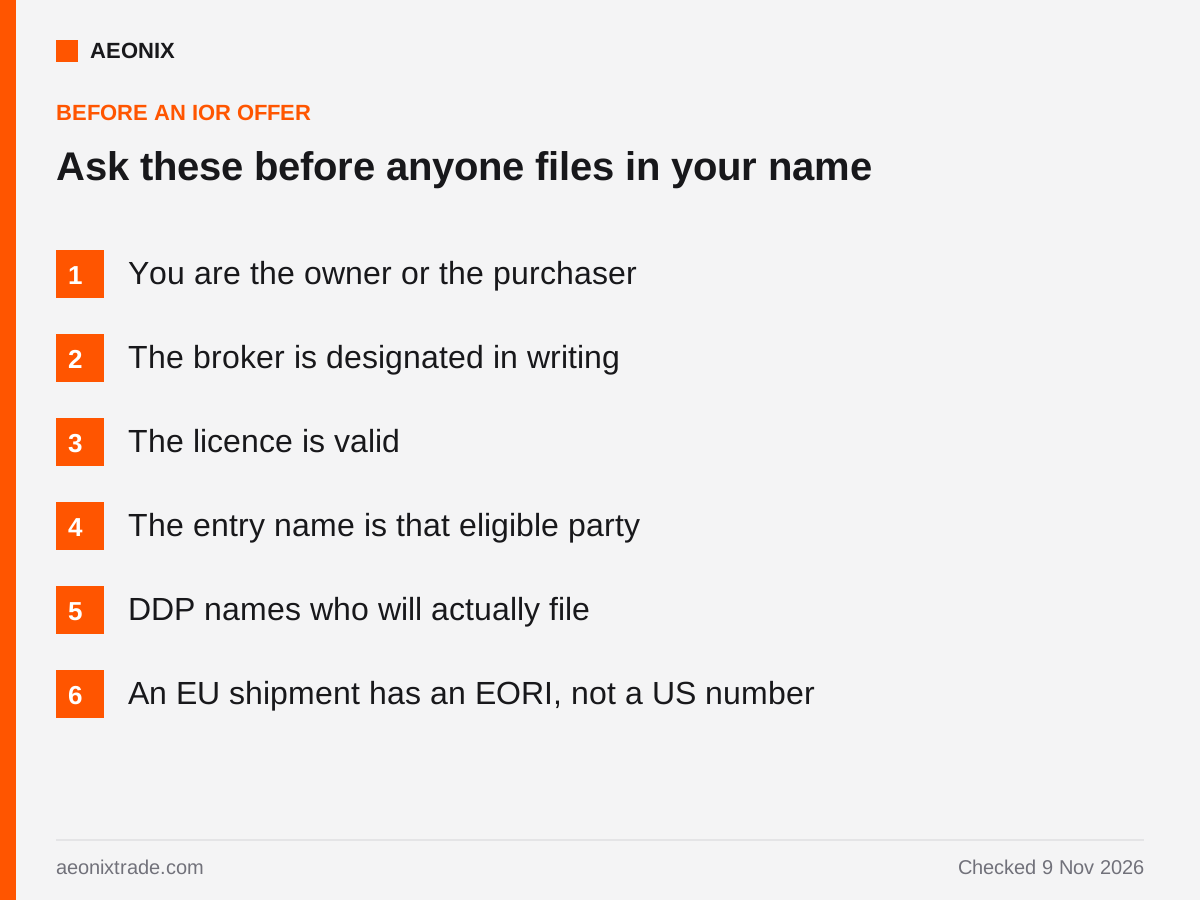
- You can say whether you are the owner or the purchaser. If you are neither, you are probably not the US importer of record.
- Any broker is designated in writing by the owner, purchaser, or consignee, and holds a valid licence.
- The entry will be in that eligible party's name, not in a friend's, and not in a name chosen because it already has a bond.
- You know that paying the broker does not end the duty debt if Customs is unpaid.
- A DDP quote names the person who will file and why that person is eligible.
- For an EU entry, the party lodging the declaration has an EORI number. A US importer number is not that number.
Put the named importer, the Incoterm, and the destination on the RFQ before a forwarder prices an "IOR service" into the freight.
Where the role goes wrong
The first miss is lending someone else's importer number to "get this one container in." The entry is a filing under penalty of reasonable care. The number belongs to the party who is eligible and who will owe the duty. A borrowed number borrows their liability and leaves you without a clean entry.
The second miss is a DDP price from a seller who cannot file and has not designated a broker. The cargo arrives, nobody is eligible, and the terminal clock runs while the contract is rewritten. Ask the eligibility question while the goods are still at the factory.
The third miss is believing the broker's invoice is the end of the duty. 19 CFR 141.1 says the opposite in plain language: if the broker does not pay Customs, the importer still owes the debt. Keep the proof that Customs was paid, not only the proof that you paid the broker.
Frequently asked questions
What does importer of record mean?
In the United States it is the party who qualifies to file the customs entry under 19 USC 1484 and who must use reasonable care when they do. The same statute says that party is the owner, the purchaser, or a licensed broker those parties, or the consignee, have designated.
Can my freight forwarder be the importer of record?
Only if the forwarder is actually eligible: the owner or purchaser, or a licensed broker designated in writing by the owner, purchaser, or consignee. Booking the freight does not confer that status. Ask which of those they are.
Does DDP make the Chinese supplier the importer?
DDP assigns import clearance to the seller as an Incoterm. It does not amend US entry law. The seller still has to be an eligible filer, or have an eligible broker designated. If they cannot, do not accept the DDP price as if the statute had moved.
If I pay the broker, am I done with the duty?
Not if the broker does not pay Customs. 19 CFR 141.1 calls the duty a personal debt of the importer and says payment to the broker does not discharge it in that case. A bond does not discharge it either.
Is an EORI number the same as being the importer of record?
No. EORI is the EU identification number for customs operations. The US importer-of-record rules are in 19 USC 1484 and the customs regulations. Use the identity the destination country actually asks for.
The person who files is also the one who holds an EORI number in the EU and who chooses which Incoterm to use.
Sources
- GovInfo: 19 USC 1484, United States Code, 2023 edition. Who qualifies as importer of record, reasonable care, and the owner, purchaser, or designated licensed broker who may file.
- eCFR: 19 CFR 141.1. Duty as a personal debt of the importer. Payment to a broker does not relieve it if Customs is unpaid. Read 9 November 2026.
- GovInfo: 19 CFR 101.1, CFR annual edition 2025. "Importer" as the person primarily liable for duties, who may be the consignee, the importer of record, the actual owner, or a warehouse transferee.
- European Commission: EORI. EU identification for import, export and transit. Not a US importer-of-record appointment. Read 9 November 2026.
Submit sourcing request
Can't find what you need?
Start with a product or image link, an approximate quantity and destination. Other details can follow.