How to Find the HS Code for a Product from China (and Check It with Customs)
Published by Aeonix Trade.
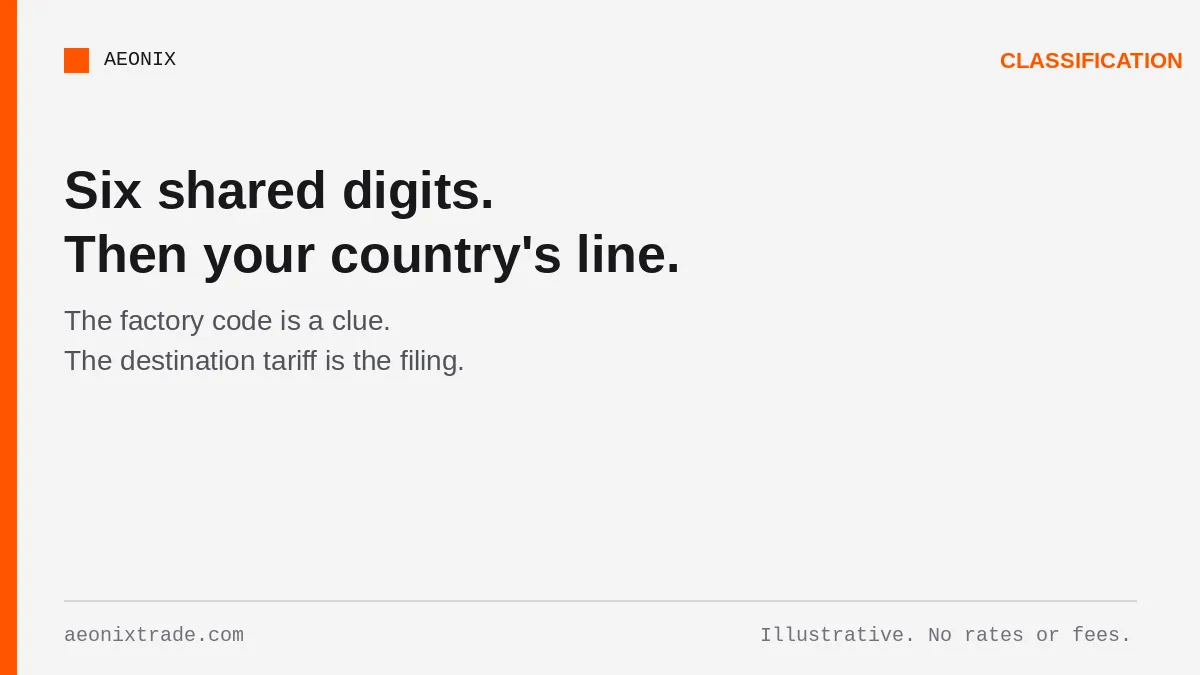
Find the HS code by what the goods are made of and what they do, then check that description in the destination country's tariff. The supplier's export code is a clue for the first six digits, not the line your broker will file.
Last fact-checked: 9 November 2026.
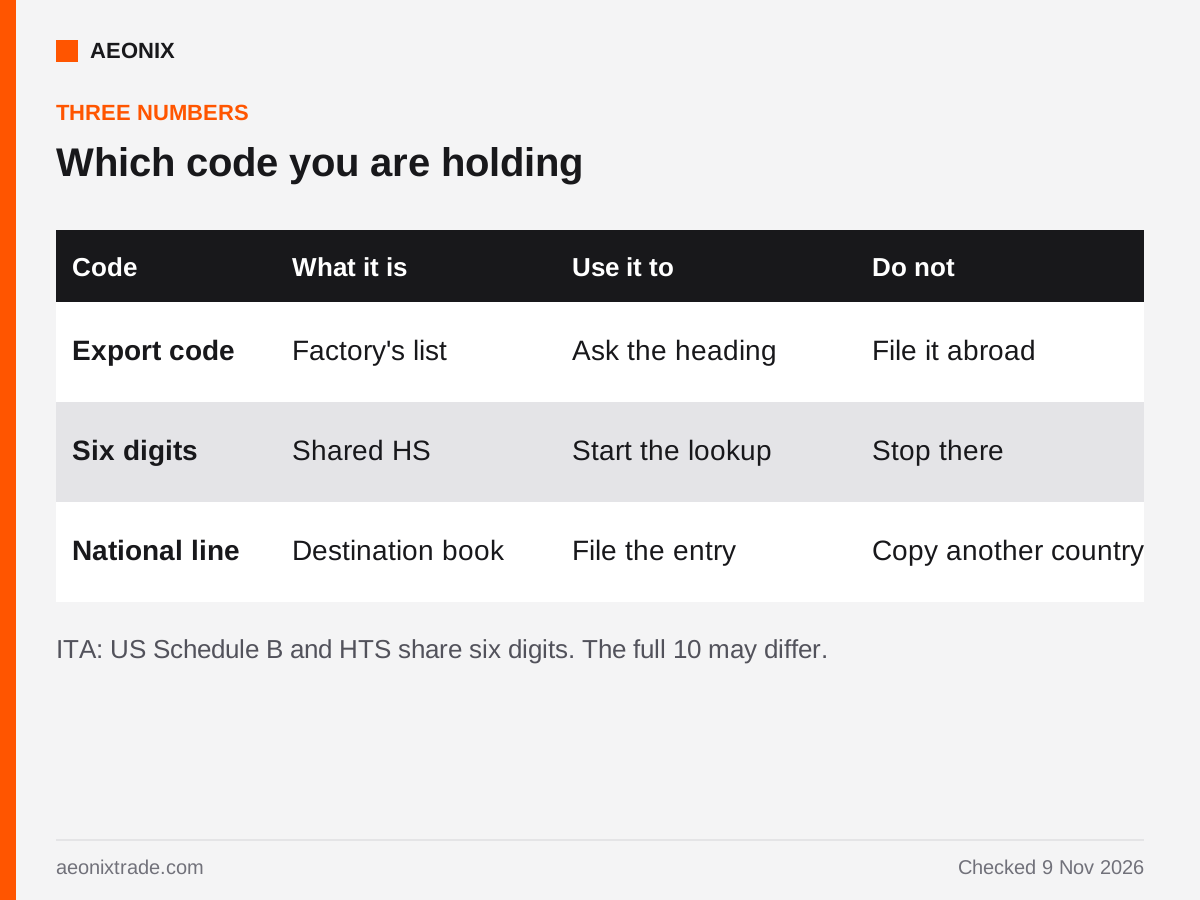
The World Customs Organization describes the Harmonized System as its international product nomenclature. On the page read 9 November 2026, the WCO says the system has more than 5,000 commodity groups, each identified by a six-digit code, and that more than 200 countries and economies use it as a basis for their customs tariffs. Over 98 percent of merchandise in international trade is classified in HS terms, on that same page. The official interpretation sits in the WCO Explanatory Notes. Those notes are a paid publication. The six digits are the shared start. Everything after them is national.
The International Trade Administration says the same split in US practice. Countries may add digits to the first six. The United States requires a 10-digit number. Schedule B, for US exports, is administered by the Census Bureau. The Harmonized Tariff Schedule, for US imports, is administered by the US International Trade Commission. The first six digits of a Schedule B number and an HTS number match. The full 10 digits may not. A factory code from China is a third national list. Use it to ask which heading text the factory matched. Do not paste it onto a US entry, an EU entry, or anyone else's.
A way to look it up without guessing a rate
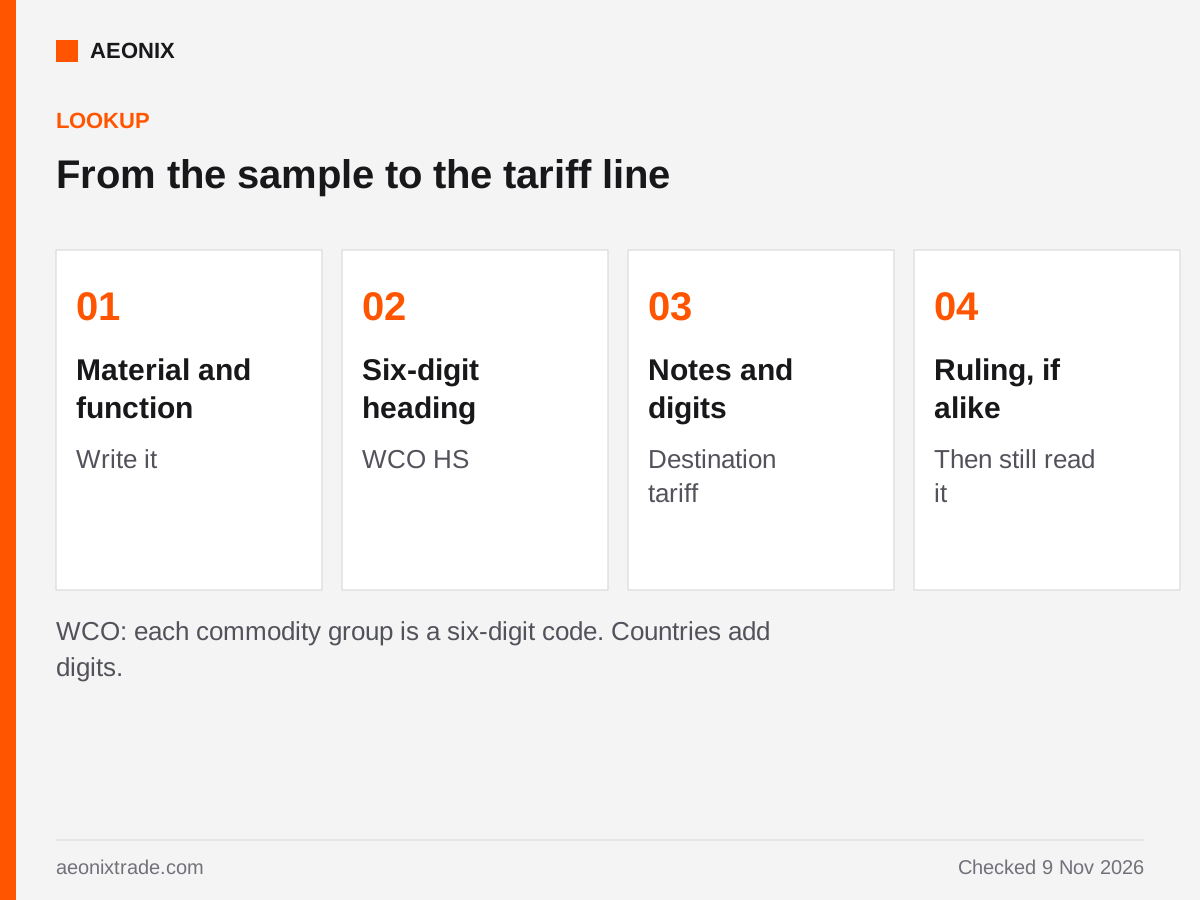
Write the product the way a customs officer will see it. Material, function, and whether you are shipping one article or a set. "Kitchen tool" is not a description. "Silicone spatula with a polypropylene handle, sold as a single utensil" is a description you can search.
Open the destination tariff and search those words. For a US import, that book is the Harmonized Tariff Schedule. Read the heading text and the section and chapter notes before you read a rate. For the European Union, the integrated tariff is TARIC. For the United Kingdom, the government publishes a trade tariff tool for finding a commodity code. Other countries have their own books. The factory does not maintain them.
When two headings both seem to fit, the Harmonized System's interpretation rules decide the order. The existing HS code page walks through that order for a set of goods, including the point where essential character matters. Use it for the rules. Use this page for the lookup. Do not freeze a duty rate into the purchase order. The rate on the official tariff, on the day of entry, is the rate. This page does not copy one.
In the United States, classification rulings are searched in the Customs Rulings Online Search System. A ruling on similar goods is a way to see how Customs has read a heading. It is not a substitute for reading the heading against your own sample. If your spatula is not the article in the ruling, do not borrow the ruling's number.
A typical case
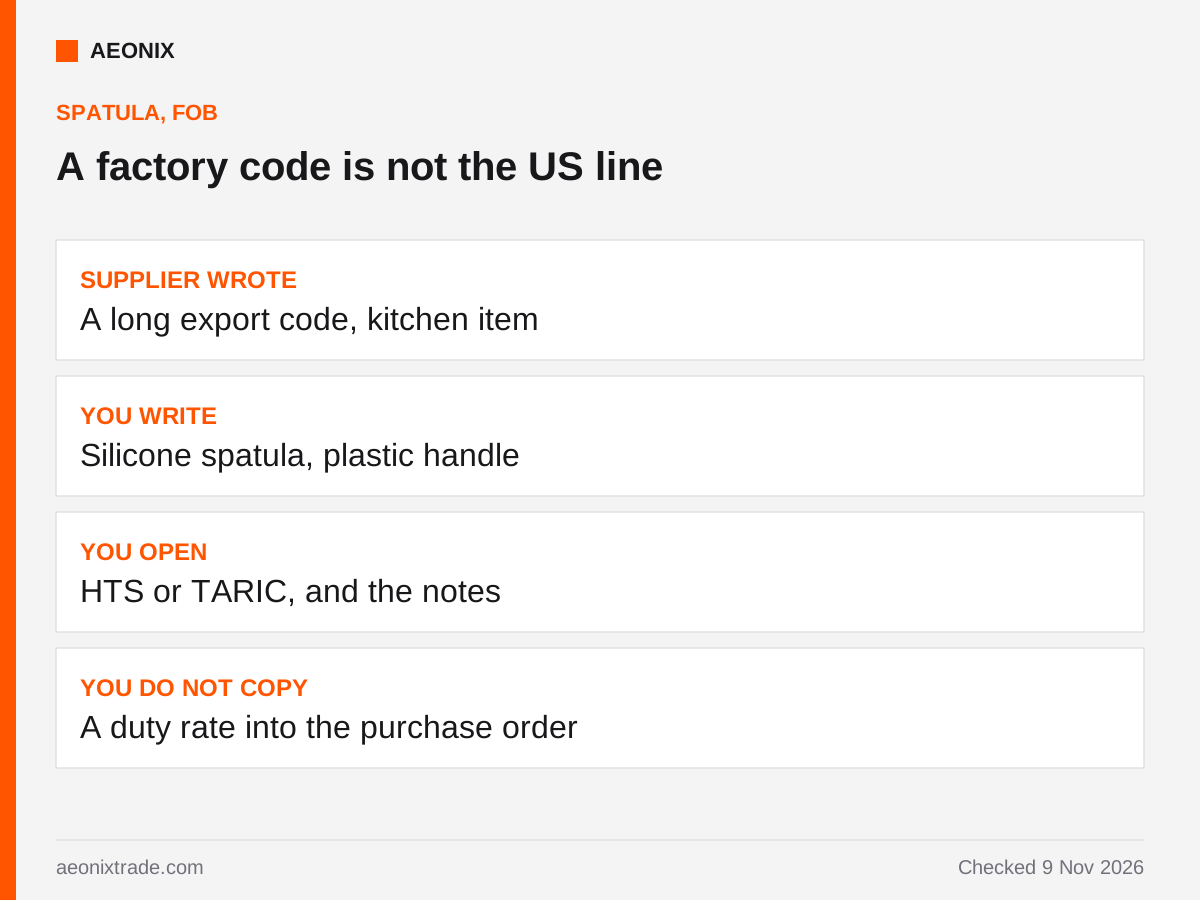
A buyer orders silicone spatulas from a Guangdong factory, FOB Shenzhen, one container by sea. The proforma shows a long numeric code and the words "kitchen item." The buyer asks the factory which heading text that code came from, and which material the code assumed. Then the buyer opens the US HTS and TARIC and searches "silicone" and "kitchen" and reads the notes, because the same shipment may be entered in more than one country over the year. The first six digits are the place the two books should be compared. The extra digits are not portable.
The commercial invoice is rewritten before production: silicone spatula, polypropylene handle, sold singly, not "kitchen item." That description is what the commercial invoice has to carry if a broker is going to classify rather than guess. If the shipment is a set, a spatula packed with a metal whisk and a textile pouch, the set rules on the HS page matter, and one code for "kitchen" will not survive contact with the notes.
The buyer does not type a duty percentage into the cost sheet from memory. The percentage, if the tariff states one, is read from the HTS or from TARIC on the day the order is priced, and again if the entry is later. The place those lines meet the rest of the shipment cost is the landed-cost calculator and the landed-cost worksheet. Both are empty until you bring a classification. Neither of them invents one.
What the supplier's code is good for
It is a conversation. Ask which heading, which material, and whether the code was for the spatula or for a set the factory shipped to someone else last year. The WCO says the HS is updated every five to six years through the Harmonized System Committee. A code copied from an old shipment can be a retired subheading. That is another reason to read the current tariff rather than the last commercial invoice.
The WCO also says the system is used for more than duty: controls, origin, quotas, statistics. A code that "has no duty" can still be a code that needs a licence, a marking, or a certificate. The first-time compliance checklist is the wider pass over those rules. Classification is one line on it. It is not the whole of it.
Before you put a code on the purchase order
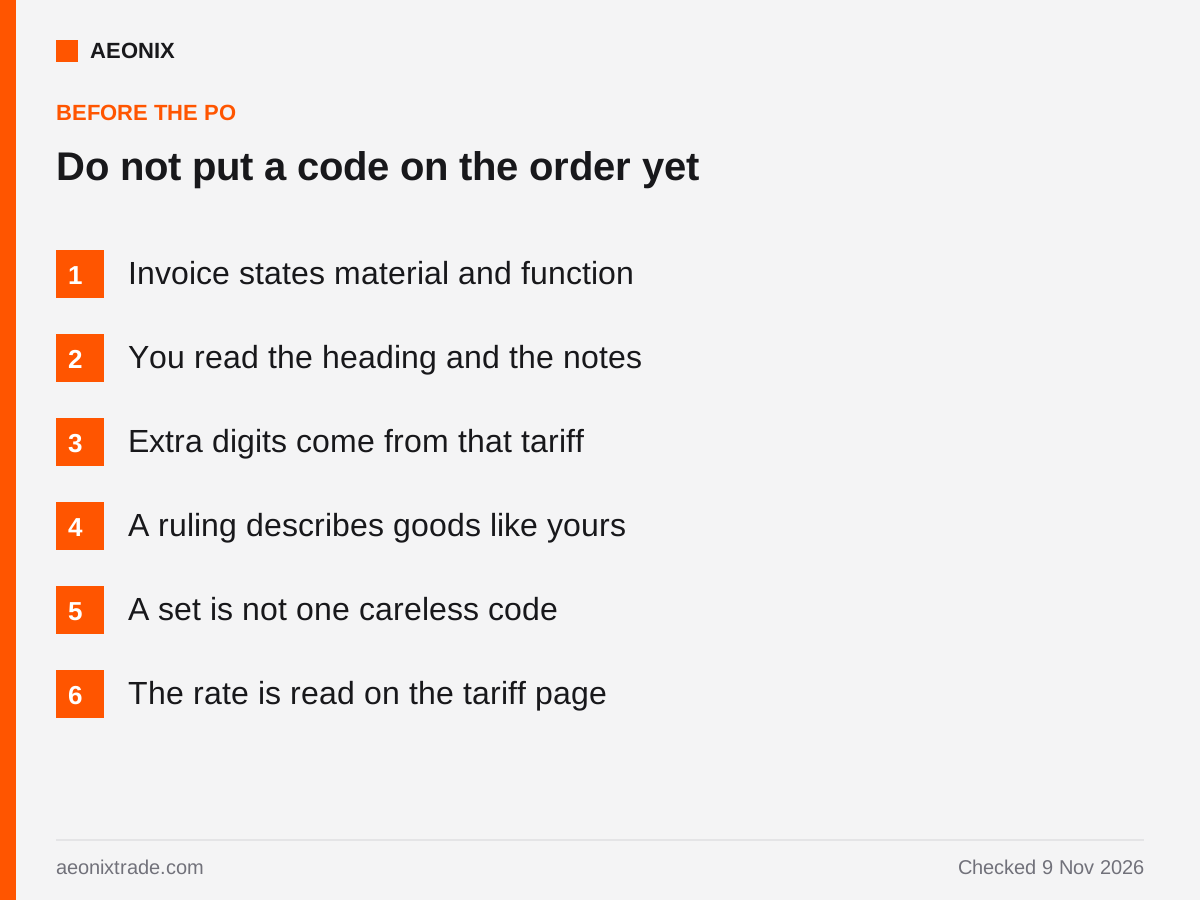
- The invoice description states material and function.
- You have read the heading text and the notes, not only a search snippet.
- The digits after the first six come from the destination tariff, not from the factory's export form.
- A ruling you rely on describes goods like yours, and you can point to it.
- Sets and spare parts are not forced into one code because they share a carton.
- The duty and tax line is opened on the official tariff, and it is not typed into this article.
The code is filed at entry by the party who is legally responsible for it. That role is on the importer of record page, and the filing sequence is on customs clearance. If you want a broker or a sourcing desk to start from your description rather than from a guess, put the material and the function on the RFQ.
Where the lookup goes wrong
The first miss is pasting the supplier's full export code into the destination entry. The first six digits are the shared language. The rest is another country's grammar. A broker who files those extra digits is filing a number the destination tariff may not contain.
The second miss is classifying from the product title on a marketplace. "Premium kitchen helper" can be silicone, steel, or an electrical appliance. The heading follows the article, not the adjective. Cut one open, or read the spec, before you search.
The third miss is shopping for the heading with the smallest duty. The WCO's point in publishing interpretation rules is that the same goods should fall in the same place. A convenient heading that the notes exclude is the heading that gets the entry questioned, and the question arrives with the goods already on the terminal.
Frequently asked questions
How do I find the HS code for a product from China?
Describe the material and the function. Use the first six digits as the WCO heading. Then open the destination tariff, read the notes, and use that country's extra digits. Check a ruling only when the goods in the ruling are like yours.
Is the supplier's HS code the one I should file?
Only as a starting clue for the six-digit heading. The International Trade Administration notes that even two US lists, Schedule B and the HTS, can differ after six digits. A Chinese export code is a further national list. File the destination country's line.
How many digits is an HS code?
The WCO identifies each commodity group with six digits. Countries add more. The United States requires 10 for imports and exports. Do not assume every other country uses 10. Open that country's tariff.
Where do I see the duty rate?
On the destination tariff for the line you are actually filing: the US HTS, EU TARIC, the UK trade tariff tool, or the equivalent book. This page does not state a rate. Rates and measures change, and they are not part of the six-digit definition.
What if two headings both fit?
Use the Harmonized System's interpretation rules, which the WCO says support uniform classification. The HS code page on this site walks through that order for a set. If you are still unsure, ask the broker to seek a ruling rather than picking the cheaper heading.
Where a preference certificate needs the same code, see Form E and other FTA certificates. The term on the quote is a separate choice, on which Incoterm to use.
Sources
- WCO: What is the Harmonized System?. Six-digit nomenclature, more than 5,000 commodity groups, used by more than 200 countries and economies. Read 9 November 2026. The page also says the HS is updated every five to six years.
- International Trade Administration: Harmonized System codes. Six shared digits, US 10-digit numbers, Schedule B for export and the HTS for import.
- USITC: Harmonized Tariff Schedule. The US import classification book. Read the rate there, not here.
- CBP: Customs Rulings Online Search System. Search for rulings on similar goods. A ruling is about the goods it describes.
Submit sourcing request
Can't find what you need?
Start with a product or image link, an approximate quantity and destination. Other details can follow.