A Form E certificate of origin is not a chamber stamp
Published by Aeonix Trade.
Last fact-checked: November 10, 2026.
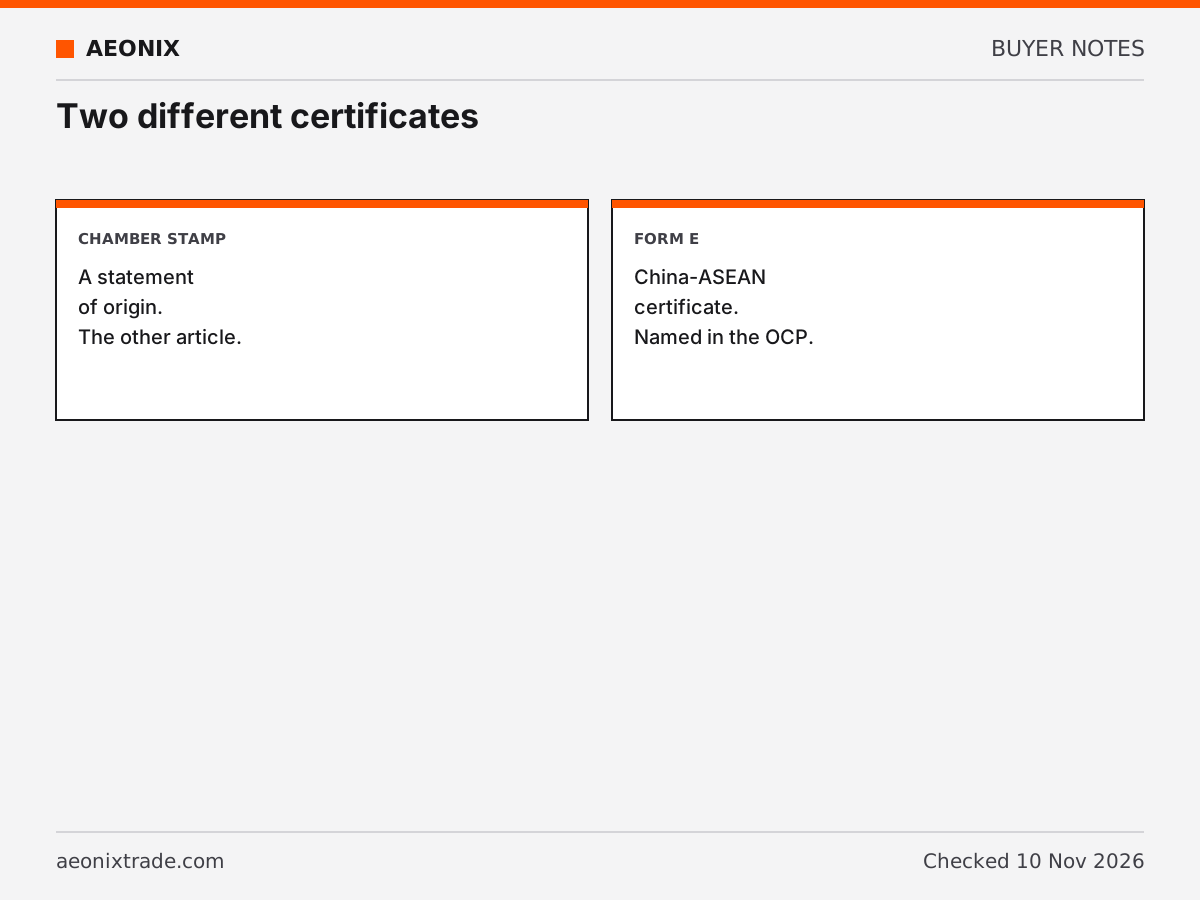
A buyer of stainless-steel tumblers wants a lower duty into Indonesia and asks the Ningbo supplier for "a certificate of origin." What comes back is a chamber stamp that says the goods are Chinese. That stamp may be a true statement about where the goods come from. It is not, by itself, the form the China-ASEAN agreement uses when someone wants the preference. The preference is a claim under one named agreement. The form is whatever that agreement names. This page is about that form. It does not print a duty rate.
The ordinary certificate, and why a chamber stamp does not repair a mismatched invoice, is a certificate of origin. The heading on the invoice has to be a heading you can defend, which is HS codes. The description the certificate repeats has to be the commercial invoice and the packing list. The shelf for the whole import is importing from China.
Form E is one agreement's certificate
The revised operational certification procedures for the rules of origin of the China-ASEAN free trade area, in the English text on the Chinese Ministry of Commerce FTA site, read on 10 November 2026, are about the Certificate of Origin (Form E). The issuing authority is whatever authority that party has authorised. The certificate is issued by the exporting party's issuing authority. At export, the exporter or an authorised representative applies in writing, with documents that show the goods qualify. For China, a footnote in that text says a manufacturer can apply where the manufacturer needs to authorise someone else to export.
The same procedures say the form is in English, on A4, with one original and two copies, a unique reference number, and one consignment. The original is forwarded by the exporter to the importer for the customs authority. The issuing authority is told to check that the description, quantity, weight, marks, and packages conform to the goods, and that the origin statement matches the evidence. None of that is a duty reduction. The rate, if any, is the destination customs tariff for the agreement you actually claimed, on the day you claim it. It is not on this page.
| Chamber or general certificate | Form E | |
|---|---|---|
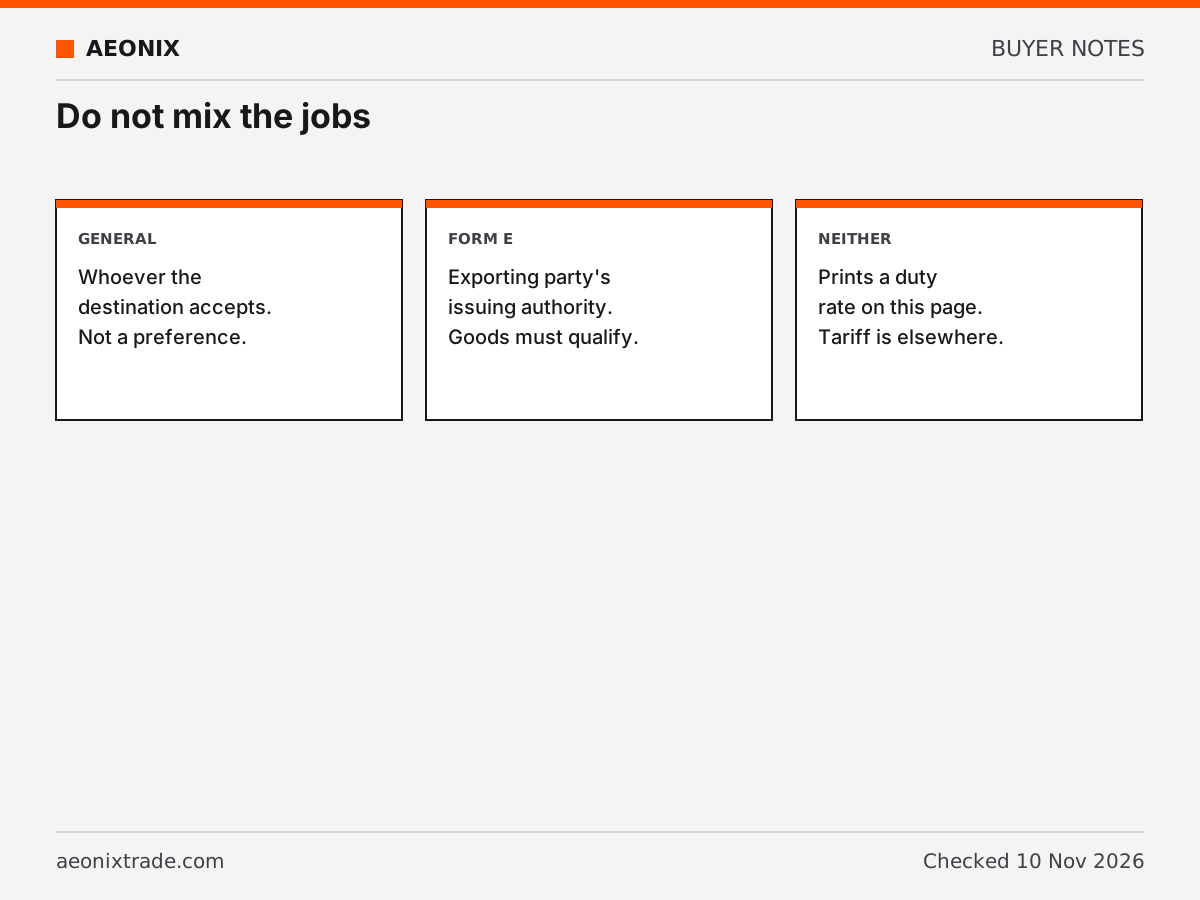
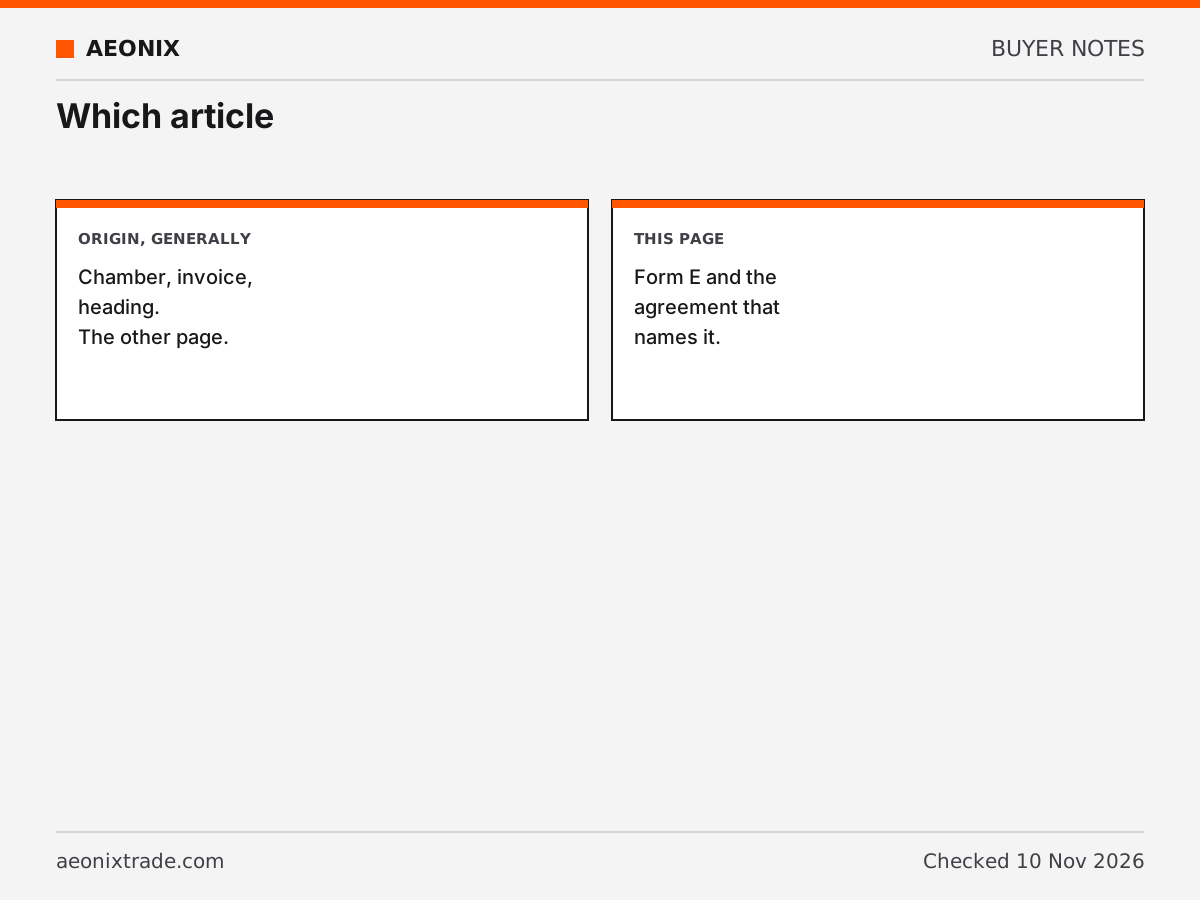
| What it is for | A statement of origin the destination, a bank, or a buyer asked for. The other article. | The certificate named in the China-ASEAN operational procedures that were opened. |
| Who issues it | Whoever that destination accepts. Often a chamber. Not automatically the Form E issuing authority. | The exporting party's issuing authority, on an application that shows the goods qualify. |
| What has to match | The invoice, the heading, and the cartons. A stamp does not repair a mismatch. | The procedures say description, quantity, weight, marks, and packages have to conform. |
| What it does not do | It does not switch on a preference the agreement never gave you. | It does not state a percentage. This page does not invent one. |
Other agreements are other forms. The Ministry of Commerce FTA site, opened the same day, also carries material on other agreements, including RCEP. This article does not rename those certificates as Form E. If the shipment is not a claim under the China-ASEAN agreement, asking the supplier for Form E is the wrong request until the agreement you want names that form.
What to check before anyone applies
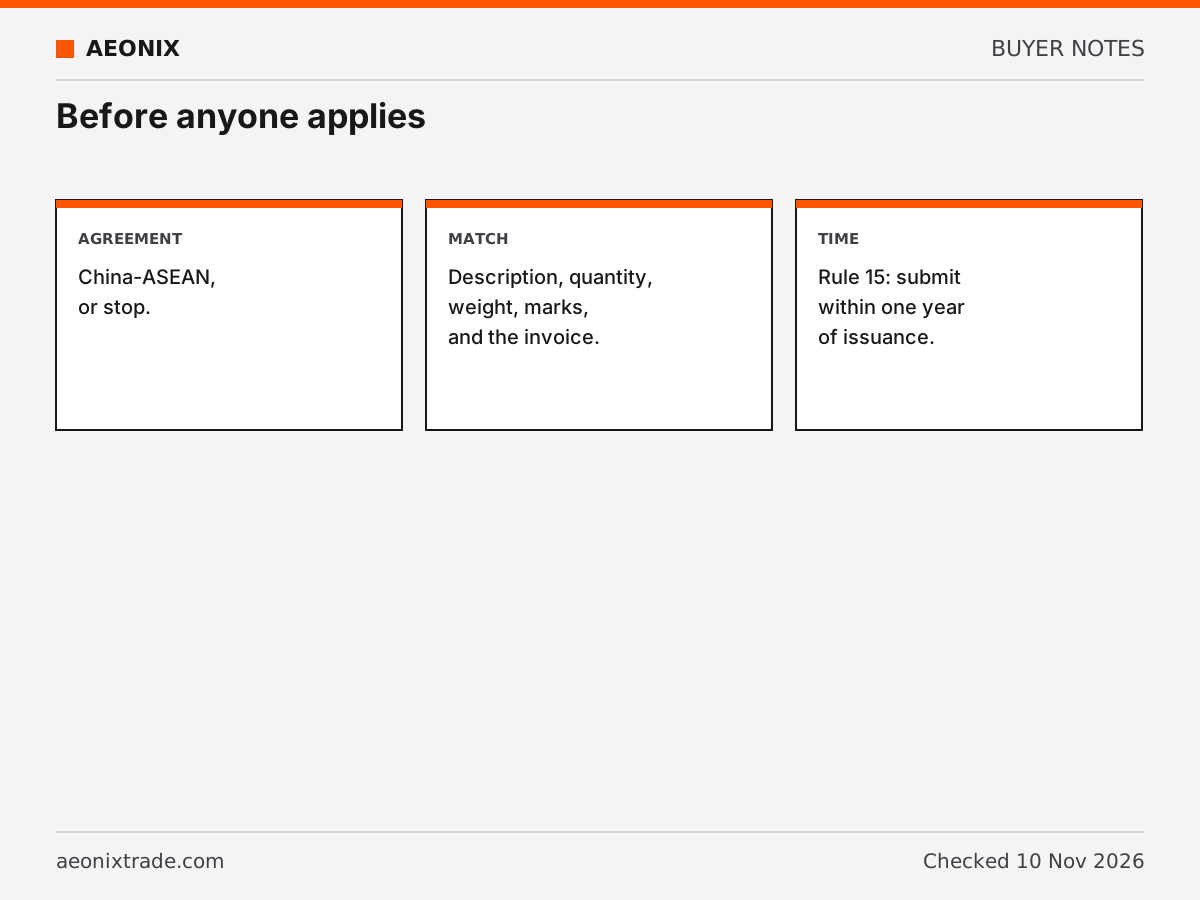
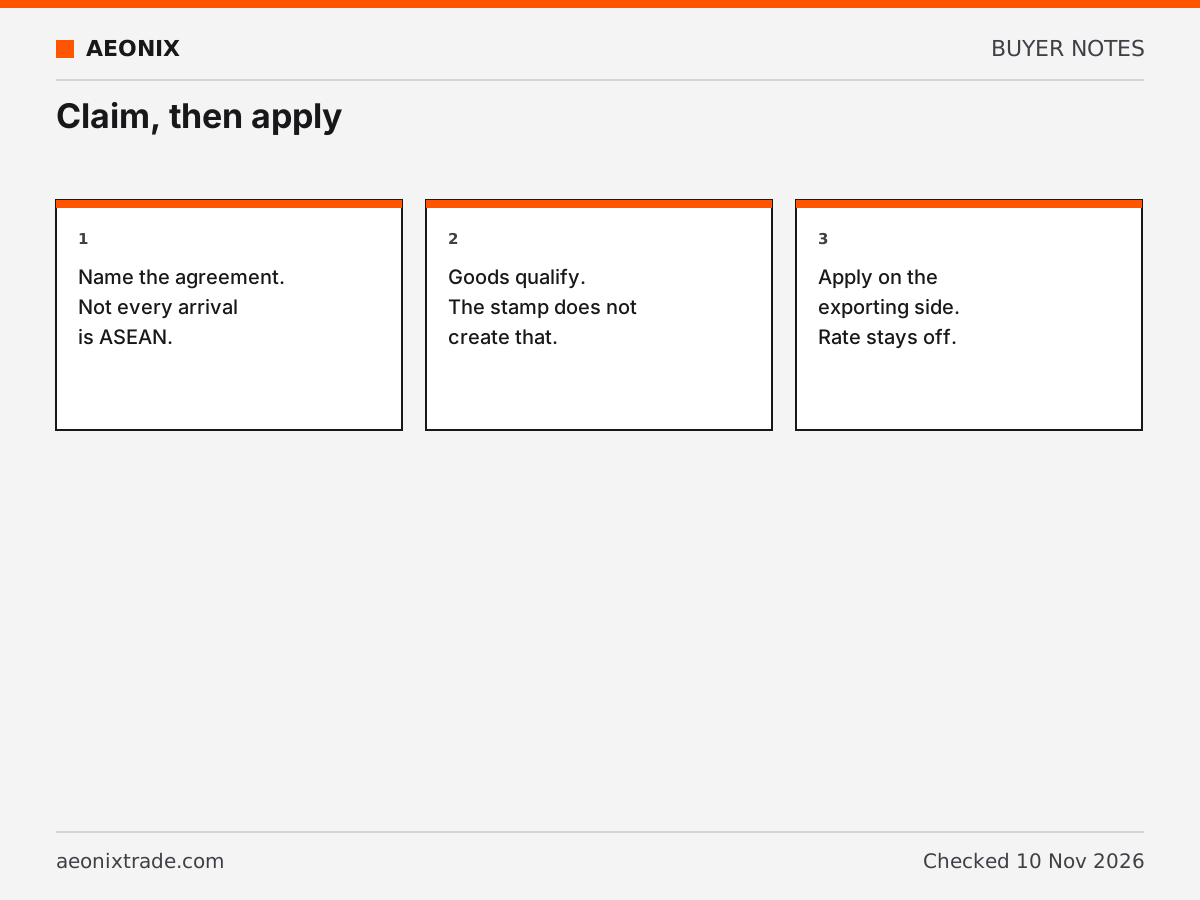
- The agreement is the one the destination will apply. ASEAN is not a synonym for every Asian arrival.
- The goods qualify under that agreement's rule. The factory's process and the materials do that. A stamp does not.
- The description, quantity, weight, and marks will match the invoice, the packing list, and the cartons. The procedures say the issuer checks this.
- The heading is the heading on the entry, not a shorter code chosen because it looked familiar. That is the HS page.
- You have not written a duty cut into the landed-cost sheet. The figure lives on the destination tariff.
- The timing in the procedures you are using. In the text that was opened, Rule 15 says the certificate remains valid and must be submitted to the importing customs authority within one year of issuance. Rule 11 says it is in principle issued before or at shipment.
Rule 11 also describes an exceptional retroactive issue, marked as issued retroactively, within twelve months from the date of shipment, under the exporting party's rules and subject to the importing party's laws. Those periods are in the procedures that were opened on 10 November 2026. A later amendment would be on the customs or FTA site. A fee is not stated in that text. A Chinese customs service guide that is sometimes quoted for a processing time returned an access error the same day, so no office-hours promise is printed here. The General Administration of Customs English home was open and is the administration. It did not, on that home page, replace the Form E procedures.
Tumblers for Jakarta
The supplier is ready to ship. The buyer asks for Form E on the morning of the booking. Nobody has checked whether these tumblers meet the agreement's rule, and the invoice description is not the description the supplier put on a draft certificate. The procedures tell the issuing authority to refuse that kind of mismatch. Fix the documents first. Then apply. The arrival file for Indonesia is the Indonesia import guide. The same split, form here and customs file there, is Malaysia, Thailand, Vietnam, the Philippines, and Singapore.
Is Form E the certificate for every Chinese export?
No. It is the certificate named in the China-ASEAN procedures that were opened. A shipment to a country outside that agreement, or a claim under a different agreement, needs the form that agreement names.
Can the buyer apply in China?
The procedures put the application on the exporter, or an authorised representative, on the exporting side. The importer receives the original and presents it to the customs authority. The footnote about a Chinese manufacturer applies when that manufacturer is the one authorising the export. It is not a buyer's shortcut.
Name the agreement, the heading, and the description you need on the certificate when you send the RFQ. A request that only says "COO" will come back as the other document.
A preference certificate is used on the customs clearance sequence, beside finding the HS code, including on imports into Cambodia.
Official sources
- Ministry of Commerce of China, revised operational certification procedures for the China-ASEAN rules of origin, read 10 November 2026. Form E, the application, and Rules 11 and 15 are from this text. No preference rate is copied from it.
- China FTA Network, opened 10 November 2026. It carries more than one agreement, including RCEP material. Those agreements are not renamed as Form E here.
- General Administration of Customs of China, English home, opened 10 November 2026. The home page did not replace the Form E procedures.
Submit sourcing request
Can't find what you need?
Start with a product or image link, an approximate quantity and destination. Other details can follow.