CPT and CIP Incoterms Meaning: Carriage Paid and Insured
Published by Aeonix Trade.
CPT means Carriage Paid To a named place. CIP means the same carriage, plus insurance. In both rules the risk passes when the seller hands the goods to the first carrier, not when they reach that named place.
Last fact-checked: 9 November 2026.
The place in the rule is where the seller's freight money runs out. It is not where the seller's risk runs out. The International Trade Administration lists both with the any-mode rules: "CPT - Carriage Paid to (insert place of destination)" and "CIP - Carriage and Insurance Paid To (insert place of destination)." They sit with FCA, DAP and DDP, not with the sea-only group.
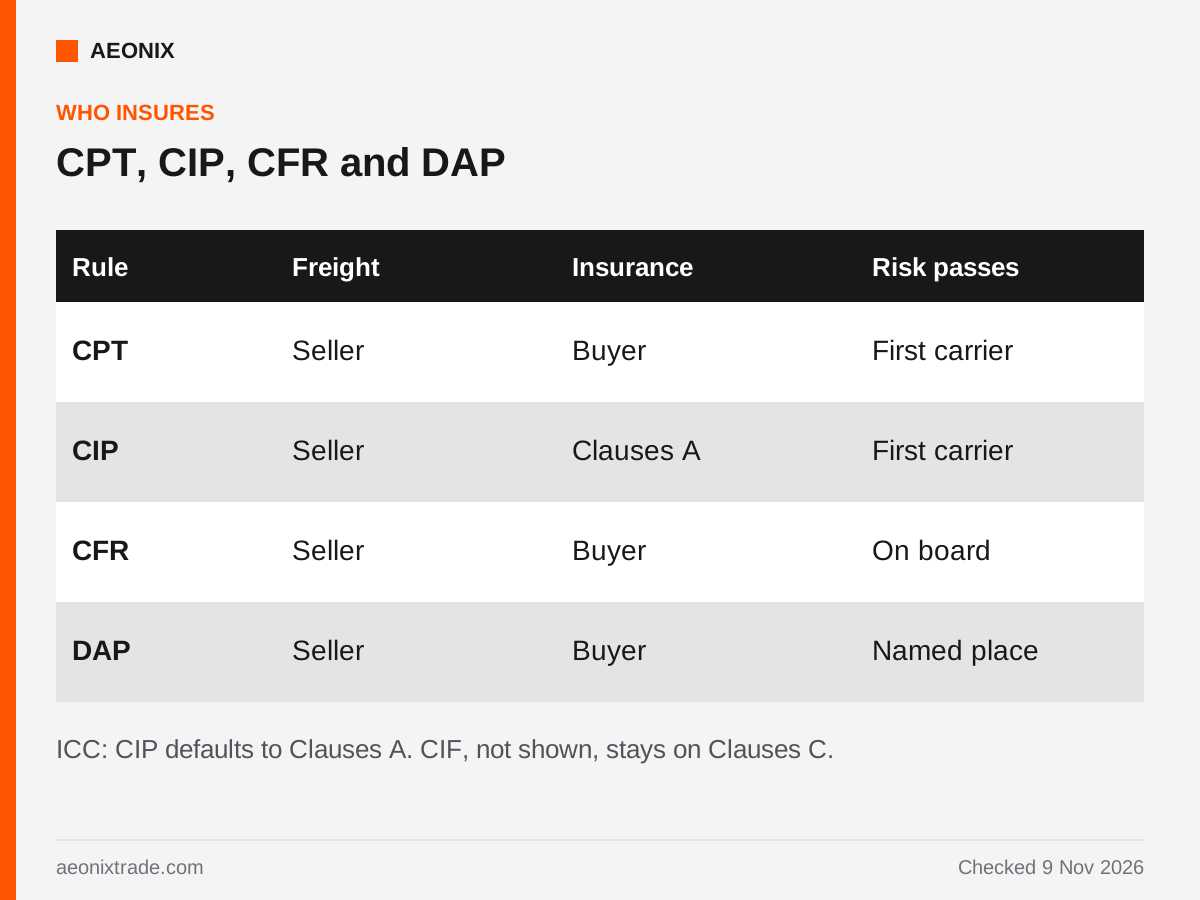
The ICC checklist (PUB817E, checked 9 November 2026) files CPT and CIP as shipment contracts. You want the seller's price to include the main carriage, and you accept the transport risk. Delivery, meaning the risk transfer, happens in the seller's country. Choose CPT when the seller should not pay for insurance. Choose CIP when the price should include insurance with all-risk cover, which the checklist describes as LMA/IUA Clauses A or similar. The ICC Incoterms 2020 page says CIP now requires cover compliant with Institute Cargo Clauses (A) or similar clauses. CIF, the sea rule, stays on Clauses (C) unless the parties agree more.
Two places, and only one of them is the risk point
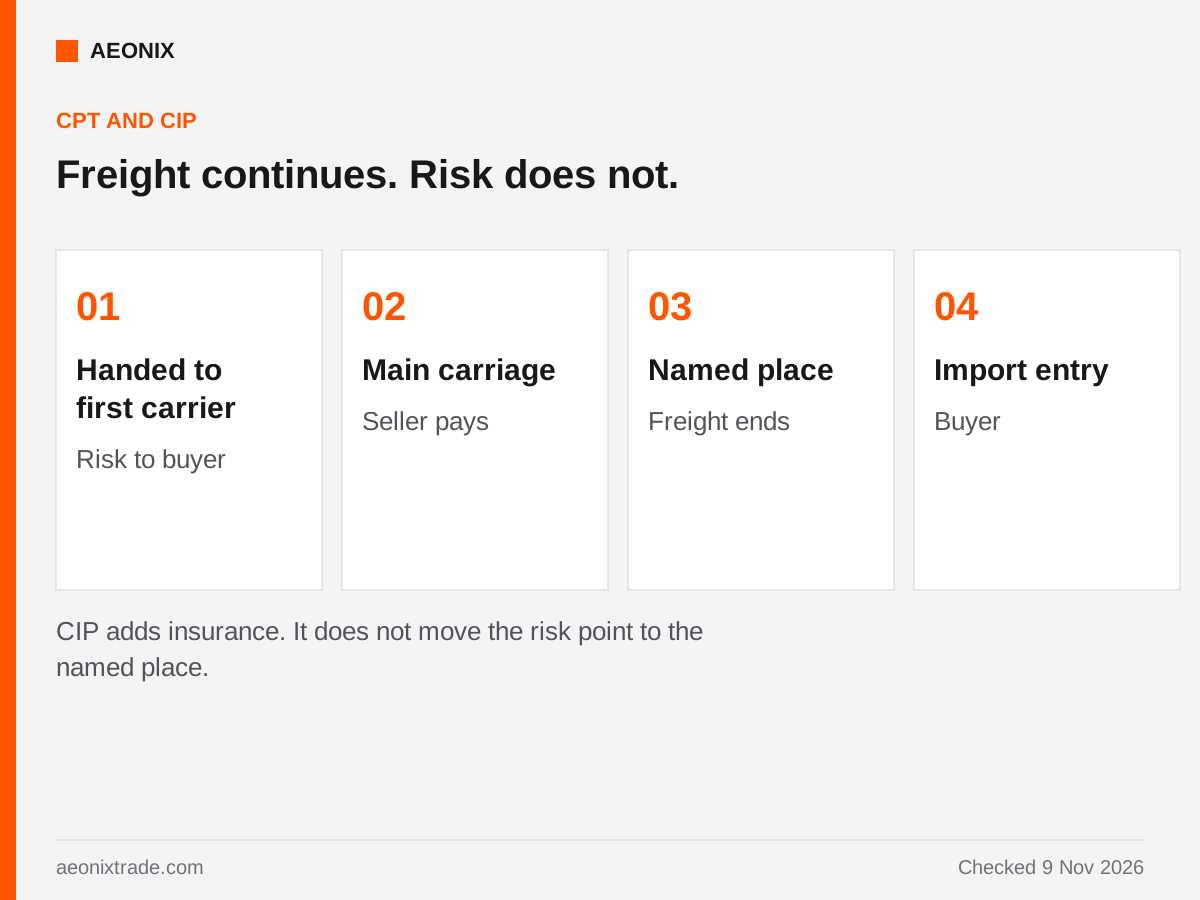
Name the destination the freight is paid to. That can be a terminal, a forwarder's warehouse, or another place the carrier will actually take the goods. Separately, know where the first carrier takes the goods over. On a China shipment that first carrier is often a truck at the factory or a warehouse in Yiwu or Ningbo, days before the container is on a ship. From that handover, the risk is yours. The seller still owes the carriage through to the named place.
CIP does not move that risk point. It adds a policy. Read who is the assured, from which place the cover starts, and which clauses were bought. The ICC default is the wider Clauses (A) cover, not the thin Clauses (C) cover that CIF still uses. The contract can change the level. If the policy names only the seller, a claim after the goods have left the factory can be a negotiation instead of a form. Ask for the certificate before the balance, and ask that you can claim under it.
If you wanted the seller to carry risk until the goods were at your door, CPT and CIP are the wrong family. That is DAP, an arrival rule, and the checklist separates the two before it talks about insurance. If the seller is not paying the main freight at all, you are in FCA territory: delivery to the carrier you engaged, not carriage paid onward.
A typical case
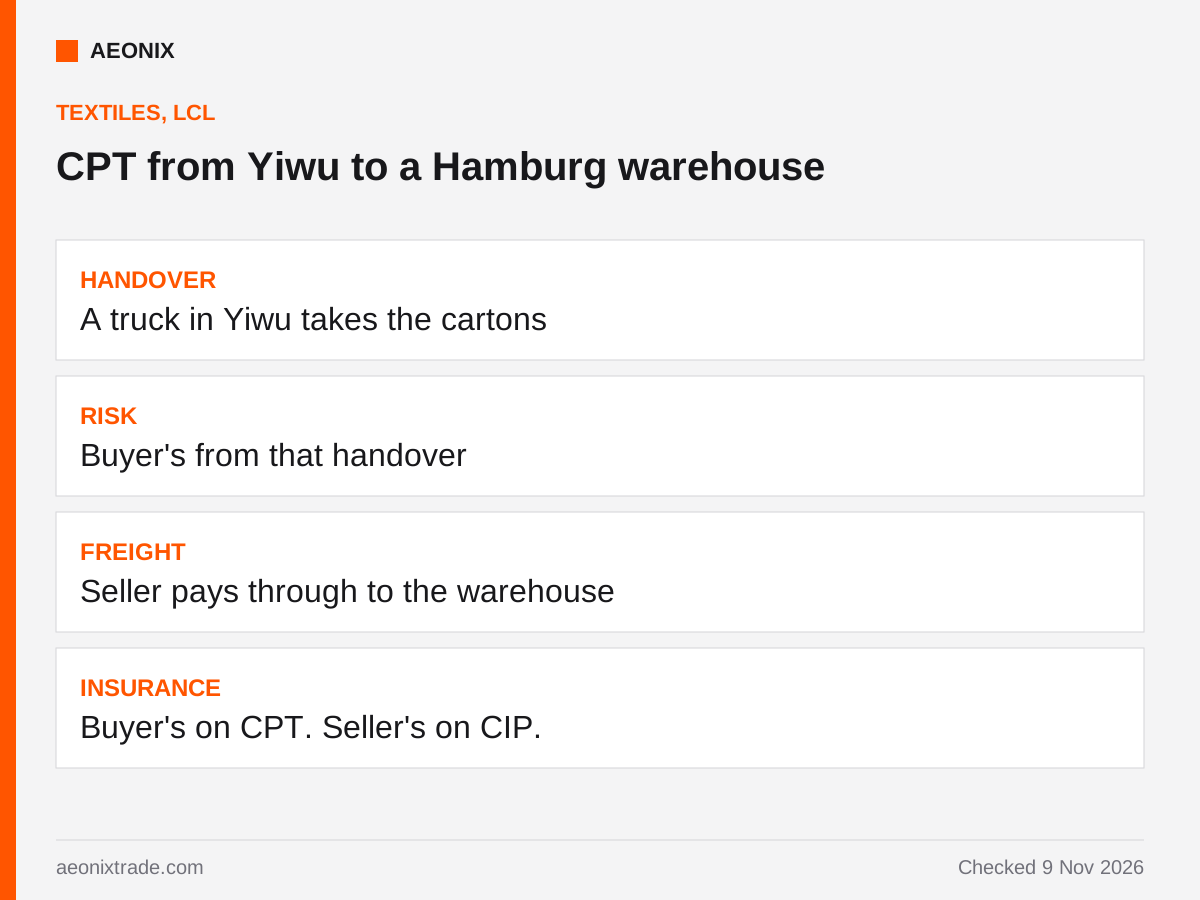
A buyer of home textiles consolidates several small lots into one LCL shipment. The cartons are picked up by a truck in Yiwu. The contract says CPT, and the named place is the buyer's forwarder warehouse in Hamburg, not "Germany" and not the port in the abstract. The seller pays carriage through to that warehouse. Risk passes when the trucker in Yiwu takes the cartons. The ocean leg, the European terminal and the last truck to the forwarder's door are inside the seller's freight bill and inside the buyer's risk.
The buyer insures from the Yiwu handover, in the buyer's name. The buyer clears the import into the EU and pays duty and tax from the TARIC measure for the classified line. Nothing on this page is that rate, and nothing on this page is an insurance premium.
The CIP version of the same quote adds the seller's policy. The buyer still asks three questions. Does the cover start at the Yiwu handover or only once the goods are on the vessel? Is the buyer a claimant, or only the seller? Is the cover Clauses (A) or something thinner the contract quietly allowed? A CIP price that cannot answer those is a freight quote with the word insurance painted on it. CIF is the sea-only cousin, and its default cover is the narrower one. Do not import CIF's minimum cover into a CIP negotiation, and do not use CIF language on an LCL move that was handed to a truck inland.
Container cargo is why these two rules exist
The checklist is blunt about mode. If the shipment is containerized or multimodal, or delivery is to an inland or port terminal, CPT or CIP is the C-rule. CFR and CIF stay with goods lifted on board, or with a deliberate choice to divide risk once the goods are on board. Most factory-loaded containers from China are handed to a terminal operator before they are on a ship. CPT matches that handover. CFR pretends the handover was on board.
The seller still clears export under CPT and CIP. You clear import. The ICC checklist says the same split for every C rule: seller pays export formalities, buyer pays import formalities, seller pays the main transport, buyer bears its risk. Destination charges that the rule does not pin down, terminal handling in particular, still cause arguments. The checklist's own advice is to write the troublesome charges into the contract on top of the rule. Articles A9 and B9 are where the ICC tells the seller to list costs. Ask for the list.
Send the named place, the first-carrier point, and whether you want CIP or your own policy on the RFQ. The paperwork that has to agree with the rule is on Incoterms and shipping documents.
Before you accept CPT or CIP
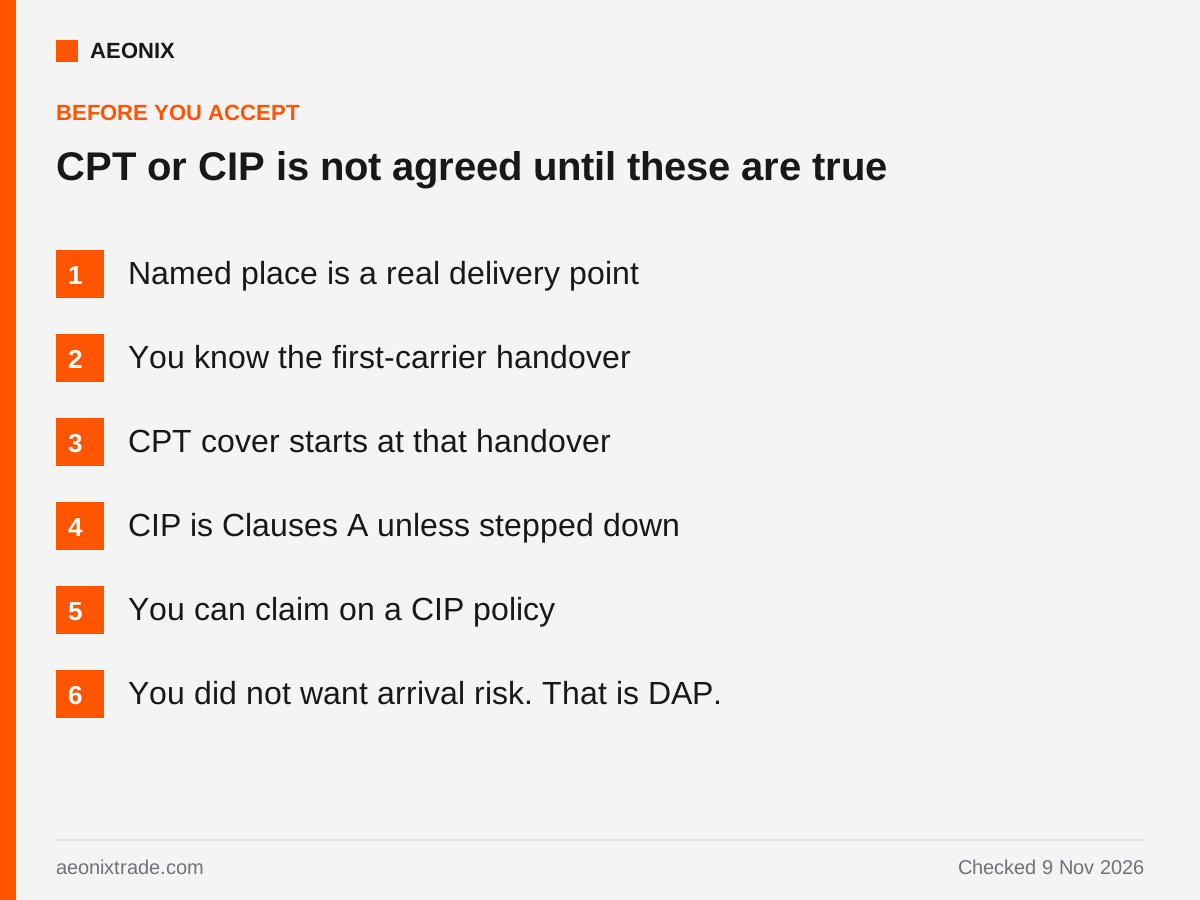
- The named place is a real delivery point the carrier will serve, not a country.
- You know the first-carrier handover, and your insurance starts there if the rule is CPT.
- If the rule is CIP, the clauses are Clauses (A) or similar, unless the contract says otherwise in writing.
- You can claim on the CIP policy, and the cover starts at the handover rather than at the port.
- You are not using CPT when you needed the seller to carry risk until arrival. That is DAP.
- The invoice states the same rule and the same place the contract states.
Where CPT and CIP go wrong
The first miss is an uninsured inland leg. The buyer buys marine cover "warehouse to warehouse" in a slogan and then discovers the policy attached at the port. The cartons were already at the buyer's risk on a truck in Zhejiang. Match the policy's start to the first carrier, not to the ocean bill of lading.
The second miss is a CIP policy that only the seller can claim, bought for the minimum cover someone copied from a CIF habit. CIP's default is the wider cover. If the contract steps down from Clauses (A), that step-down should be a sentence you agreed, not a surprise in the certificate.
The third miss is choosing CPT because the price "includes shipping," then arguing the seller owes you for damage at sea. The freight was the seller's cost. The risk was yours from the handover. If that allocation is not the one you can live with, change the rule before production, not after the survey.
Frequently asked questions
What does CPT mean?
Carriage Paid To. The seller pays carriage to the named place of destination. Risk passes when the goods are handed to the first carrier in the seller's country. The seller does not insure the cargo.
What does CIP mean, and how is the insurance different from CIF?
Carriage and Insurance Paid To. The carriage and the risk point match CPT. The seller must also procure insurance. Under Incoterms 2020, CIP requires Institute Cargo Clauses (A) or similar cover. CIF stays on Clauses (C) unless the parties agree a higher level. CIP is any-mode. CIF is sea and inland waterway.
Does the seller's risk last until the named place?
No. The named place is the end of the paid carriage. The risk transfers earlier, at delivery to the first carrier. If you need the seller's risk to last until arrival, look at DAP, DPU or DDP.
When should a China container use CPT instead of CFR?
When the container is handed to a terminal or moves by more than one mode, and the seller is paying the main carriage. The ICC checklist reserves CFR for goods whose risk you intend to divide once they are on board.
Who pays import duty under CPT or CIP?
The buyer. The seller pays export formalities. Duty and tax are assessed by the destination customs authority. This page does not state a rate.
The paperwork next to this choice is which Incoterm to use, 20-foot, 40-foot, and high-cube containers, a bonded warehouse, and cargo insurance.
Sources
- ICC: Incoterms 2020. CIP requires Institute Cargo Clauses (A) or similar. CIF keeps Clauses (C) as the default.
- ICC: Incoterms 2020 checklist and flowcharts, PUB817E. CPT without insurance, CIP with all-risk cover, both as shipment contracts for container or multimodal cargo.
- International Trade Administration: Know Your Incoterms. CPT and CIP in the any-mode group, each with a named place of destination.
Submit sourcing request
Can't find what you need?
Start with a product or image link, an approximate quantity and destination. Other details can follow.