Import from China to Japan in 2026: Duties, Documents and Landed Cost
Published by Aeonix Trade.
Last fact-checked: November 9, 2026.
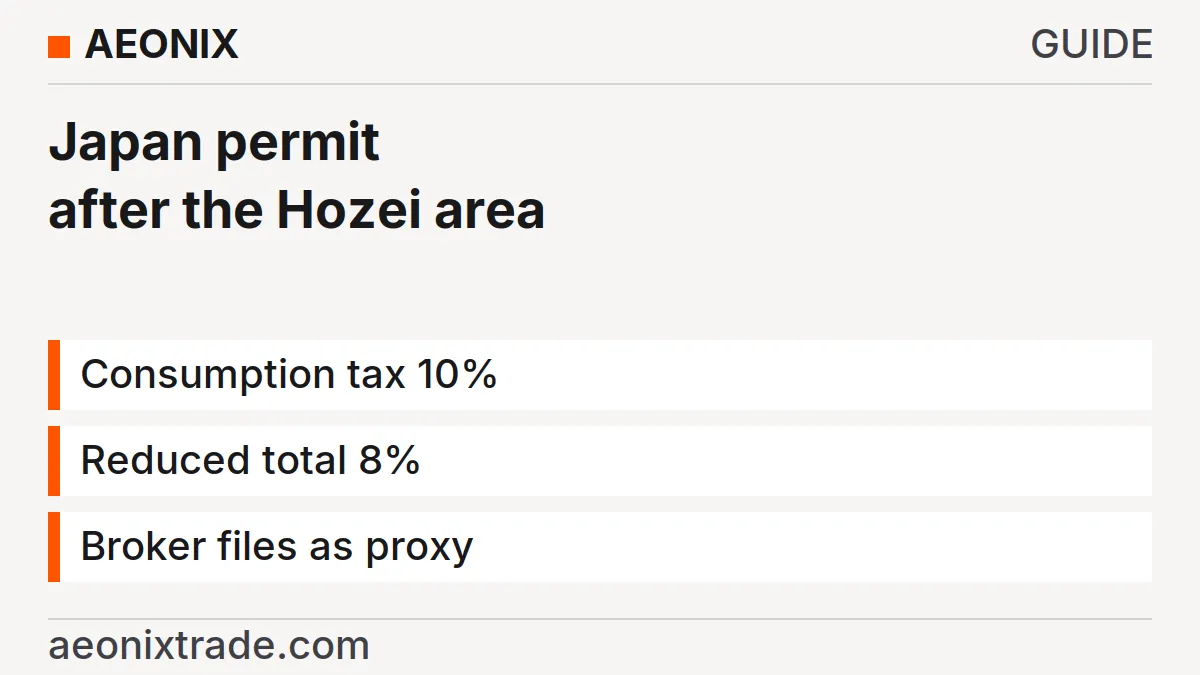
An Osaka importer buys 8 CBM of plastic storage boxes, FOB Ningbo, and thinks the forwarder's arrival notice is the customs entry. Japan Customs says any person who wants to import goods must declare them to the Director-General of Customs and obtain an import permit after examination. The declaration is made, in general, after the goods are in a hozei area. Importing from China to Japan is that permit, plus customs duty where the tariff says so, plus consumption tax.
A typical case
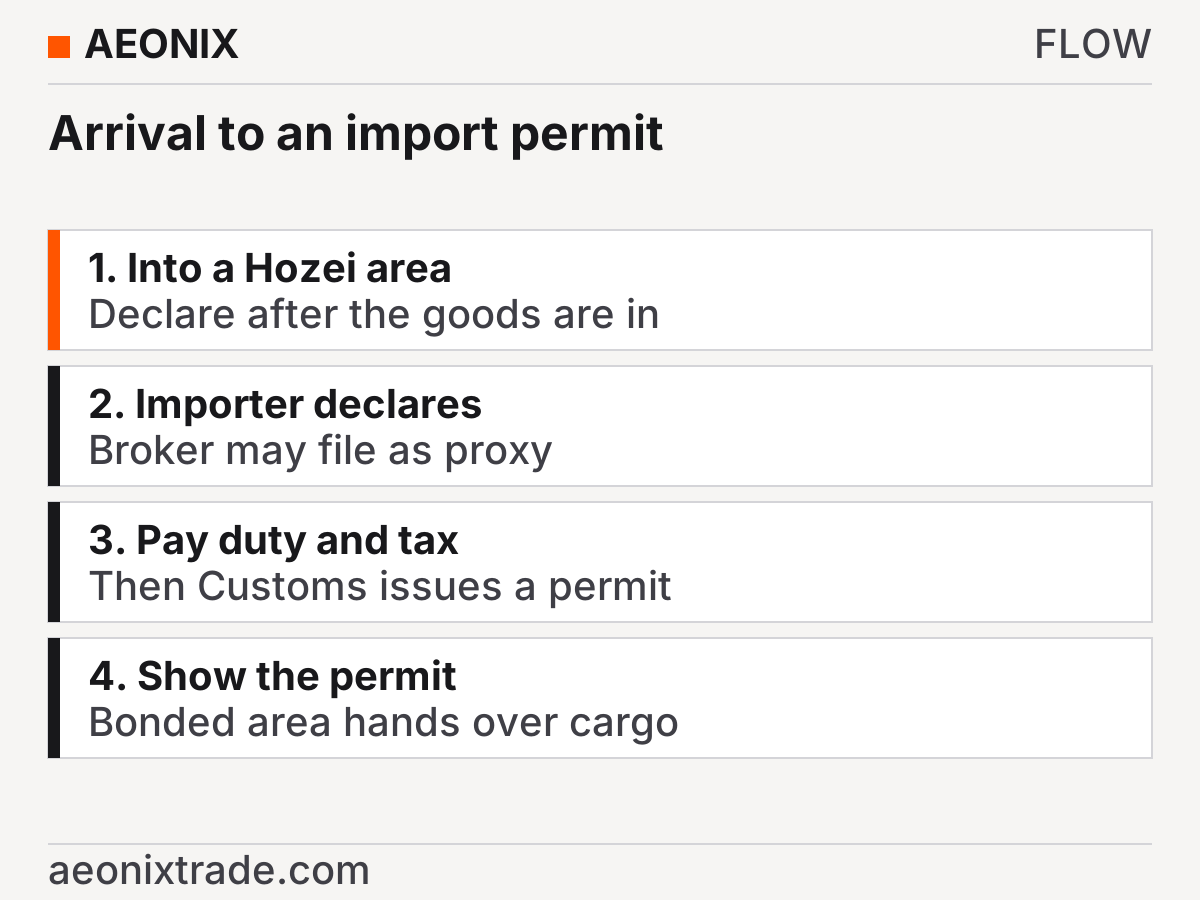
The boxes are plain household storage, not food, not alcohol and not a phone. The invoice is FOB Ningbo. The shipment is LCL into Osaka or Kobe. The carrier issues an arrival notice. The importer, or a customs broker acting as proxy, declares the goods to the customs office that covers the bonded area, with the invoice the factory sent. Customs may inspect. In principle it approves the import after the duties and taxes are paid. The goods are handed over when the import permit is shown at the bonded area.
That sequence is Japan Customs' own FAQ on the flow from arrival to release, and the import-procedures page. The procedures page also says more than 90 percent of import procedures are computerized. The page does not date that share. Treat it as the sentence on the page, not as a count you measured.
10% or 8%, and how the tax is split
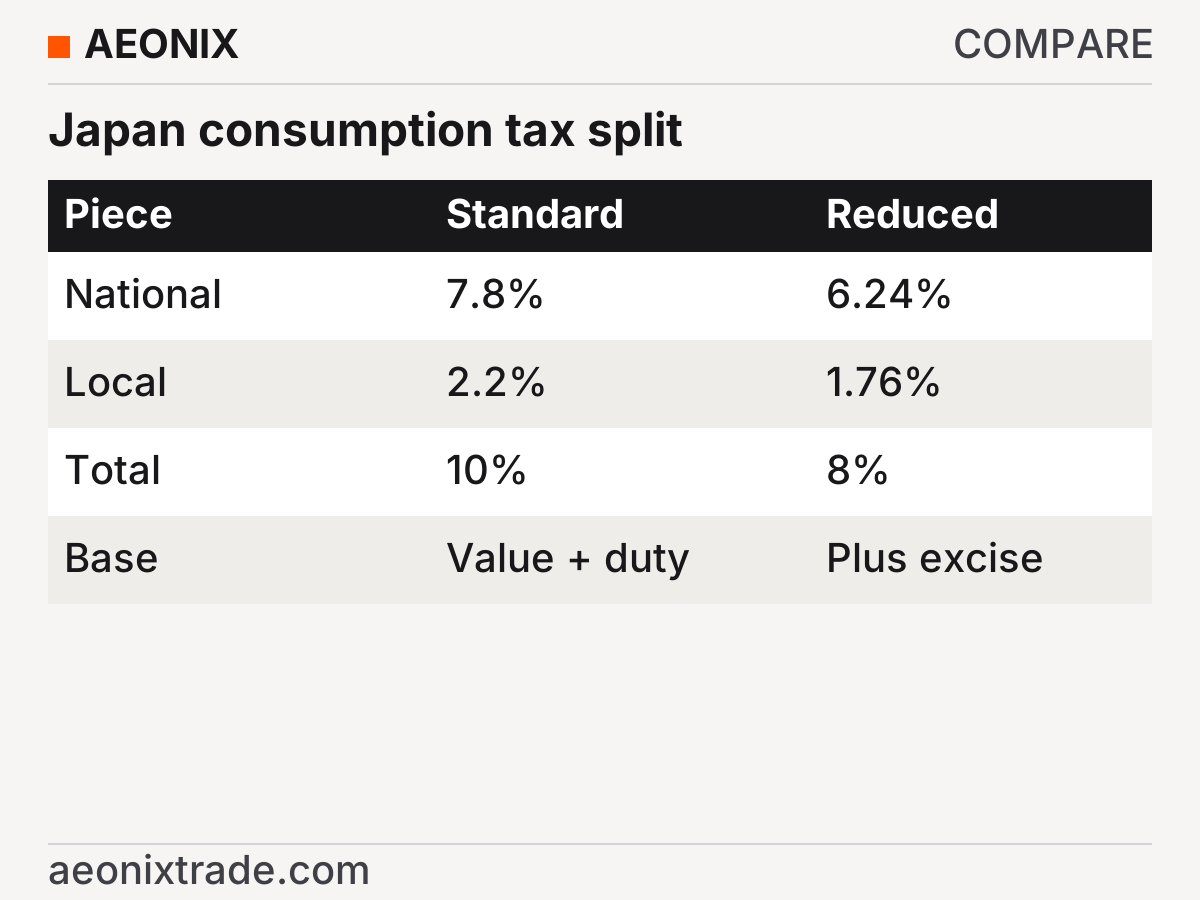
Japan Customs' tariff outline says imported goods are subject to customs duty and consumption tax, and that other internal taxes such as liquor tax can apply to the goods those laws name. Consumption tax is imposed at 10% as the standard rate or 8% as the reduced rate. The amount is calculated on the customs value of the goods plus customs duty payable and, where they apply, other excise taxes payable.
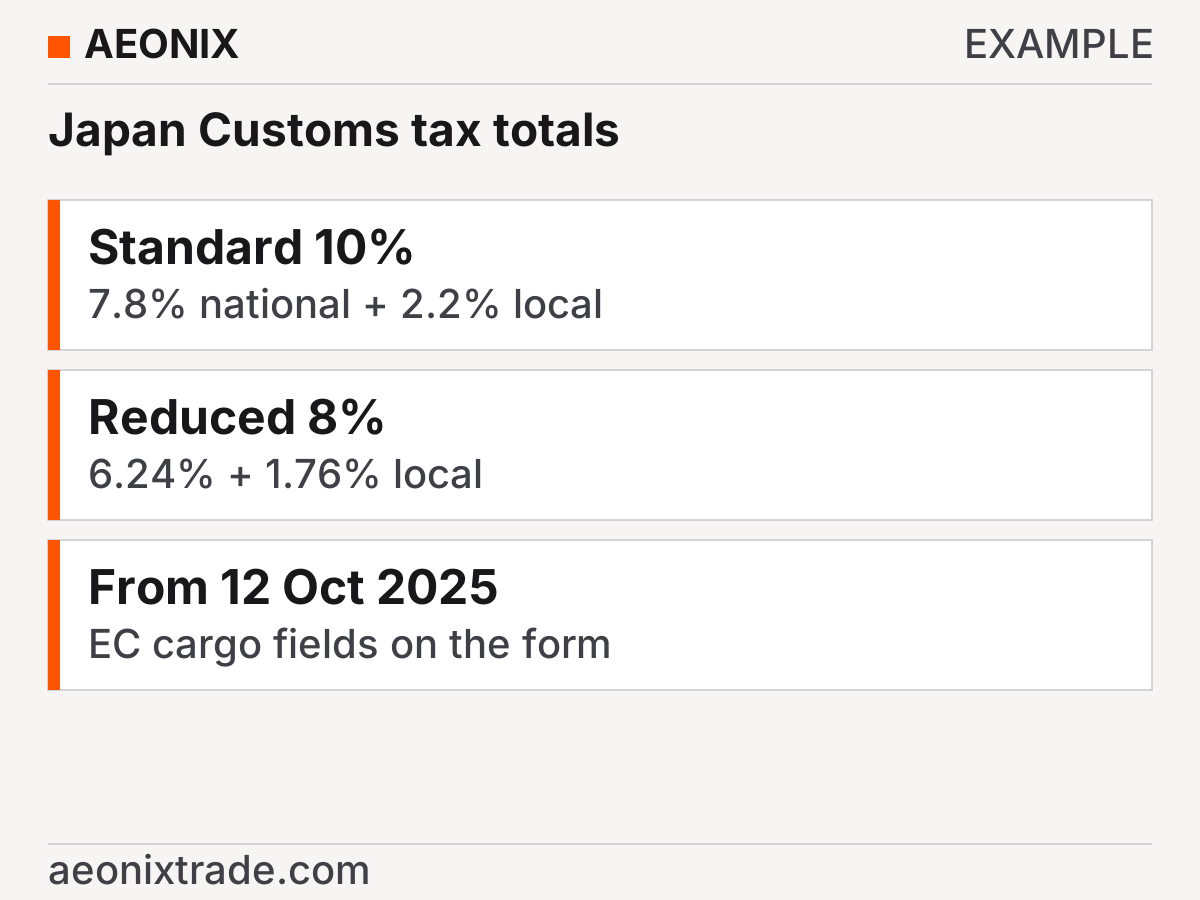
FAQ 1111 splits those totals. The standard total of 10% is a national consumption tax of 7.8% plus a local consumption tax of 2.2%, which is 22/78 of the national tax. The reduced total of 8% is 6.24% national plus 1.76% local, again 22/78 of the national tax. Storage boxes are not automatically the reduced rate. The reduced rate is a classification, not a favour for "simple goods." Ask the broker which total they will use, and do not invent a food-and-newspaper list this page has not copied from an English customs page.
Duty is a different number from the consumption tax. The tariff outline says the Customs Tariff Law sets a general rate, a temporary rate can prevail, and a WTO concession rate can apply where the conditions are met. This page does not state a duty percent for plastic boxes. Look up the heading. A certificate of origin is one of the documents the import page lists where a WTO rate applies. The certificate of origin is that paper, not a claim that China origin takes a concession by itself.
Who signs the declaration
The import page says the declaration is made, in principle, by the person importing the goods. Usually a customs broker files it as a proxy. The broker is not the importer because they typed the form. Know whose name and address are in the first field. FAQ 1106 lists what the form carries: the importer's address and name, the goods code, number, name, quantity and price, the country of origin and the shipper, the carrier, where the goods are stored, and the delivery place. From 12 October 2025 the form also asks whether the cargo was bought through an EC platform, and the name of that platform. A storage-box order placed on a marketplace is not the same declaration as a factory contract, even if the cartons look identical.
Documents under the import page, Customs Law article 68, include the invoice, a bill of lading or air waybill, the origin certificate where a WTO rate applies, packing lists and freight accounts where needed, and licences where a law other than the Customs Law restricts the goods. Form C-5020 is the declaration form the page names. A commercial invoice that does not match the form is how the inspection starts.
Price the Ningbo quote as Japan, not as freight
FOB Ningbo stops at the Chinese port. Ocean freight, the LCL charges, the broker, duty if any, and consumption tax are still open. Put them on the landed-cost sheet. The FOB term and the LCL explanation cover the move. They do not pick the 10% or the 8%.
A Korea file is the neighbour and a different law. Importing from China to South Korea uses UNI-PASS and a 10% VAT that is not this consumption-tax split. Do not add the Japanese local-tax fraction to a Busan entry. Singapore is a different permit again: importing from China to Singapore.
After the permit
The permit is what the bonded area wants to see. Until it exists, the goods stay in the hozei area and storage is the carrier's clock, not yours to ignore. The general arrival pattern, free time and delivery, is on what happens when cargo arrives. The HS code is what the duty line hangs on.
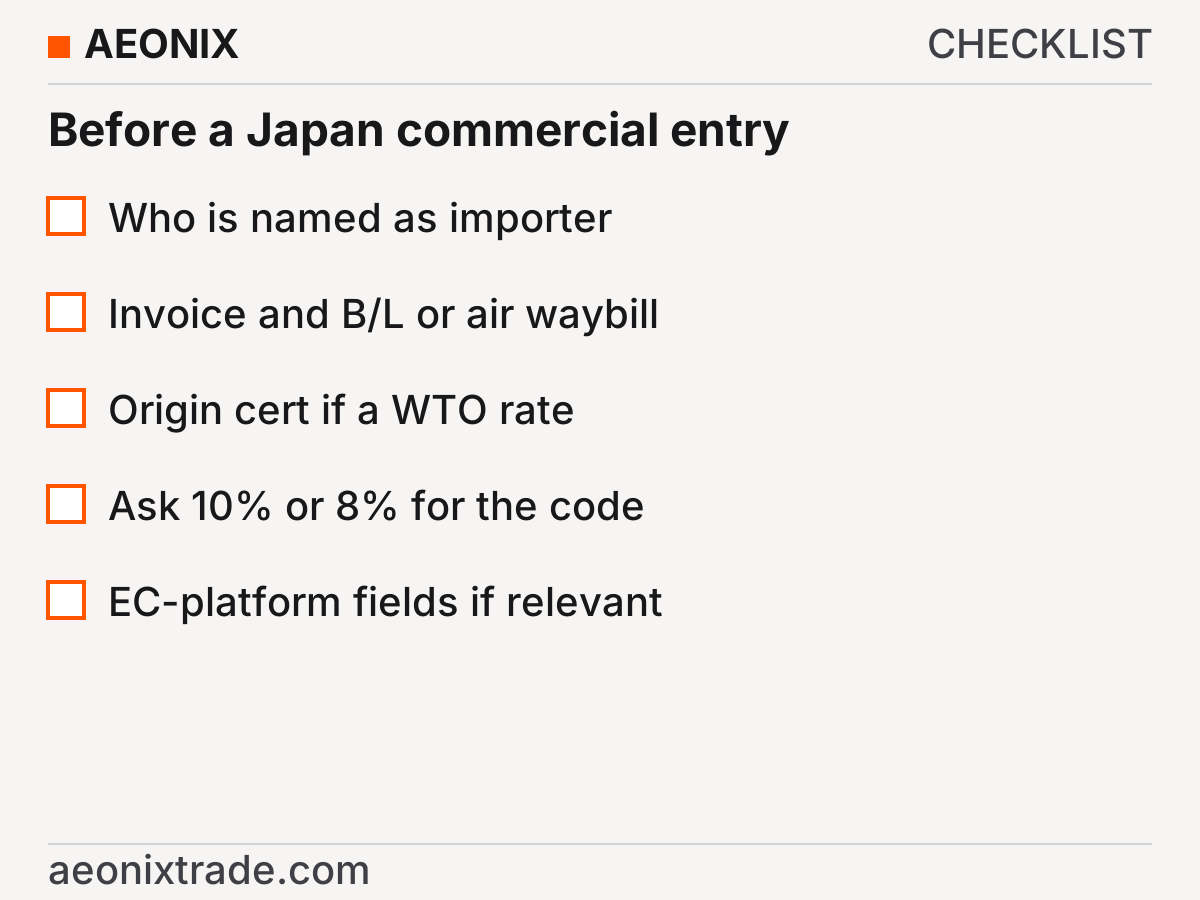
- Name the importer, and say if a broker is only the proxy.
- Match invoice, packing list and the declaration price.
- Ask whether the heading takes duty, and which consumption-tax total applies.
- Add the origin certificate if a WTO rate is the reason the duty looks low.
- If the order came through a platform, expect the fields added on 12 October 2025.
Mistakes
- Calling the forwarder the importer because they filed the form.
- Using 8% because the boxes are "simple." The reduced total is a listed treatment, not a vibe.
- Forgetting that consumption tax sits on customs value plus duty, so a duty change moves the tax.
- Shipping a marketplace order and leaving the EC-platform questions blank.
- Copying a Korean 10% VAT note onto this calculation. The 10% here is 7.8 plus 2.2.
Questions buyers actually ask
Is consumption tax the same as customs duty?
No. Japan Customs lists both. Duty comes from the tariff. Consumption tax is 10% or 8% on top of the customs value plus duty and any other excise that applies.
Can I declare before the ship arrives?
The import page says the declaration is in general made after the goods are in a hozei area. It allows an earlier declaration for specific items if the Director-General of Customs approves. Do not assume your LCL boxes qualify.
Does the broker become responsible for the tax?
The page says the importer declares, and the broker usually files as proxy. Ask whose name is on the form before you treat the broker's invoice as the tax.
What do I send the factory?
An invoice the declaration can follow, and a heading you have checked. The country overview is on import from China. If the Ningbo FOB quote should be rebuilt into a permit-ready file, use the RFQ form.
The quote and the entry are covered in which Incoterm to use, the importer of record, and the customs clearance sequence.
Official sources
- Japan Customs: import procedures. Declaration to the Director-General, permit after examination and payment, declaration in general after the goods are in a hozei area, importer as declarant, broker as proxy, and the document list including form C-5020. Read 9 November 2026.
- Japan Customs: tariff and duty rates. Duty plus consumption tax at 10% or 8%, calculated on customs value plus duty and applicable excise. Read 9 November 2026.
- Japan Customs FAQ 1111. Standard total 10% as 7.8% national plus 2.2% local. Reduced total 8% as 6.24% plus 1.76%. Read 9 November 2026.
- Japan Customs FAQ 1102. Arrival notice, declaration, inspection, payment, permit, handover at the bonded area. Read 9 November 2026.
- Japan Customs FAQ 1106. Declaration fields, including EC-platform items added from 12 October 2025. Read 9 November 2026.
Submit sourcing request
Can't find what you need?
Start with a product or image link, an approximate quantity and destination. Other details can follow.