Yiwu to Oman: Shipping Routes, Customs Papers and Cost Lines
Published by Aeonix Trade.
Last fact-checked: November 9, 2026.
Yiwu to Oman is a Bayan declaration, not a stall receipt. The Royal Oman Police Directorate General of Customs asks for a commercial invoice and a manufacturer's country-of-origin certificate, and a permit when the goods need one. The port you type has to match the way the cargo actually arrives. A sea booking filed as a land port is not a small typo.
Muscat is where many buyers want the cartons. Muscat is not, by itself, the customs port on the form. The declaration names the port. If the warehouse is in the city and the vessel calls somewhere else, the truck between them is its own line.
A typical case
A buyer in Muscat takes kitchenware from three Yiwu booths. The illustrative lot is about 7 CBM, quoted FOB, booked as sea LCL. Each booth has its own invoice. Bayan will see one declaration. The origin certificate the customs service asks for is a manufacturer's certificate, not a sentence on the packing list. If one booth cannot produce it, that lot should not ride inside the others to "save a document."
Put the three invoices on the RFQ form and name the Omani company that will own the declaration. There is no Oman chapter in the older country-guide set. Do not borrow the UAE guide. That is a different customs system. The neighbouring lanes that are written the same way are Saudi Arabia, South Africa, and Sri Lanka.
What the declaration service asks for
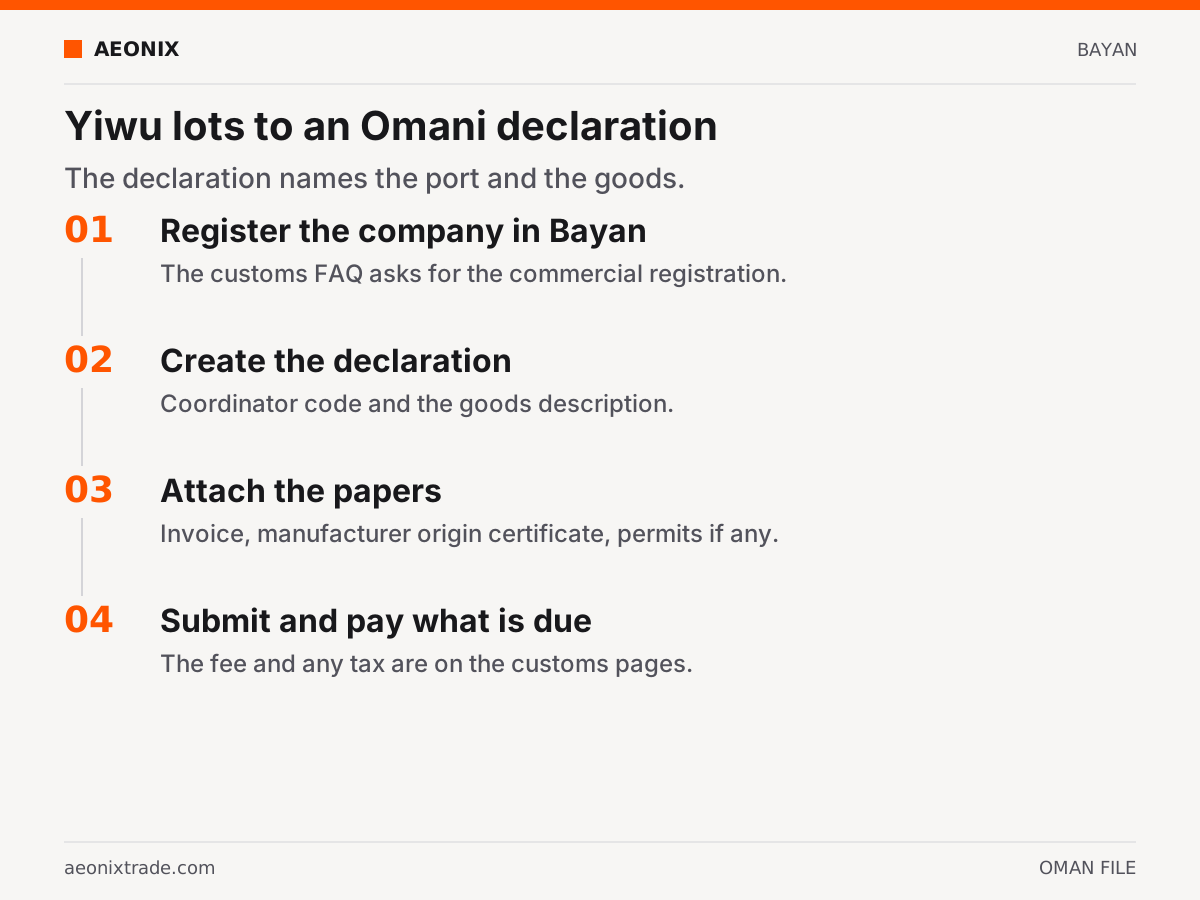
The Directorate General of Customs describes "Create a Custom Declaration" as a permit the applicant, or a representative, submits to customs. The required documents on that page are a commercial invoice, a manufacturer country certificate, and a permit file if the goods require a permit. The procedure is: register in the Bayan system, create the declaration, submit, and pay. The service page also publishes an application fee, different for a company and for a private individual. Read the figure on that page. It is not reprinted here, and it is not a duty rate.
A second service page, for generating declarations on import, export, or transit, lists a commercial invoice, a manufacturer's country-of-origin certificate, and a declaration issued by the exporting country, plus permits when the item needs them, and payment of taxes when the goods are not exempt. Use that procedural page beside the create-declaration page. If the two lists both apply to your entry, attach the fuller set and let the officer tell you which one is spare. Do not drop the origin certificate because a forwarder calls it optional. The customs page does not call it optional.
The customs FAQ says a new company is registered on the customs site with a civil card or the electronic authentication system, and the company's commercial registration number. Adding activities is done inside the company account in Bayan. HS codes are looked up by downloading the customs tariff from the customs site. Those answers are on the common questions.
The port mode is part of the filing
The same FAQ says a wrong port of the same kind, sea for sea or land for land, can be an amendment. A wrong port of a different kind, land for sea or land for air, needs a cancellation. Both requests are approved from the port you first selected. That is an expensive way to discover that the Yiwu forwarder booked a vessel and the declaration says a land border.
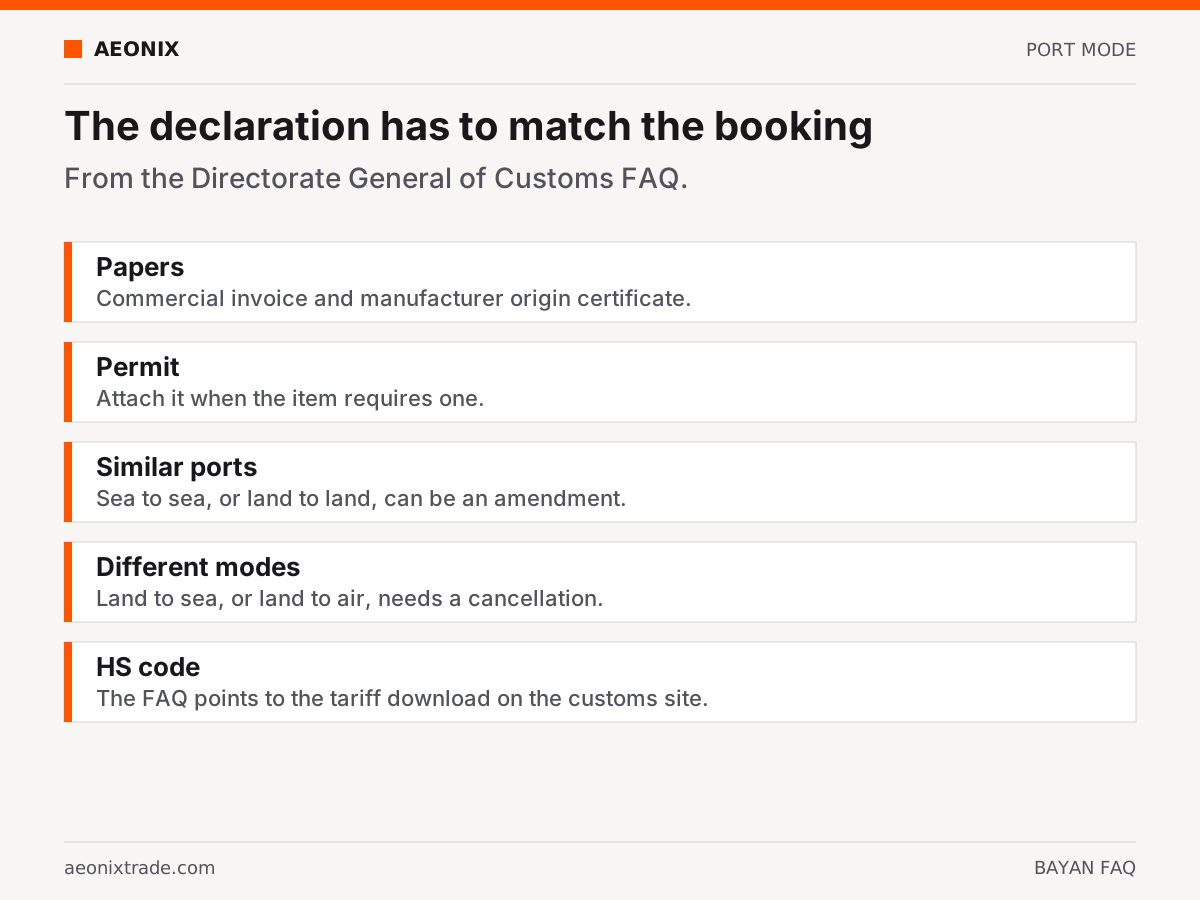
Name the sea port that is actually on the booking before anyone types the declaration. Yiwu cargo does not have one default Omani port. Muscat on the delivery address is the shop, unless the bill of lading also names a port there.
Cost lines
| Line | What it is | Where the figure comes from |
|---|---|---|
| Goods | Each booth on a named Incoterm | Proforma. FOB needs a place |
| Yiwu handling | Collection and consolidation of the booths | Forwarder. Consolidation |
| Freight | Sea LCL or another mode you actually book | Carrier. LCL, LCL from China |
| Declaration fee | The fee the customs service page publishes | The create-declaration page. Not this article |
| Duty or tax | Due when the goods are not exempt | The declaration and the tariff file. No rate is printed here |
| Delivery | From the port you named to the warehouse | The trucker, after the port mode is right |
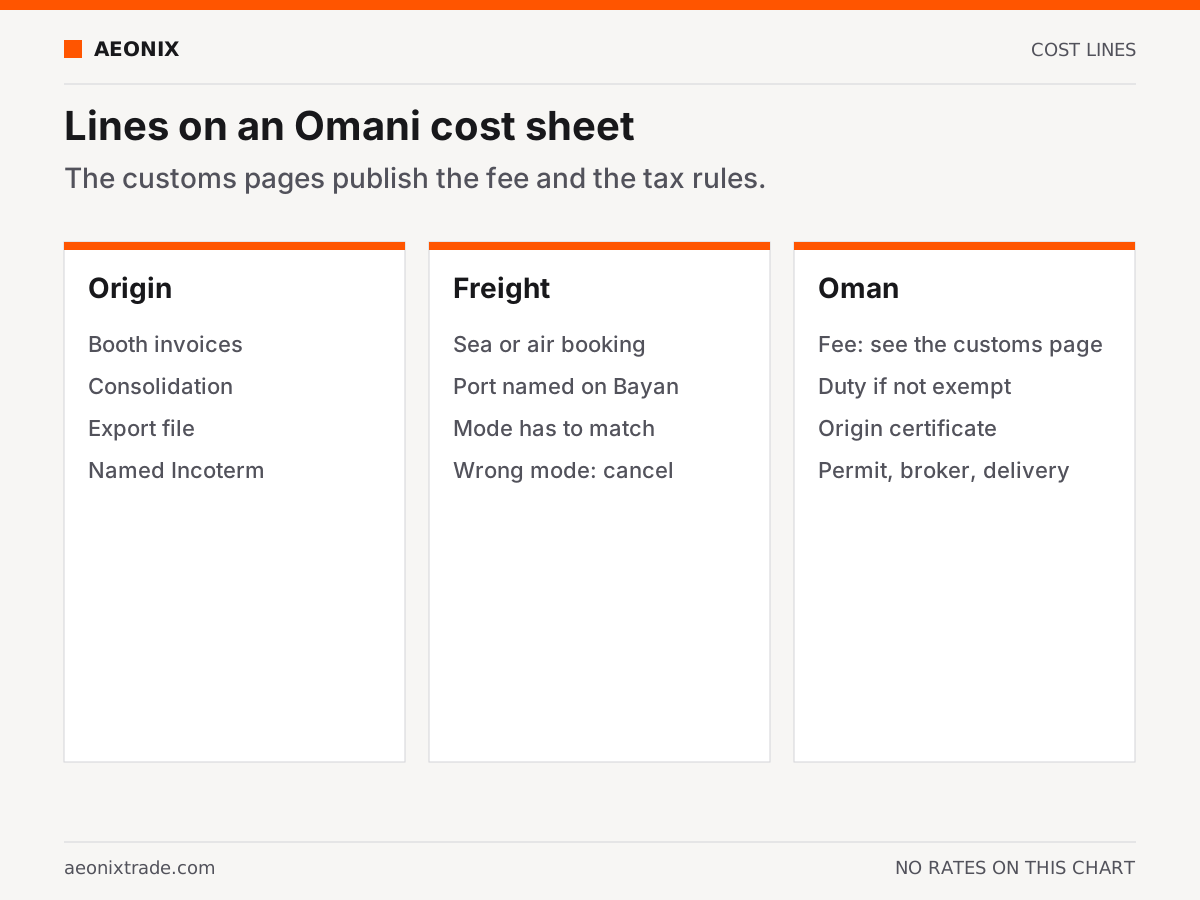
Use the landed-cost checklist and leave the duty cell as "see the customs tariff." A percentage from a neighbouring country is the wrong country's number.
What usually goes wrong
- One commercial invoice that never names the Omani company on the Bayan account.
- Skipping the manufacturer origin certificate because the cartons say "Made in China." The service page still asks for the certificate.
- Filing a land port for a sea container. The FAQ treats that as a cancellation, not a quick edit.
- Assuming a kitchenware mix needs no permit. Attach the permit when the item requires one. The customs page does not say kitchenware is exempt.
- Quoting a declaration fee from memory. Open the customs service page on the day you file.
Before the cartons close
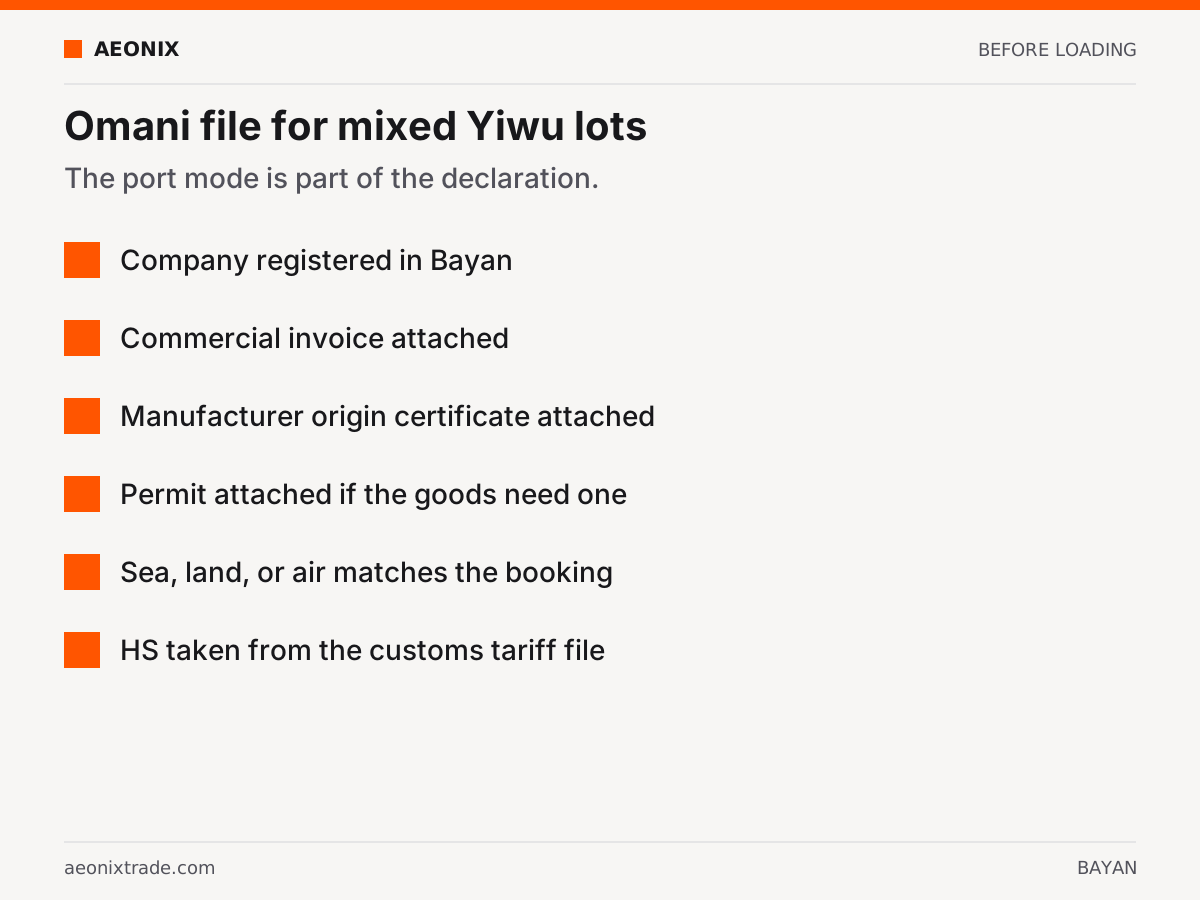
- The company is registered in Bayan, with the commercial registration the FAQ asks for.
- Each booth's goods can be described on the commercial invoice. See commercial invoice.
- A manufacturer's country-of-origin certificate is in the file. See certificate of origin for the general idea, then follow the Omani page for what it must be.
- The exporting country's declaration is attached if the procedural service applies to this entry.
- Any permit is attached before submission, not after the vessel sails.
- The port mode matches the booking: sea with sea, land with land, air with air.
- The HS code comes from the tariff download on the customs site. See HS codes.
How the Yiwu cartons become one LCL booking is on how LCL from China works. The arrival sequence after the ship berths is only useful once the declaration names the right port. See when cargo arrives for the general clocks, and the Bayan status for the Omani ones.
See also Yiwu Market Guide for Overseas Buyers and Shipping from Yiwu.
Official sources
- Directorate General of Customs: Create a Custom Declaration. Invoice, manufacturer country certificate, permit if required, and the published fee.
- Request to apply a custom declaration. Invoice, origin certificate, exporter-country declaration, permits, and tax when goods are not exempt.
- Customs common questions. Company registration, HS lookup, and how a wrong port is amended or cancelled.
- Directorate General of Customs. The authority those services belong to.
Submit sourcing request
Can't find what you need?
Start with a product or image link, an approximate quantity and destination. Other details can follow.