Yiwu to Sri Lanka: Shipping Routes, Customs Papers and Cost Lines
Published by Aeonix Trade.
Last fact-checked: November 9, 2026.
Yiwu to Sri Lanka is a customs entry lodged through a Customs House Agent, after the importer's tax number is registered with Inland Revenue and then with Sri Lanka Customs. The cartons can leave several Yiwu booths. They still need one declaration that describes them, and duty is payable before release unless an exemption covers the goods.
Colombo is the port the Sri Lanka Ports Authority's own history describes. Name the terminal your bill of lading actually books. A delivery address in the city is not the port.
A typical case
A Colombo buyer takes stationery and household goods from three Yiwu booths. The illustrative lot is about 8 CBM, quoted FOB, moving as sea LCL. One extra line, a box of snacks, is on the same notebook page. Stationery and a simple household item can share a sourcing week. Food may need a permit the other cartons do not. The Declaration Directorate tells importers to watch commodities that need authorisation from other authorities, and it gives examples rather than a one-line waiver for "general cargo."
There is no older Sri Lanka import guide on this site to lean on. Put the invoices on the RFQ form with the TIN the Customs House Agent will use. The Saudi, South African, and Omani files will not clear this box. Those lanes are Saudi Arabia, South Africa, and Oman.
Register, then appoint the agent
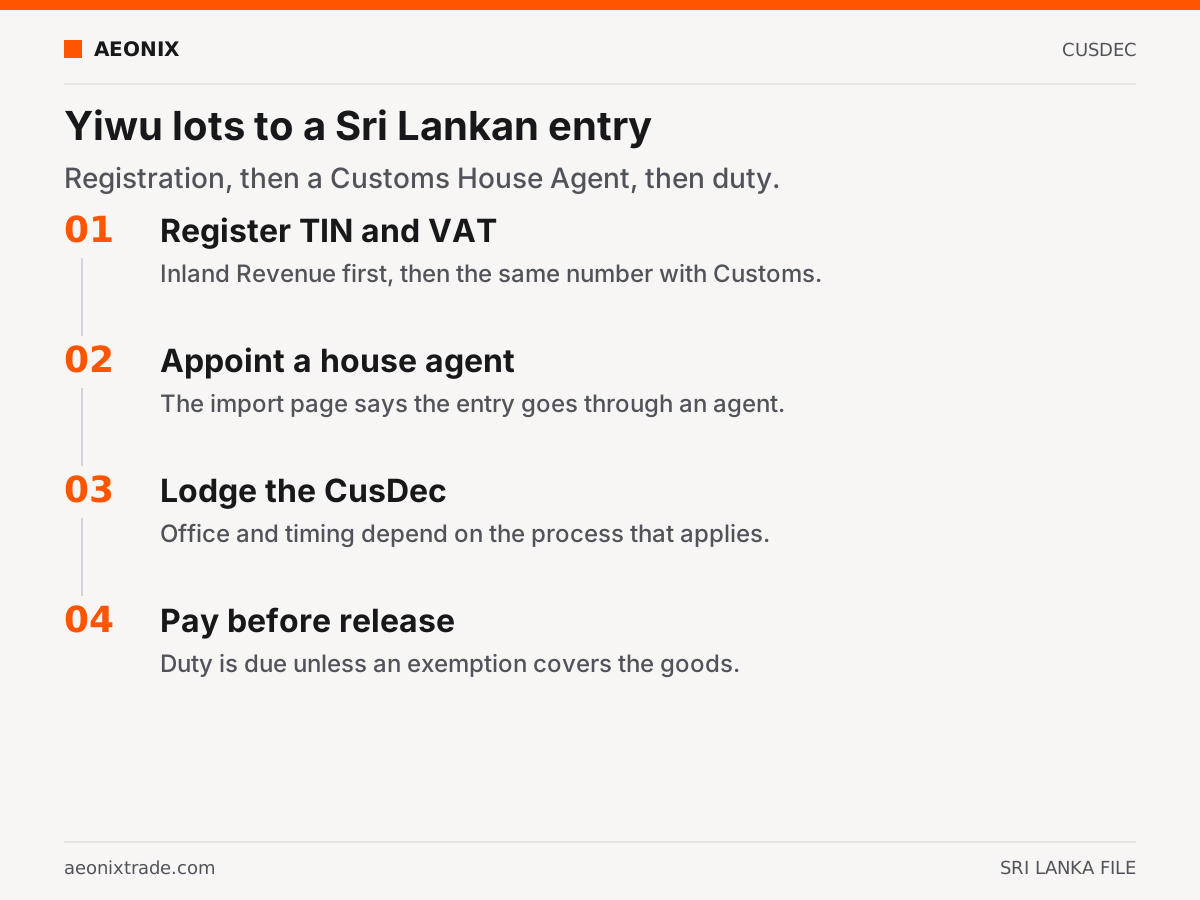
The Declaration Directorate says an importer of commercial goods should first register a Taxpayer Identification Number and a VAT number with the Inland Revenue Department, and then register the same number with Sri Lanka Customs. All goods imported into Sri Lanka must be declared, and duty is payable unless an exemption or a duty waiver covers them. Prohibited goods cannot be imported. The directorate points to Schedule B of the Customs Ordinance and gives narcotics and psychotropic substances as the main examples. Read the schedule. Do not treat that pair of examples as the whole list. The page is the Declaration Directorate. Inland Revenue is at ird.gov.lk.
The same directorate says the importer should be able to show the carrier's authority to claim the consignment, a full description, the correct HS classification, the true transaction value, payment through permitted banking channels, and the licences or permits that apply. It names examples of authorities that may have to authorise a commodity, including the Import and Export Controller and the Sri Lanka Standards Institution. The list on that page is the one to read with your agent. A blog summary is not the permit file.
Importing goods says import consignments are declared through a Customs House Agent, online, and that the customs declaration should be submitted after the goods arrive and after the delivery order is obtained from the shipping agent. It also states the importer's obligation: declare the goods correctly and pay the correct duty before release.
Two official timings, two scopes
Those sentences are still on the importing-goods page. A newer page says the paperless declaration process at the CBHQ1 office is effective from 1 October 2026. Under that process, declarations are lodged to ASYCUDA with a digital signature, together with signed scans of the commercial invoice, packing list, bill of lading, proxy, certificate of origin, permits, and any other document a regulating agency requires. Officers review them in the system. The page is Paperless declaration process. It is written for CBHQ1, not as a repeal of every other office's timing.
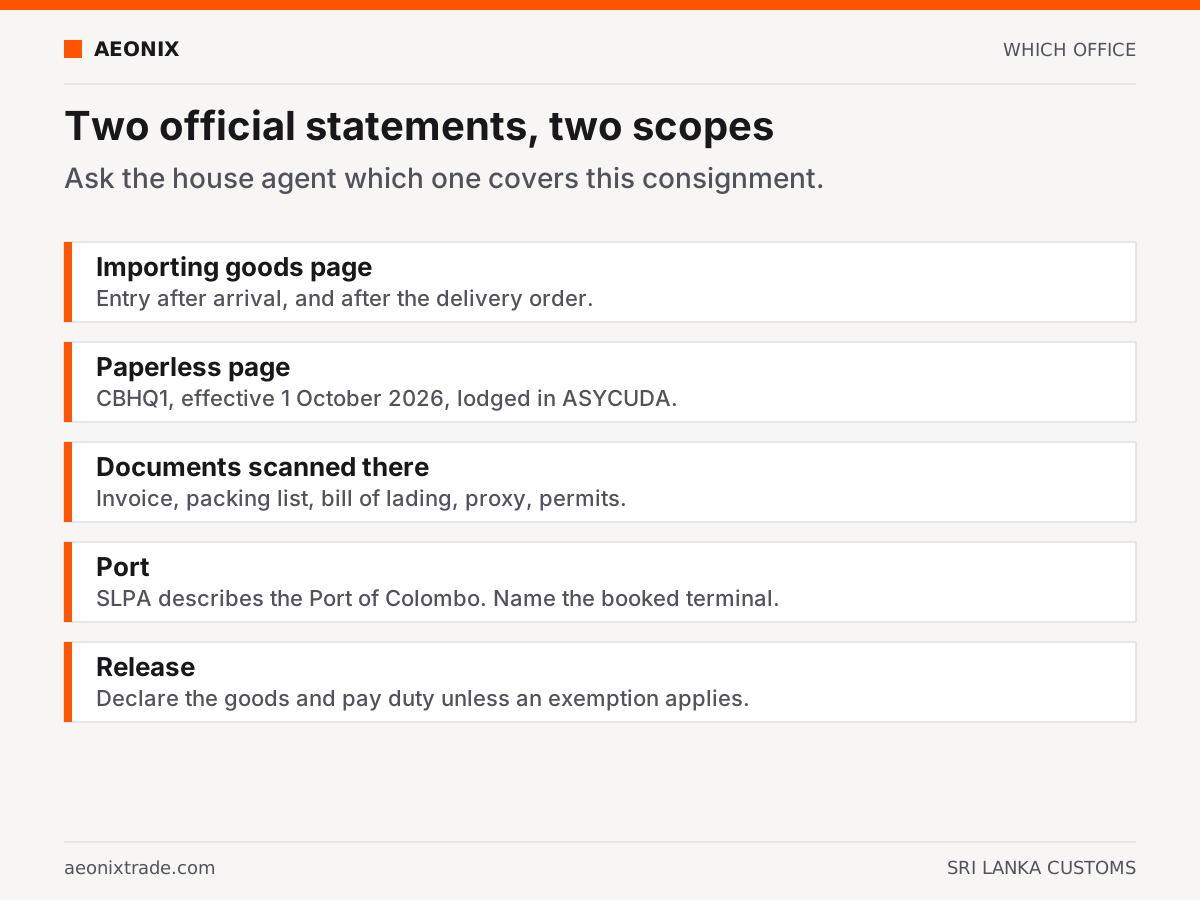
Ask the Customs House Agent which office will see this consignment, and which of those two pages applies, before you promise a customer a delivery date. Do not average them into one rule.
Colombo, and the papers that have to match
The Sri Lanka Ports Authority describes the Port of Colombo as the port it was constituted to run. If the booking is Colombo, the bill of lading should say so, including the terminal the line names. Yiwu consolidation does not choose the Colombo terminal. The carrier does. Your job is to make the invoice, the packing list, and the bill of lading describe the same cartons the agent will declare.
Mixed booths are where that match breaks. Three stationery suppliers and a snack supplier do not become "assorted goods" because they shared a Yiwu warehouse. Give each line its own description and its own HS code question. Keep a line that may need a permit out of the cartons that do not.
Cost lines
| Line | What it is | Where the figure comes from |
|---|---|---|
| Goods | Each booth on a named Incoterm | Proforma. FOB needs a place |
| Yiwu handling | Collection and consolidation | Consolidation, if the Incoterm excludes it |
| Ocean freight | Sea LCL to the booked terminal | LCL and LCL from China |
| Duty | Payable unless an exemption or waiver covers the goods | Sri Lanka Customs, via the agent. No rate is printed here |
| Permits | Only where an authority on the directorate's list applies | That authority. Not the booth |
| Delivery | After release, from the terminal to the warehouse | The local truck. Separate from ocean freight |
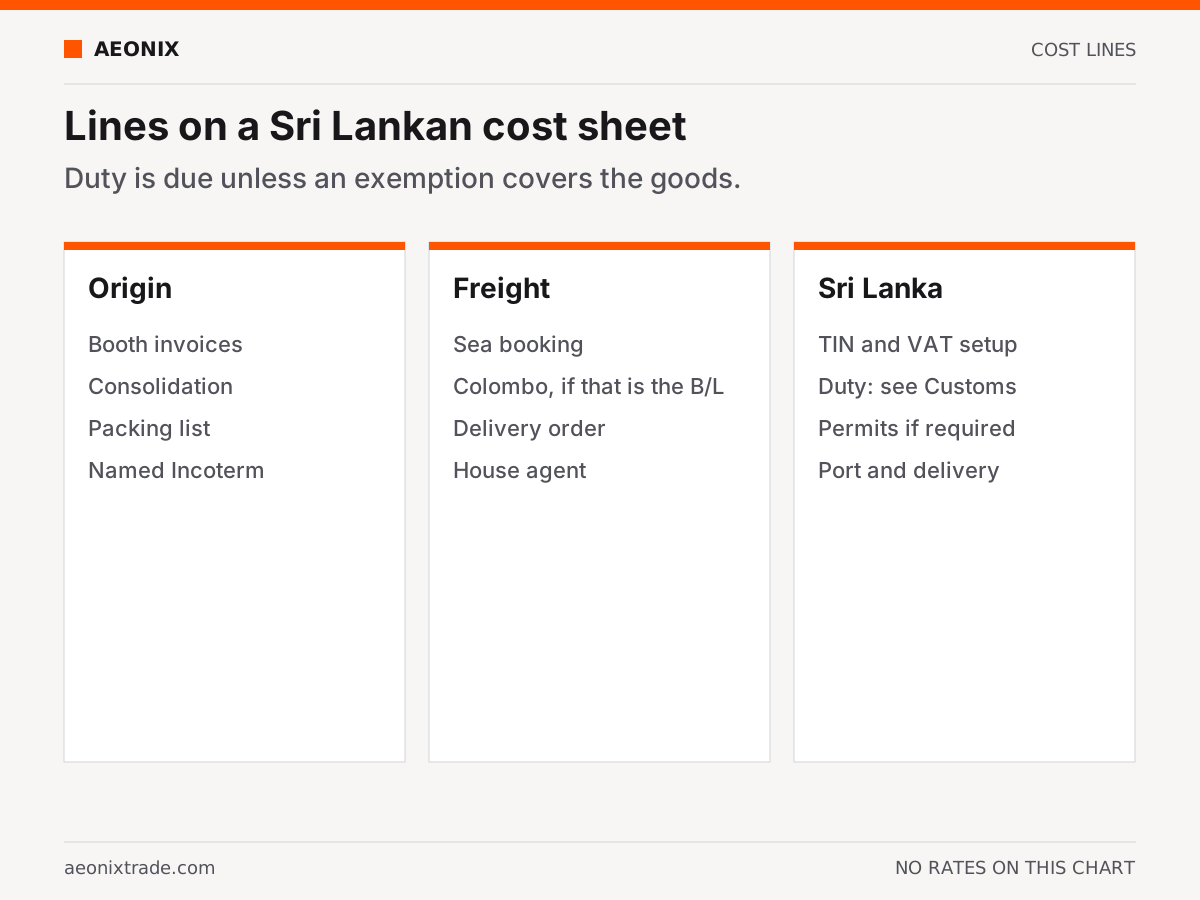
The landed-cost checklist is the sheet. Leave the duty cell as "see Customs." A rate from another Asian port is not this port's rate.
What usually goes wrong
- Asking the Yiwu side to be the importer. The TIN is a Sri Lankan registration. The Declaration Directorate starts with Inland Revenue.
- Lodging the entry with no Customs House Agent because the forwarder "knows the port." The importing-goods page says the declaration goes through an agent.
- Using the delivery-order timing and the CBHQ1 paperless timing as if they were the same office.
- Printing one packing list that hides a food line inside stationery cartons.
- Paying the factory balance before anyone has checked whether the goods sit on Schedule B or need a permit.
Before loading
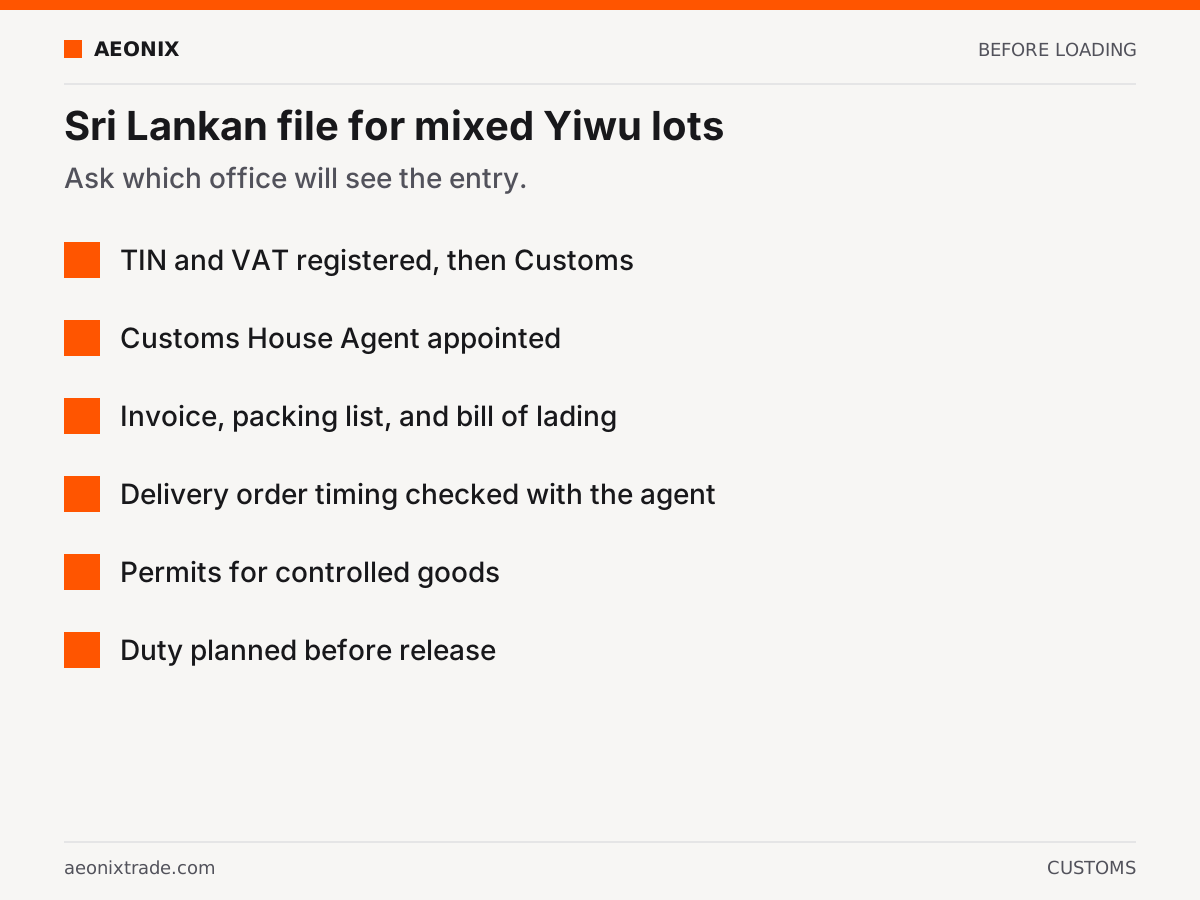
- TIN and VAT are registered with Inland Revenue, then the same number is registered with Customs.
- A Customs House Agent is appointed and has said which office will process the entry.
- Invoice, packing list, and bill of lading describe the same goods. See the commercial invoice, the packing list, and the bill of lading.
- You know whether this consignment waits for the delivery order, or whether CBHQ1's paperless process from 1 October 2026 is the one that applies.
- Permits are identified for any line the directorate's examples would catch, including food.
- Duty is budgeted before release, unless the agent shows an exemption that covers these goods.
- The port on the bill of lading is the one SLPA or the line actually booked. For Colombo, that means the terminal on the booking, not the shop address.
How several Chinese suppliers become one shipment is on how LCL from China works. After the vessel is alongside, the general sequence is on when cargo arrives. The Sri Lankan differences are the TIN, the house agent, and which declaration process the office is using.
See also Yiwu Market Guide for Overseas Buyers and Shipping from Yiwu.
Official sources
- Sri Lanka Customs, Declaration Directorate. TIN and VAT registration, duty unless exempt, Schedule B, and the documents the entry has to support.
- Inland Revenue Department. Where the directorate says the TIN and VAT number are registered first.
- Importing goods. Customs House Agent, entry after arrival and after the delivery order, duty before release.
- Paperless declaration process. CBHQ1, effective 1 October 2026, lodged in ASYCUDA with scanned documents.
- Sri Lanka Ports Authority. The Port of Colombo, as the authority describes it.
Submit sourcing request
Can't find what you need?
Start with a product or image link, an approximate quantity and destination. Other details can follow.