Yiwu to South Africa: Shipping, SARS Clearance and Cost Lines
Published by Aeonix Trade.
Last fact-checked: November 9, 2026.
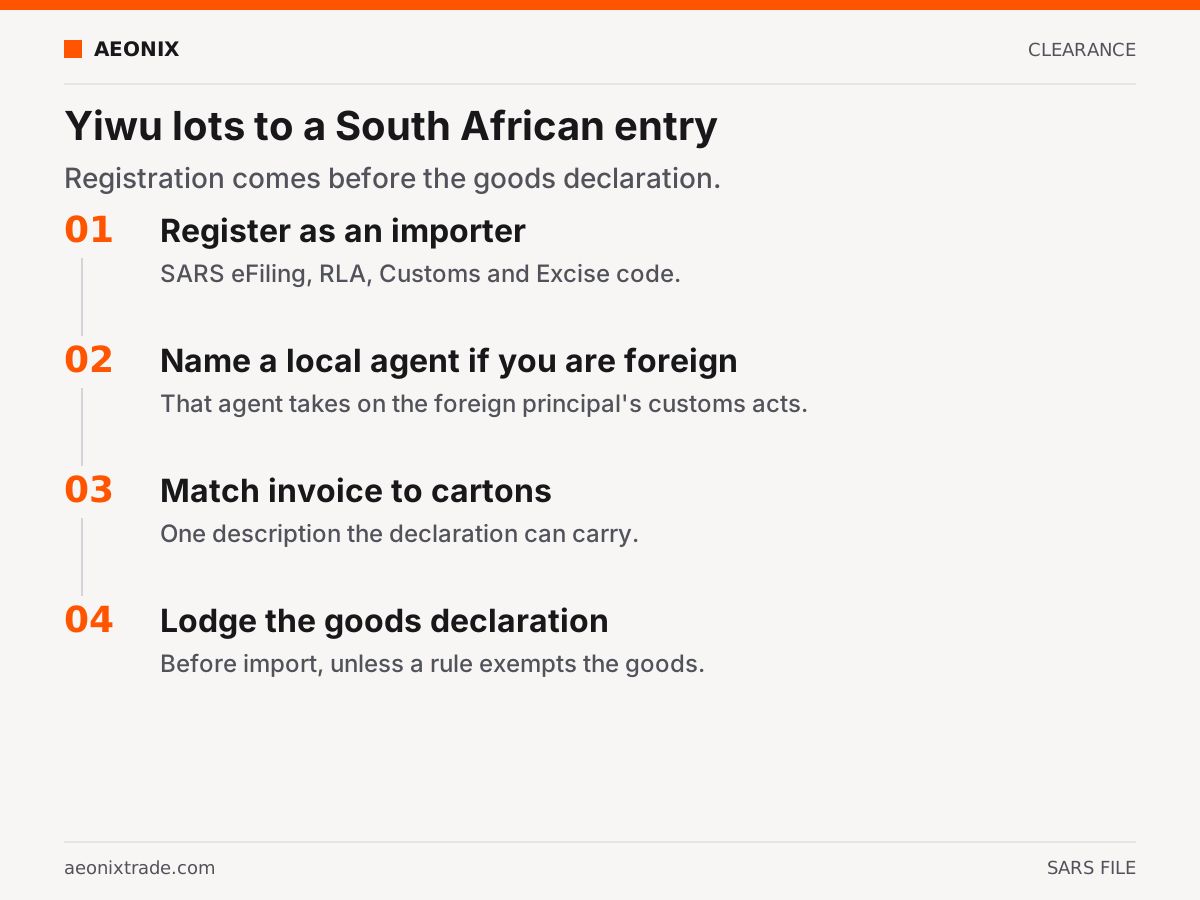
Yiwu to South Africa fails when the cartons sail before anyone is registered to import them. SARS requires the importer, including a foreign buyer, to be registered. A foreign importer has to nominate a registered agent in South Africa, and that agent assumes liability for the foreign principal's customs acts. The goods declaration comes after that, not instead of it.
The wider country path is on import from China to South Africa. This page is the mixed-booth version: several Yiwu invoices, one declaration, and a port such as Durban that still is not the clearance itself.
A typical case
A Durban buyer collects household goods from four Yiwu booths. The illustrative lot is about 14 CBM, quoted FOB, moving as LCL to the Port of Durban, then by truck to a warehouse in the city. Each booth writes its own description. The goods declaration has to carry those lines without inventing a single product called "household." If it cannot, the lots should not share a house bill.
Put the four proformas on the RFQ form with the importer's legal name. The forwarder's name is not a substitute for the customs code.
Registration before the declaration
SARS says any person who imports goods into South Africa must register as an importer. A foreign individual or company must register and nominate a registered agent located in South Africa before that foreign importer is registered. The nominated agent must assume full liability for the acts of the foreign principal in relation to customs. The steps run through eFiling and the Registration, Licensing and Accreditation system. The page is SARS: Importers. The wider RLA note is on Registration, Licensing and Accreditation.
The code you receive is the importer's code. Retrieve it from SARS after registration. A forwarder should not invent one so the bill of lading has a number in the box.
The goods declaration
SARS says importers, exporters, and their clearing or registered agents must be registered or licensed before they submit a goods declaration. Every importer or exporter must lodge one, except where a rule exempts the goods, before the goods are imported or exported. The client self-assesses from the transaction documents and submits the declaration electronically or manually. Customs can release the goods or ask for supporting documents. Clients must prove origin when preferential rates of duty are applied. Goods may enter only through ports of entry designated in the Rules. Some goods need a permit. That is the goods declaration page.
Do not write a China-South Africa preference onto the invoice because someone at the booth said the duty is lower. Prove origin when a preference is actually claimed, and only if that preference exists for the line. If you are not claiming one, do not dress the file up as if you were. The rate itself is on the SARS tariff. It is not copied here.
Durban is a port TNPA names
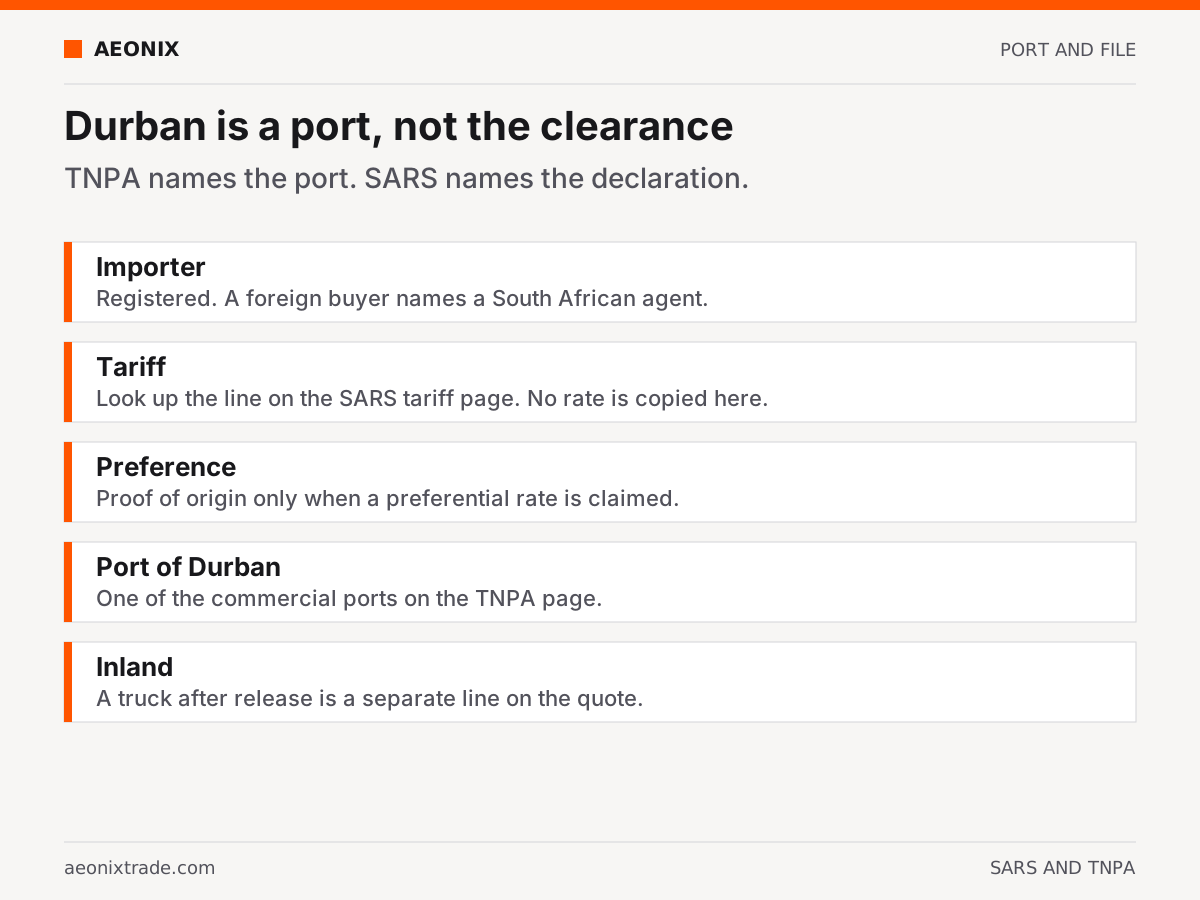
Transnet National Ports Authority's page names the Port of Durban among the commercial ports it administers, together with Cape Town, East London, Mossel Bay, Ngqura, Port Elizabeth, Richards Bay, and Saldanha. That list is on TNPA. It tells you Durban is a real commercial port in the national system. It does not clear the goods. SARS does, through the declaration, at a designated port of entry. If your bill of lading says Durban, the inland move after release is still a separate quote. A stall that says "Durban delivered" has not named the importer, the duty, or the truck.
Cost lines
| Line | What it is | Where the figure comes from |
|---|---|---|
| Goods | Each booth on a named Incoterm | Proforma. See FOB |
| Yiwu handling | Collection and consolidation | Forwarder, if the Incoterm stops short of the warehouse |
| Ocean freight | LCL or a full box to the named port | Booking. LCL and LCL from China |
| Duty and VAT | The live tariff for the line | SARS tariff page, via your broker. No rate is printed here |
| Broker, port, inland | Declaration, terminal, truck | Those invoices. Not the booth |
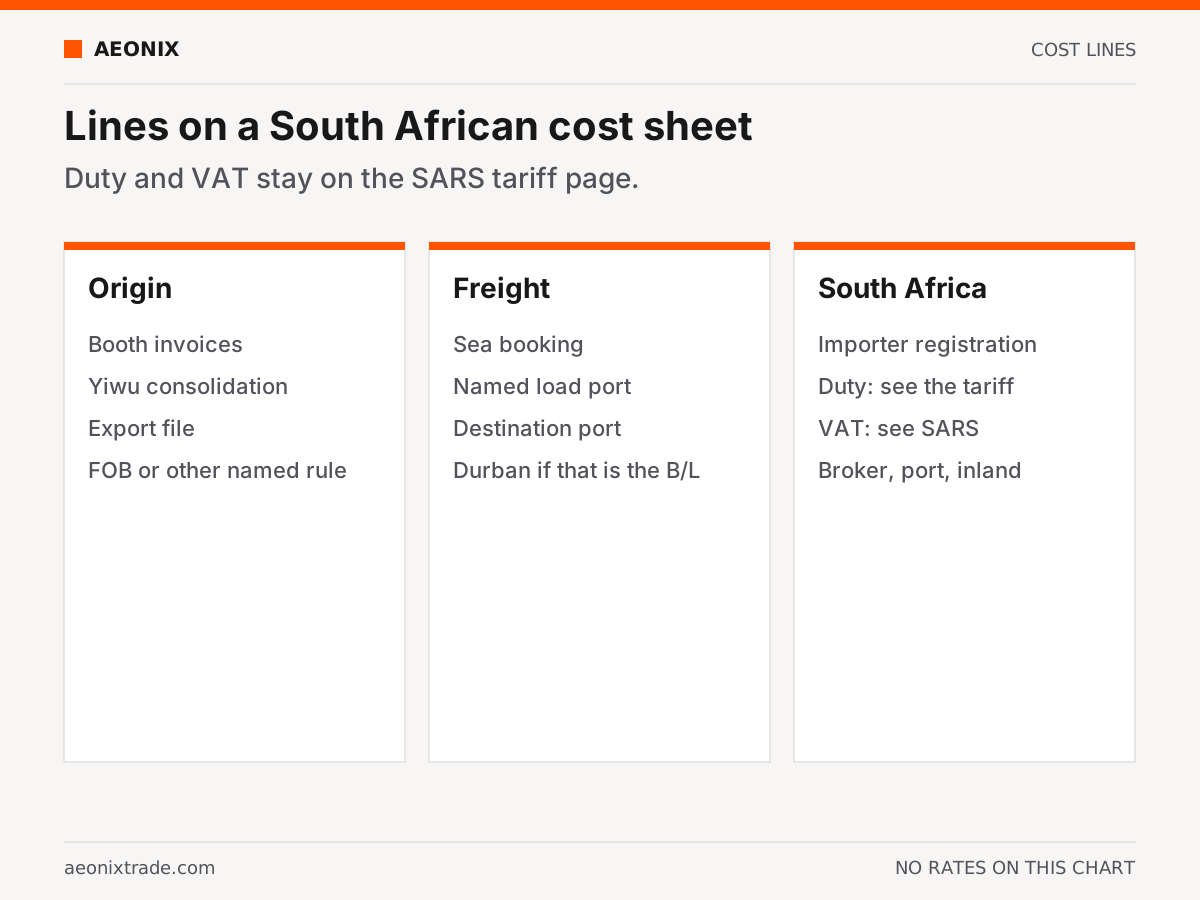
Build the sheet with the landed-cost checklist. A Saudi SABER file, an Omani Bayan printout, or a Colombo entry will not clear this box. Those lanes are Saudi Arabia, Oman, and Sri Lanka.
What usually goes wrong
- Shipping to the forwarder's name because registration "can be done on arrival." SARS wants the importer registered before the declaration. A foreign buyer still needs the local agent in place.
- One carton mark for four booths. The declaration is a self-assessment. A vague description is your description.
- Claiming a preferential rate with no origin proof. SARS asks for that proof when the preference is used.
- Treating Durban as the delivery address. It is a port. The warehouse is another leg.
- Copying a duty percentage from a previous season. Open the tariff page again.
Before loading
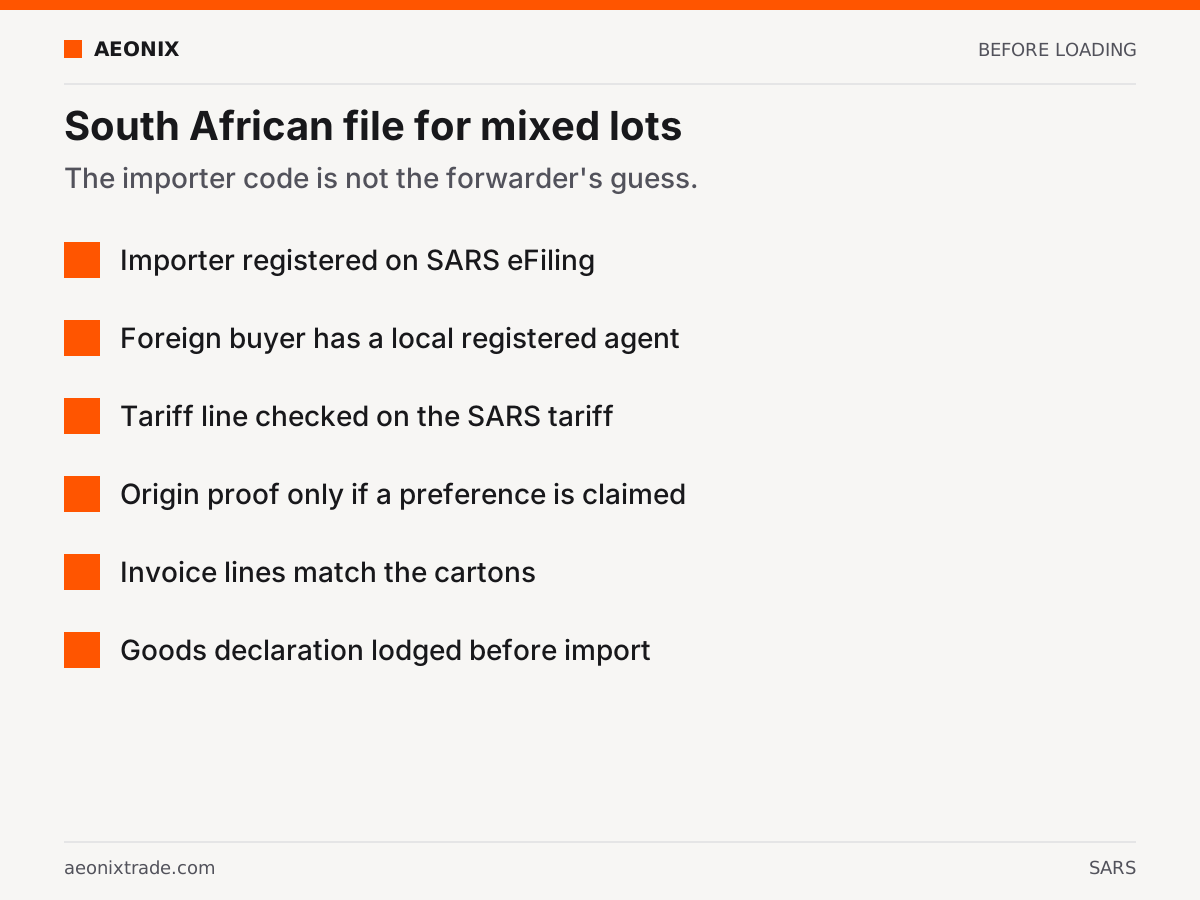
- The importer is registered on SARS eFiling, and you can retrieve the customs code from SARS.
- If the buyer is foreign, the South African registered agent is nominated and understands the liability SARS describes.
- Each booth line has a tariff heading someone will defend. See HS codes.
- Origin documents exist only if a preference is claimed. See certificate of origin.
- The commercial invoice and packing list match the cartons. Invoice and packing list.
- The goods declaration will be lodged before import, unless a rule exempts these goods.
- The port on the bill of lading is a designated port of entry. Durban qualifies as a TNPA commercial port. Confirm the entry rules with your clearing agent.
Shared-container handling from several Chinese suppliers is on how LCL from China works and on consolidation. What happens after the vessel berths, in general terms, is on when cargo arrives. The South African differences stay the registration, the declaration, and the tariff.
See also Yiwu Market Guide for Overseas Buyers and Shipping from Yiwu.
Official sources
- SARS: Importers. Who must register, and the local agent a foreign importer must nominate.
- SARS: Registration, Licensing and Accreditation. The eFiling path.
- SARS: Goods declaration. Lodge before import unless exempted. Prove origin when a preference is claimed.
- SARS tariff. Look up the line. No rate is copied onto this page.
- Transnet National Ports Authority. Durban and the other commercial ports TNPA administers.
Submit sourcing request
Can't find what you need?
Start with a product or image link, an approximate quantity and destination. Other details can follow.