Yiwu Market Guide for Overseas Buyers: Districts, Hours and How Orders Work
Published by Aeonix Trade.
Last fact-checked: November 10, 2026.
This Yiwu market guide is for an overseas buyer who wants the mart, not a slogan about it. The operator publishes five International Trade Mart district pages, plus separate pages for District 1 East, District 2 East and Huangyuan Market. Chinagoods also names a District 6 and an international production-materials market. This page covers the five district pages that actually describe products. It does not assign categories to the markets those pages do not describe.
The operator's own footer calls the market a very large commodities centre. That is their line. What you can check is more useful: which district opened when, which floor names which goods, and which clocks on the public pages are not booth hours.
Futian is the area name you will see on maps and in hotel addresses around the mart. It is not a sixth product category. The Yiwugo navigation also lists District 1 East, District 2 East, and Huangyuan Market as their own pages. Chinagoods names a District 6 and an international production-materials market. Product groups for those extra markets are unavailable in this guide, because the five district pages used here do not describe them. If a supplier says "we are in Yiwu market," ask which district and which floor, and ask them to point at the operator page, not at a blog map. A District 5 fabric booth and a District 1 toy booth are not a stroll you should invent a time for. Walking minutes between districts are unavailable.
Do not add the booth counts into one market total. District 1's page prints area and an opening date and does not print a booth count. District 2 prints above 8,000 booths. District 3 prints over 6,000 standard booths on floors 1 to 3, plus more than 600 larger booths on floors 4 and 5. District 4 prints above 16,000. District 5 prints more than 7,000. A single "Yiwu has X booths" figure that adds those lines would still miss District 1 and would mix different counting methods. That total is unavailable. Use the district page for the district you are walking. The floor wording, including where a paragraph and a table on the same page disagree, is the district and floor guide.
The five districts, in one pass
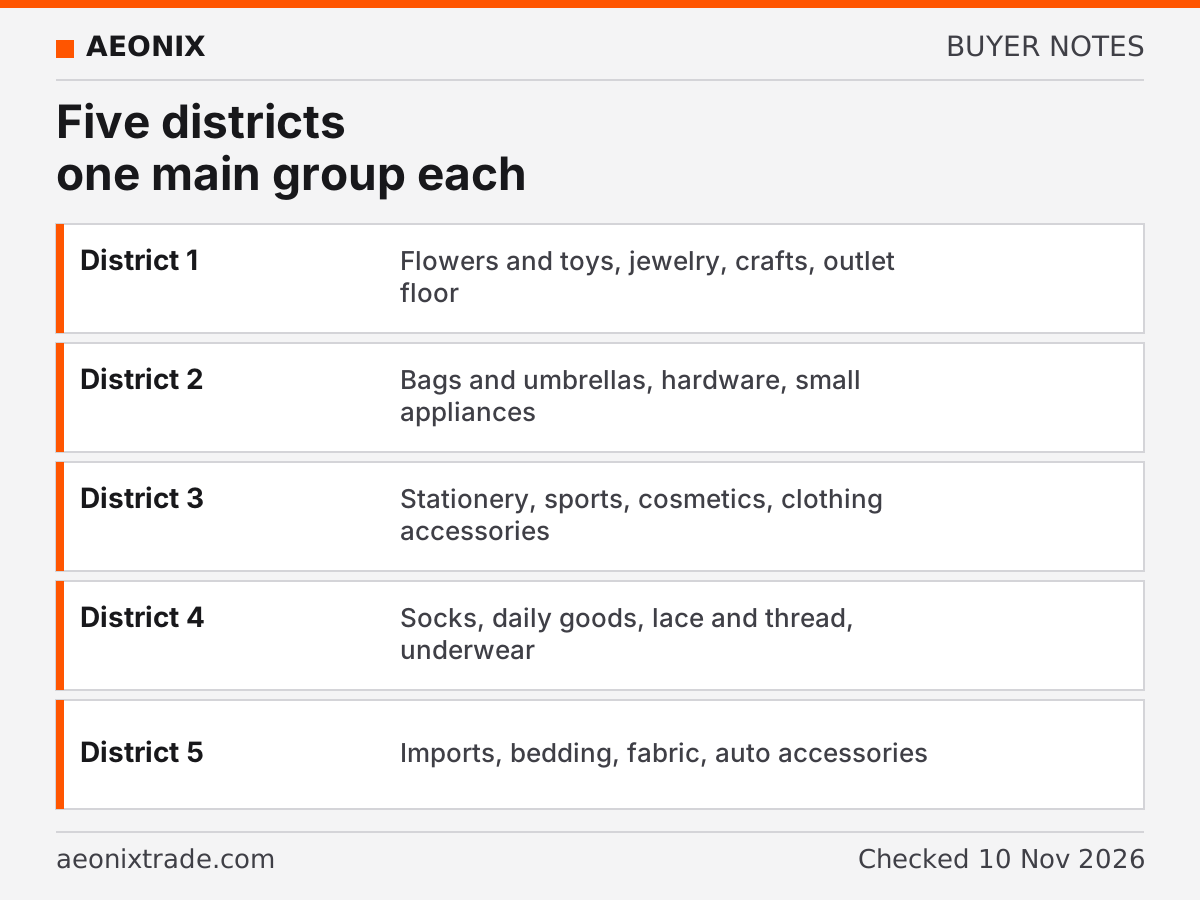
District 1, in operation from 22 October 2002, is flowers, toys, jewelry and crafts, with a manufacturer outlet on the upper floor in the operator's paragraph. A jewelry and hair-accessory buyer starts there, and the narrower note is Yiwu jewelry and hair accessories. Toys and festival goods on that same first floor are toys and festival goods. District 2, opened 22 October 2004, is bags, umbrellas, hardware, small appliances, and a foreign-trade service floor. District 3 is stationery, sports, cosmetics, and clothing accessories such as zippers and buttons, which is stationery, office, and sports, not a garment hall. District 4, in operation from 21 October 2008, is socks, daily goods, lace, and underwear. Socks and the textile accessories around them are socks, hosiery, and textile accessories. District 5 is imported goods, bedding, fabric, and auto accessories.
| You are buying | Start | Do not start |
|---|---|---|
| Toys, artificial flowers, jewelry, hair ornaments, festival craft | District 1 | District 4. Its first floor is socks. |
| Bags, umbrellas, hardware, small appliances, clocks | District 2 | District 1. Crafts are not tools. |
| Pens, paper, sports, cosmetics, glasses, zippers | District 3 | A blog that calls District 3 "the clothing market." |
| Socks, hats, gloves, underwear, scarves | District 4 | District 3, unless you also need buttons or zippers. |
| Bedding, fabric, curtains, imported goods, auto parts | District 5 | District 2, unless the part is the hardware the District 2 page names. |
If the product is not on any of those five pages, Yiwu may be the wrong building. Other wholesale markets in China, by category, are the markets-by-category guide. Yiwu against Guangzhou and Shenzhen, as a choice of city rather than a choice of floor, is which city to visit. A single fair phase that already contains your whole range is a different trip: Canton Fair versus Yiwu versus the Yiwu Fair.
Hours: what is printed, and what is not
Booth trading hours are not printed on the five district pages. Two clocks on the Chinagoods market page are easy to misread. The District 2 customer-service centre is listed as 9:00-11:30 and 13:00-17:00, and the summer row and the winter row show the same times. A contact number on that page is listed as Monday to Sunday, 08:30-17:00. Neither line is captioned as the time booths trade. The Yiwu Fair site publishes 08:30-17:00 for its own trade days. That is the fair, not the mart. If another site gives one opening time for the whole market, treat it as unverified. Holiday closures, including any Spring Festival shutdown, are unavailable on the pages checked. The page that has to carry a dated closure, or say that the date is still unavailable, is opening hours, holidays, and when to go. Do not plan a January trip on a blog's memory of last year's festival.
How an order actually moves
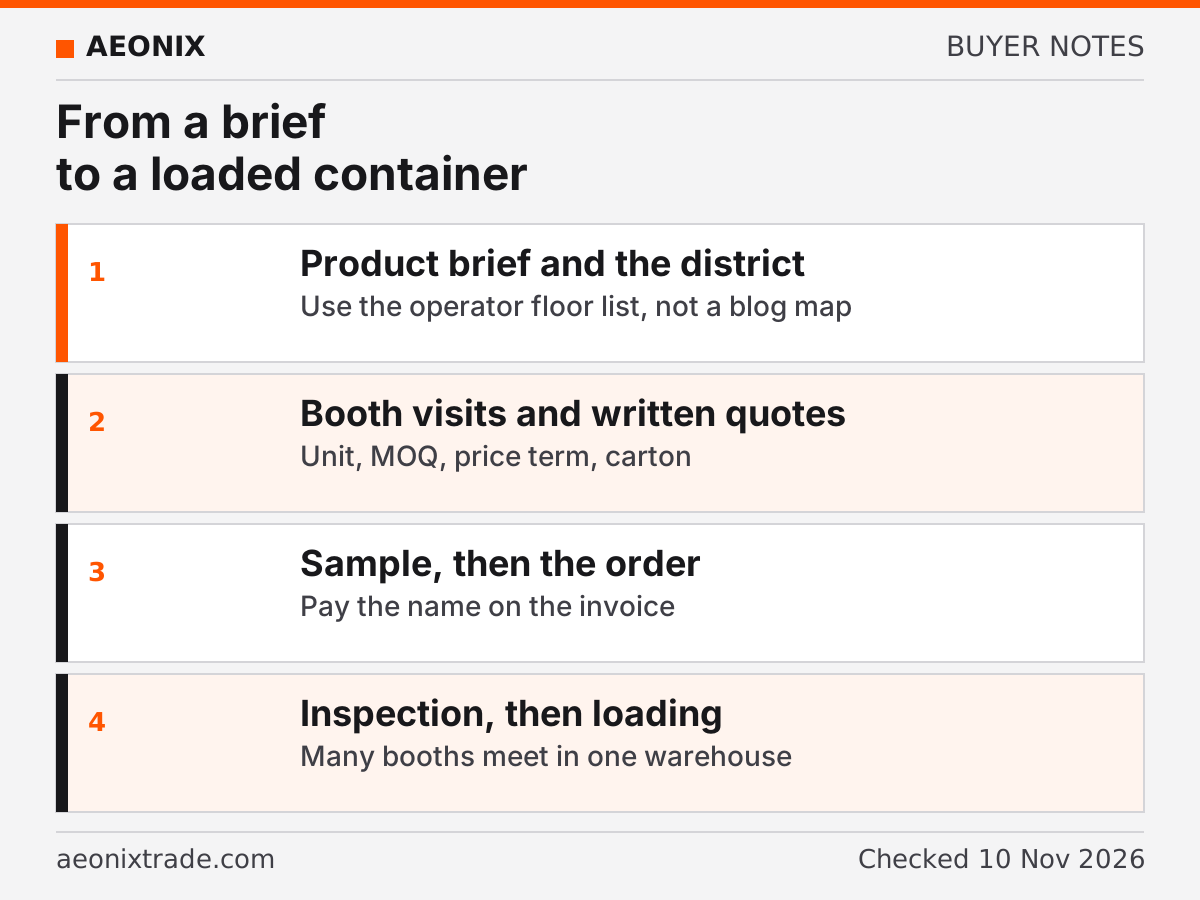
You arrive with a spec, not with a hope that the right floor will announce itself. The trains and flights into the city are getting to Yiwu. You take written quotes. You pay the company on the invoice. You inspect before the cartons from different booths share a mark. The walk-through is how to buy from Yiwu. What you can push on minimums and samples, and what the booth will not move, is MOQ and samples at the booth. There is no official Yiwu MOQ and no official deposit percentage. Anyone who quotes one ratio as "the market rule" is not quoting the operator.
Payment, inspection, and the truck are three different contracts. The goods invoice names the seller and the price term. EXW at the booth is not FOB on a ship. The deposit, if you agree one, goes to that seller. A personal account is a reason to stop, which is the same check as verifying a supplier before payment. The booth versions of that trick are common booth scams. Inspection is a right you write down before production, using something like the pre-shipment inspection checklist. It is not a favour the booth offers after you have paid the balance. The truck is the third contract: many booths, one warehouse, one booking. That is consolidating Yiwu booths, and the sea leg for a small cube is how LCL from China works.
A destination does not change the district. It changes the papers after the warehouse. Freight rates, duty, and any country permit are unavailable on this page. The lanes that have to carry those notes, and to say unavailable where the official page was not open, are Yiwu to the UAE, Saudi Arabia, South Africa, Oman, and Sri Lanka. Local China customs pages on market-procurement rules returned HTTP 412 on 10 November 2026, so the value cap and the supervision code are not copied here either. Ask the forwarder which method is on the declaration, and read the customs notice.
Buying without flying is a real question and an unfinished one. Yiwugo and Chinagoods are the operator's own sites. What their checkout does for an overseas company, and whether a listing is an export contract, was not tested on those pages. Treat a screen as a way to preview a district. The note on how those sites work for a foreign buyer is Yiwu online: Chinagoods and Yiwugo. Whether that screen replaces the walk is ordering online or walking the aisles.
Go yourself, send an agent, or stay on the website
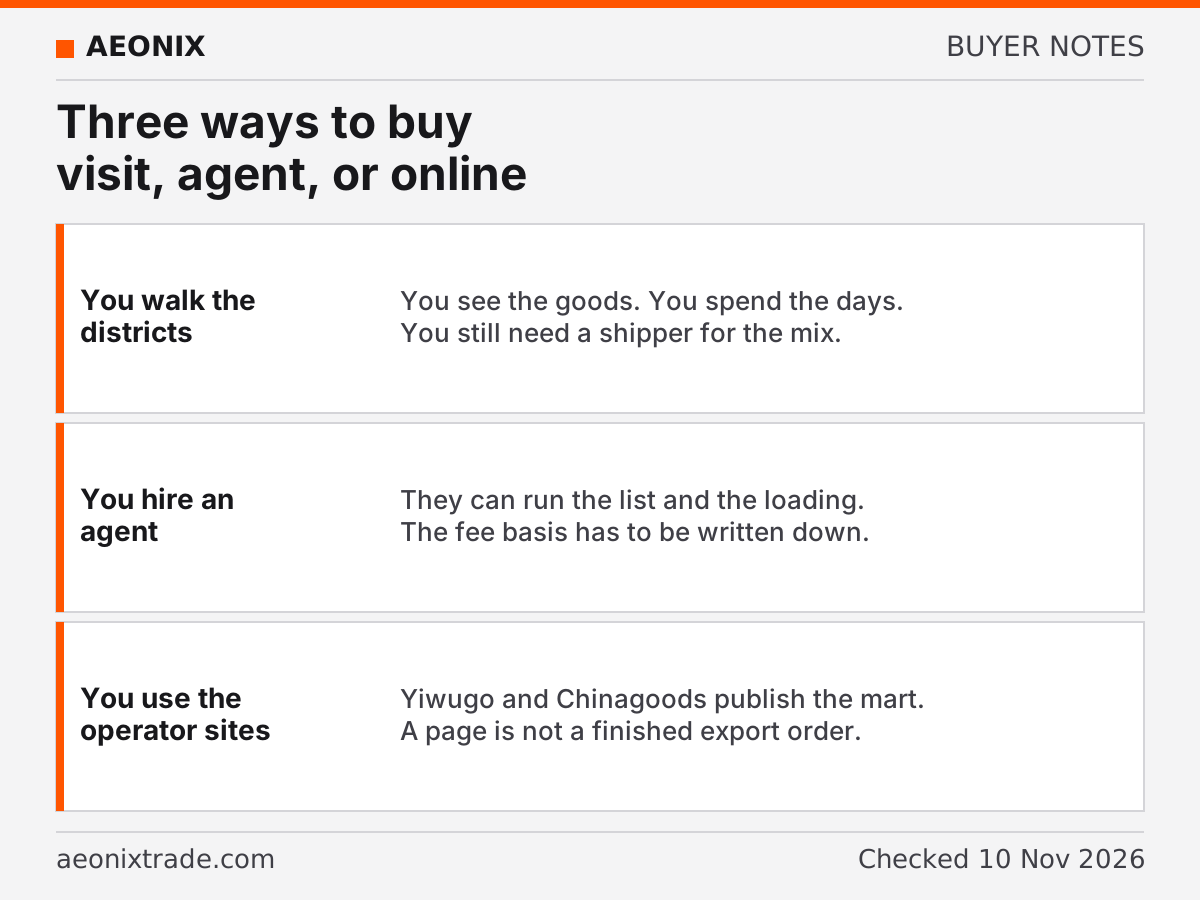
| You see the goods | You control the price term | Someone checks the cartons | |
|---|---|---|---|
| You walk the districts | Yes, if you reach the floor | Only if you write the term down | You, or an inspector you book |
| You hire an agent | Only if they send photos against your spec | Only if the fee and the goods price are separate lines | Only if the contract says they can hold the goods |
| You use Yiwugo or Chinagoods | You see what the page shows | A listing is not an export contract | Nobody has opened a carton |
Choosing the agent, and the ways the fee can be hidden, is how a Yiwu sourcing agent charges. The service page, if you want Aeonix to run the list, is the Yiwu agent page. A trip you take yourself can still use the market-visit page for the planning.
A typical case
A buyer needs hair clips, a small plush toy, and gift bags. Nothing fills a container alone. Hair clips and toys point at District 1. Gift bags point at District 2. The buyer writes one spec sheet per item, walks those floors, and refuses any quote that will not state a price term. The shipment is LCL on FOB terms once the cartons are counted in one warehouse. The case is typical. It is not a record of a named order, and it has no unit prices because none were measured for this page.
A second buyer wants socks, a zipper, and a cosmetic pouch for the same retail set, and has four days. How long the floors actually take is how many days to stay. Socks are District 4. Zippers are District 3. The pouch may be District 2 if it is a bag, or District 3 if it is a cosmetic item. The buyer does not "do Yiwu" as one building. The buyer writes three briefs, visits those districts, and leaves a booth that will only quote EXW when the rest of the order is being compared on FOB. An agent is worth hiring here if the buyer cannot tell those districts apart on the ground. The agent is not worth hiring if the brief is "find me something that sells." How to tell those two engagements apart is how a Yiwu sourcing agent charges.
First morning
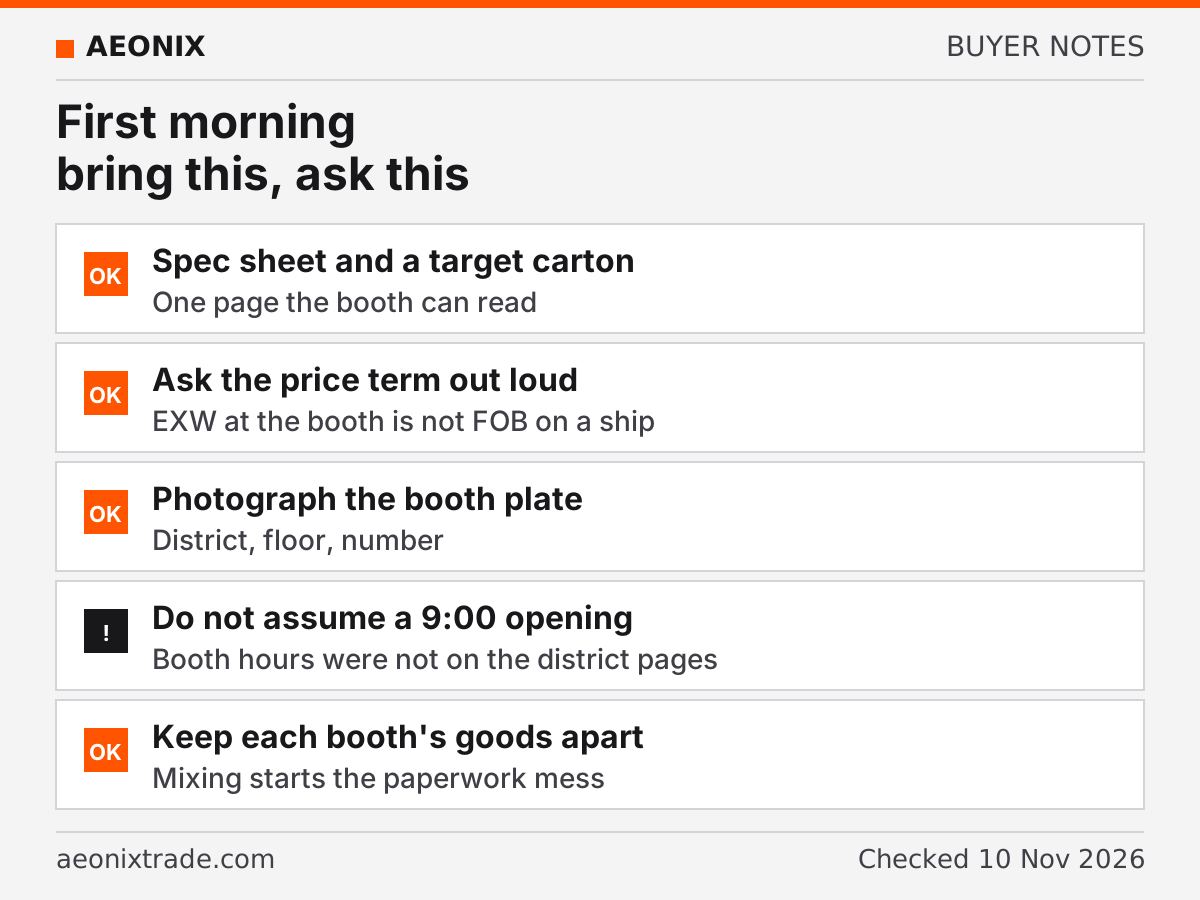
- One page per SKU: unit, colour, packing, and the term you want.
- Ask whether the number is EXW at the booth or something else. Read what EXW leaves you holding.
- Photograph the booth plate: district, floor, number.
- Do not plan the day around a 9:00 opening. That clock is not on the district pages.
- Keep each booth's cartons identifiable. Mixing them is how the packing list breaks.
Pitfalls
- A booth price treated as a factory price. Ask who issues the invoice. The payee and the maker are often different companies.
- A District 3 description from a blog that calls it a clothing market. The operator page names stationery, sports, cosmetics, eyeglasses, zippers, buttons and apparel accessories. Garments are not that list. Socks and underwear are District 4.
- Using the fair's hours, or the customer-service desk's hours, as if the booths had published them.
- Adding the district booth counts into one number and calling it the size of the market. District 1 does not print a booth count, so the sum is unavailable.
- Paying a deposit to a personal account because the booth is busy. The seller is the company on the invoice, or you do not pay.
Questions that do not have an official number yet
What time do the booths open?
Unavailable on the five district pages checked on 10 November 2026. Do not promote the customer-service clock or the fair clock into a booth hour.
Can I order a small quantity?
There is no published market-wide MOQ. The number is whatever that booth writes on that spec. How to ask, and what is a waste of time, is the MOQ note linked above.
Should I go to Yiwu or to a fair?
Go to Yiwu when the order is a mix of small commodities and you can name the districts. Go to a fair phase when one published product list contains the whole range. If you cannot name either, you are not ready to book the flight. Send the list on the RFQ form. A visit you take yourself can still be planned from the market-visit page, and a list you want walked is the Yiwu agent page.
The district pages are the operator's map. The export rule for a recognised market cluster is Customs Announcement 2019 No. 221, republished by the Ministry of Commerce. A named delivery term on the quote is ICC Incoterms 2020, and the US briefing on the market is the China Commercial Guide.
Next steps
- Hotels by the trade city
- Futian versus the trade city
- An invitation letter for the visit
- An interpreter on the floor
Official sources
- Yiwugo: International Trade Mart District 1.
- Yiwugo: International Trade Mart District 2.
- Chinagoods Yiwu market page, including the customer-service hours.
- Ministry of Commerce: Customs Announcement 2019 No. 221. What market-procurement trade is, for goods bought in a recognised market cluster.
- International Trade Administration: China Commercial Guide.
- ICC Incoterms 2020.
Submit sourcing request
Can't find what you need?
Start with a product or image link, an approximate quantity and destination. Other details can follow.