Yiwu International Trade City: What Each District and Floor Sells
Published by Aeonix Trade.
Last fact-checked: November 10, 2026.
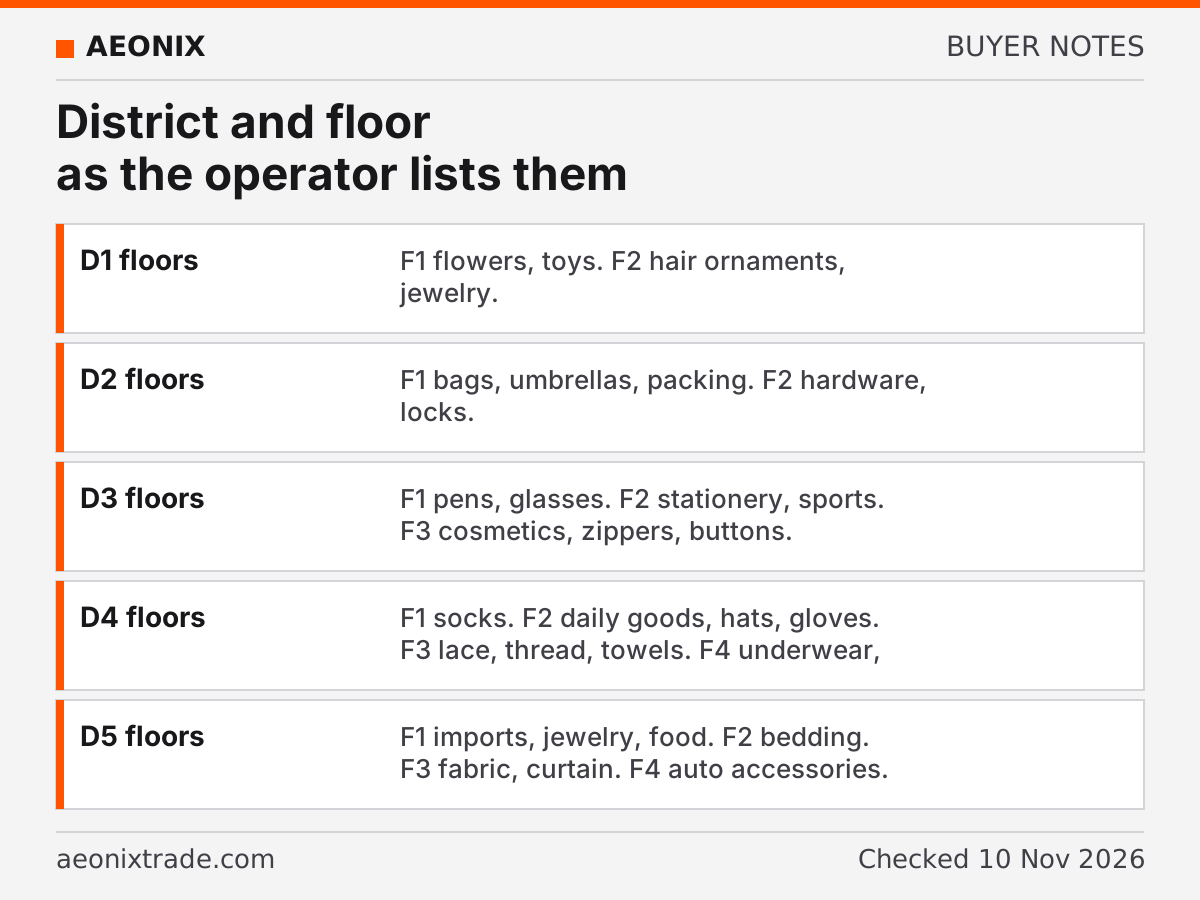
Yiwu International Trade City districts are published as separate operator pages, and the floors do not match the summaries that circulate in blog posts. The notes below were taken from District 1, District 2, District 3, District 4 and District 5 on 10 November 2026. Where a page's paragraph and its product table use different words, both are shown. Where a page is silent, the cell stays empty.
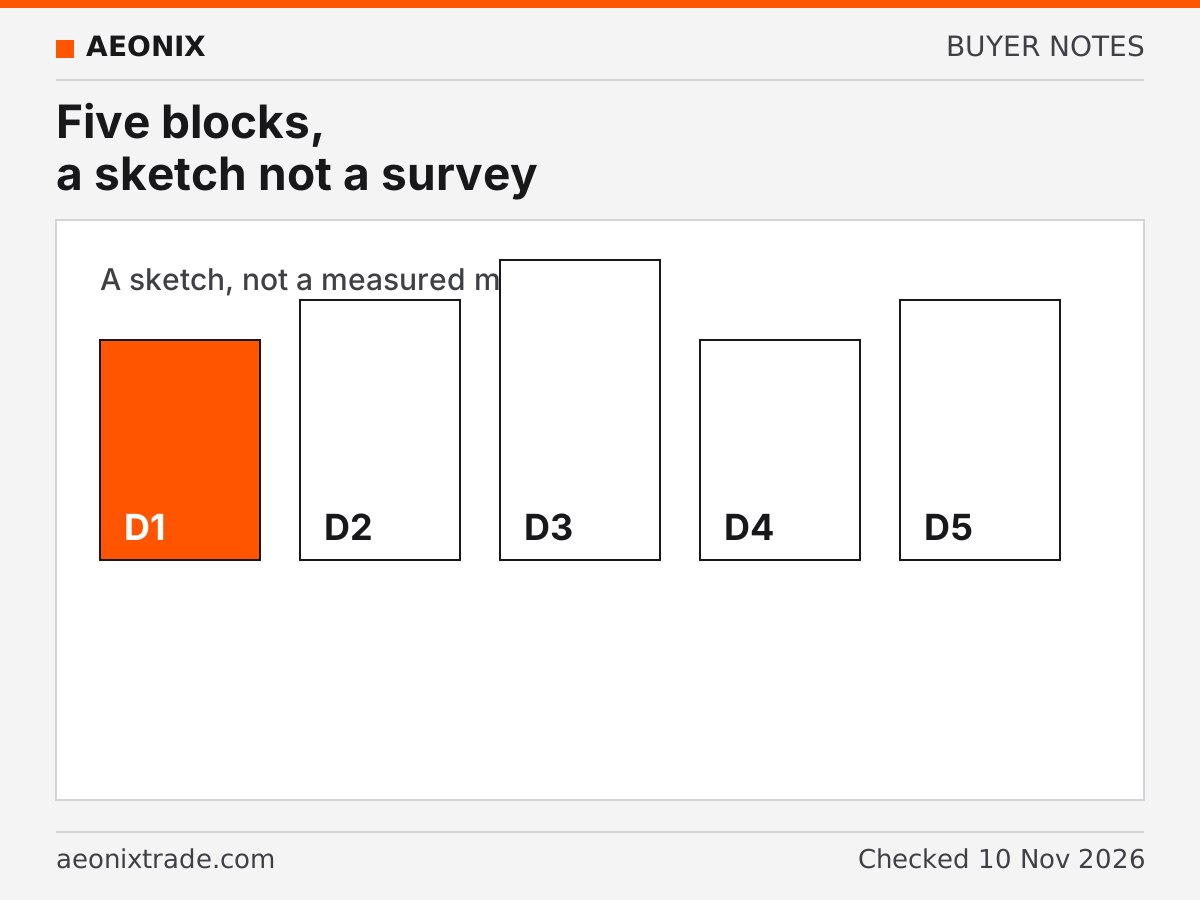
The drawing is a sketch of five blocks. It is not a measured map, and it is not a walking time.
District by floor
| District | What the paragraph says | What the floor table adds or words differently |
|---|---|---|
| 1 | Floor 1 artificial flowers and toys. Floor 2 jewelry. Floor 3 arts and crafts. Floor 4 manufacturer outlet. Opened 22 October 2002. 340,000 square metres. Founded October 2001. 420 mu. | Floor 1 also lists flower accessories. Floor 2 lists hair ornaments and jewelry. Floor 3 lists festival crafts, decorative craft, ceramic crystal, tourism crafts, jewelry accessories and photo frames. The table does not label floor 4. |
| 2 | Floor 1 suitcases, bags, umbrellas, raincoats, packing bags. Floor 2 hardware, electrical products, locks, vehicles. Floor 3 kitchen and sanitary hardware, small appliances, telecom, instruments, clocks. Floor 4 manufacturer outlet. Floor 5 foreign-trade sourcing service. Opened 22 October 2004. Over 600,000 square metres. Above 8,000 booths. Over 10,000 operators. 483 mu. | The table's floor 4 rows name hardware, luggage and clocks rather than only "outlet." Chinagoods prints the same opening date, area and booth count. |
| 3 | Stationery, sports, cosmetics, eyeglasses, zippers, buttons, apparel accessories. 460,000 square metres. Over 6,000 booths of 14 square metres on floors 1-3. More than 600 booths of 80-100 square metres on floors 4 and 5. Outlet on floor 4. Opening year: not on the page. | Floor 1 pens, ink, paper, glasses. Floor 2 office and stationery, sports. Floor 3 cosmetics, mirrors and combs, zippers, buttons, clothing accessories. Floor 4 of the same table also names cosmetics, stationery and sports, quality luggage and handbags, clocks and watches, and zippers, buttons and clothing accessories. The table does not give floor 5 a product row. |
| 4 | Floor 1 socks. Floor 2 daily necessities, gloves, hats, knitted and cotton goods. Floor 3 shoes, webbings, lace, thread, towels. Floor 4 bras, underwear, belts, scarves. In operation 21 October 2008. 1,080,000 square metres. Above 16,000 booths. | The table's floor 3 rows name towel, wool yarn, necktie, lace and sewing thread. They do not repeat the word shoes, which appears in the paragraph. |
| 5 | Imported goods, bedding, textile, knitting materials, auto products and accessories. 640,000 square metres. 266.2 mu. More than 7,000 booths. Opening year: not on the page. | Floor 1 imported products, African products, jewelry, photo frames, consumer goods, foods. Floor 2 bedding. Floor 3 towel, knitting material, fabrics, curtain. Floor 4 auto accessories. |
District 1's jewelry floor is why a hair-clip buyer and a toy buyer can share one building and still not share a floor. Toys and artificial flowers are floor 1. Hair ornaments and jewelry are floor 2 on the table, which is also what the paragraph calls the jewelry floor. Festival craft, decorative craft, ceramic, photo frames, and tourism craft are floor 3. The paragraph puts a manufacturer outlet on floor 4. The table does not label floor 4 at all. Both sentences are on the same operator page, checked 10 November 2026. A buyer who needs the outlet should ask the booth for the floor, not assume the table's silence means the outlet closed.
District 2 is the bag and hardware building, not a second craft building. Floor 1 is bags, umbrellas, rainwear, and packing, which is where bags and luggage start. Floor 2 is hardware, electrical goods, locks, and, in the paragraph, vehicles. The floor table does not repeat the word vehicles. Floor 3 is kitchen and sanitary hardware, small appliances, telecom, instruments, and clocks. Those clock rows, including the floor 4 table, are watches and clocks. Floor 4 is a manufacturer outlet in the paragraph, while the table's floor 4 rows name hardware, luggage, and clocks. Floor 5 is the foreign-trade sourcing service. If a supplier says "vehicles, District 2," that word is in the paragraph and missing from the table. Write down which floor they mean.
District 3 is the page other guides most often rewrite. The operator's paragraph says stationery, sports, cosmetics, eyeglasses, zippers, buttons, and apparel accessories. It does not say men's wear, women's wear, or children's wear. The table puts pens, ink, paper, and glasses on floor 1, office and sports on floor 2, and cosmetics, mirrors, combs, zippers, buttons, and clothing accessories on floor 3. The cosmetics rows are cosmetics and personal care. Floor 4 of that table names cosmetics again, together with stationery and sports, quality luggage and handbags, clocks and watches, and zippers, buttons, and clothing accessories. The paragraph puts the manufacturer outlet on floor 4 and counts the larger booths on floors 4 and 5. The table does not give floor 5 its own product row, so this page does not assign cosmetics or clocks to floor 5. An opening year is not on the page. Area is 460,000 square metres. Someone who tells you District 3 is "the clothing market" is not reading this page. Clothing in the garment sense is not this list. Socks and underwear are District 4.
District 4 is the sock and daily-wear building. Floor 1 is socks. Floor 2 is daily necessities, gloves, and hats, and the paragraph also says knitted and cotton goods. Floor 3 in the paragraph includes shoes, webbings, lace, thread, and towels. The shoe line, which the table does not repeat, is shoes. Floor 3 in the table lists towel, wool yarn, necktie, lace, and sewing thread, and does not repeat "shoes." Floor 4 is bras, underwear, belts, and scarves. The building has been in operation since 21 October 2008, with 1,080,000 square metres and above 16,000 booths on that page. If you came for shoes, believe the paragraph enough to ask, and do not pretend the table confirmed it.
District 5 is the wide one. The paragraph names imported goods, bedding, textile, knitting materials, and auto products. The table is more specific and more mixed: floor 1 is imported products, African products, jewelry, photo frames, consumer goods, and foods. Floor 2 is bedding. Floor 3 is towel, knitting material, fabrics, and curtain. Floor 4 is auto accessories. Jewelry on District 5 floor 1 is not a reason to skip District 1 floor 2 if you came for fashion jewelry. The District 1 page is the one that describes hair ornaments and jewelry as a floor. District 5's jewelry line sits inside a mixed import floor. Opening year for District 5: unavailable. Area on the page: 640,000 square metres, 266.2 mu, more than 7,000 booths.
An example route, not a measured one
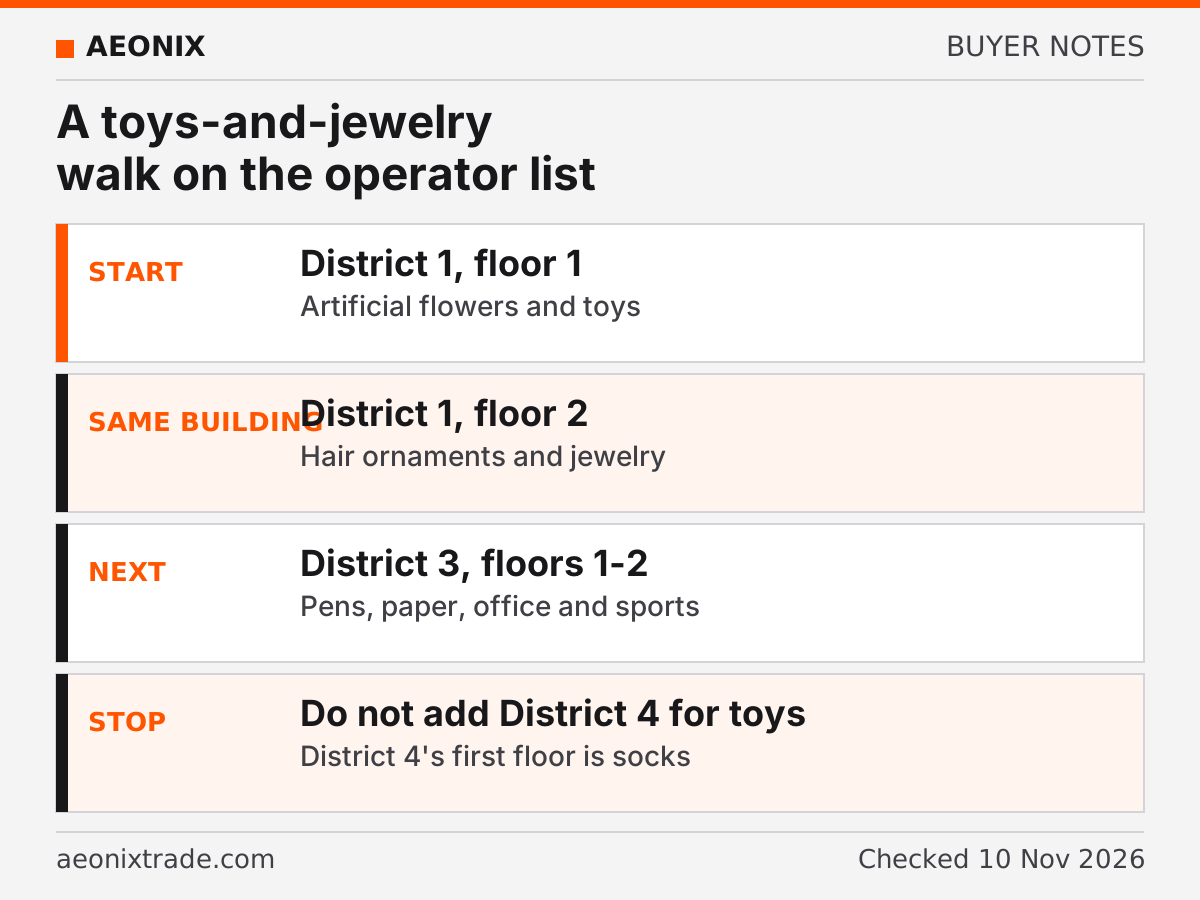
Toys and artificial flowers: District 1, floor 1. Hair ornaments and jewelry: District 1, floor 2, in the same building. That pair of floors is why a toy-and-jewelry afternoon does not need a second district. The category notes that sit on those floors are toys and festival goods and jewelry and hair accessories. Stationery, if the same buyer needs it: District 3, floors 1 and 2, which is stationery, office, and sports. Do not add District 4 because a blog called it "the toy area." District 4's first floor is socks, and the sock note is socks, hosiery, and textile accessories.
A second route, still without a clock: socks on District 4 floor 1, then underwear, belts, and scarves on District 4 floor 4, then gift bags on District 2 floor 1 if the range includes bags. All three stops are on the operator pages. How many minutes sit between District 4 and District 2 is unavailable. Do not print a walking time from a map you have not measured. The market guide is the overview of how an order leaves these floors. The buying steps are from booth to loading. If the category is not in Yiwu at all, the wider map of China markets is wholesale markets by product.
Opening years, only where the page has them
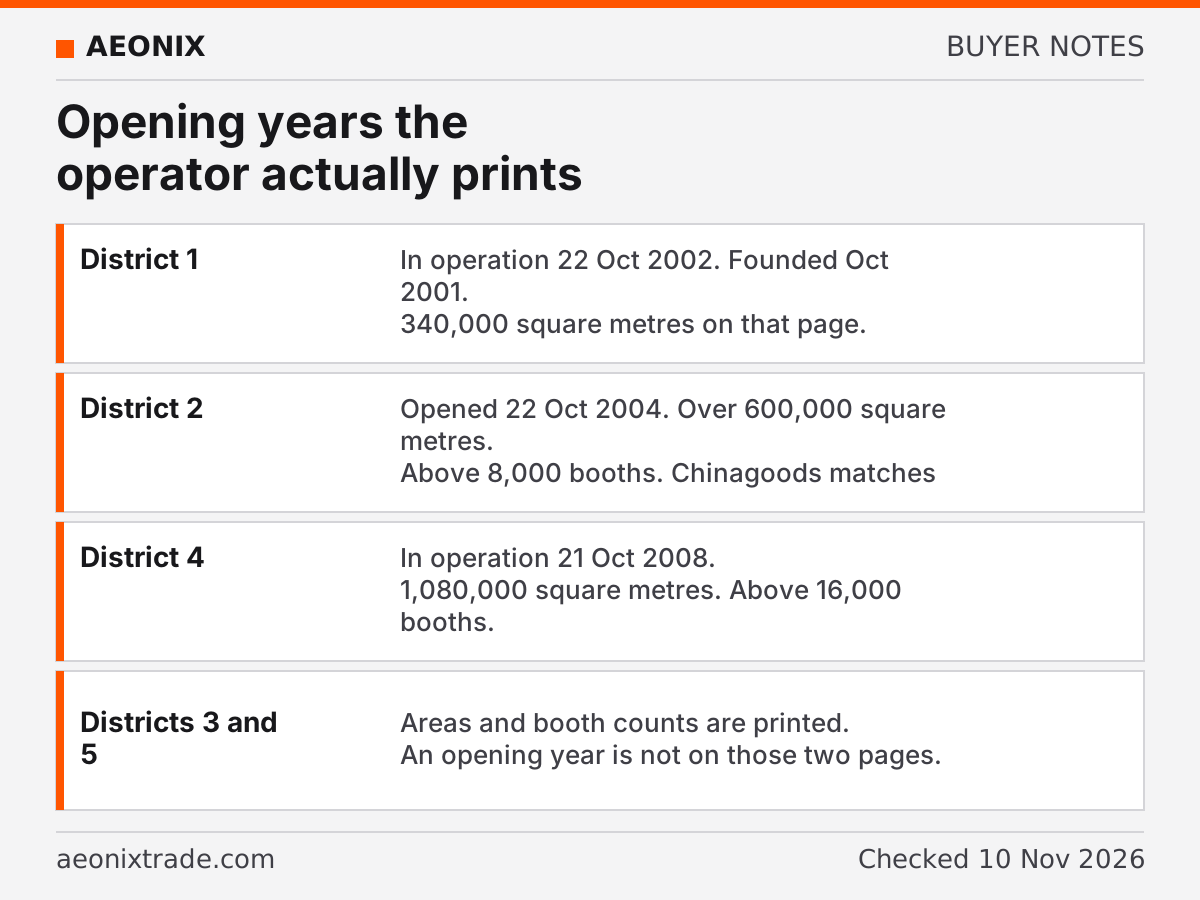
District 1 names 22 October 2002 and a founding month of October 2001, with 340,000 square metres and 420 mu. District 2 names 22 October 2004, over 600,000 square metres, 483 mu, above 8,000 booths, and over 10,000 operators. Chinagoods repeats that opening date, the area, and the booth count, and it prints 483 mu as 32.2 hectares. District 4 names 21 October 2008. Districts 3 and 5 print area and booth counts and do not print an opening year. Those years are unavailable. Do not fill them from a competitor timeline.
| Question | On the operator pages checked |
|---|---|
| District 3 opening year | Unavailable |
| District 5 opening year | Unavailable |
| District 6 product groups | Unavailable. Chinagoods names the district and does not describe the floors on the page used here. |
| District 1 East, District 2 East, Huangyuan, production-materials market | Named in the navigation or on the Chinagoods index. Product groups: unavailable in this guide. |
| Booth trading hours | Unavailable. The Chinagoods clocks are a service desk and a contact line, not booth hours. |
| Minutes between districts | Unavailable. This page's drawing is a sketch, not a survey. |
Holiday closures are also unavailable here. A dated closure belongs on opening hours and holidays, or it stays unavailable.
Category to the first door
| If the goods are | Open this district first | Then check |
|---|---|---|
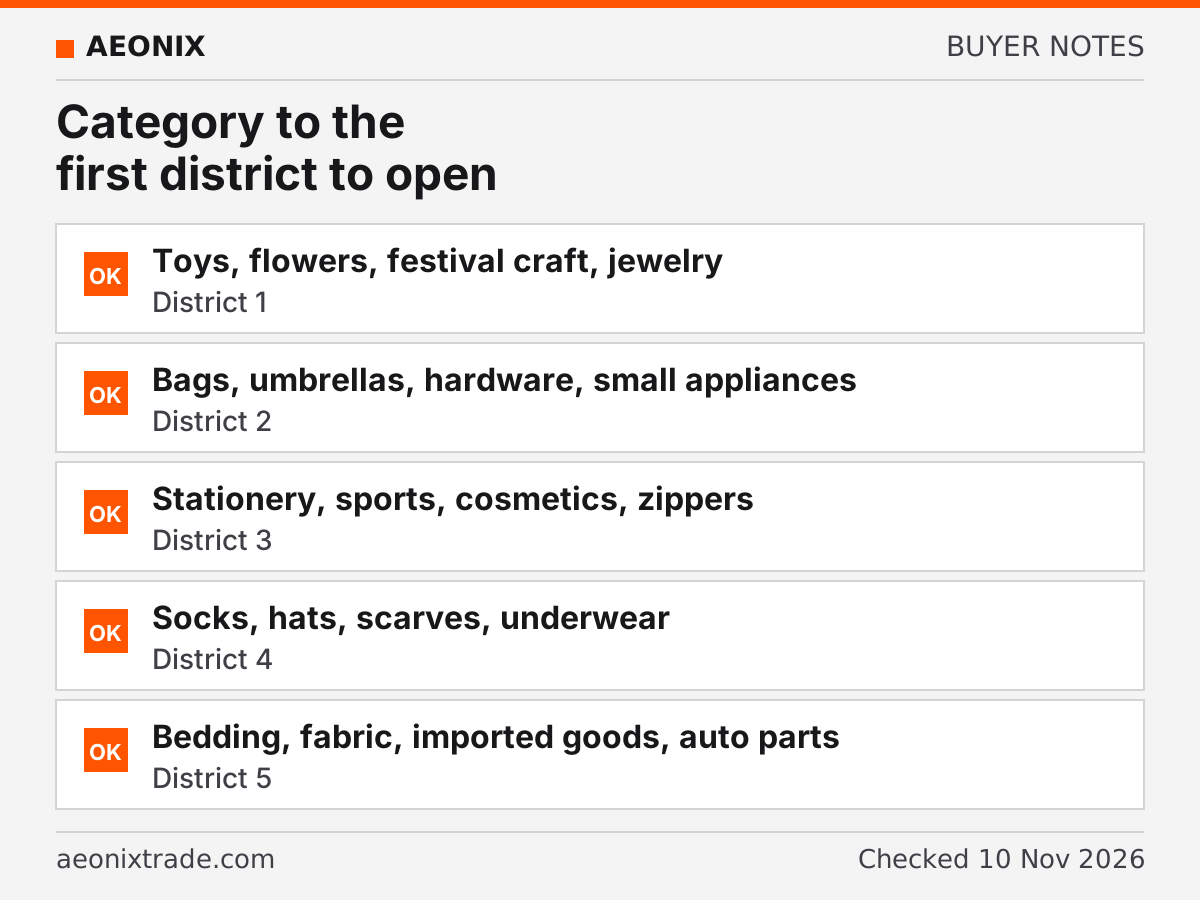
| Toys, artificial flowers, festival craft, jewelry, hair ornaments | District 1 | Floors 1 to 3, and the outlet line on floor 4 |
| Bags, umbrellas, packing, hardware, locks, small appliances, clocks | District 2 | The paragraph's vehicle line, which the table does not repeat |
| Pens, paper, sports, cosmetics, glasses, zippers, buttons | District 3 | Floor 4 of the table repeats cosmetics and also names clocks. Floor 5 has no product row. Not the sock floors |
| Socks, hats, gloves, lace, underwear, scarves | District 4 | The paragraph's shoe line against the table |
| Bedding, fabric, curtains, imported goods, auto accessories | District 5 | Floor 1 is a mix, not one category |
A typical case
A buyer of fashion jewelry and a small plush toy lands with one afternoon. Both lines are District 1 on the operator pages: toys on floor 1, jewelry and hair ornaments on floor 2. The buyer does not cross the city for jewelry. A zipper shortfall, if it appears, is a District 3 errand, not a reason to re-walk floor 2. The order is still a set of booth quotes. Nothing on the map is a price. The case is typical. It is not a recorded order.
A second buyer wants socks, a scarf, and a bottle of nail cosmetics for the same checkout display, on FOB terms if the quotes will say so, otherwise the comparison stops. Socks and scarves are District 4, floors 1 and 4. Cosmetics are on District 3 floor 3 of the table, and the floor 4 table names them again, with clocks and watches. Floor 5 of that table has no product row. The buyer who starts in District 3 because a blog called it clothing will meet zippers and sports goods and will not meet the sock floor. The buyer who then adds "a few cushions" has left both buildings: bedding and some textiles are District 5, and home textiles at a fair are a different calendar. This page only places the Yiwu floors. It does not price the goods and it does not time the walk.
What a conflicting guide usually gets wrong
| Claim you may read elsewhere | What the operator page says |
|---|---|
| District 3 is the clothing market | Stationery, sports, cosmetics, eyeglasses, zippers, buttons, apparel accessories. Not garments. |
| District 4 is toys | Floor 1 is socks. Toys are District 1, floor 1. |
| Every district opened in a neat sequence you can memorise | 2002, 2004, and 2008 are printed. Districts 3 and 5: opening year unavailable. |
| The market opens at 8:30 or at 9:00 | Booth hours: unavailable. Those clocks, where they exist, are labeled as something else. |
Do not paper over a conflict
- Quoting a single floor list when the paragraph and the table disagree. Show both, as the shoes line on District 4 and the vehicles line on District 2 require.
- Inventing an opening year for District 3 or District 5. The pages do not have one. Write unavailable.
- Treating customer-service hours on Chinagoods as the time the floors trade. They are labelled as the service centre.
- Sending a garment buyer to District 3, or a toy buyer to District 4, because a third-party map swapped them.
- Using this sketch as a measured floor plan. It is not one. The operator pages are the source. A surveyed walking map is unavailable here.
Before you follow any other map, check three things: the district number matches an operator URL, the floor word matches either the paragraph or the table on that URL, and the date you are using is the date you opened the page. If the third-party page cannot pass those three, ignore the floor it names.
Send the floor list with the spec on the RFQ form, or have it walked from the Yiwu agent page.
The floor rows above are the operator's own table. Export clearance for goods bought in a recognised market cluster is a separate file: the Ministry of Commerce copy of Customs Announcement 2019 No. 221 defines market-procurement trade. When a quote names FOB or another three-letter term, the rulebook is ICC Incoterms 2020.
Next steps
- Clothing and the Huangyuan garment market
- Home textiles
- Hardware and auto accessories
- A floor check before the goods ship
Official sources
- Ministry of Commerce: Customs Announcement 2019 No. 221 on market-procurement trade. Defines the mode used for goods bought in a recognised market cluster.
- ICC Incoterms 2020. The named term on a booth quote, not a floor number.
- District 1 operator page.
- District 2 operator page.
- District 3 operator page.
- District 4 operator page.
- District 5 operator page.
- Chinagoods confirmation of the District 2 opening figures.
Submit sourcing request
Can't find what you need?
Start with a product or image link, an approximate quantity and destination. Other details can follow.