Yiwu Sourcing Agent: What They Do, How They Charge, and Red Flags
Published by Aeonix Trade.
Last fact-checked: November 10, 2026.
A Yiwu sourcing agent is a person you pay to run the market work: the short list, the quotes, the sample chase, and often the consolidation. They are not, by that job, the seller of the goods. The seller is the company on the invoice. This page is about how to choose one and how the fee can be structured. It does not name a commission, a day rate, or a "best" agent. No public official price list exists for that fee, so a number here would be invented.
If you want the job description in general, read what a sourcing agent does. If you are choosing between an agent and a trading company, read agent versus trading company. If you already want Aeonix to do the Yiwu work, the commercial page is the Yiwu agent service. This article stays on the selection.
What they should do, and what they should not own
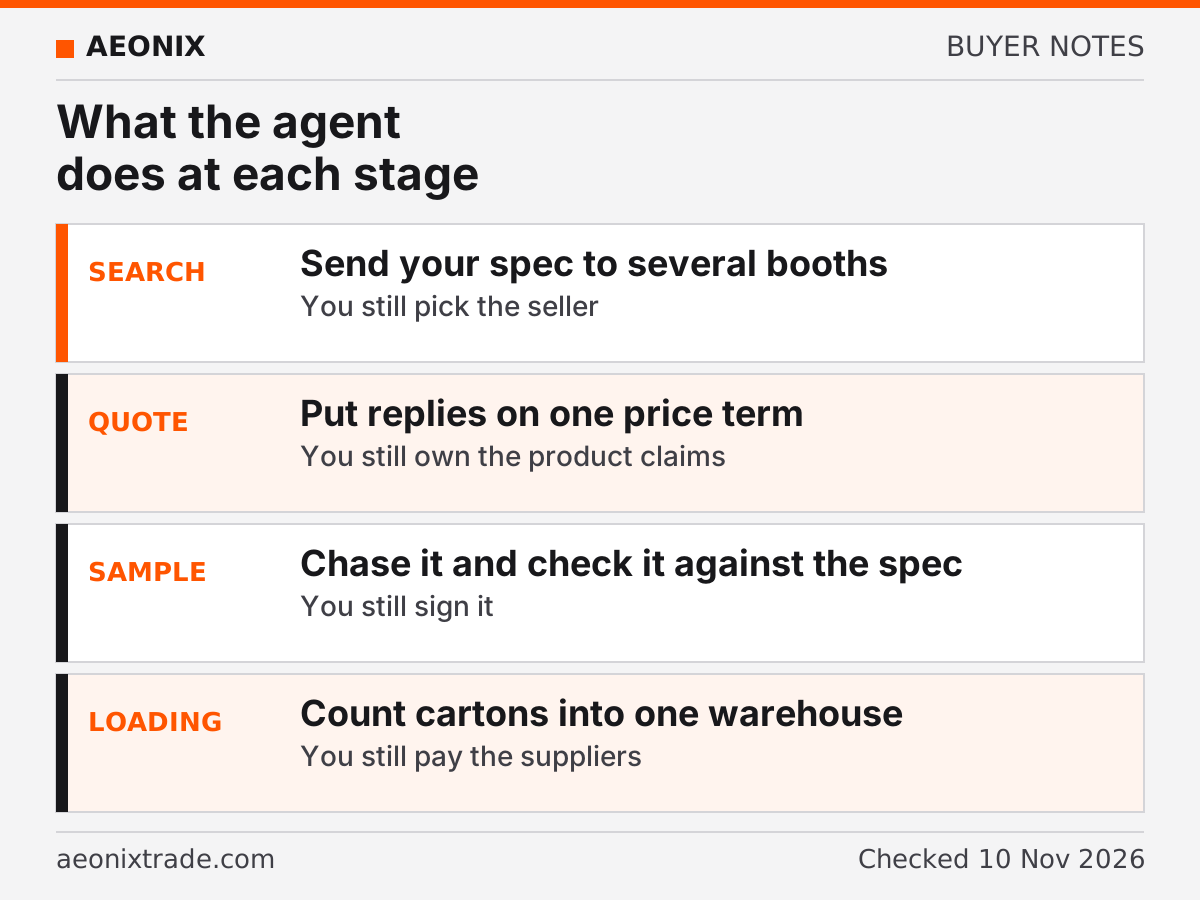
At search, they send your spec to more than one booth and bring the replies back. At quote, they put those replies on the Incoterm you named. At sample, they chase the courier and check the piece against the spec. You still sign the sample. At loading, they can count cartons from many booths into one warehouse. You still pay the suppliers. They do not become your importer in your country by walking District 1.
Ask for the report in a table, not a voice note. Each row should show the district and booth, the name on the board, the price term, the MOQ, the carton, and whether a sample is already in hand. Rows that fail the term go back, not into a "best of" shortlist the agent picked alone. If the agent also offers to be the exporter of record for the mixed lots, that is a different contract from the sourcing fee. Split them. A sourcing fee plus a hidden trading margin on the same SKU is how the two-line test gets skipped.
How the money is usually shaped
You will see one of these, or a mix. None of them has a rate on this page.
- A percentage of the goods value, billed on top of the supplier invoice.
- A flat fee for the order, or a fee for the days in the market.
- A markup inside the unit price, so the quote looks like one number and the fee is invisible.
- Separate lines for samples, inspection, translation, and the warehouse.
The third one is the structure that causes arguments. Ask for the supplier's price and the agent's fee on two lines before anyone walks a floor. If the agent is also the seller, you are not hiring an agent. You are buying from a trading company, and the comparison page above is the right one.
Ask who pays the sample courier, the warehouse intake, and the inspector, and whether those amounts sit inside the fee or beside it. A flat fee that excludes the warehouse is not a full price for a 40-SKU mix. You do not need their rate card to ask the question. You need the answer in the same email as the scope, before the first booth visit is booked.
Alone, with an agent, or on the operator sites
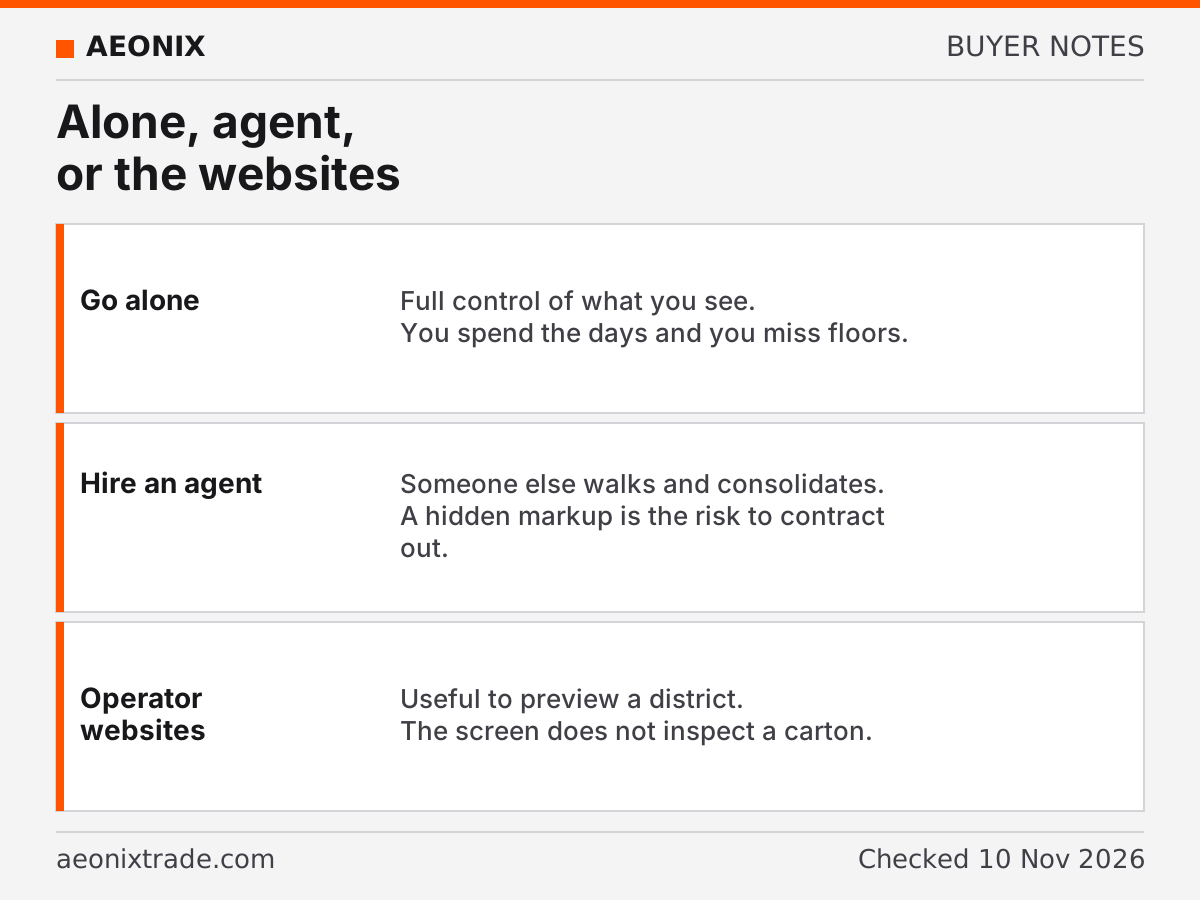
| Effort on the floor | Control of the spec | The risk to write down | |
|---|---|---|---|
| You go | Yours | High, if you take notes | You miss floors and you still need a shipper |
| You hire an agent | Theirs, inside the scope | High only if you approve samples | A hidden markup, or a fee with no inspection right |
| Yiwugo or Chinagoods | Low | You see a page, not a carton | A listing treated as an export contract |
The operator sites are real. Chinagoods and Yiwugo's District 1 page describe the mart. They do not replace a count of your cartons.
Put this in the contract
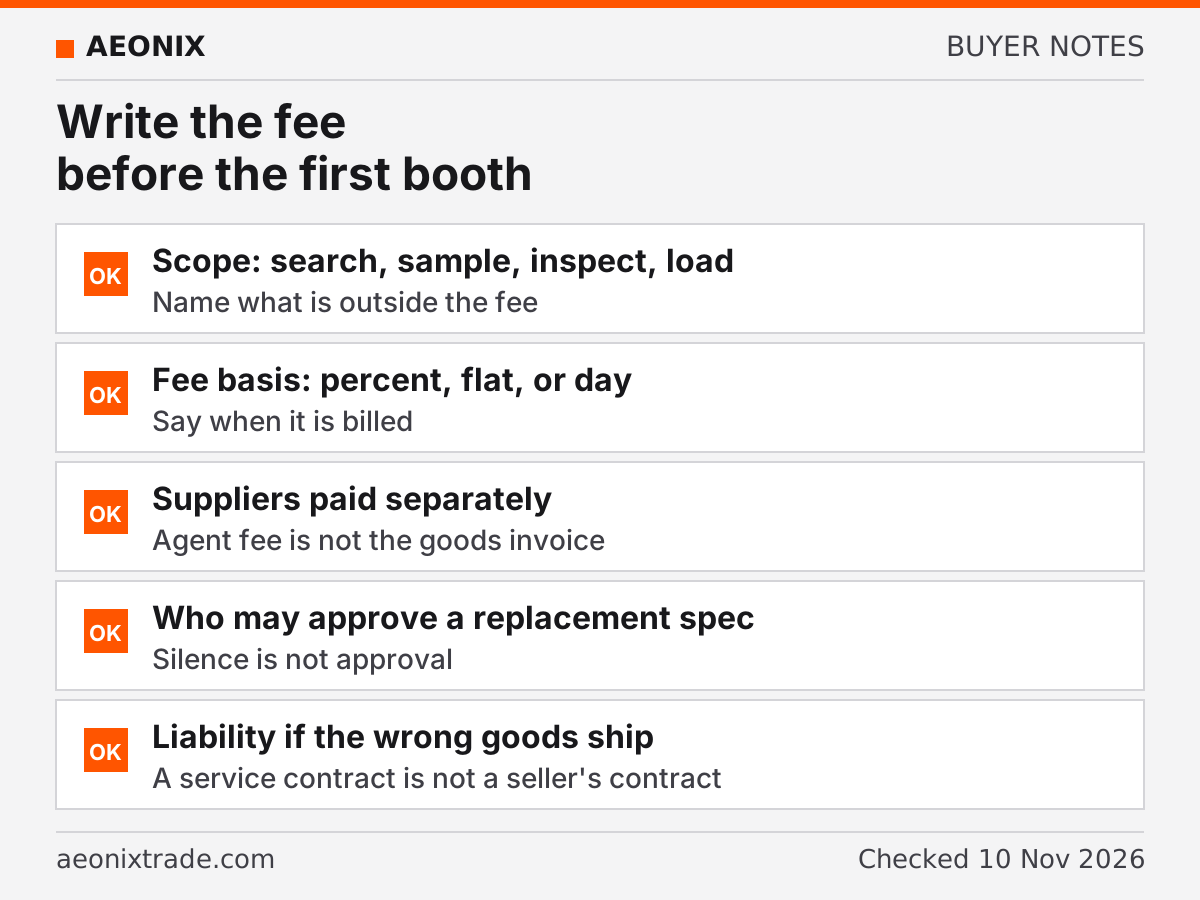
- Scope: search, sample, inspection, loading. Name what is outside.
- Fee basis: percent, flat, or day, and when it is billed.
- Supplier invoices paid to the suppliers. The agent's fee is a different bill.
- Who may accept a changed spec. Silence is not a yes.
- What happens if the wrong goods are loaded. A service contract does not make the agent the seller. Payment mechanics are discussed on Trade.gov's methods of payment.
A typical case
A buyer wants 40 SKUs of hair accessories and small toys, FOB, LCL, and cannot spend a week in Yiwu. The agent is asked to visit District 1 only, return at least three quotes per hero SKU on FOB terms, and send photos against the spec. The fee is a separate line. The deposit for the goods goes to each supplier's invoice. The agent may book the inspection and may not approve a colour change. That is a workable scope. "Handle Yiwu" is not.
Warning signs
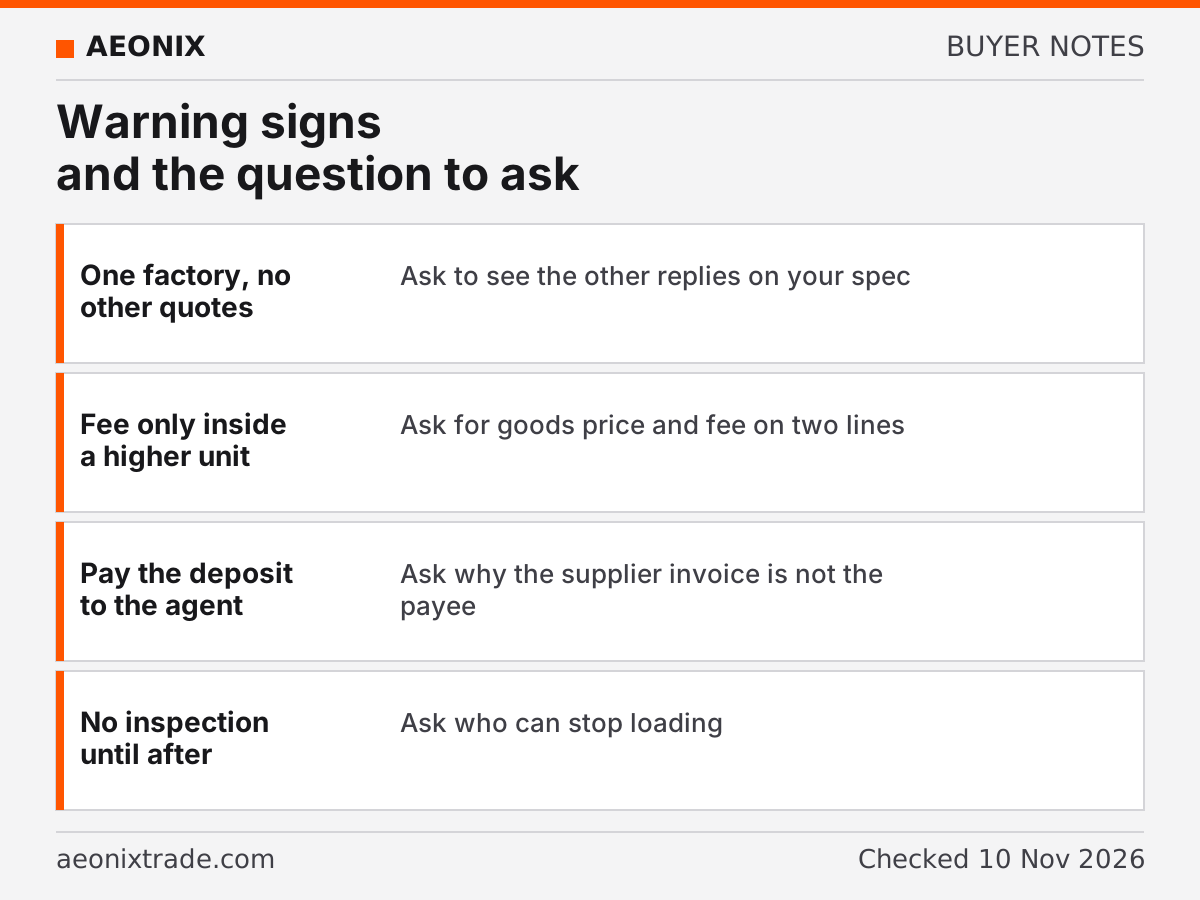
- Only one factory is offered, and the other replies are "not worth seeing." Ask to see them.
- The fee exists only as a higher unit price. Ask for two lines.
- The deposit is requested to the agent personally. Ask why the supplier invoice is not the payee. The check is the same as verifying a supplier before payment.
- Inspection is promised after the ship has sailed. Ask who can stop the loading.
The booth routine, if you go yourself instead, is how to buy from the market. A wider China mandate, not only Yiwu, starts at the China sourcing agent page. The spec, either way, goes on the RFQ form.
See also Yiwu Market Guide for Overseas Buyers.
Official sources
- Trade.gov: methods of payment.
- Trade.gov: common export documents.
- Yiwugo District 1, the market the agent would actually walk.
- ICC Incoterms 2020, so the fee conversation and the goods term are not the same word.
Submit sourcing request
Can't find what you need?
Start with a product or image link, an approximate quantity and destination. Other details can follow.