Sourcing Agent vs Freight Forwarder vs Buying Office: Who Does What?
Published by Aeonix Trade.
Last fact-checked: November 9, 2026.
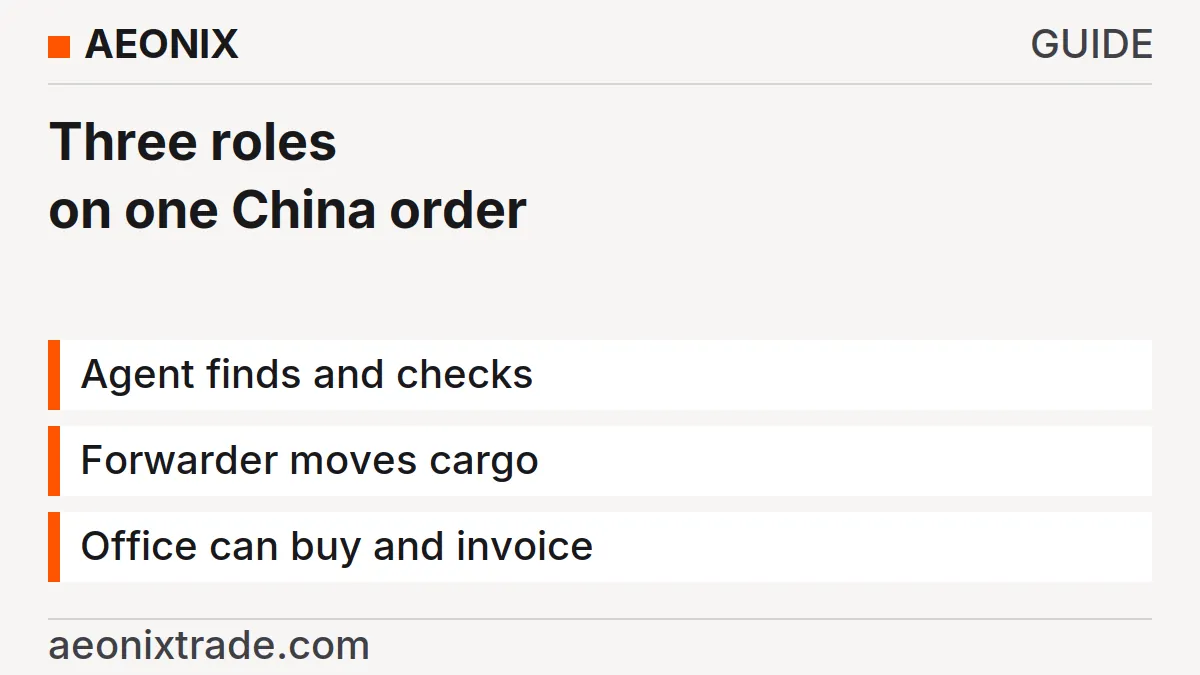
A buyer in Manchester has three quotes for the same 800 plastic storage boxes. One is from a sourcing agent, one is from a freight forwarder who says they "can also source," and one is from a buying office that wants to invoice the goods. The unit prices are not comparable until you know who sells, who carries, and who is allowed to be the importer. A sourcing agent versus a freight forwarder versus a buying office is that split. It is not three names for one job.
A typical case
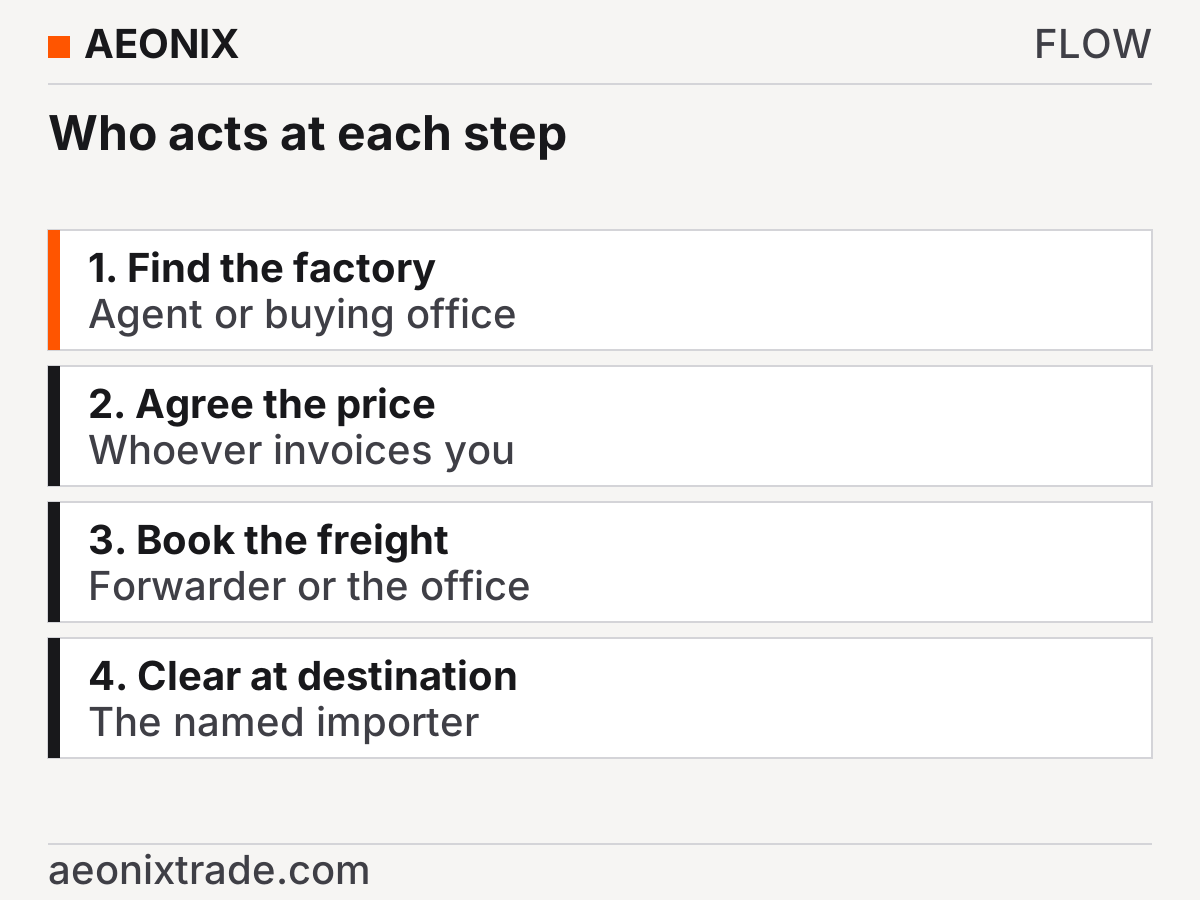
The boxes are a repeat of a sample the buyer already approved. The target is FOB Ningbo, then LCL to the buyer's port. The agent quotes a fee to find two factories, compare them, and book an inspection. The forwarder quotes the LCL and offers to "pick a supplier we know." The buying office quotes a delivered unit price and will put its own company on the commercial invoice. Same product. Three different contracts.
The ICC Incoterms 2020 checklist puts the carriage and the clearance on named sides of each rule. It does not appoint your agent, your forwarder or your office. The rule you write, FOB or something else, only says which party must do the carriage and which party must clear import. If the contract never says who that party is, the Incoterm is a label on an empty job.
What each one actually sells
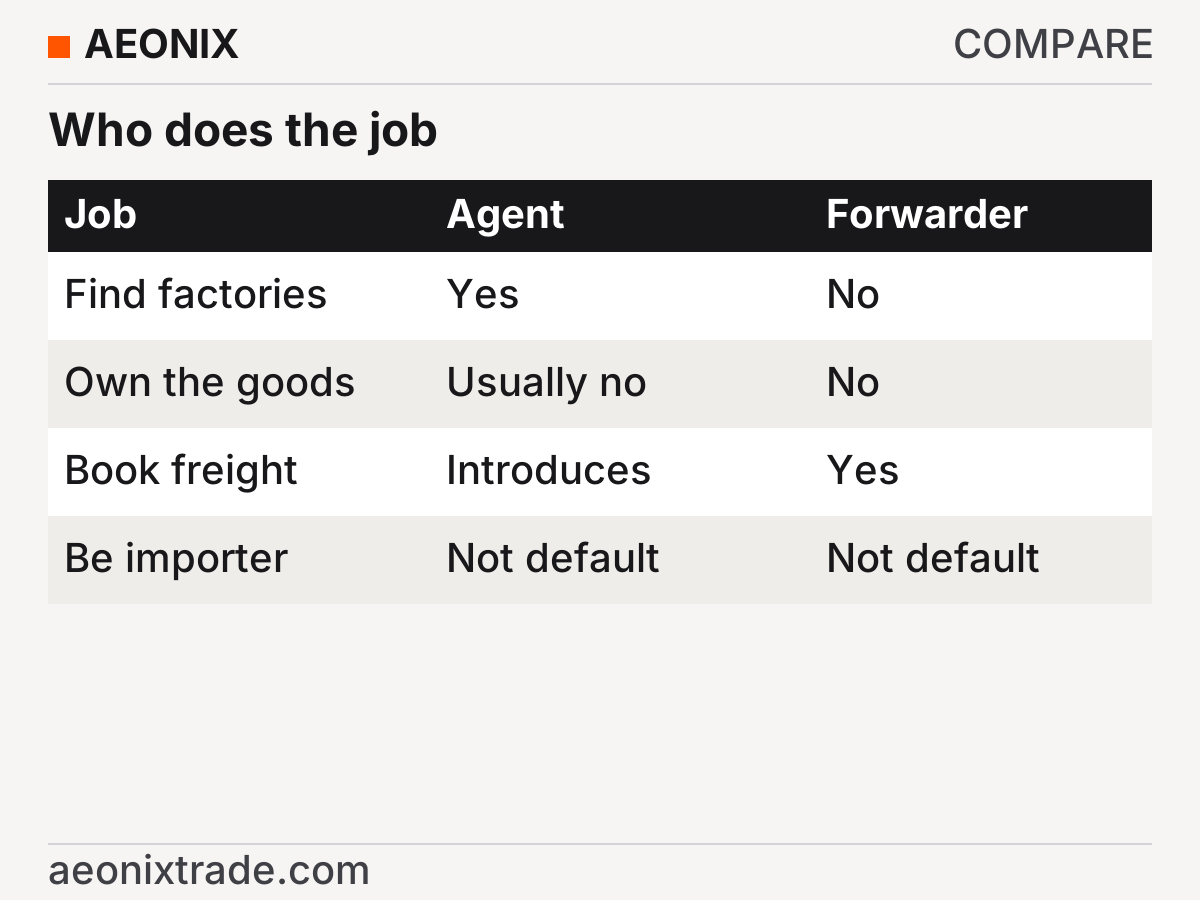
A sourcing agent is paid to act for you. On a normal brief the agent looks for factories, compares offers, follows the sample, and can arrange an inspection. The agent does not own the goods and does not become the seller because they sent the introduction. The factory, or a trader, still invoices. Read what a sourcing agent is and how that differs from a trading company before you treat the agent invoice as the goods invoice. Our own scope, if you want a firm to do this work, is on the sourcing agent page. The fee basis belongs in the contract. This page does not state a commission.
A freight forwarder sells the move. They book space, coordinate the warehouse, and handle the transport documents. Japan Customs, writing about import declarations generally, says the importer declares and a customs broker usually files as proxy. A forwarder who also brokers is still not the buyer. They are not the party who approved the mould, and they are not automatically the importer of record. If they offer to "use our import entry," ask whose tax number that is. The LCL mechanics are on how LCL shipping from China works and on the consolidation page.
A buying office can be a purchaser that takes title and resells to you. Then the office is the seller on the invoice, the factory is their supplier, and your contract is with the office. That can be the right shape when you want one invoice and one throat to choke. It is a bad shape when you thought you were paying a fee to stay in a direct factory contract. The test is the invoice: whose name is on it, and who you pay for the goods.
Where the jobs get blurred on purpose
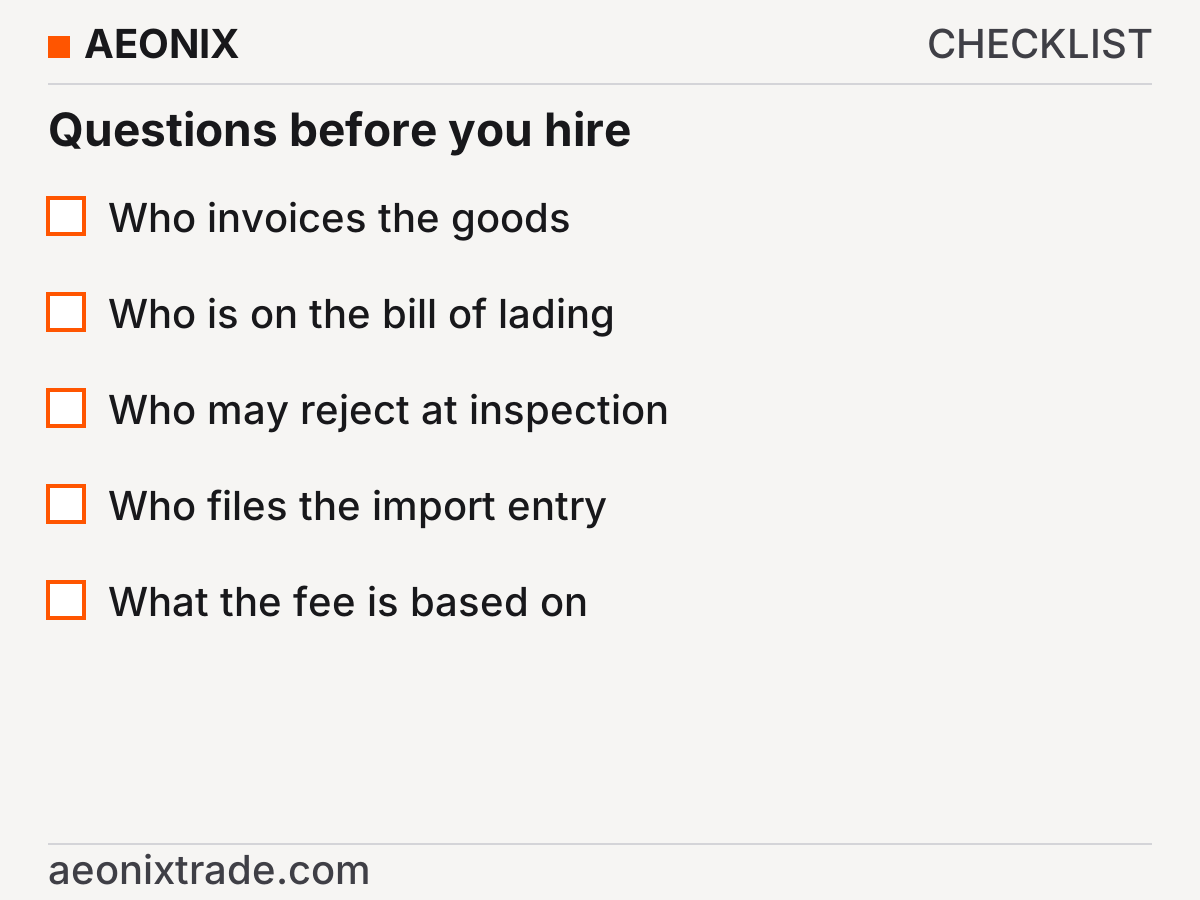
The dangerous quote is the one that bundles a low unit price with a vague "we handle everything." Everything might mean the office buys the goods and marks them up, or the forwarder only moves whatever supplier you name, or the agent introduces a trader who then invoices. Ask five questions in writing.
- Who is the seller on the commercial invoice for the 800 boxes?
- Who is the shipper on the bill of lading?
- Who can reject the goods at inspection, and who pays for the rework?
- Who files the import entry in your country, and in whose name?
- Is the fee a service, a margin inside the unit price, or both?
The ICC checklist's warning on DDP is the same instinct: a party who offers to clear import may be unable to. DDP does not turn a forwarder into an importer. FOB does not turn an agent into a carrier. Pick the term after you know the parties. The map of the terms is on Incoterms and shipping documents.
How to compare the three quotes
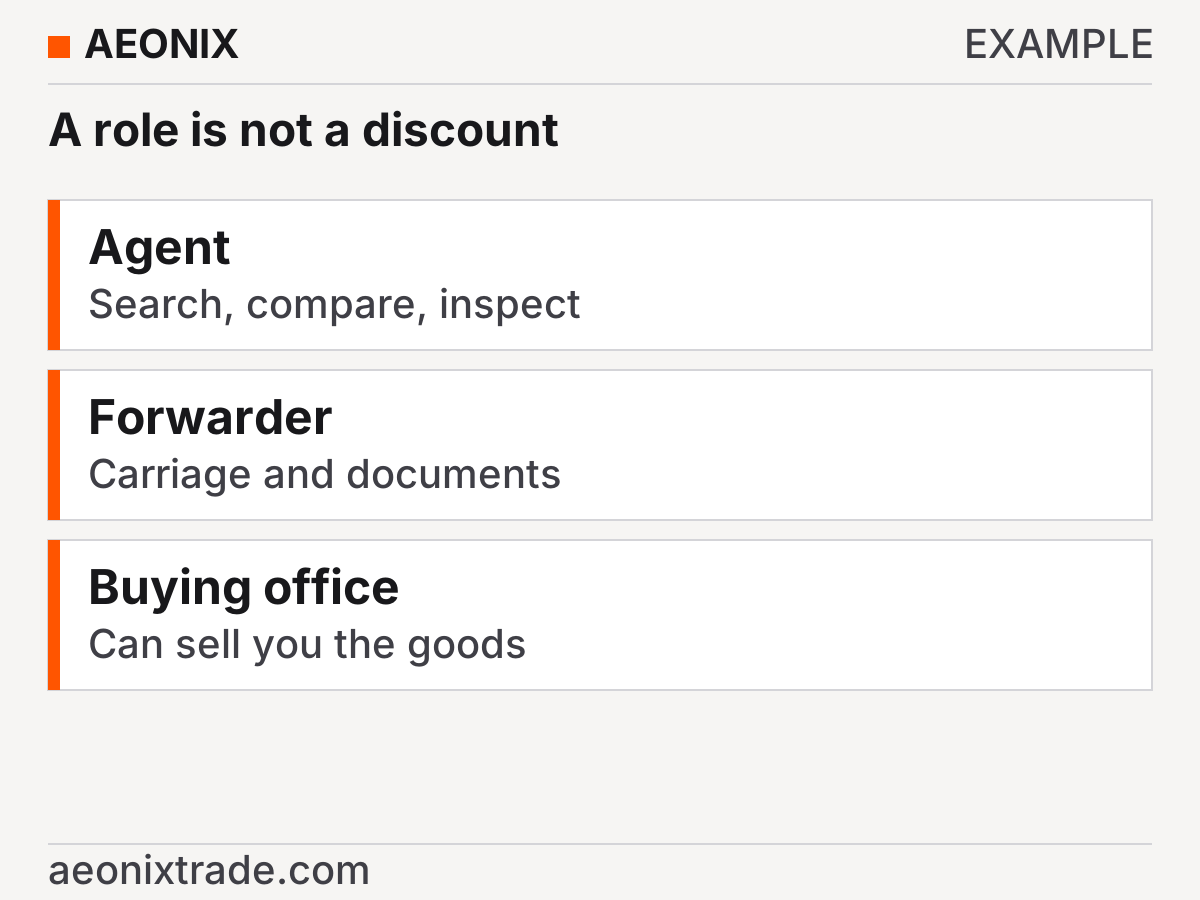
Strip each quote back to the same specification, the same Incoterm and the same named importer. Then the agent's fee is visible, the forwarder's freight is visible, and the office's unit price either includes a margin or it does not. If the office will not say the factory price, you are buying a resale, which is allowed, but you should know that is the product. Service fees for work this firm does are described on the service fees page, not as a percent in this article. Checking that a factory exists is a different job again: supplier verification.
| Quote | You are buying | You still have to name |
|---|---|---|
| Sourcing agent | A service: search, compare, follow-up | The seller, the forwarder, the importer |
| Freight forwarder | Carriage and transport documents | The seller, the specification, the importer |
| Buying office | Often the goods themselves | Whether you still have a factory contract |
Mistakes
- Picking the lowest unit price when one quote is a fee and another is a resale.
- Letting the forwarder choose the factory because they are already booking the container.
- Assuming the agent is on the hook for freight damage. Their contract probably is not the bill of lading.
- Letting anyone "use their import entry" without reading whose tax identity that is. Japan Customs' plain statement is that the importer declares. Other countries are at least as strict.
- Signing DDP with a party who cannot be the importer.
Questions buyers actually ask
Should the sourcing agent also be the forwarder?
Only if the contract says they are doing both jobs, and you can see the fee and the freight as separate lines. One company can wear two hats. The hats still have different duties.
Is a buying office just a large agent?
Not when the office invoices the goods. Then it is the seller. An agent who never takes title is a different contract. Look at the invoice, not the business card.
Who is the importer?
The person your customs authority will accept, named on the entry. A forwarder filing as broker is a proxy. An agent abroad is not the importer because they found the factory.
How do I start?
Write the specification, the Incoterm you think you want, and which of the three roles you are hiring. Send that through the RFQ form. If you already have the three quotes, send those too, with the invoice names visible.
Who runs the file is also covered in How to Choose a China Sourcing Agent, agent fees and the contract, where to find suppliers, and writing an RFQ.
Official sources
- ICC: Incoterms 2020 checklist. Which side carries, which side clears, and the caution that a seller may be unable to clear import. Read 9 November 2026.
- ICC: Incoterms 2020. The rules that assign cost and risk. They do not appoint your agent or your forwarder.
- US International Trade Administration: Know Your Incoterms. Each term states who arranges carriage and who handles import formalities.
- Japan Customs: import procedures. The importer declares. A customs broker files as proxy. Used here as a clear official statement of that split, not as every country's statute.
Submit sourcing request
Can't find what you need?
Start with a product or image link, an approximate quantity and destination. Other details can follow.