China Sourcing Agent Fees: How Agents Charge and What the Contract Should Say
Published by Aeonix Trade.
Last fact-checked: November 9, 2026.
A China sourcing agent cost is the fee basis plus everything the basis leaves out. Two agents can both say "commission" and still be selling different jobs. This page names the shapes of the charge and the lines the contract should carry. It does not publish a rate. Aeonix's own included work and exclusions are on service fees. The service you are hiring is described on China sourcing agent.
How the agent role differs from a trading company is on sourcing agent versus trading company. The Yiwu service page is Yiwu agent. Which channel needs an agent at all is on how to find suppliers in China.
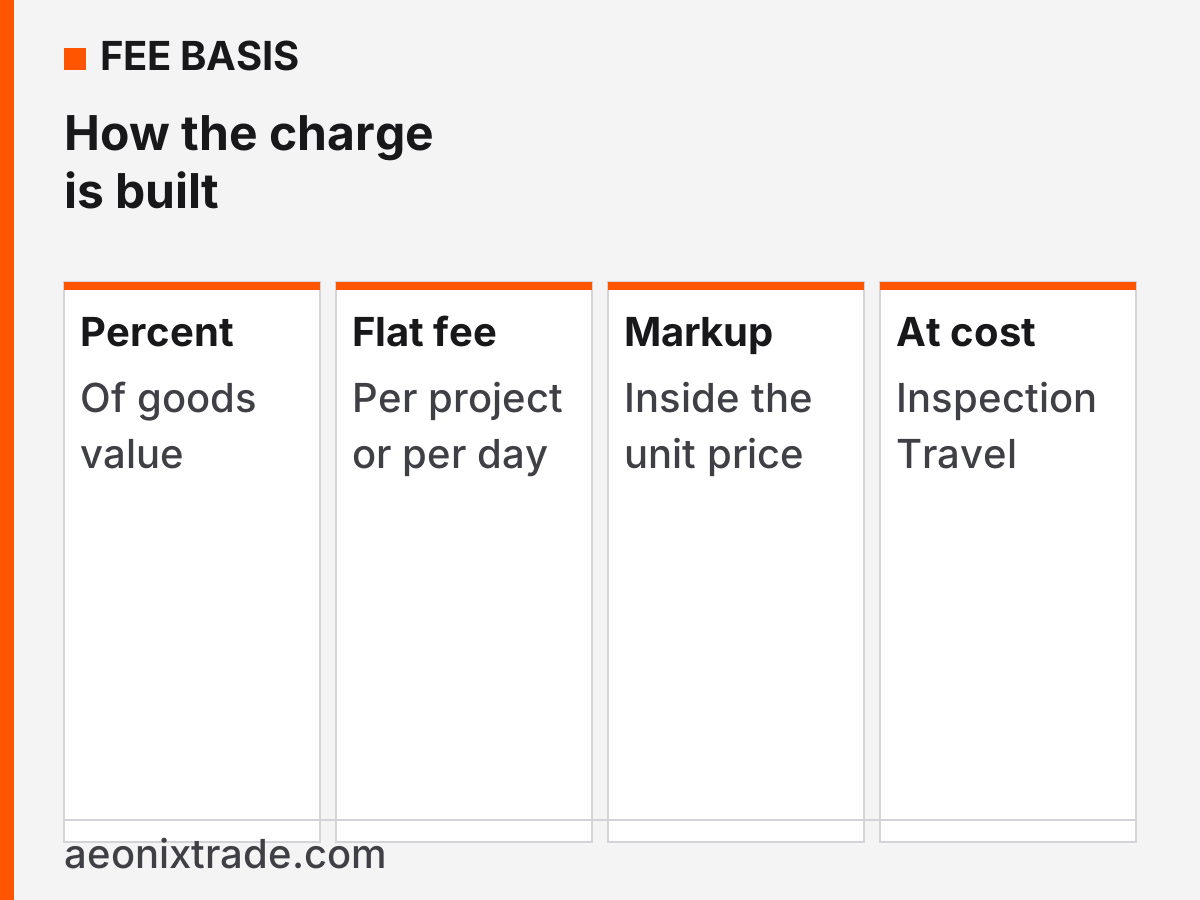
None of those columns has a percentage on it. If a proposal will not say which column it is in, you cannot compare it with another proposal.
How the charge is built
| Basis | What you should see in writing | The usual blind spot |
|---|---|---|
| Percent of goods value | The base (product only, or product plus tooling and packing) and when the percent is calculated | A higher unit price raises the fee, so a sloppy spec makes the fee larger |
| Flat fee | What the fee buys: search, factory visits, quote comparison, order follow-up, or a defined mix | A low flat fee that excludes the inspection and the travel you actually need |
| Markup inside the unit price | Whether the agent is allowed to add margin on top of the factory price, and whether you see the factory invoice | A "no commission" offer that is paid inside the unit price |
| Pass-through, at cost | Inspection, lab tests, samples, translation and travel, at cost, with the supplier invoice attached | A pass-through that has no receipt, which is just another fee |
The price on the factory quote is also an Incoterm. The ICC Incoterms 2020 rules are the three-letter terms for the sale contract. The U.S. International Trade Administration says each rule assigns tasks, costs and risks. An agent fee quoted against an EXW factory price is not comparable with a fee quoted against an FOB port price, because the goods values are different jobs. Freight, duty and the destination charges are not the agent's commission. They still have to be named so they are not quietly left inside "all in."
How you pay the supplier is a separate contract from how you pay the agent. Cash in advance, as the Administration describes it on methods of payment, moves money before ownership of the goods. Pay the agent on the fee basis you wrote down. Pay the supplier on the purchase order. Mixing the two wires is how a deposit becomes impossible to trace.
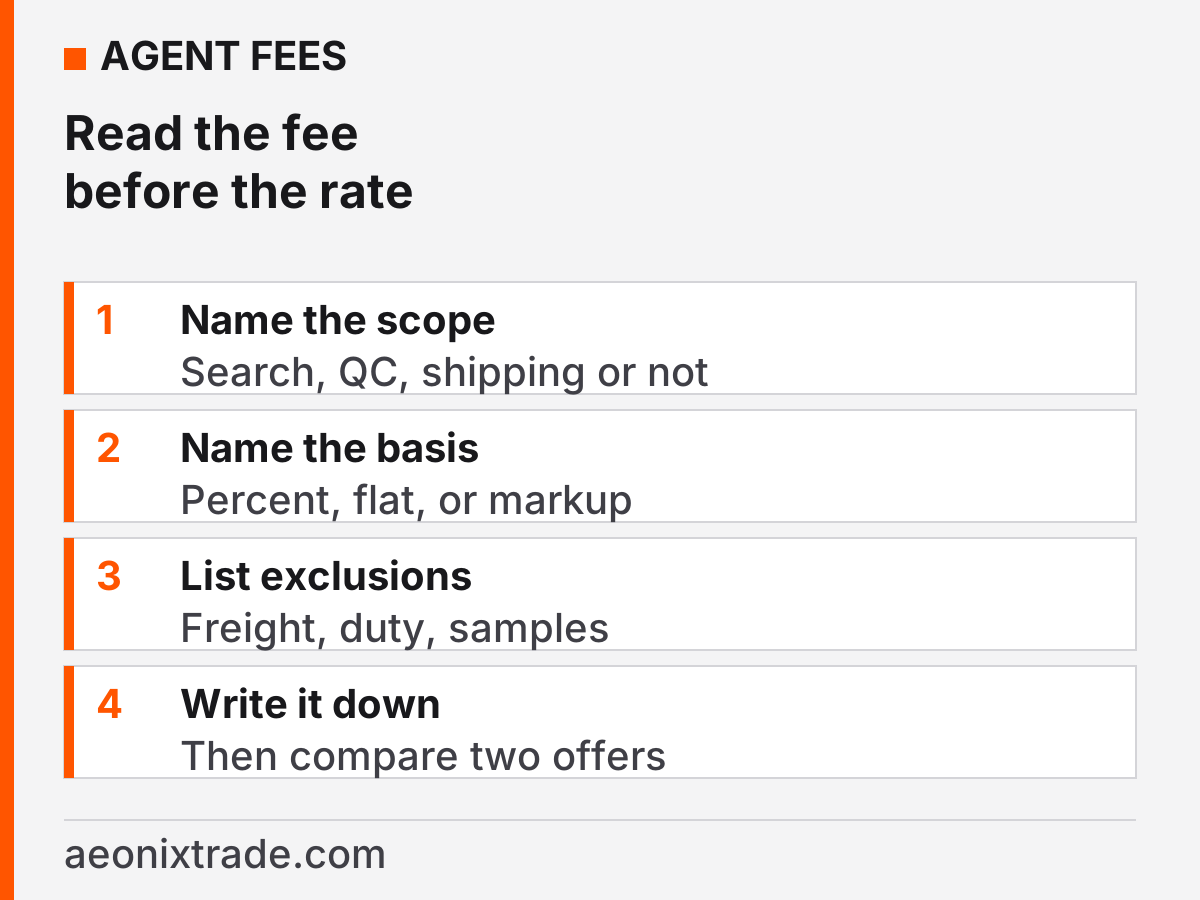
Do the four steps before you ask "how much." A rate without a basis is a slogan.
A typical case
A buyer has a housewares order. In this example the goods are about USD 22,000, FOB at a named Chinese port. Two agents reply.
Proposal A is a percent of goods value. The base is the FOB value. Samples, a pre-shipment inspection and the agent's travel are listed as pass-through with receipts. The agent does not invoice the goods. The factory does.
Proposal B is a flat fee for supplier search, three factory visits and a written quote comparison. The contract forbids a markup inside the unit price and requires the factory proforma to be forwarded. Inspection is excluded and has to be hired separately.
The buyer cannot pick A or B by which introduction email sounded cheaper. A is a percent of a value that is not final until the spec is final. B is a defined piece of work that stops before inspection. Both can be honest. They are comparable only after the exclusions are on one page. The lines that should be on that page are below. Who you are allowed to pay is a prior question, on verifying a supplier before payment.
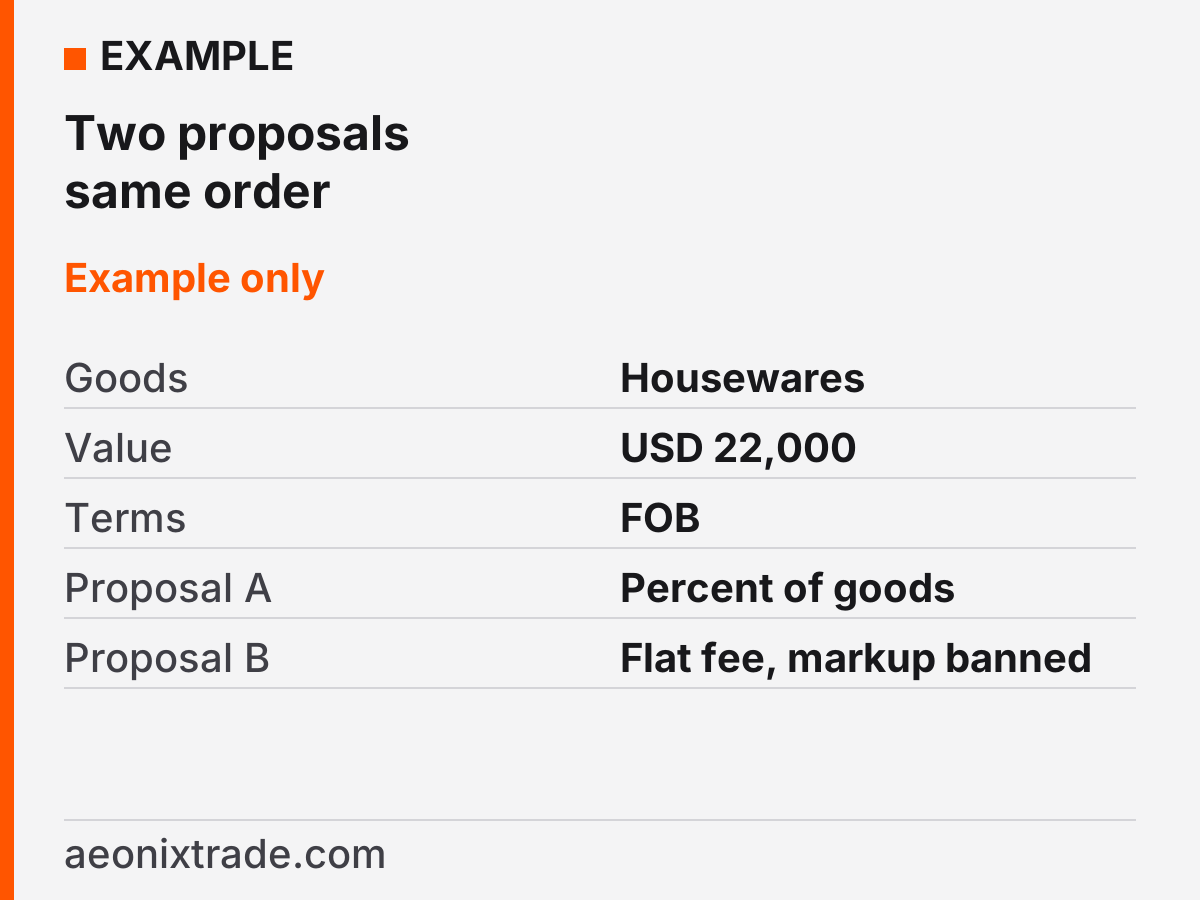
The USD 22,000 is the example's goods value, not a fee. No commission rate is stated because this page does not set one.
Where fee talks go wrong
- Asking for the lowest commission before the scope exists. You will be quoted a number that leaves out the factory visit, the inspection, or both.
- Accepting "no fee" without seeing the factory invoice. The pay is then inside the unit price, and you cannot tell a high factory price from an agent's margin.
- Letting the agent collect the supplier deposit into the agent's own account "for convenience." The fee contract and the goods contract are two payments. The supplier check matters even more when a third party is holding the wire.
Lines the contract should carry
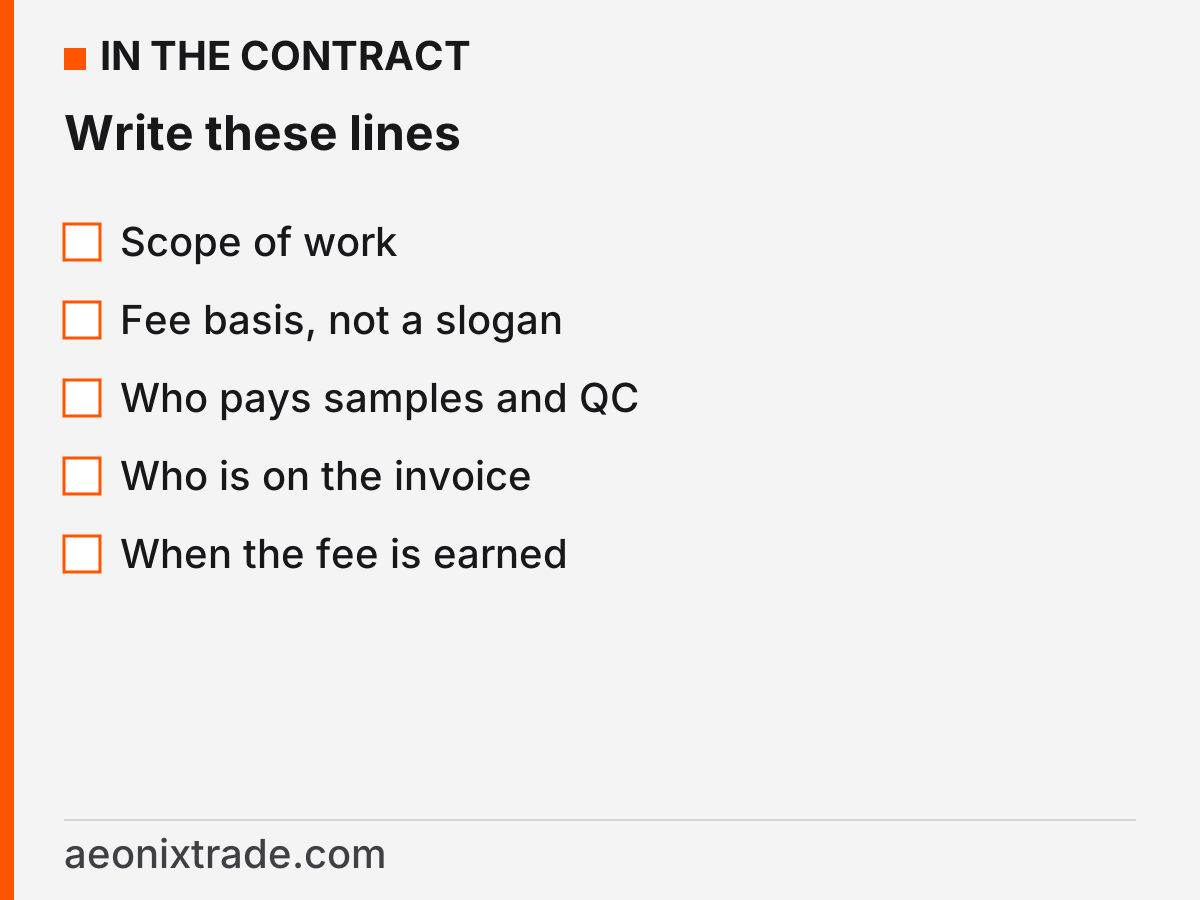
- Scope: search, visits, quote comparison, order follow-up, inspection, shipping, or a stated subset.
- Fee basis: percent of a defined value, flat fee, markup banned or allowed, pass-through with receipts.
- Who pays samples, lab tests and the pre-shipment inspection.
- Whose name is on the commercial invoice and who receives the goods deposit.
- When the fee is earned: on introduction, on a signed purchase order, or on shipment.
- What happens if you do not place the order.
Send that scope with the product on the RFQ. A rate card with no scope is not a quote you can accept.
Frequently asked questions
How much does a sourcing agent cost?
The number is whatever the written basis produces for your order. This page does not give a percentage, a day rate, or a typical total. Ask which of the four bases applies, what is excluded, and for a worked example on your own quantity and Incoterm. Then compare two of those worked examples.
Is a commission better than a flat fee?
A commission tracks the goods value, which is useful when the scope runs through shipment and the value is still moving. A flat fee is easier to cap when the job is a defined search. The worse option is an unnamed mix. Pick the basis that matches the work, and write the exclusions beside it.
Should the agent fee include freight?
Only if the contract says the agent is also arranging carriage, and the freight is shown as freight. A sourcing fee that silently includes an unknown freight number cannot be compared with a factory FOB price. Keep the lines separate even when one company handles both.
Who runs the file is also covered in How to Choose a China Sourcing Agent, an agent, a forwarder, or a buying office, writing an RFQ, and WeChat for sourcing.
Sources
- ICC: Incoterms 2020. The sale-contract rules that change the goods value a percent fee is calculated on. Open on 9 November 2026.
- U.S. International Trade Administration: Know Your Incoterms. Tasks, costs and risks assigned by each rule.
- U.S. International Trade Administration: methods of payment. Why the supplier payment and the moment ownership transfers are separate from the agent's fee.
Submit sourcing request
Can't find what you need?
Start with a product or image link, an approximate quantity and destination. Other details can follow.