Shipping Goods Bought at Canton Fair: Samples, Consolidation and Paperwork
Published by Aeonix Trade.
Last fact-checked: November 9, 2026.
Goods bought at Canton Fair do not ship themselves when the hall closes. Samples and commercial cartons are two moves. Each supplier still needs an invoice and a packing list. Several booths become one shipment only after the cartons are in one warehouse and the Incoterm says who books the freight.
The session itself is on the Canton Fair site. How an LCL shipment is built is how LCL shipping from China works and the service page LCL shipping from China. The handoff into one booking is consolidation shipping.
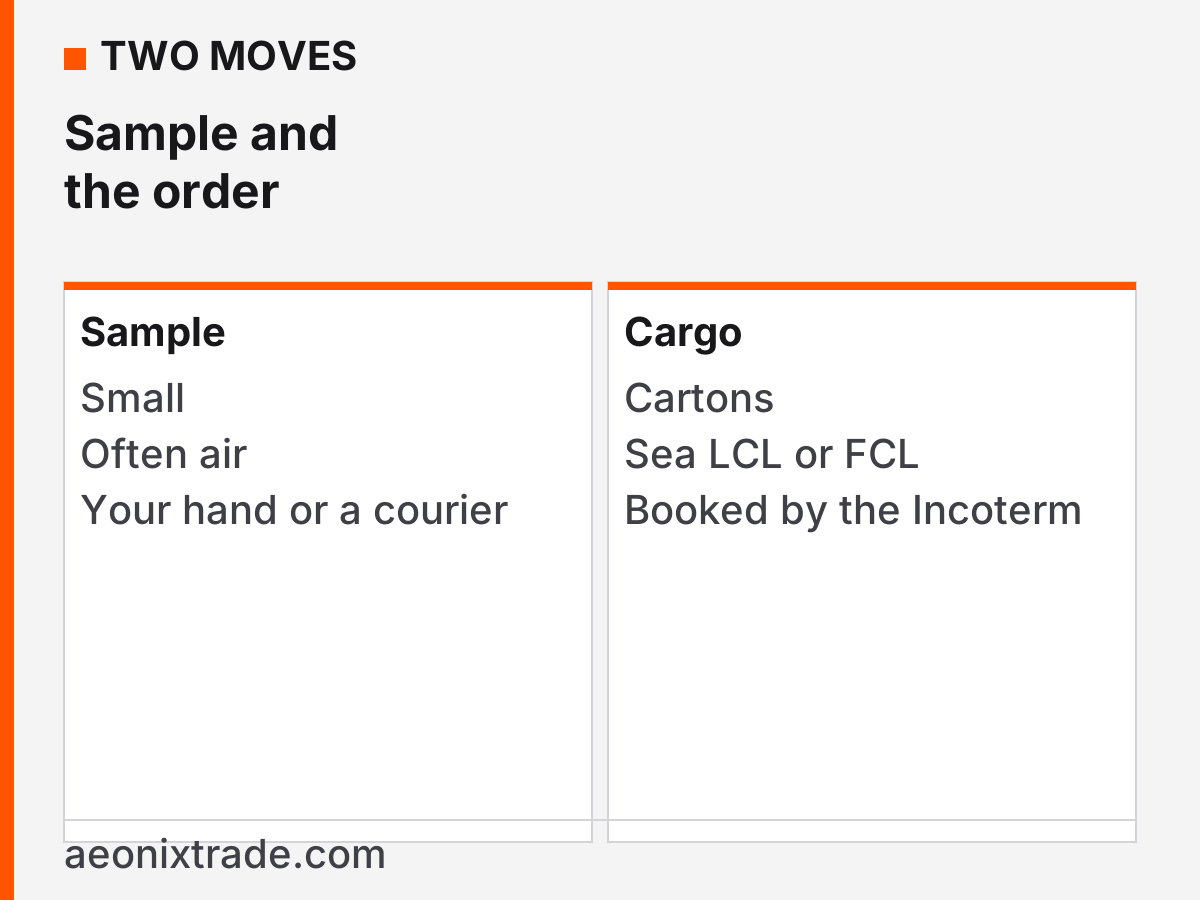
Keep the two columns apart in your notes. A sample bag in your suitcase is not a packing list, and a verbal "we will ship it" at the booth is not a booking.
Samples first, cargo second
A sample is the piece you will approve. Tag it with the booth name, the product, and the quote reference before you leave the aisle. If it goes home with you, it still has to be allowed in your baggage and, later, into the destination. If it contains a lithium battery, it is a dangerous-goods question. The IATA dangerous goods program is the industry page for that cargo. This article does not copy a watt-hour limit or a packing instruction. Ask the carrier which service accepts the sample, and do not hide a battery in checked luggage because the booth said it was "only a demo."
Commercial cartons wait for the purchase order. The fair organiser's site, cantonfair.org.cn, is where the session and the buyer pass live. It is not a freight desk. Who books the truck and the vessel is the Incoterm on the sales contract. The ICC Incoterms 2020 rules are those terms. The U.S. International Trade Administration says each rule assigns tasks, costs and risks. FOB at a named port means the seller delivers on board at that port. EXW means you take the goods at the seller's premises. Six booths on six different terms are six different freight jobs. Align them before you promise one sailing.
What FOB covers, in plain language, is FOB meaning. A single sample you want produced and sent on purpose can also start as a sample order instead of a pocket full of loose pieces.
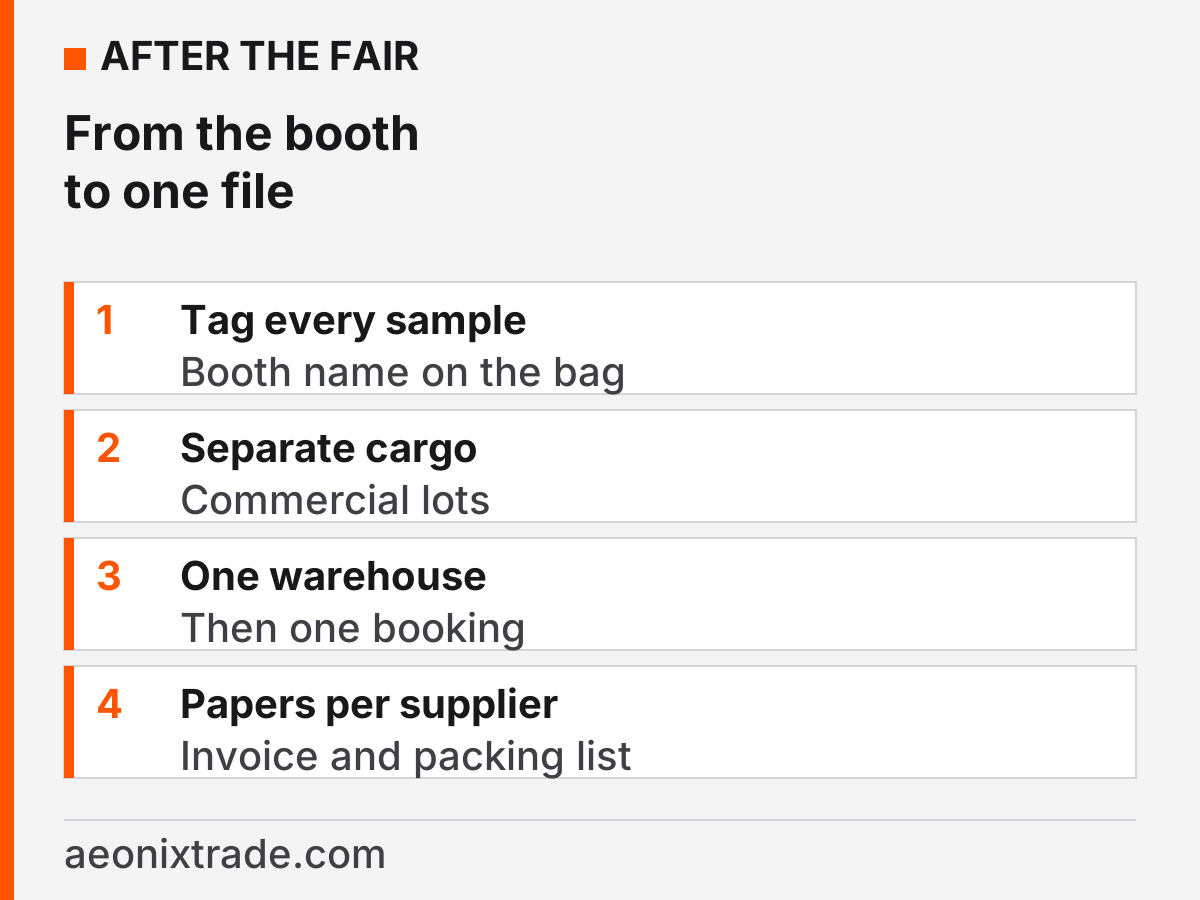
The warehouse is the point where several booths can become one shipment. Before that point they are separate purchases.
Papers, one supplier at a time
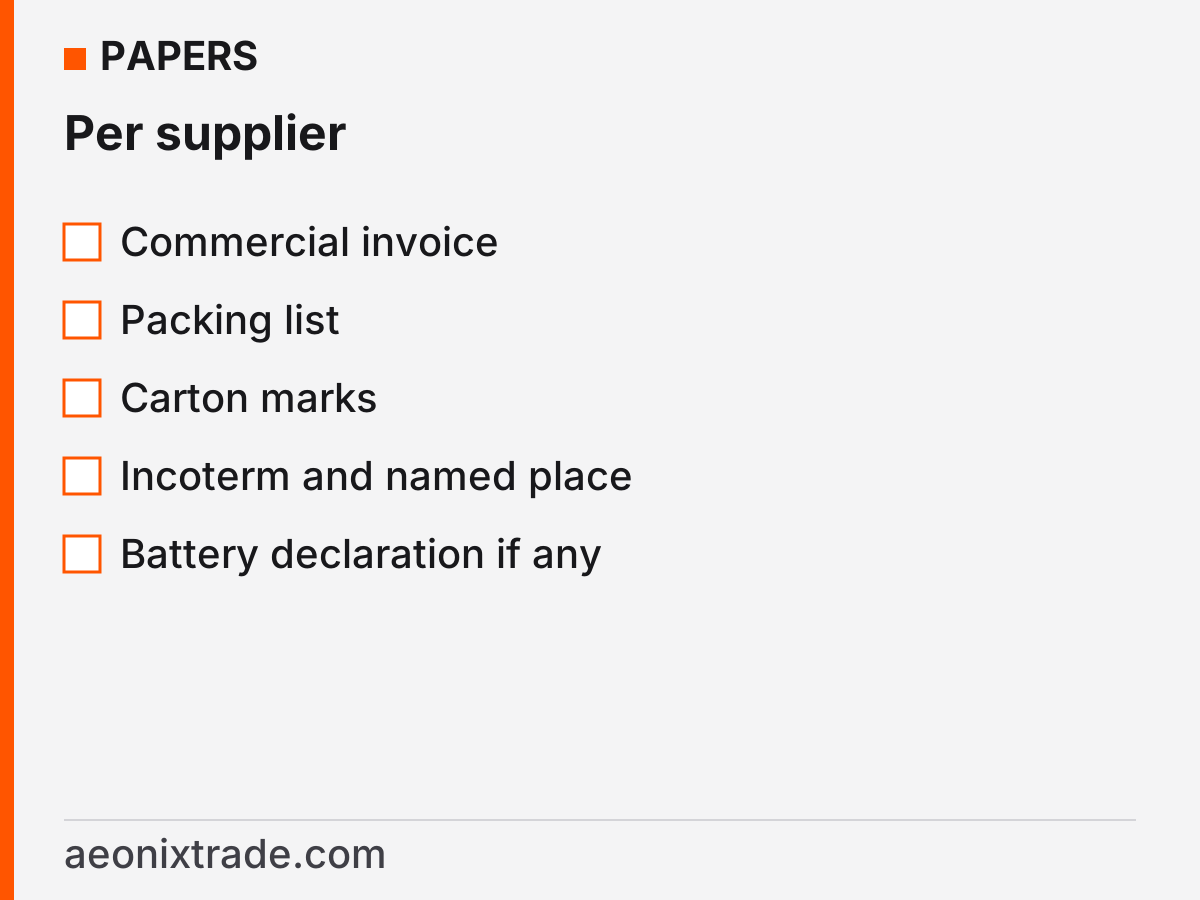
Each supplier needs a commercial invoice and a packing list that describe that supplier's goods. The International Trade Administration describes the commercial invoice as a document used in export and import clearance, and as the document destination customs uses when it assesses duties and taxes. What belongs on the invoice and on the packing list is spelled out on commercial invoice and packing list. U.S. Customs and Border Protection's overview of basic importing and exporting is the doorway for the U.S. side of that file.
A single invoice that adds six factories together, with one vague description, is how a consolidated shipment gets stuck. The forwarder can put the cartons in one container. The paperwork still shows which cartons came from which seller, with marks that match the boxes. Mixed cartons need a line per product so the classification can be done. The Harmonized System is the nomenclature that classification uses. You do not have to guess a code on the show floor. You do have to keep the products distinguishable.
A typical case
A buyer leaves the housewares halls with samples from six booths and a real order from three of them. In this example the commercial lots add up to about 4 cubic metres, FOB Guangzhou, enough for LCL and not enough to pretend it is a full container. The samples fly home the week after the fair, each bag tagged. The cartons are booked to one consolidation warehouse after the purchase orders are signed and the deposits are paid to the suppliers named on those orders.
The buyer does not ask booth four to "include booth five's cartons on your invoice" so there is only one wire. Each supplier invoices its own goods. The consolidator receives three sets of cartons and three sets of papers, checks the counts, and the forwarder issues one set of transport documents for the move. The Incoterm on all three purchase orders is FOB at the same named place, so the handover to the vessel is the same job three times. If one supplier will only sell EXW at a factory two hours away, that leg is priced on its own before it is allowed to join the warehouse.
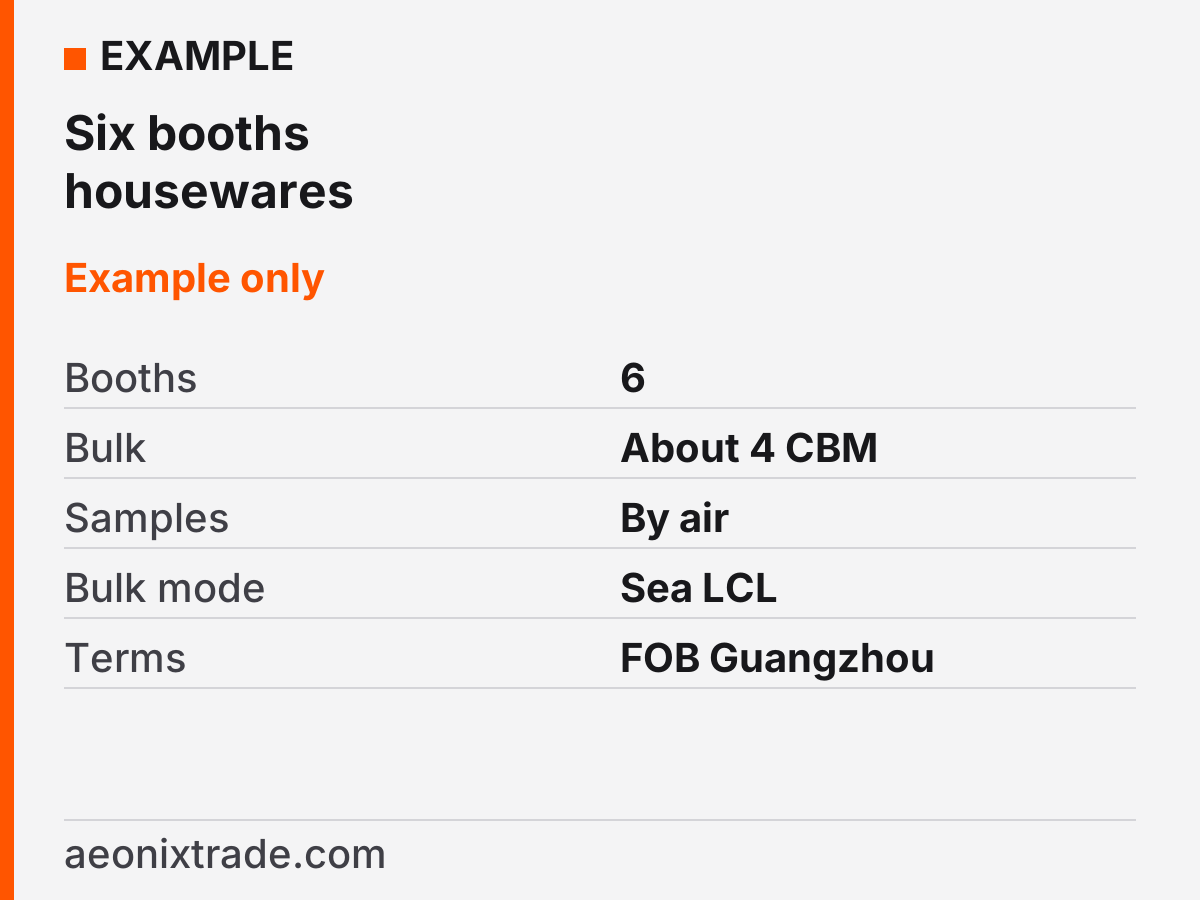
The six booths, the 4 cubic metres and FOB Guangzhou are the example. They are not a freight tariff. Ask your forwarder for the rate on the actual cartons.
Where fair shipping goes wrong
- One commercial invoice for every booth you liked, written by the agent in the aisle. You lose the link between the box and the seller, and you may pay the wrong company.
- Samples with batteries in ordinary luggage because the piece is small. Ask the airline or the courier against the IATA rules for that battery. A refused bag at the airport is a bad place to learn the rule.
- Promising a ship date on the show floor before the Incoterm and the carton sizes exist. The sailing you can catch is the one booked after the warehouse has the cargo and the papers, not the one a booth mentions in passing.
Before you leave the hall
- Every sample is tagged with booth, product and quote reference.
- Every real order has its own supplier name, Incoterm and named place.
- You know which cartons go to which warehouse, and who pays the truck to get them there.
- Invoice and packing list are promised per supplier, with carton marks.
- Anything with a battery is flagged before it is packed. Send the lots that are real on the RFQ so the file stays in one place.
Frequently asked questions
Can the fair ship my samples?
Plan on arranging the sample move yourself or with a carrier. The organiser site is the place for the session and the buyer pass. It is not a substitute for a waybill. Tag the sample and choose a service that accepts what is inside it.
Should several Canton Fair suppliers share one shipment?
Yes, when the cartons are compatible, the papers stay separate by supplier, and the Incoterms can meet at one handover. Consolidation is the warehouse step. It does not merge the purchase orders into one seller.
Is sea or air the default after the fair?
Samples often move by air or courier because they are small and you need them for approval. Commercial cartons of several cubic metres usually wait for sea, LCL or FCL, once the quote exists. The choice is the deadline and the cargo, including any battery, not a habit from the last trip.
Other markets for the same kind of buy are China Wholesale Markets by Product Category, US clothing distributors versus importing, auto parts, and Guangzhou wholesale markets.
See also Canton Fair 2027 Dates, Phases and Which Products Each Phase Covers and After Canton Fair.
Sources
- Canton Fair. The organiser site for the session. Open on 9 November 2026. This page does not treat it as a freight booking desk.
- ICC: Incoterms 2020 and U.S. International Trade Administration: Know Your Incoterms. Who books carriage follows the named rule.
- U.S. International Trade Administration: commercial invoice. Why each supplier's goods need an invoice customs can use.
- U.S. Customs and Border Protection: basic importing and exporting. The U.S. overview of the import file.
- IATA: dangerous goods. The page to open before a sample battery is handed to an airline. No packing limit is copied here.
- World Customs Organization: Harmonized System. Why mixed fair cargo still needs a description per product.
Submit sourcing request
Can't find what you need?
Start with a product or image link, an approximate quantity and destination. Other details can follow.