Wholesale Clothing Vendors: US Distributors vs Importing Direct from China
Published by Aeonix Trade.
Last fact-checked: November 9, 2026. Duty and tax rates are not stated. Use the official tariff for the garment you actually ship.
A typical case
A shop wants 400 women's cotton shirts for a spring delivery. Two offers arrive on the same afternoon. A US wholesaler can ship mixed sizes from stock next week, in cartons that already have labels. A factory in Guangzhou can cut the same silhouette in the shop's color, FOB, after a sample, at a quantity the factory sets and a lead time the factory has not put in writing.
Those offers are not two prices for one product. One seller already imported. The other is asking you to become the importer. The search that usually lands here, wholesale clothing vendors and wholesale clothing distributors, is often looking for the first seller. The second seller is a different job. This page separates them so the quotes can be compared after the job is clear.
The distributor path on this site is wholesale clothing distributors. The China path starts with a sourcing brief or the RFQ, not with a US carton price.
What each offer is actually selling
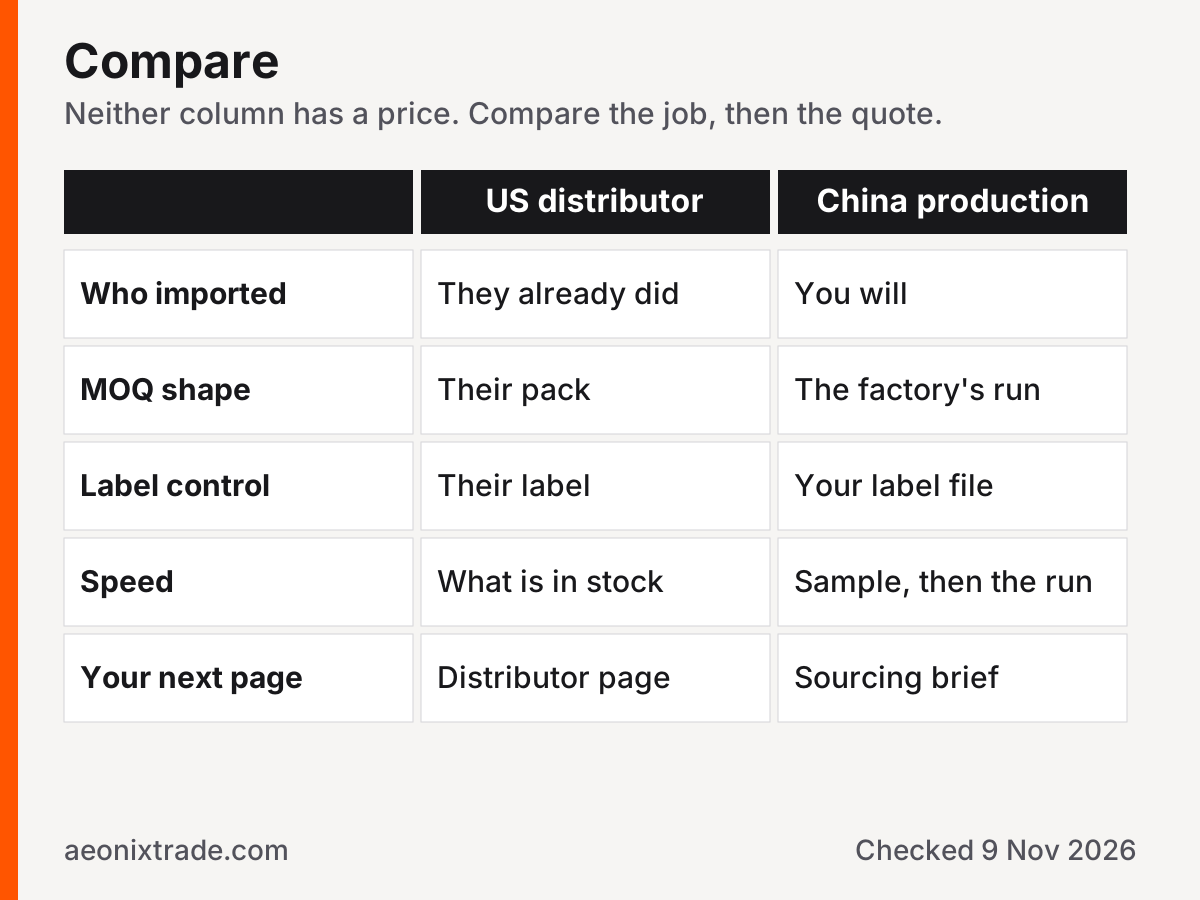
| US distributor or wholesaler | China production | |
|---|---|---|
| Who imported | They did, or their supplier did. You are buying goods already in the market. | You will, unless a named importer of record is on the contract. |
| What you can change | Usually nothing structural. You buy the style they hold. | Color, size run, brand, and pack, inside the minimum they accept. |
| Label | Theirs, already on the garment. Read it. | Yours to specify before bulk. Part 303 is the US textile rule. |
| Speed | Whatever is in the warehouse. | Sample, then the cut. Read lead time before you promise the floor. |
| Minimum | Their pack. Often smaller, because the run already happened. | The factory's run. How to ask is MOQ. |
| Price you are looking at | A domestic resale price. Freight may be a parcel. | Usually FOB or a similar term. Duty, brokerage, and delivery are not inside it. See FOB. |
Add the missing lines before you decide the China shirt is cheaper. This article will not invent the duty. The rate sits in the tariff for that fiber and that garment, on the customs site for the country of import.
If the shirts are cut in China, the US label file is yours
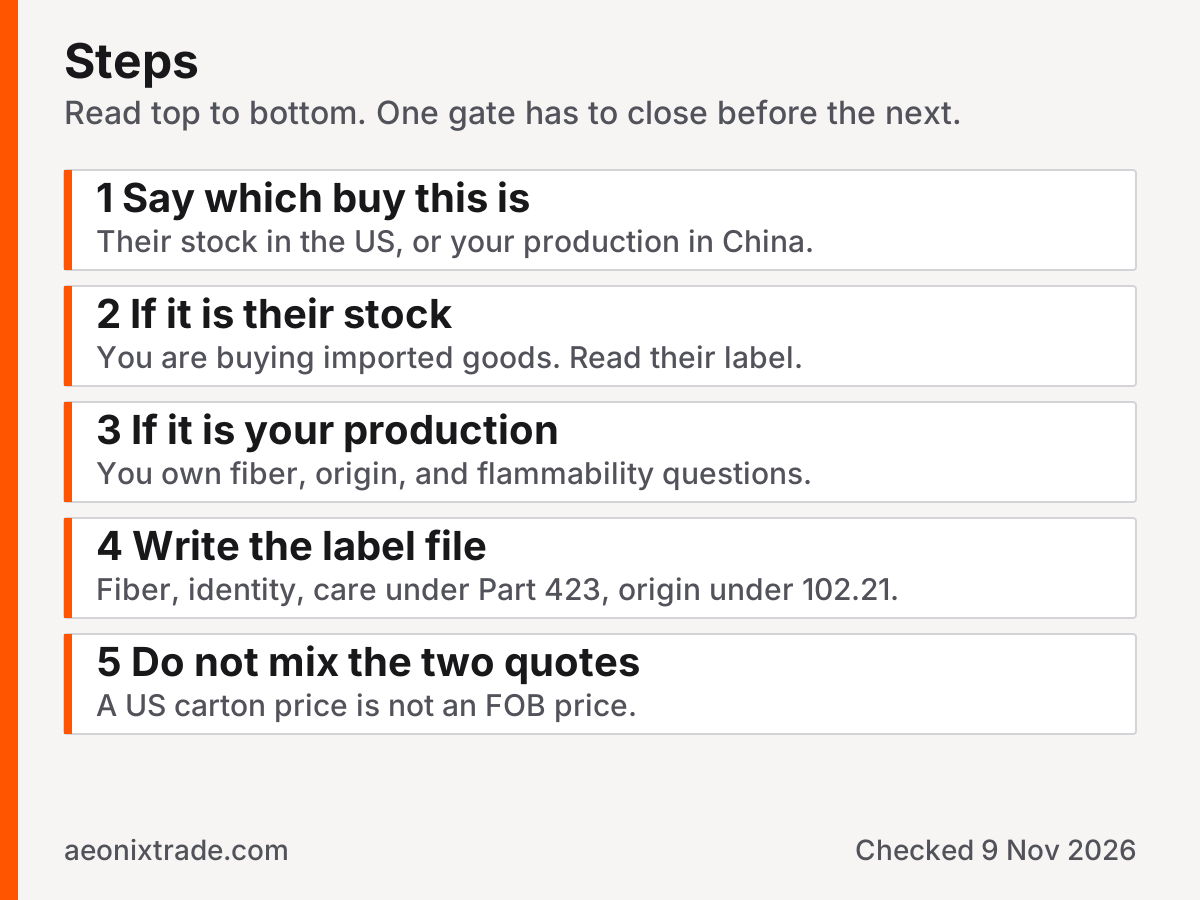
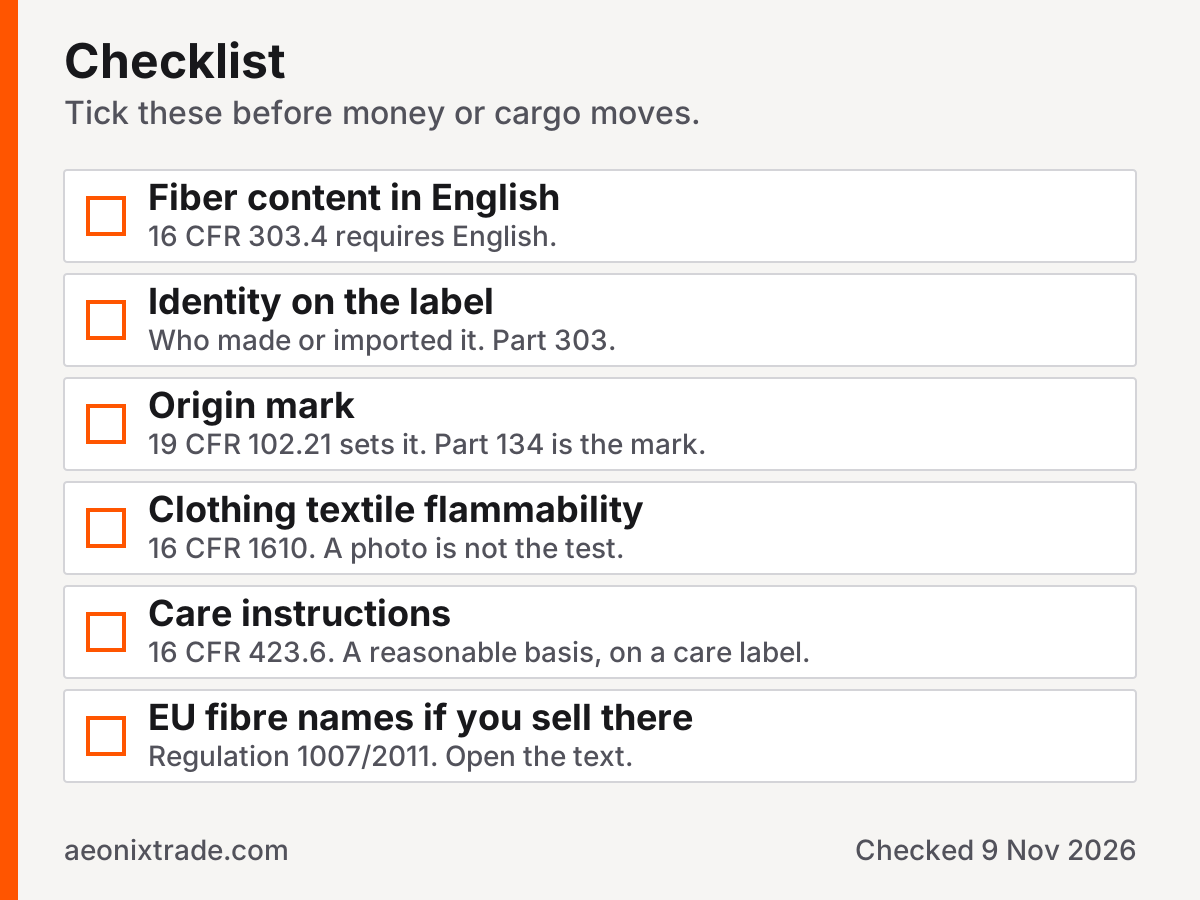
The US Textile Rules are 16 CFR Part 303. Section 303.15 is the required label and how it is attached. Section 303.16 covers arrangement of the information. Section 303.19 covers the name or other identification. Section 303.4, on the same part, says all required information shall be set out in the English language. If another language is also on the label, English still has to be there.
Do not guess fiber percentages in a chat and have them woven. Open the section that matches the shirt and use the generic fiber names the rules require. A private-label logo does not replace that label. The difference between a logo job and a new pattern is in ODM, OEM, and private label.
Part 303 is not the care label. 16 CFR 423.6 says a manufacturer or importer of textile wearing apparel must attach a care label stating the regular care needed for ordinary use, and must have a reasonable basis for those instructions before sale. On these shirts that is normally a permanent label the shopper can find. Fiber, identity, and origin do not stand in for it.
How the origin is marked, for many imported articles, is 19 CFR Part 134. For a shirt whose fabric, cutting, and sewing are not all in one country, do not pick the country of the last substantial transformation and print that. CBP decides the origin of textile and apparel products under 19 CFR 102.21, including the tariff-shift and assembly rules in that section. Part 134 is how you mark the origin those rules produce. Do not print "designed in" as a substitute.
Clothing textiles and the flammability standard are 16 CFR Part 1610. A showroom photo does not perform that test. Children's sleepwear is a different part of the rules. Do not treat a women's cotton shirt and a child's sleep set as the same file.
If the same shirt will be sold in the European Union, fiber names and textile labelling sit in Regulation (EU) No 1007/2011. General product safety for consumer products placed on the EU market is Regulation (EU) 2023/988. Neither regulation is a substitute for the US textile label if the shop is in the US. Use the rule for the country of sale.
If you buy the US wholesaler's stock
You are not automatically the importer. You still read the label that is already sewn in. If the fiber line is missing, or the origin is a slogan, that problem is in the carton you are about to pay for. Ask for the label photo before the wire, not after the customer complaint.
A wholesaler who offers "trendy" closeouts is still selling a finished garment. Quantity, size run, and what they will not take back belong on their invoice. Those terms are not a China MOQ. Do not send their line sheet to a Guangzhou factory and expect the same colors next month.
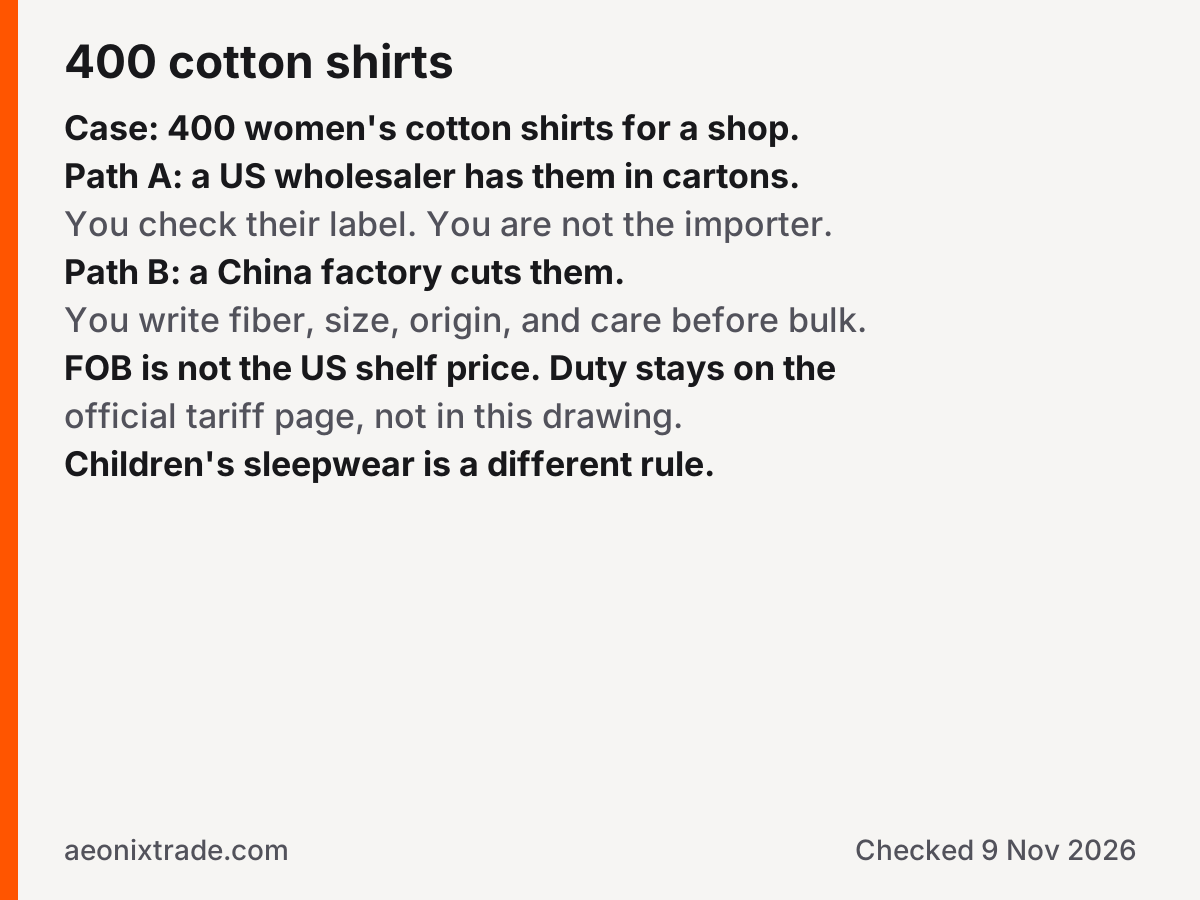
Where the comparison usually lies
- The FOB price is set next to the US wholesale price with duty, brokerage, and inland delivery missing. The China shirt looks cheaper because the bill is incomplete.
- The factory copies a US brand's wash label because you sent a photo of a shirt you like. That is their intellectual property, not a template. Send your own file.
- Children's wear is ordered on the adult-shirt rule. Part 1610 is not the whole of children's clothing. Open the rule that names the garment.
- The shop needs 400 pieces in four weeks. The factory's sample has not been signed. The distributor's stock is the path that matches the date. Pretending otherwise is how a launch misses the floor.
Finding factories, when the China path is actually the one you want, starts from how buyers compare channels. A short version of that choice is what a sourcing agent does and agent versus trading company. The distributor page stays the right door when the goods are already in the United States.
Which path fits the 400 shirts
Choose the US wholesaler when you need a date, a mixed size run, and you can live with their label and their style. Choose China when you need a color or a brand they do not stock, and you can carry the sample, the label file, the minimum, and the import. Many shops do both: stock from a distributor for the sizes that sell every week, and a China cut for the style that is actually theirs.
Write the path in the first line of the RFQ so the quote comes back as the job you meant.
Questions the two quotes raise
Is a US distributor always more expensive?
Not on a landed-cost basis you have not finished. Their price includes an import someone already paid. Your FOB price does not. Finish the lines, then compare.
Can I put my brand on the distributor's shirts?
Only if they sell it that way. Relabeling a finished garment can break the textile label rules and their terms. Ask. Do not cover their fiber label with a hang tag and call it private label.
Does the factory's ISO certificate clear the flammability test?
No. A quality-management certificate is not Part 1610. The test, if you need it, is a separate report on the fabric you are actually cutting.
Other markets for the same kind of buy are China Wholesale Markets by Product Category, auto parts, Guangzhou wholesale markets, and the East China Fair in Shanghai.
Official sources
- eCFR, 16 CFR Part 303, Textile Fiber Products Identification Act rules, including the English-language requirement and the required label.
- 16 CFR 303.15, required label and method of affixing.
- eCFR, 16 CFR 423.6, care labels for textile wearing apparel, and the reasonable-basis requirement. Checked November 10, 2026.
- eCFR, 19 CFR Part 134, country of origin marking.
- eCFR, 19 CFR 102.21, country of origin of textile and apparel products. Checked November 10, 2026.
- eCFR, 16 CFR Part 1610, flammability of clothing textiles.
- Regulation (EU) No 1007/2011, textile fibre names and labelling.
- Regulation (EU) 2023/988, general product safety.
Submit sourcing request
Can't find what you need?
Start with a product or image link, an approximate quantity and destination. Other details can follow.