How to Negotiate MOQ with Chinese Suppliers Without Losing Quality
Published by Aeonix Trade.
Last fact-checked: November 9, 2026. No supplier's minimum is a market rate. The numbers in the case are the case, not a survey.
A typical case
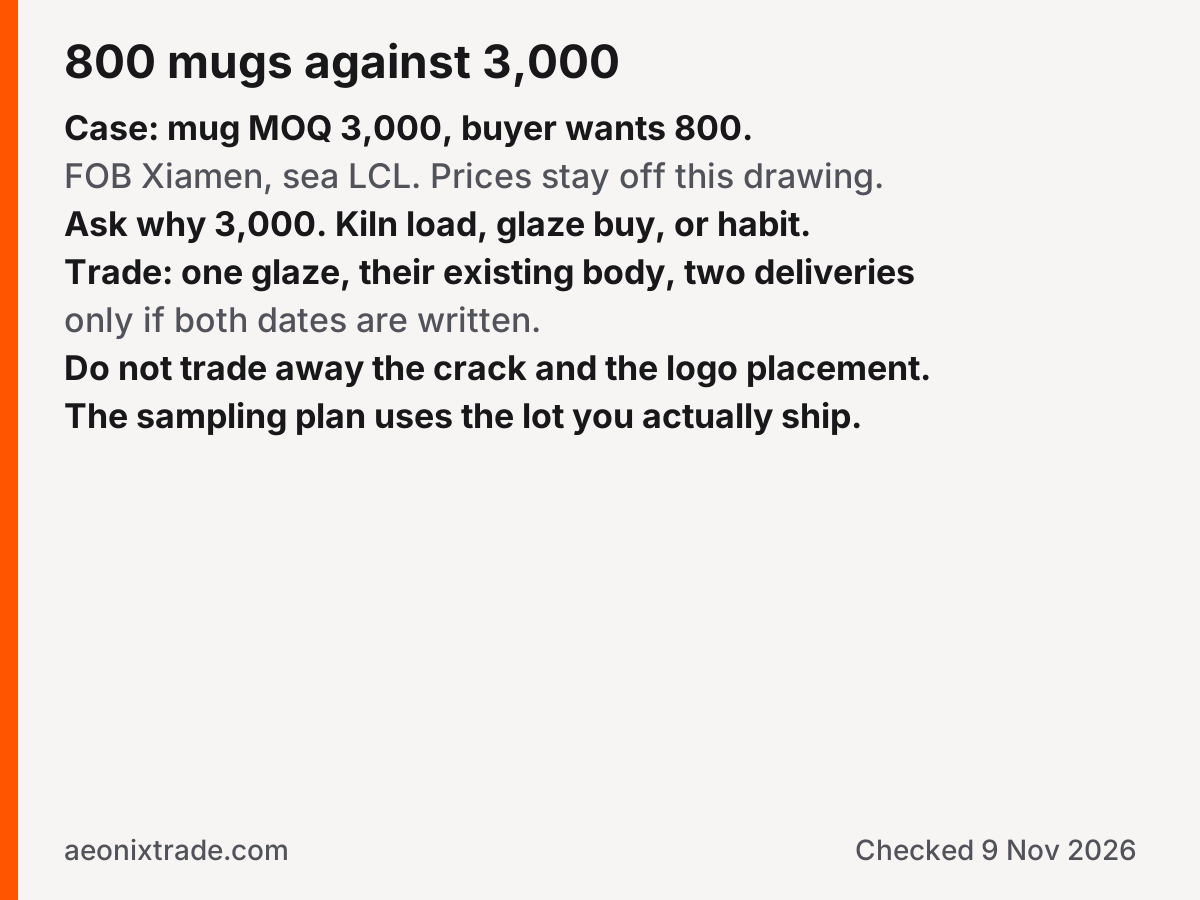
A stoneware mug, one glaze, a small pad-printed mark. The factory in Xiamen writes MOQ 3,000. The buyer can sell 800 before the next season and wants the rest later, FOB Xiamen, sea LCL. The factory's reply to "can you do 800" is a higher unit price and a shorter sentence about quality: "for small quantity, small color difference is normal."
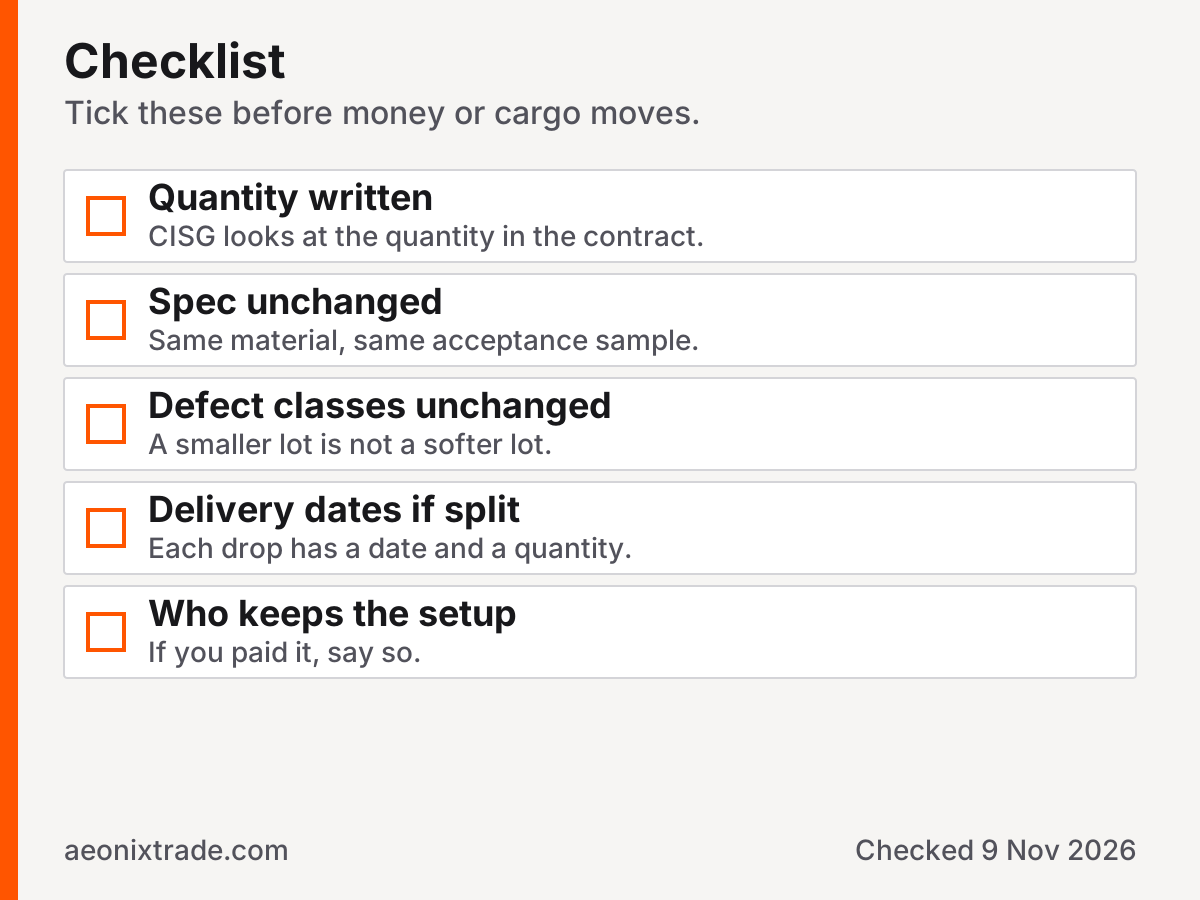
That second sentence is the part to refuse. Quantity and quality are both terms of the contract. UNCITRAL's description of the CISG says the seller delivers goods that conform to the quantity and the quality stipulated in the contract. A smaller lot does not create a vaguer mug.
What MOQ means on a quote, before you argue with it, is in MOQ meaning. How a small retailer tests a first lot is in low MOQ for small retailers. This page is the conversation in between.
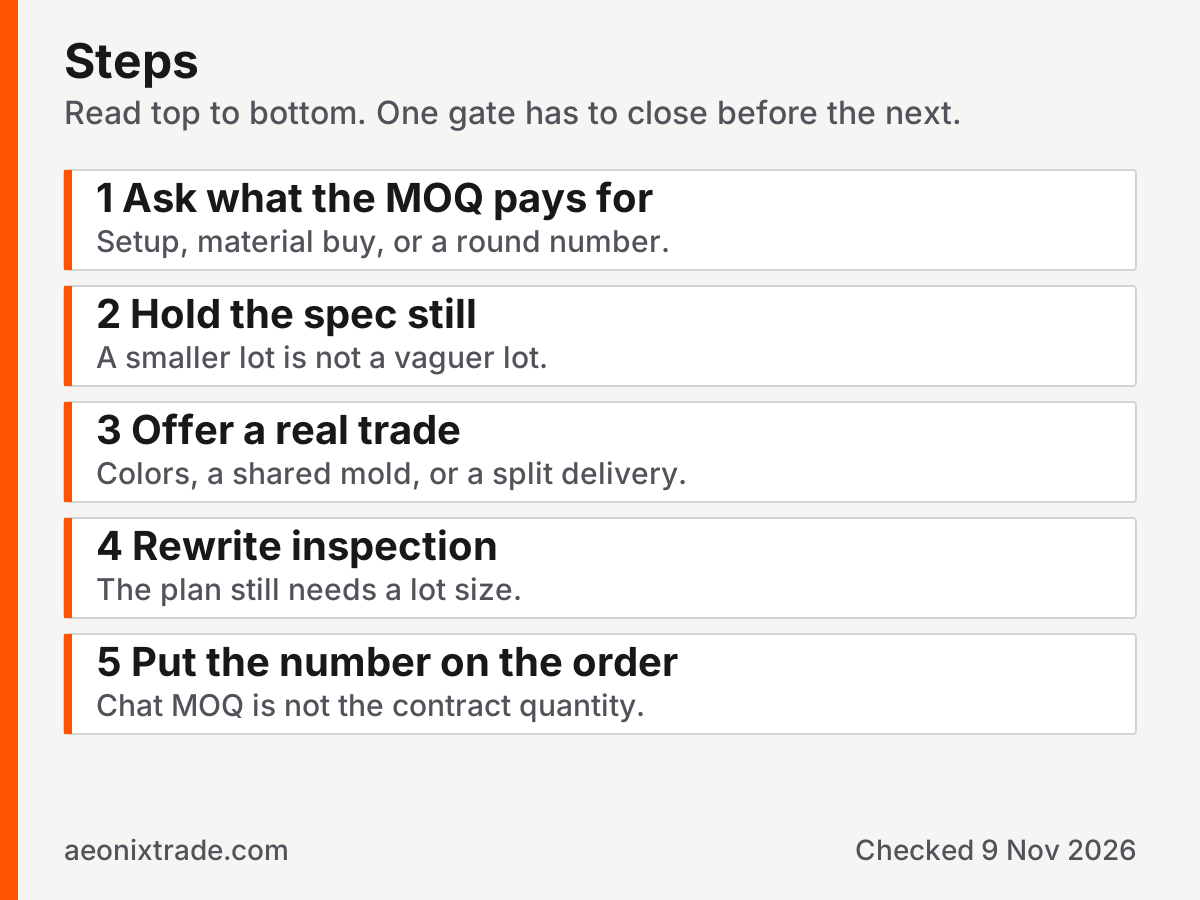
Ask what the 3,000 is paying for
A minimum is rarely one thing. On a mug it is often a mix of these, and the factory may not separate them until you ask.
- A kiln or a glaze batch that they do not want to fire half empty.
- A carton, a screen, or a setup they spread across a longer run.
- A number they use with every new buyer because it keeps small orders away.
- A material buy they already made for a color they are pushing.
You cannot negotiate the third item the same way as the first. "Habit" moves if you are a credible reorder. "The kiln" moves if you accept their firing schedule or their existing glaze. Write down which reason they gave. If they will not give one, you are negotiating a mood.
Trades that do not touch the defect list
These are questions, not discounts you should expect. None of them has a rate.
| You ask | You offer | You do not offer |
|---|---|---|
| Fewer colors | One glaze on this order | A wider color tolerance |
| Use their body and mold | No new tooling on this lot | Ownership of their shape |
| Split the 3,000 | Two dates and two quantities, both written | "Ship the rest when you can" |
| Pay the setup as its own line | A named setup, and who owns the screen | A blank extra fee with no description |
| Share a run they already planned | Their glaze, your mark, their date | A silent change of clay body |
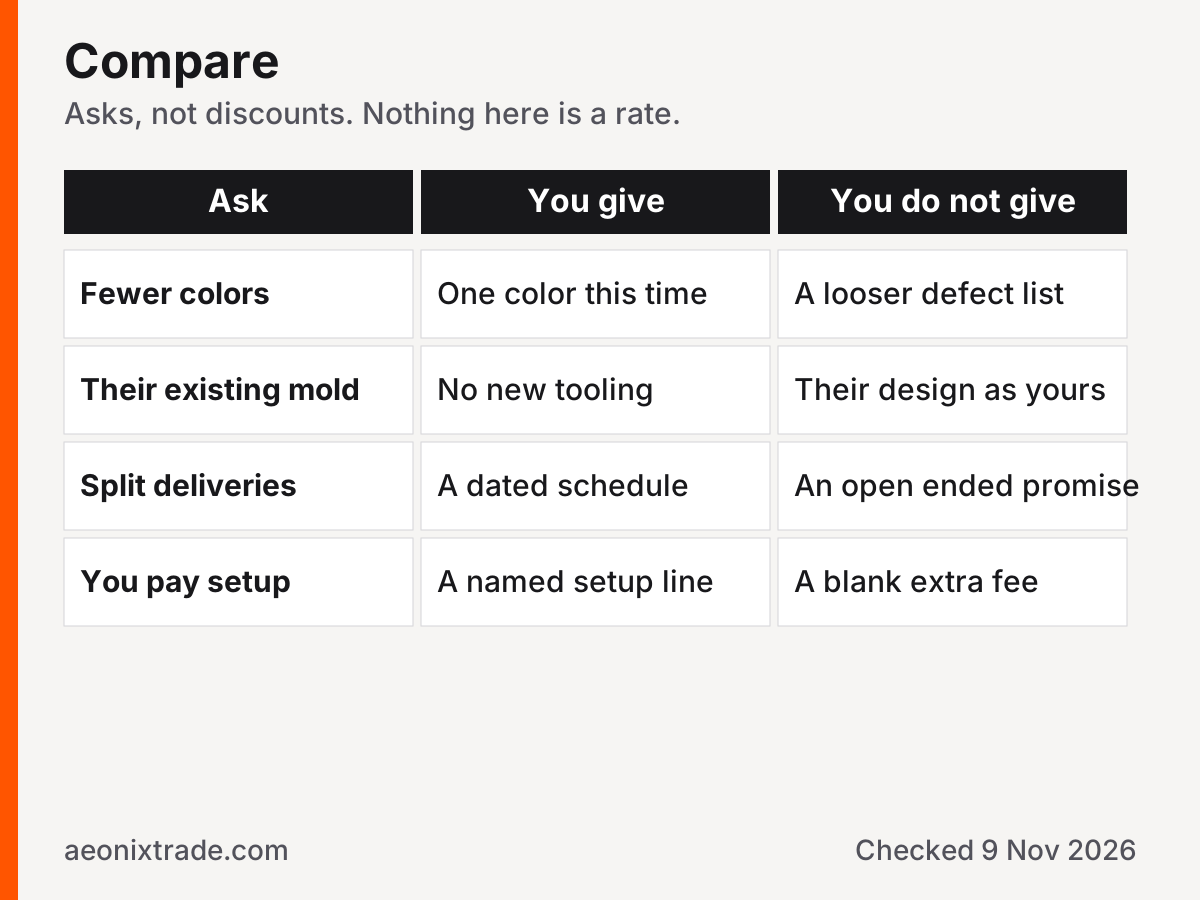
A split delivery is still one spec. Each drop needs a date, a quantity, and the same acceptance sample. If the second drop can change glaze, it is a second product. Say so.
Payment method does not set the minimum. A deposit and a balance are a way to pay, described among other methods by the International Trade Administration. Paying faster does not make a kiln larger. Do not trade the balance away to buy a lower MOQ unless the inspection result is already defined.
The sampling plan uses the lot you actually ship
If you ship 800, the lot is 800. If you ship 3,000 in two drops of 1,500, decide whether each drop is its own lot. BS ISO 2859-1:2026, current on the BSI page and published January 31, 2026, is the sampling standard indexed by acceptance quality limit. The ISO catalogue page did not return a readable copy on November 9, 2026, so the edition check is the BSI record plus the copy your inspection firm opens.
The AQL is an index into that plan. It is not a percentage of mugs you agree to overlook. How the index works is in AQL meaning. A smaller lot can mean a different sample size. It does not mean cracks and logo drift become minor because you bought fewer.
The MOQ planner is where you put your own quantity against the quote. It does not know the factory's kiln. You still have to ask.
What not to say in the reply
- "Any quantity is fine, we are testing the market." That tells them there is no reorder. The minimum will not move, or the quality sentence will.
- "Same as your other customers." You do not know their other customers' defect list. Attach yours.
- "Reduce the MOQ and we will skip inspection." You just bought the right to receive the color difference they warned you about.
- A unit price with the setup buried inside it. When you reorder without the setup, you cannot see it. Ask for the line.
Samples are how you learn whether 800 of this mug are worth arguing for. The approval gate is product samples from China. The same quantity talk at a Yiwu booth, where the minimum is a carton on the table rather than a kiln, is Yiwu market MOQ and samples. What the word means before you argue with a number is MOQ meaning. The trial-order page is MOQ, samples, and trial orders.
A reply you can send
State the quantity you want now, the quantity you will reorder if the lot passes, the spec that will not move, and the trade you are actually offering. One glaze. Their body. Two dated drops, or one drop of 800 and a setup line. Inspection against the signed mug, using the sampling edition you name. Ask them to price that, not to "do their best."
Put the same facts in the RFQ so the quote comes back with lines instead of a single number.
Questions buyers ask next
Will a factory always accept 800?
No. Some kilns and some materials will not. The useful outcome is a written reason and a price for a defined trade, including a no.
Should I raise the unit price myself to look serious?
Ask them to price the smaller lot. Inventing a premium without knowing their setup teaches you nothing and can lock in a number they would have undercut.
Does FOB change the MOQ?
No. The Incoterms 2020 rules say who does which transport job. They do not set a factory minimum. FOB Xiamen still needs a quantity on the order. Read FOB for the delivery point, not for how many mugs to buy.
Other markets for the same kind of buy are China Wholesale Markets by Product Category, US clothing distributors versus importing, auto parts, and Guangzhou wholesale markets.
Official sources
Submit sourcing request
Can't find what you need?
Start with a product or image link, an approximate quantity and destination. Other details can follow.