Product Samples from China: Process, Costs and Approval Before Mass Production
Published by Aeonix Trade.
Last fact-checked: November 9, 2026. No sample prices are stated. Ask for the lines. Fill the amounts from the quote.
A typical case
The cotton tote is still a file. The factory sends three photos and a courier quote, and calls all three "the sample." One photo is a bag they already sell. One is a rushed print of your art on a different fabric. One is a flat sketch of the carton. The buyer replies "looks good" in the chat. Two weeks later the bulk fabric is a third shade, and the chat is the only record.
A sample from China is a physical piece with a job. The job has to be named, or the piece cannot approve anything. The commercial door for that request is the sample order. The development side of the same work is sample development.
Four pieces buyers mix up
| Piece | What it can prove | What it cannot prove |
|---|---|---|
| Counter sample | What they make today, in the fabric and stitch they already run. | That they will change it, or that your art will survive the print. |
| Development sample | That a change is possible: your print, your size, your handle. | That the bulk lot will be made the same way. This round is allowed to be wrong. |
| Pre-production sample | The materials, process, and pack you intend to order in quantity. | That every unit in the future lot matches it. That is the inspection. |
| A piece pulled from the bulk lot | This shipment, if it was pulled across the lot under a plan. | The next order. Keep the signed pre-production piece so the next lot has a reference too. |
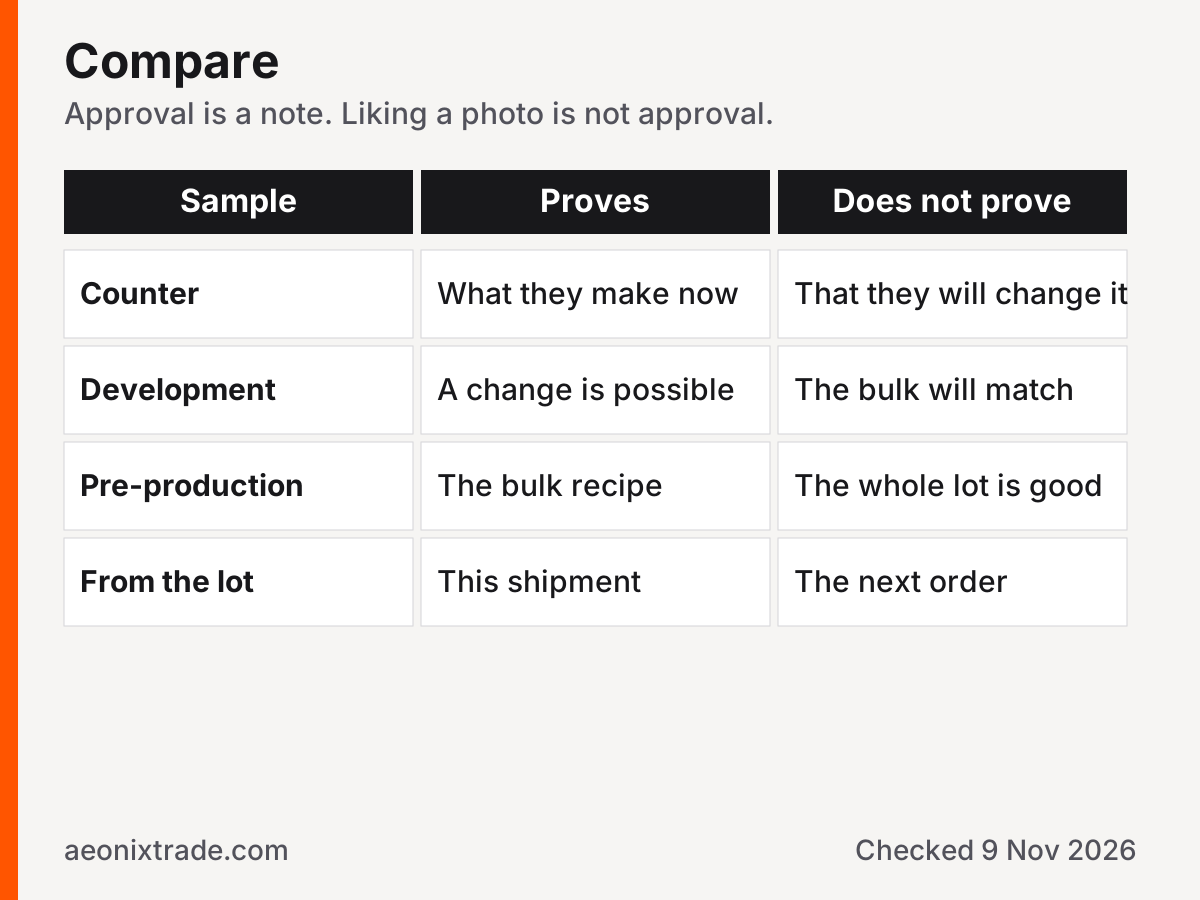
Approval is a note attached to one of these, not a mood. The note names the round, the date, the differences you rejected, and the differences you accepted. "Looks good" accepts the photo. It does not accept a fabric.
Quantity still belongs on the bulk order, not in the sample chat. How far you can move a minimum without softening this note is negotiating MOQ. The seller's duty to match the quality in the contract is the point UNCITRAL makes about the CISG. The sample note is where that quality gets specific.
Cost lines, with the amounts left blank
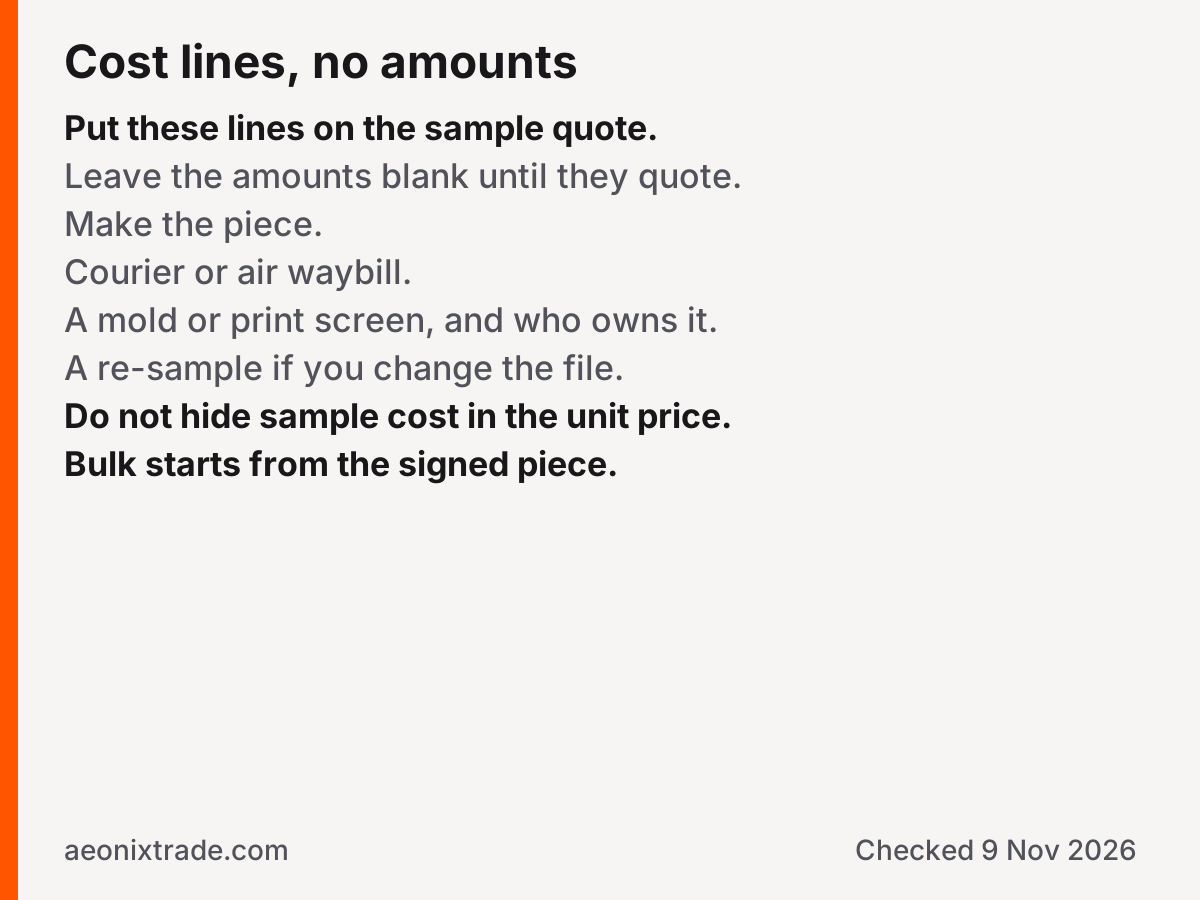
Ask the factory to price these separately. Hide nothing inside a unit price you cannot see on the reorder.
- Making the piece, including the fabric and the print for that round.
- The courier or the air waybill. A sample is often one parcel. It is not the bulk sailing.
- A screen, a mold, or a cutter, and who owns it after you pay.
- A re-sample when you change the file. If you change the art, you owe another round. Say so before you change it.
- Who pays if the piece does not match the file they were given. Their miss and your new idea are different invoices.
Payment method for that invoice is still a choice. The International Trade Administration lists the usual methods. A sample fee is small enough that people wire it casually. The casual part is how the wrong fabric gets approved.
How long the round takes is a lead time, not a sample type. Read lead time before you promise a launch date off a courier estimate.
How the piece travels
A cotton tote with no battery and no aerosol is ordinary cargo. Express, air, or a sea parcel are commercial choices. How those three carry a sample is in shipping samples from China. The Incoterms 2020 rules still tell you who hands it to the carrier. Do not assume "sample" means the factory pays freight. Write it.
If the product has a battery, a magnet, a perfume, or an aerosol, stop and read the dangerous-goods rules before anyone calls it a document parcel. IATA's dangerous goods page is the airline rule set. It is not a suggestion from the courier counter. A power bank sample has to follow it. A cotton tote does not.
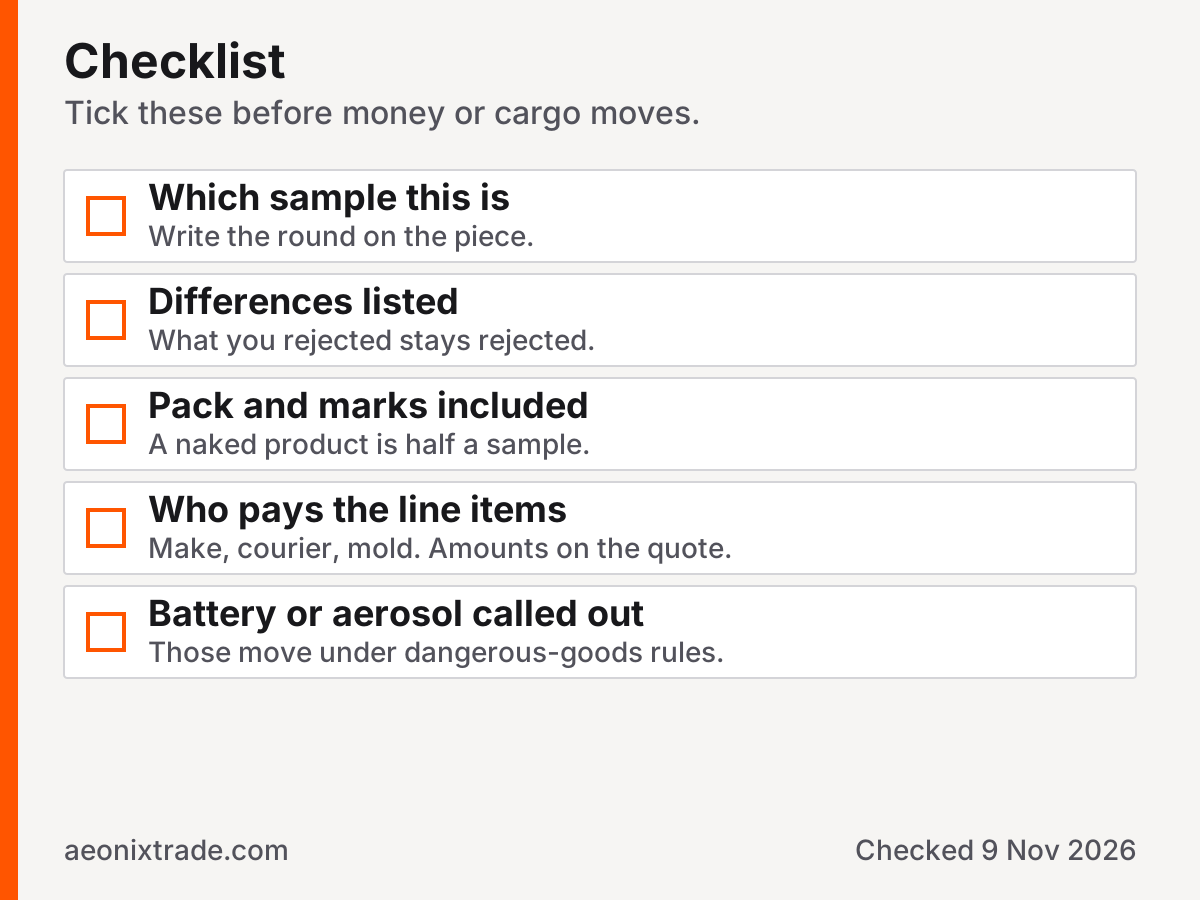
What to sign, and what to keep
- Mark the round on the piece and on the bag it arrived in.
- List what is wrong and what is accepted. Silence is not acceptance of a change you did not notice.
- Include pack, marks, and the origin line if the bulk goods need them. A naked tote is half a sample.
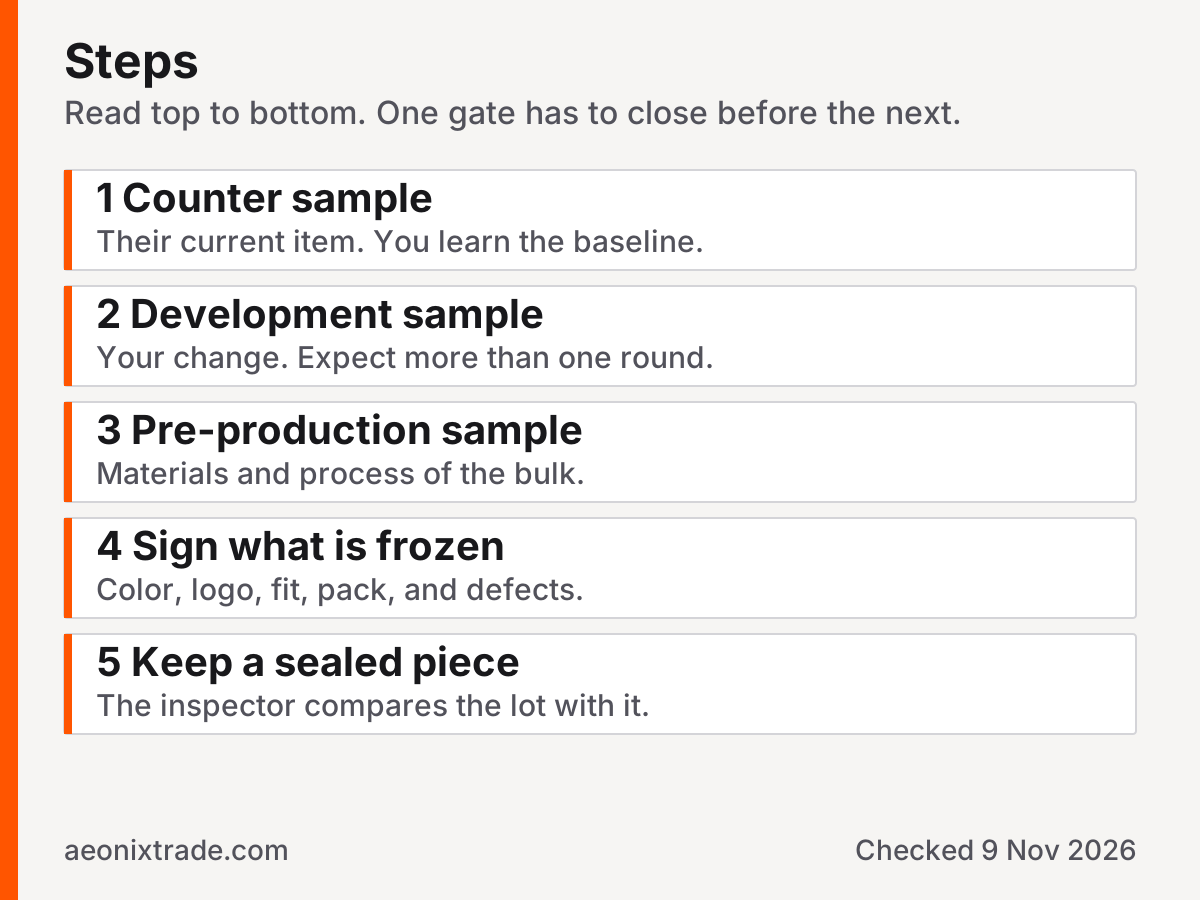
- Seal one accepted piece for you and one for the factory. The inspector compares the lot with those, not with the first development reject.
- Do not start bulk from a development sample you already marked up. Start from the pre-production piece that replaced it.
How samples go wrong
- Three photos, one approval. You approved a sketch, a different fabric, and their old bag at the same time.
- The courier cost is argued, and the screen cost is forgotten. On the reorder the screen is "included" at a price you cannot see.
- The factory keeps the good sample and ships you the reject by mistake. Mark the pieces before they leave the table.
- A battery product goes as a gift parcel because it is "just a sample." The dangerous-goods page exists for that sentence.
When the signed piece exists, the lot check is third-party inspection. Until then, keep the brief on the RFQ so the sample quote comes back with lines.
Questions that decide the next round
How many samples do I need?
Enough to finish the job of each round. One counter sample. As many development pieces as the change requires. One pre-production piece you are willing to seal. A second pre-production piece if you and the factory both need to hold one. Anything beyond that is a new change, and it should be priced as one.
Should I pay for the sample?
Ask for the lines and then decide. A free sample is often their current product, which is a useful counter sample and a useless approval of your art. Free is not the same as relevant.
Can the sample ship with the bulk?
Only if you do not need it to release the bulk. If the pre-production piece is still on the vessel, you do not have a reference in the room where the inspector is standing.
The production file next to this one is Private Label Meaning, starting a private label from China, an NNN agreement versus an NDA, and the purchase contract.
Official sources
- UNCITRAL, CISG. Quantity and quality belong in the contract. The sample note is how quality gets specific.
- International Trade Administration, methods of payment.
- ICC, Incoterms 2020.
- IATA dangerous goods, for samples that are not ordinary cotton.
Submit sourcing request
Can't find what you need?
Start with a product or image link, an approximate quantity and destination. Other details can follow.