Third-Party Inspection in China: How to Hire an Inspector and What to Ask
Published by Aeonix Trade.
Last fact-checked: November 9, 2026. Sampling tables are not copied here. They live in the standard.
A typical case
2,400 cotton tote bags, one print, FOB Shenzhen, sea LCL, goods packed and waiting on the balance. The supplier says their own QC already passed the lot. The trading company offers to "have a look" on the way to the port. A third firm will send an inspector next Thursday if you send a defect list, which you do not have yet.
Those are three different products. Only one of them is a third-party inspection. The other two can still be useful. They are not a substitute for a report you paid for, against rules you wrote, by someone who does not get paid when the container leaves.
Who is actually writing the report
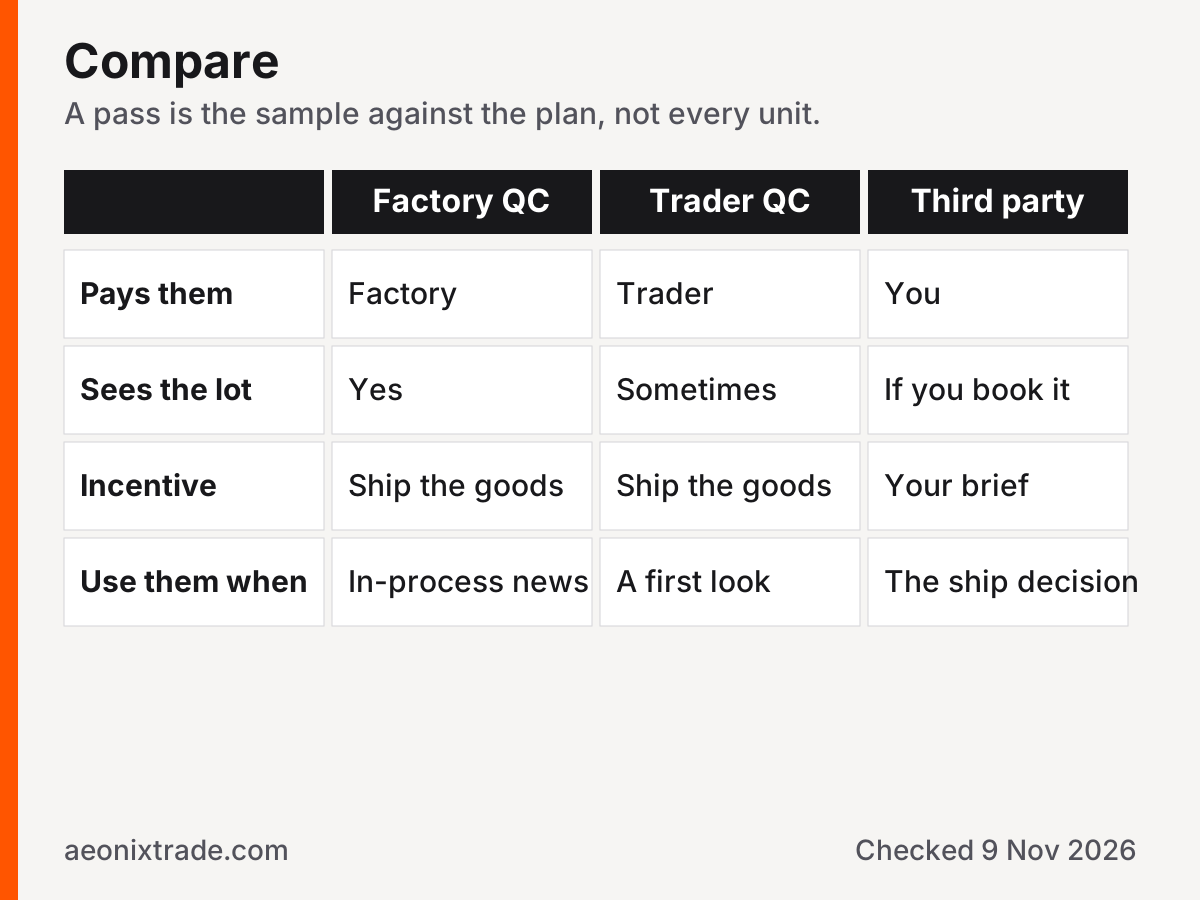
| Factory QC | Trader's check | Third party you hire | |
|---|---|---|---|
| Who pays | The factory | The trader, unless the invoice says otherwise | You |
| What they want | The goods to ship | The goods to ship, and the relationship to hold | Whatever your brief says, including a fail |
| When it helps | During production, as news from the line | A first pair of eyes if you have no one else in the city | The decision to pay the balance or to hold the lot |
| What to watch | A pass with no defect list | A look at the cartons by the door | A visit booked before you defined a defect |
Use the factory's check for in-process news. Use an outside inspector when the result decides whether the lot moves. The service shape of that outside visit is on quality control inspection. The on-site sequence, from during production to the container door, is the pre-shipment checklist. A shorter field list lives on the quality control checklist page.
Write the defects before you ask for a day rate
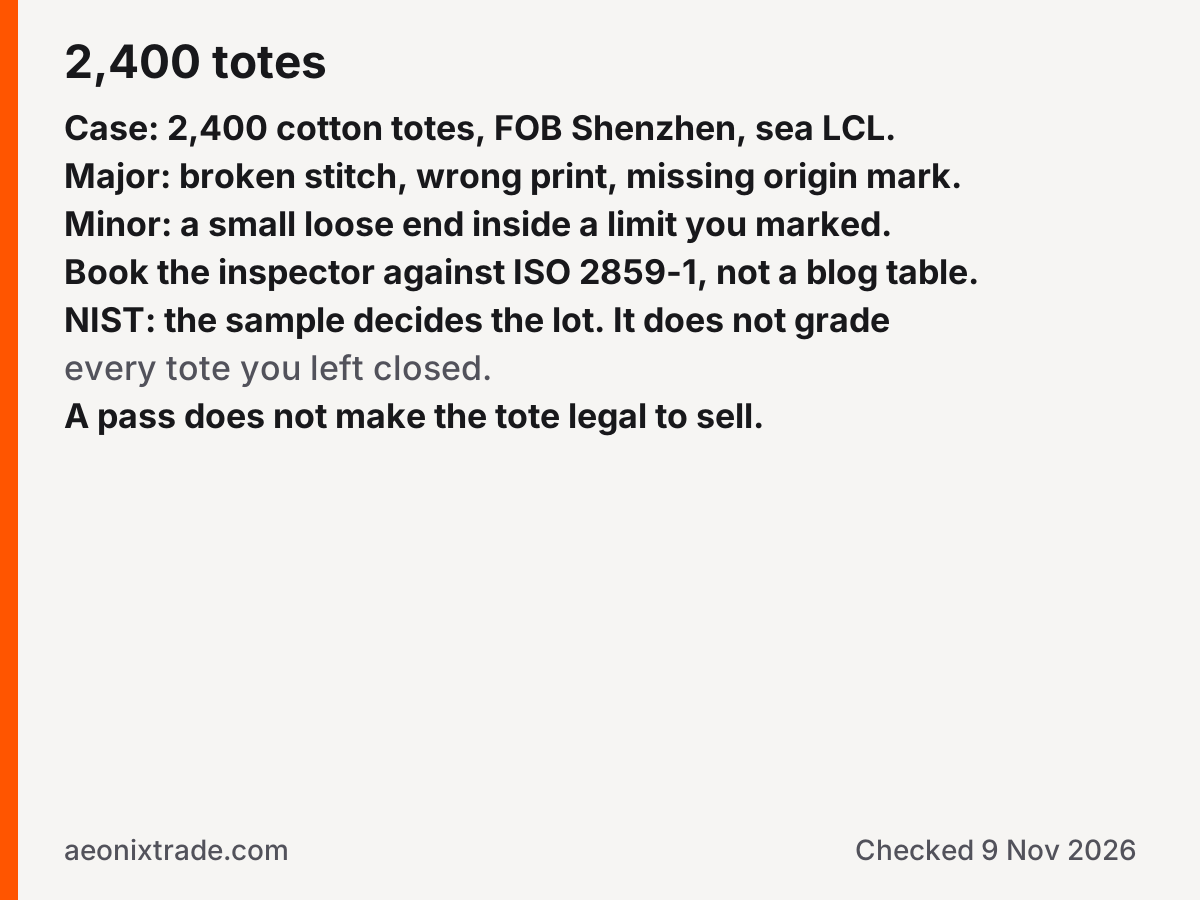
AQL does not know what a broken stitch is. You do. For these totes, agree the classes against the approved sample.
- Critical: a needle left in the bag, or a handle that separates under a pull you specified. Say what the inspector does when they find one.
- Major: a broken stitch on the seam a shopper sees, the wrong print, a missing origin mark you required.
- Minor: a short loose end in a place you marked on the sample. The same end on the front panel may be major. Write the place.
Do not let the inspector downgrade a major on the day because the count is one over the line. That decision is yours, and it belongs in the brief.
Name the plan. Do not paste a table from a blog.
BS ISO 2859-1:2026 is listed by BSI as current, published January 31, 2026. BSI describes it as the international standard for acceptance sampling by attributes: single, double, and multiple plans indexed by the acceptance quality limit, used to decide whether a lot is accepted. The purpose BSI states is to push the producer to hold a process average at least as good as the AQL, while limiting the chance that a buyer accepts an occasional poor lot.
The ISO catalogue URL did not return a readable page on November 9, 2026. Use the BSI record for the edition, and use an authorized copy of the tables. Do not mix a 2026 order with a code letter taken from the 1999 edition.
The NIST handbook page on acceptance sampling is the plain version: you sample because checking every unit is impractical, and the sample supports a yes or no on the lot. It does not estimate the quality of every unit you left closed. The next NIST page distinguishes kinds of lot acceptance plans. NIST explains the decision. ISO 2859-1 is the plan you put in the contract. They are not substitutes.
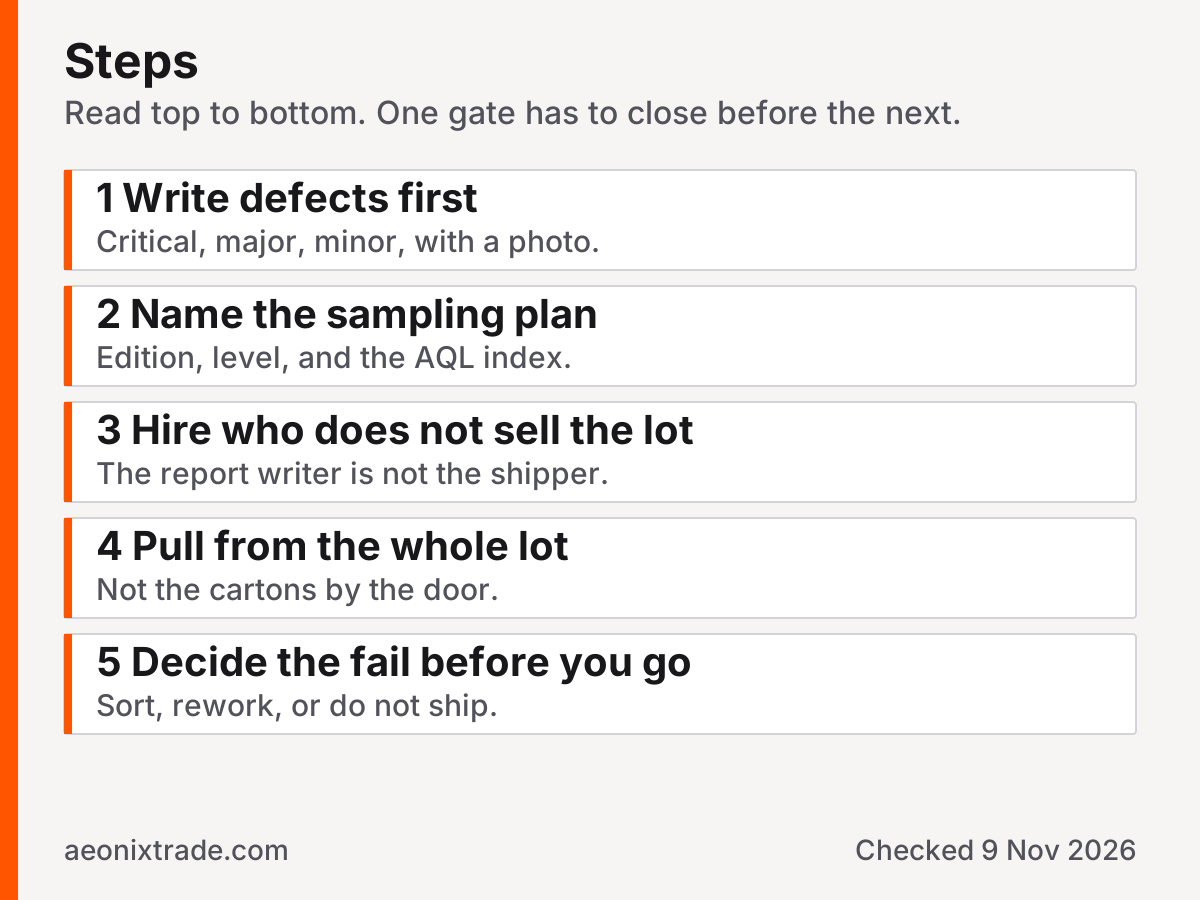
On the brief, write the lot size (2,400 totes, cartons still closed), the edition, the inspection level and severity, the AQL index for each class you defined, who pulls units from across the lot, and the acceptance and rejection numbers from the table the firm used. Ask them to keep a copy of that page with the report. "AQL 2.5" alone is not a booking.
What the index is, and what people confuse it with, is already written in AQL meaning. This page is about who you hire and what you hand them.
What you are buying when you compare firms
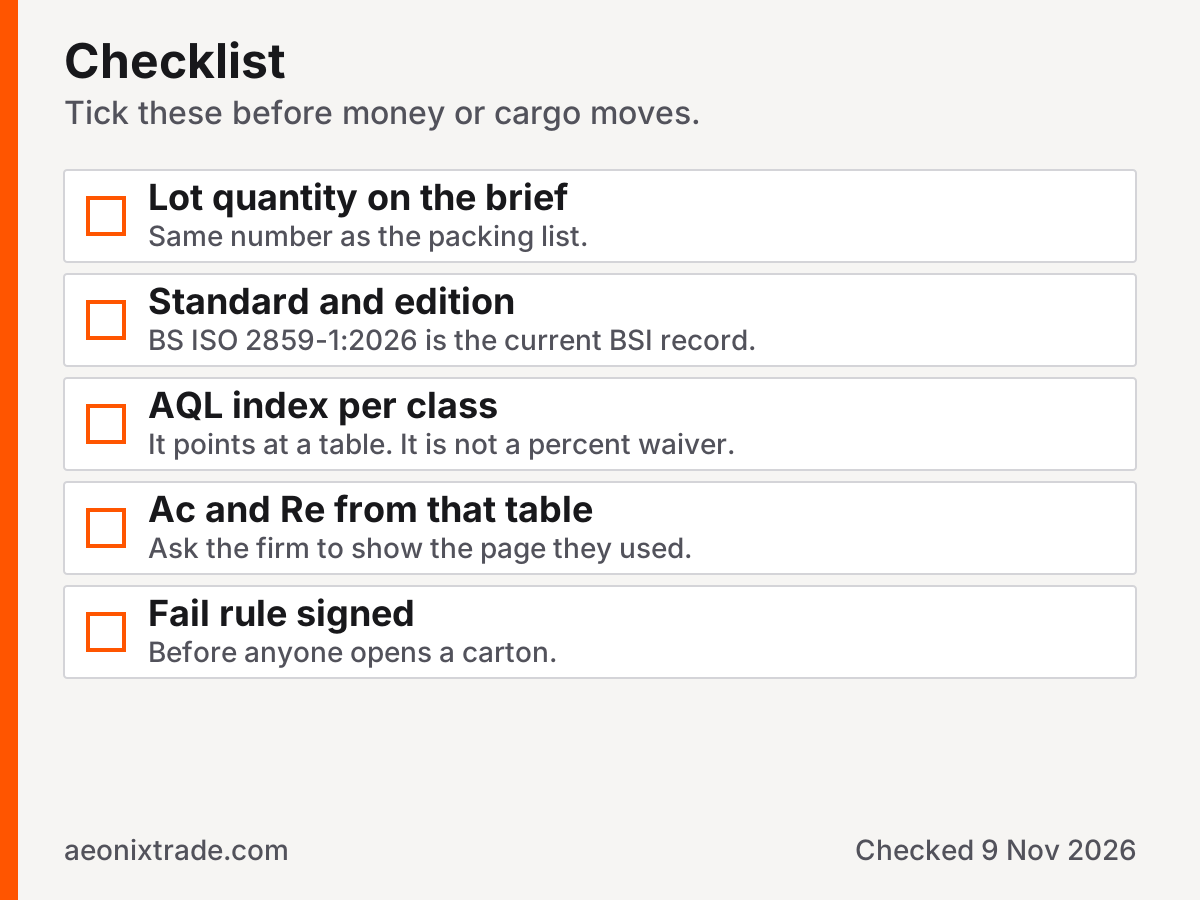
Ask each firm the same six things. Prices stay on their quote, not in this article.
- Will they refuse the job if you cannot provide a defect list and an approved sample?
- Which edition of ISO 2859-1 will they open, and will the report cite the page?
- Who pulls the cartons, and do they have the right to open cartons the factory did not offer?
- How fast do photos arrive, and who speaks to the factory on site?
- What does a fail mean in their process: they leave, they stay for a sort, they rebook?
- Are they also selling you the goods, the freight, or the next order? If yes, they are not outside the shipment.
A factory audit answers a different question: whether this workshop should receive the first deposit. That visit is the factory audit checklist. Do not skip it and hope the pre-shipment visit will discover that the sewing left the building.
Failures that show up as a clean report
- You book "a final inspection" and send only the purchase order. The inspector photographs totes. You still do not know if the lot passed, because nobody defined a fail.
- The sample comes from the stack by the door. The lot is 2,400. The other stacks were never in the sample. NIST's point stands: the decision is about the lot you sampled. Sample the lot.
- A pass is forwarded to the marketplace team as proof the tote is legal to sell. The plan did not test fiber labeling, origin marking, or flammability. Those are different files.
- The trading company rewrites a major as a minor so the sheet says pass. Your brief should say they cannot.
Send the defect photos, the edition, and the fail rule with the RFQ when you want the visit quoted. Quality control is the wider system. Sampling is one block of it.
Questions to settle before Thursday
Is a third-party inspector required by Chinese law?
Not as a general rule this article can cite. It is your contract term. If you do not book it, you are relying on the factory's own sheet.
Can one inspector cover three suppliers in one day?
Only if each lot gets the sample the plan requires. A courtesy walk through three workshops is not three inspections, and it is not a choice between during-production inspection and pre-shipment inspection. Say which address is the lot.
What if the factory refuses entry?
That is a result. Do not pay the balance to keep the schedule. The access rule belongs in the order before the goods are finished, not in a doorway conversation. The spec that visit checks is a quality agreement and the product spec.
Next steps
Official sources
- BSI, BS ISO 2859-1:2026, current, published January 31, 2026. Acceptance sampling by attributes, indexed by AQL.
- NIST/SEMATECH e-Handbook: what acceptance sampling is.
- NIST/SEMATECH e-Handbook: kinds of lot acceptance sampling plans.
Submit sourcing request
Can't find what you need?
Start with a product or image link, an approximate quantity and destination. Other details can follow.