Yiwu Shipping to USA Is a Warehouse Problem Before It Is a Port Problem
Published by Aeonix Trade.
Last fact-checked: November 10, 2026.
A Yiwu shipment to the United States is several booth files that have to become one describable export, and then a U.S. entry. Duty, and any special tariff the entry attracts, stays on the official tariff and on the United States import guide. This page does not copy a rate. The market is in Yiwu, Zhejiang. Cargo from here is not cargo from the Dubai venue that uses the Yiwu name.
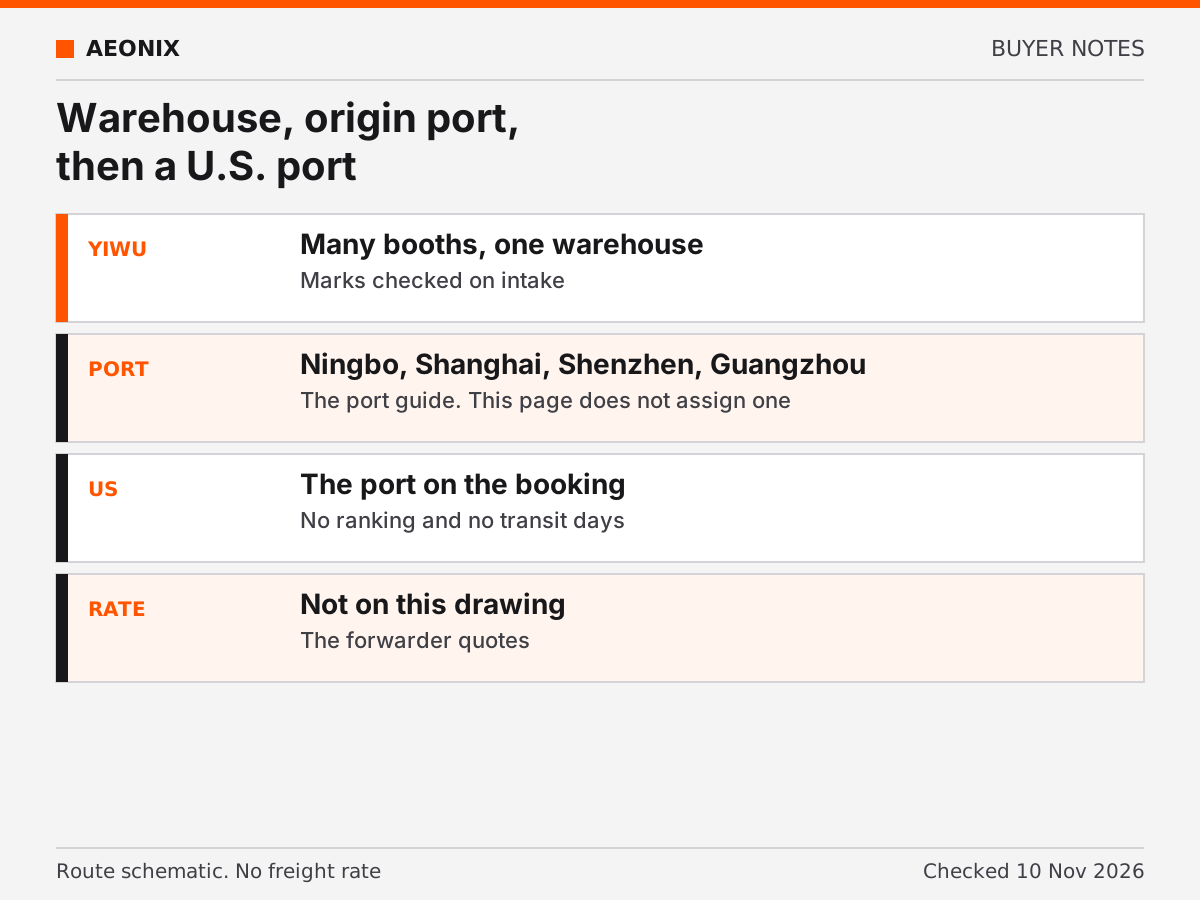
The booths become one booking in consolidating goods from many booths. Which Chinese port is named on the bill is choosing a China origin port. This article does not assign Yiwu cargo to Ningbo, Shanghai, Shenzhen, or Guangzhou, and it does not print a transit time. After arrival, the sequence is what happens when cargo arrives.
One warehouse, then the U.S. file
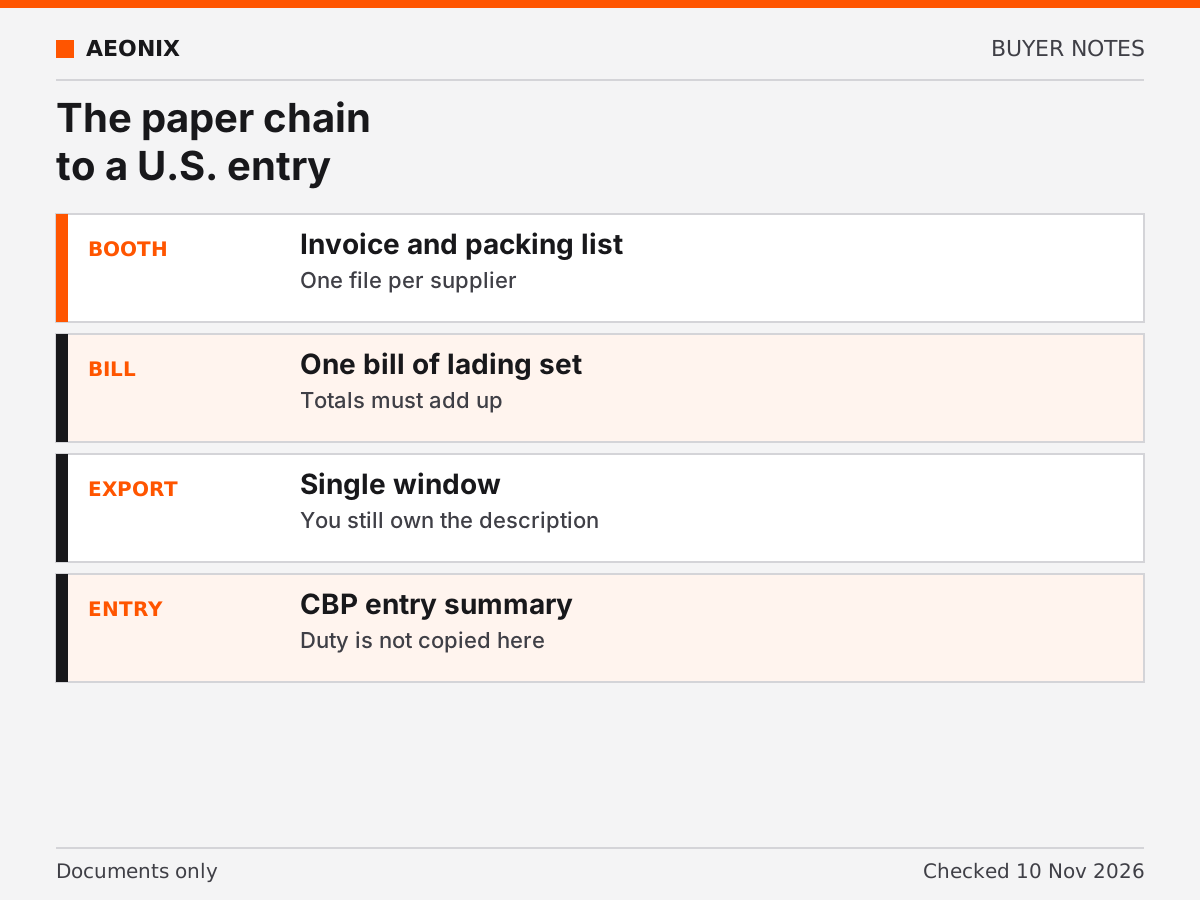
Each booth keeps its own commercial invoice and packing list. The shipment gets one booking and one bill of lading set. Totals have to equal the sum of the booth files. A shared container for a small cube is LCL, explained as a China operation in how LCL from China works. A full box is FCL. The service that receives the mix is consolidation shipping. No ocean rate is printed here.
China's export declaration is filed through the International Trade Single Window. The English home of GACC was open on 10 November 2026 and does not publish a Yiwu-to-U.S. freight tariff. Your broker files the export. You still own the description of the goods.
What the U.S. side reads
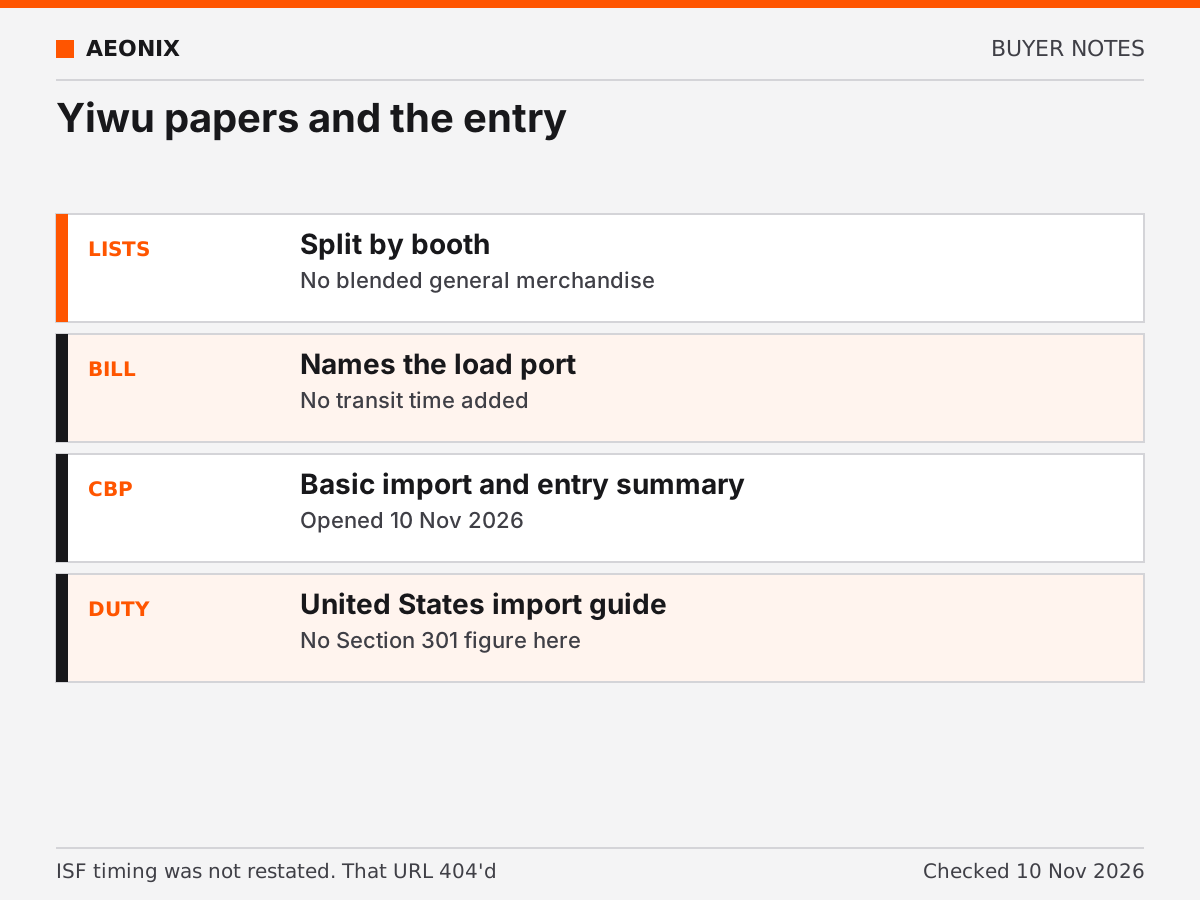
| Record | Where it comes from | What this page will not add |
|---|---|---|
| Booth invoices and packing lists | Each Yiwu supplier | A blended description that hides a booth |
| Bill of lading | The carrier, after the booking | A transit time |
| U.S. entry | CBP basic import and export and CBP entry summary | A duty rate or a merchandise-processing figure |
| Classification | An HS code per product, then the U.S. line your broker files | One code because the goods shared a truck |
The import guide is where entry, the security filing, and the duty line are discussed. An Importer Security Filing URL tried for this article returned HTTP 404, so the timing is not restated here. Read the guide and the CBP page that loads on the day you ship. A first-time checklist that sits beside the country guide is the first-time import compliance checklist.
A general import is not a marketplace prep
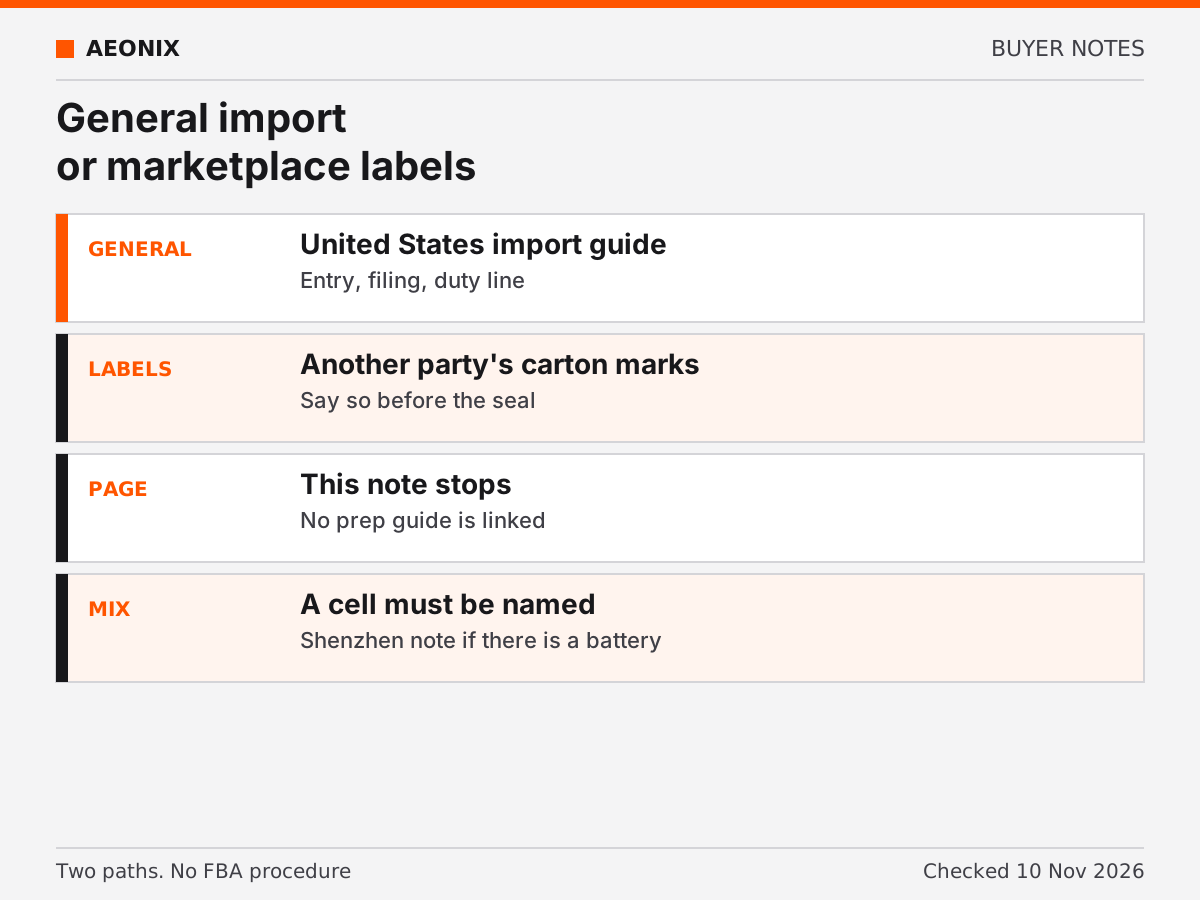
Carton labels for a marketplace warehouse are a different job from a general import. This page does not teach those labels, and it does not link a prep guide that is not on this site. If the cartons need another party's label, say so before the warehouse seals them. The customs path is still the United States guide.
Goods bought on the floors that feed this kind of mix include bags, home goods, and hardware. The same warehouse serving the UK or the EU is Yiwu to the UK and Europe. India is Yiwu to India. How the booths were bought is how to buy from Yiwu Market.
A typical case
A buyer leaves District 2 with bags and a small tool lot, and District 5 with cushions. None of the lots fills a container. The warehouse receives three mark sets. The forwarder books one LCL consol and names the Chinese load port on the bill. The U.S. broker gets three packing lists and one bill of lading. Nobody rewrites the three descriptions as "general merchandise" to shorten the form. Duty is whatever the entry assessment says, read from CBP and the import guide, not from the booth. The case is typical. It has no freight rate and no transit-day claim.
What usually goes wrong
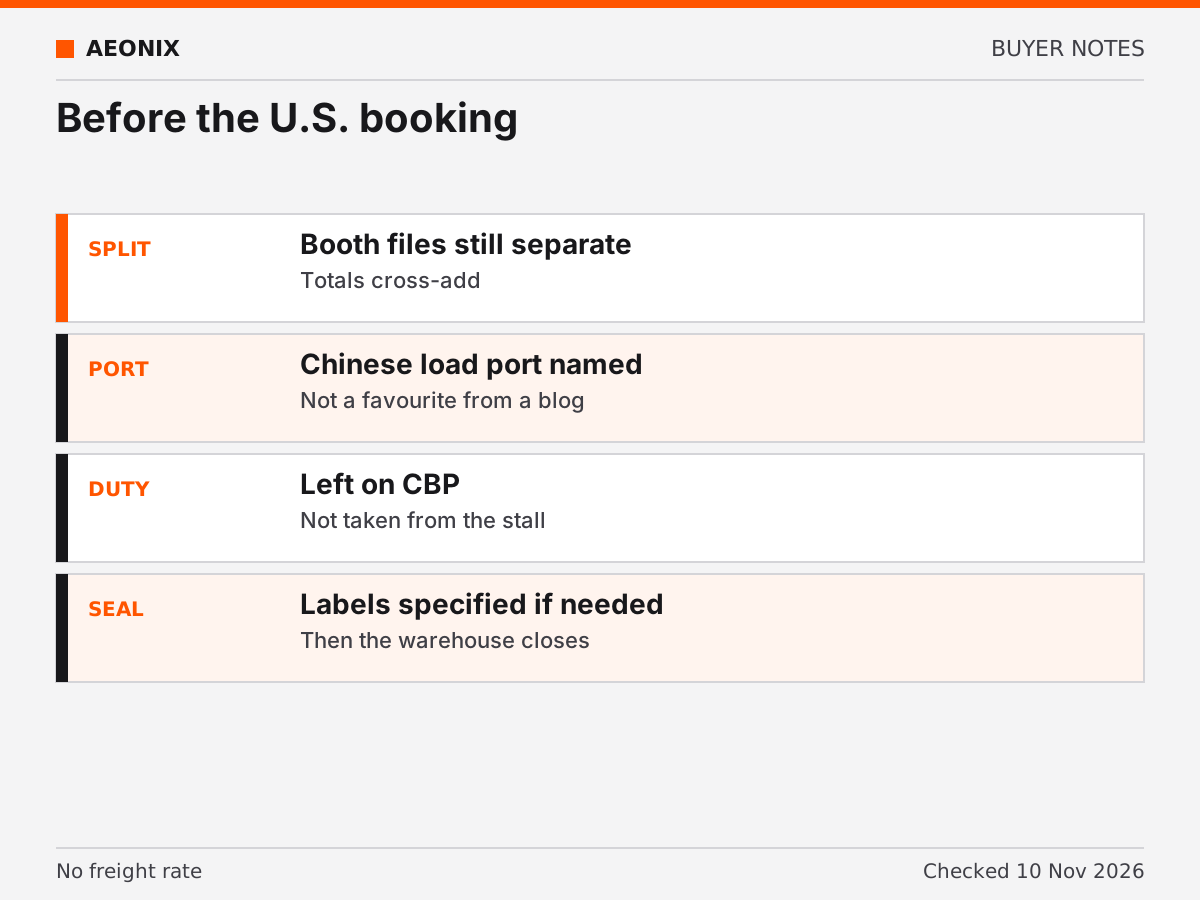
- Merging booth descriptions so the entry cannot see what was bought.
- Asking this page, or the stall, for a duty or a Section 301 figure.
- Picking an origin port because a blog named a favourite, without reading the port guide.
- Sealing marketplace labels into a general-import consol you have not specified.
Frequently asked questions
Which U.S. port should the bill name?
The one your forwarder and your broker can actually clear, written on the booking. This page does not rank ports and does not print a rate to any of them. CBP's basic import page is the government starting point opened on 10 November 2026.
Who files in China?
The broker files through the single window. You still have to be able to describe the goods. A Yiwu trading company is the exporter only if that is what the documents say.
Can the same consol include a battery lamp?
Only if the description says so and the battery rules are handled in the Shenzhen electronics note. Do not hide the cell inside a decor line.
Send the booth list, the named load port if you have one, and the U.S. importer's role on the RFQ form. The buying walk is the Yiwu market guide and the Yiwu sourcing desk.
Other ways the same cartons leave Yiwu are Yiwu to Nigeria, Yiwu to Australia, Yiwu to Bangladesh, and Yiwu to Brazil.
Sources
- U.S. CBP: basic import and export. Opened 10 November 2026.
- U.S. CBP: entry summary and post-release processes. Opened 10 November 2026.
- U.S. CBP home. Opened 10 November 2026. No duty figure copied from it.
- GACC English home and China International Trade Single Window. Opened 10 November 2026. No Yiwu-to-U.S. freight tariff on the customs home.
Submit sourcing request
Can't find what you need?
Start with a product or image link, an approximate quantity and destination. Other details can follow.