Choosing a China Origin Port: Ningbo, Shanghai, Shenzhen or Guangzhou
Published by Aeonix Trade.
Last fact-checked: November 9, 2026.
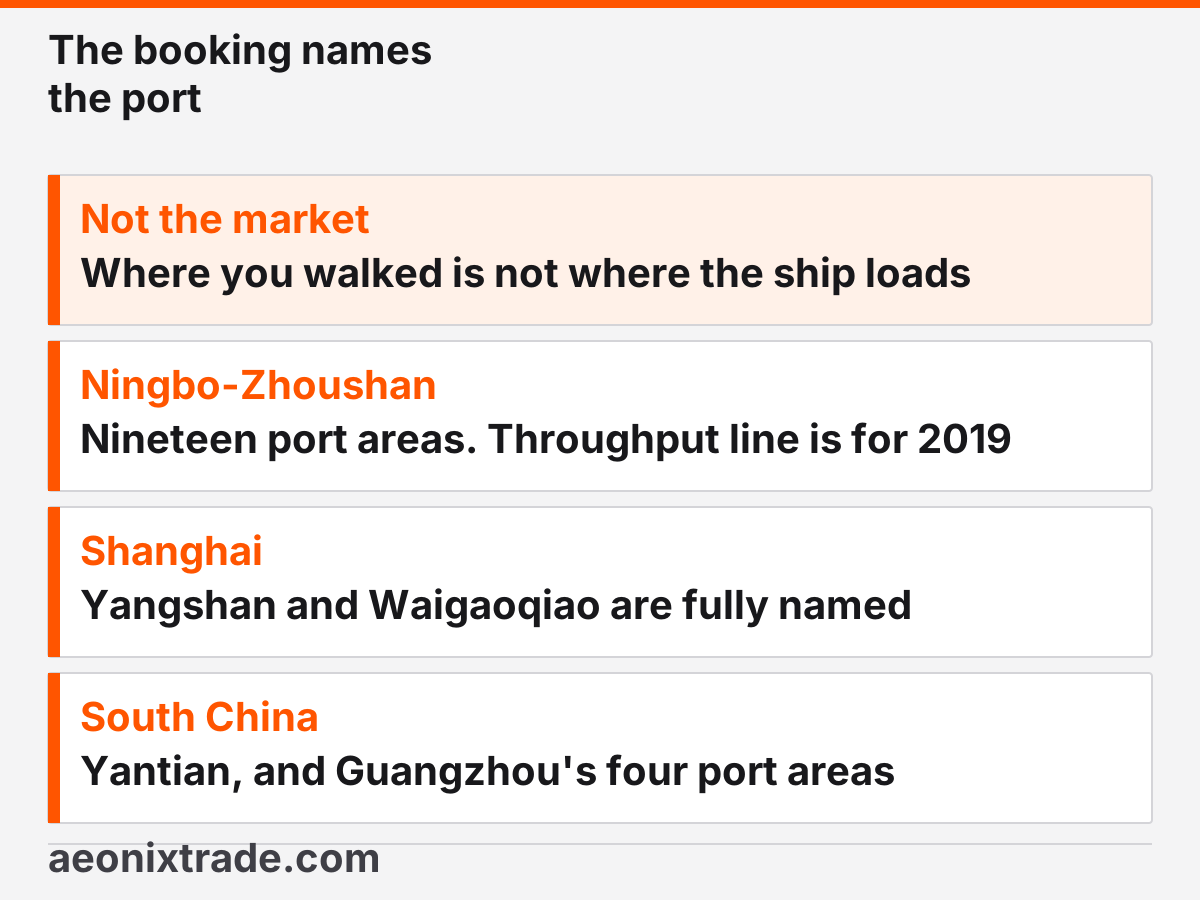
China shipping ports are a line on the booking, not the city where you walked the market. Ningbo versus Shanghai, or Shenzhen versus Guangzhou, is the question of which terminal the truck can reach before the cut-off. A throughput ranking from 2019 is not that question. The English "about" pages below still carry 2019 volume sentences. Those sentences are old. They are not repeated here as a reason to choose a port in 2026.
A typical case
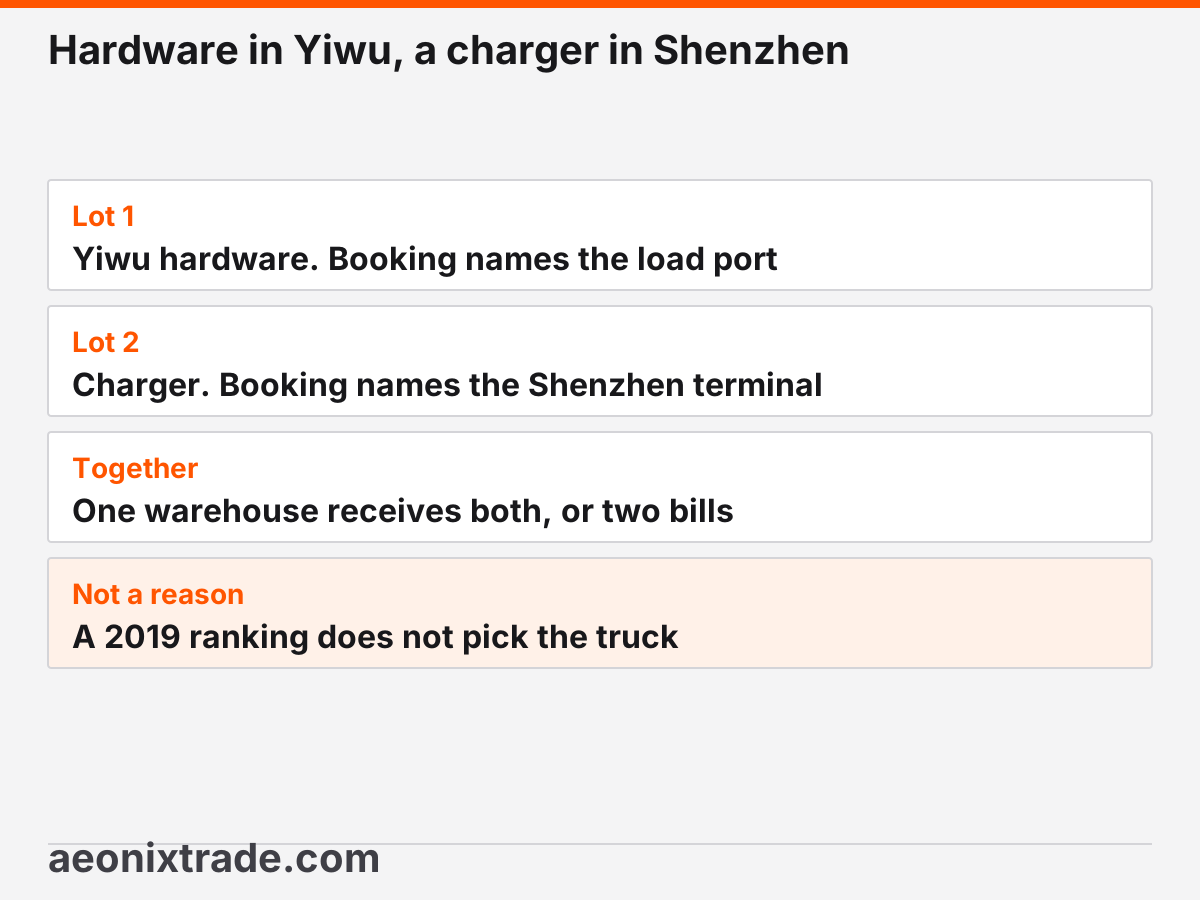
One purchase is hardware from a Yiwu booth. Another is a charger from Shenzhen. The buyer asks for "one FOB China shipment." The forwarder can only make that true if one warehouse receives both lots before one cut-off. Otherwise there are two bills of lading and two terminals. Yiwu being in Zhejiang does not, by itself, print "Ningbo" on the bill. The consolidation address does. How the clocks around that cut-off work is on shipping time from China. Sea versus air, if the charger has a cell, is on sea freight versus air freight.
What the operator pages actually support
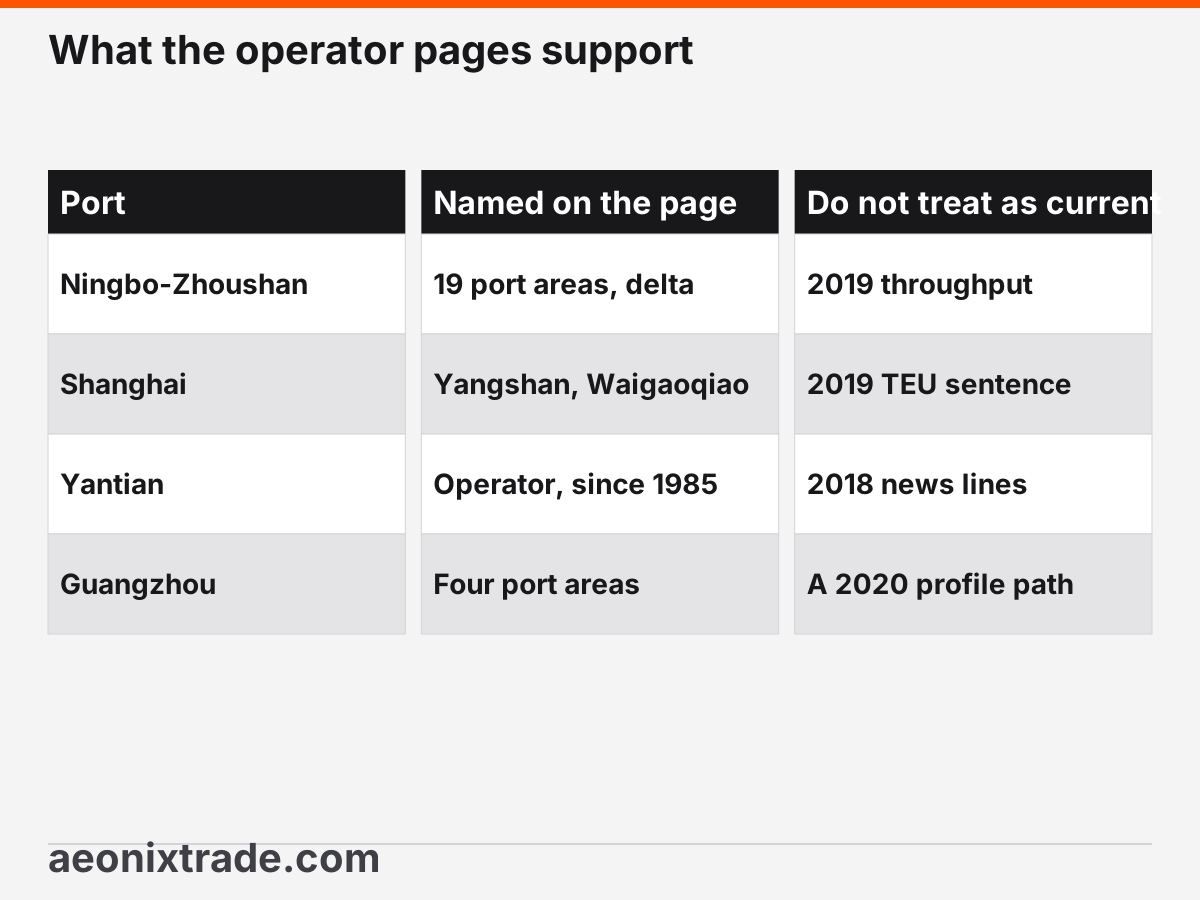
| Port | What the English page supports | What not to use |
|---|---|---|
| Ningbo-Zhoushan | Zhejiang Seaport's English profile describes Ningbo-Zhoushan Port as 19 port areas on a long coastline, with the Yangtze River Delta as the hinterland, and an address at Ningbo Global Shipping Plaza, 269 Ningdong Road, Yinzhou, Ningbo | The same page's throughput sentences are for 2019. Do not pick the port because of a 2019 ranking |
| Shanghai | SIPG's English site says Shanghai's container terminals are distributed in port areas and fully names Yangshan and Waigaoqiao. The sentence on that page cuts off the third name, so the third name is not guessed here. The about page describes SIPG as the operator of public terminals, restructured from the Shanghai Port Authority in January 2003 | The about page's container-throughput sentence is for 2019. It is not a 2026 league table |
| Yantian | Yantian Port Group's English home page says the group was founded in 1985, is under the Shenzhen government, and is in Yantian District. The visible address line is the Haigang building in Yantian | The news lines on that English home page are dated 5 November 2018. The page does not list other Shenzhen terminals. Do not invent Shekou or Chiwan from memory. If the booking says a different terminal, believe the booking |
| Guangzhou | Guangzhou Port's English profile, on a path dated 29 April 2020, names the Downtown, Huangpu, Xinsha, and Nansha port areas from the Pearl River out to the sea. It also records the 26 February 2004 split between the port authority and Guangzhou Port Group | Nansha is a port area on that page. It is not a wholesale hall. Clothing markets in the city are a different visit, covered as a gap on Yiwu, Guangzhou, and Shenzhen |
How to choose without a ranking
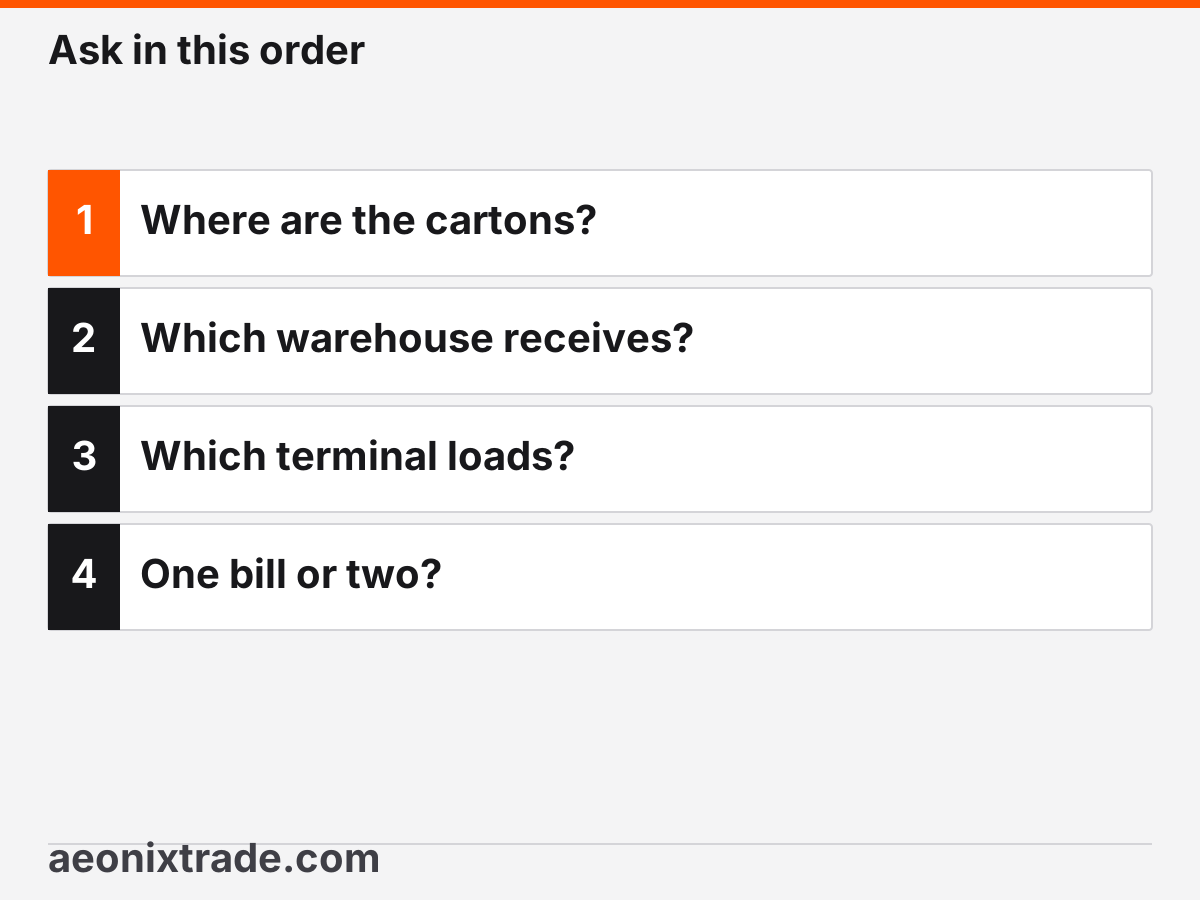
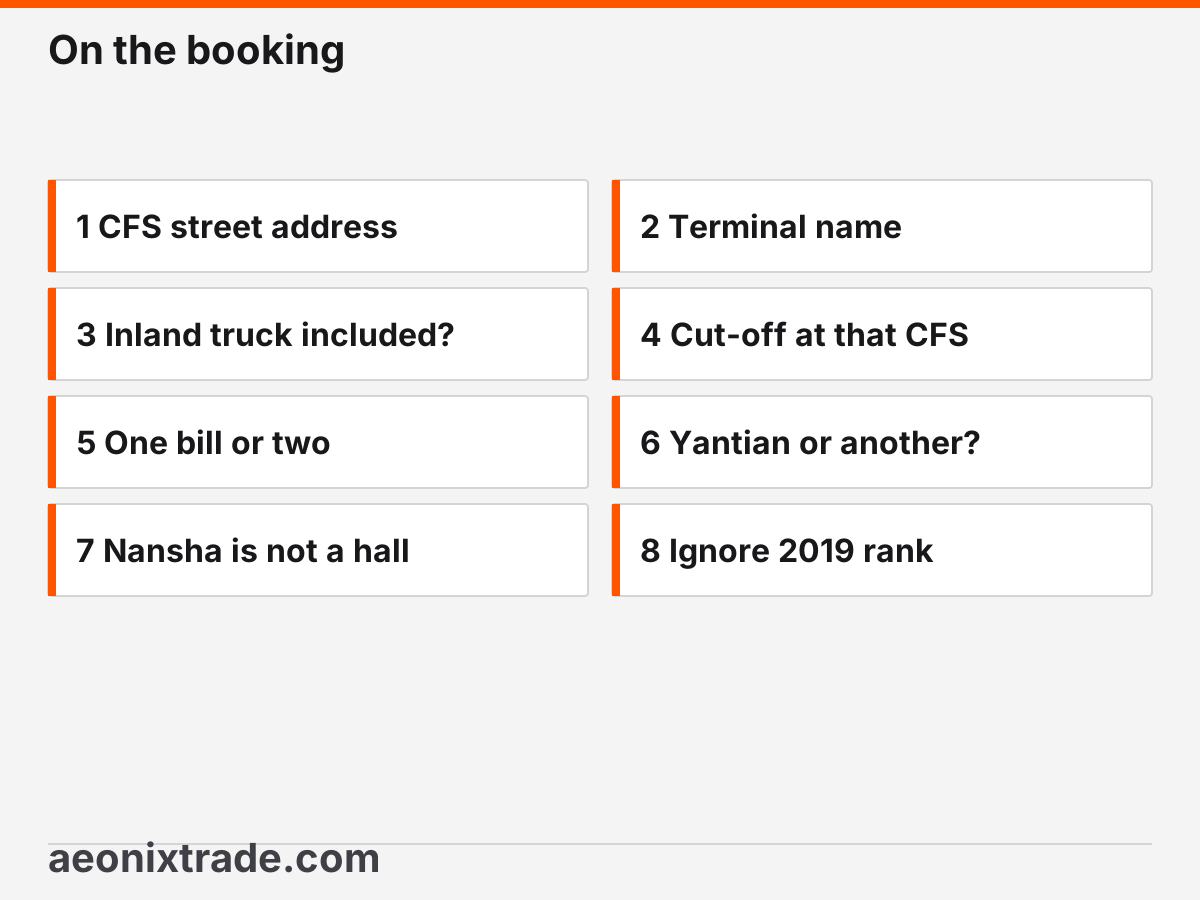
Ask where the cartons are tonight, which warehouse will receive them, and which terminal that warehouse trucks to. The answer is a street address and a terminal name. Compare two quotes only when both name the same receiving address or both show the inland truck as a separate line. A quote that says "FOB China" and hides the truck from Yiwu to the terminal is not comparable to a quote that starts at the terminal gate.
Full container or shared container is independent of the city. Those modes are on FCL and how LCL works. The service for putting several suppliers into one box is consolidation shipping, and the LCL offer is LCL from China. If the goods were bought in Yiwu, the person who knows which warehouse is holding the booth receipts is whoever you hired for that market. The service page is Yiwu agent.
The truck is its own line
Yiwu sits inland in Zhejiang. Ningbo-Zhoushan and Shanghai are both coastal gateways the operator pages describe for that delta. Which one your cartons use is the warehouse's habit and the cut-off, not a rule this page can print. Ask the forwarder for the receiving street address, the terminal name, the receiving cut-off, and whether the truck from that address is inside the quote. If you have a second pickup, ask whether it is the same bill of lading. Write the answers into the comparison before you talk about "the China port."
A charger with a cell may not be allowed to share a box with ordinary hardware. That is a stowage rule from the carrier, on top of the port choice. Split the question: first, can these goods travel together; second, which terminal is on the booking. The battery half of that question is on the sea-versus-air page. The market half, if you are still deciding where to buy, is the Yiwu and Shenzhen comparison linked above.
Where this goes wrong
- Choosing Shanghai because a 2019 throughput sentence called it first. The cargo does not care about a seven-year ranking. It cares whether it can make the cut-off at the terminal on the booking.
- Assuming the market city is the load port. Yiwu cargo can leave Ningbo or Shanghai. Shenzhen cargo can leave Yantian or another terminal the booking names. Guangzhou's wholesale streets, if that is where you bought, are not Nansha until the truck says so.
- Merging two origins on a spreadsheet and calling it one shipment. Two warehouses, two cut-offs, and often two bills. Say so before you promise one arrival to your customer.
- Using a thin English port homepage as a live vessel schedule. Yantian's English page, as opened, is an identity page with old news lines. Schedules come from the carrier.
Put both supplier addresses, or both warehouse addresses, on the RFQ form if you want one sailing. Rate context, still without a number from this article, is on shipping rates.
A port group's homepage is not the customs rule and it is not the safety rule. Export declarations for market-cluster goods are described in the Ministry of Commerce copy of Customs Announcement 2019 No. 221. Packed-container safety, including verified gross mass, is the IMO safety section. Ocean intermediaries on a US lane are in the Federal Maritime Commission's remit.
Official sources
- Ministry of Commerce: Customs Announcement 2019 No. 221. Market-procurement export clearance.
- International Maritime Organization: maritime safety.
- US Federal Maritime Commission.
- Zhejiang Seaport: Ningbo-Zhoushan Port, read November 9, 2026. Throughput sentences on that page are for 2019.
- SIPG English home and about SIPG, read November 9, 2026. The throughput sentence is for 2019.
- Yantian Port Group, read November 9, 2026. Visible news lines dated 5 November 2018.
- Guangzhou Port English profile, path dated 29 April 2020, read November 9, 2026.
Submit sourcing request
Can't find what you need?
Start with a product or image link, an approximate quantity and destination. Other details can follow.