Sea Freight vs Air Freight from China: Decision Table by Cargo and Deadline
Published by Aeonix Trade.
Last fact-checked: November 9, 2026.
Sea freight vs air freight from China is a cargo question and a date question. Air freight vs sea freight is the same decision read from the other side. It is not a rate table, and it is not a fixed number of days. Ship from China by air or by sea only after you know whether the goods can fly, which Incoterm both quotes use, and which schedule the carrier will actually put in writing.
A typical case
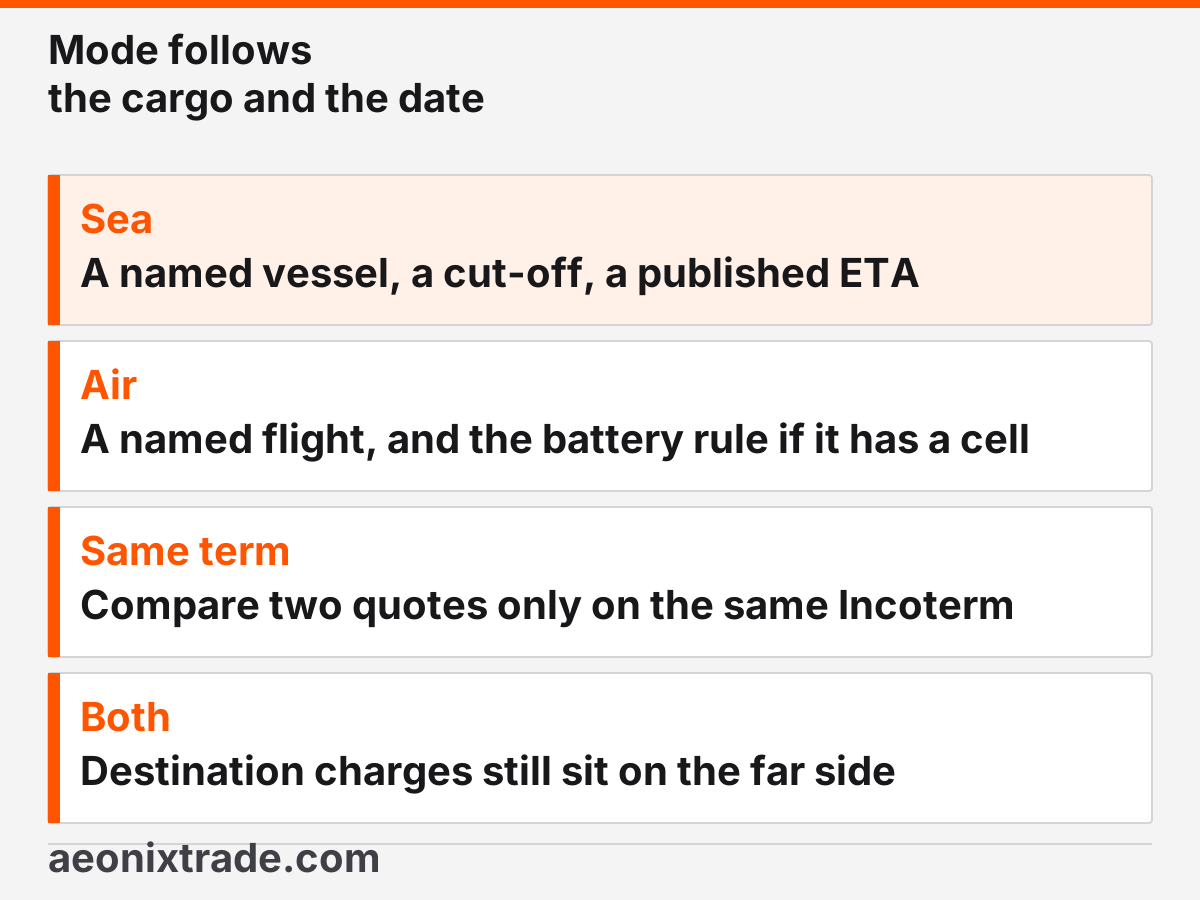
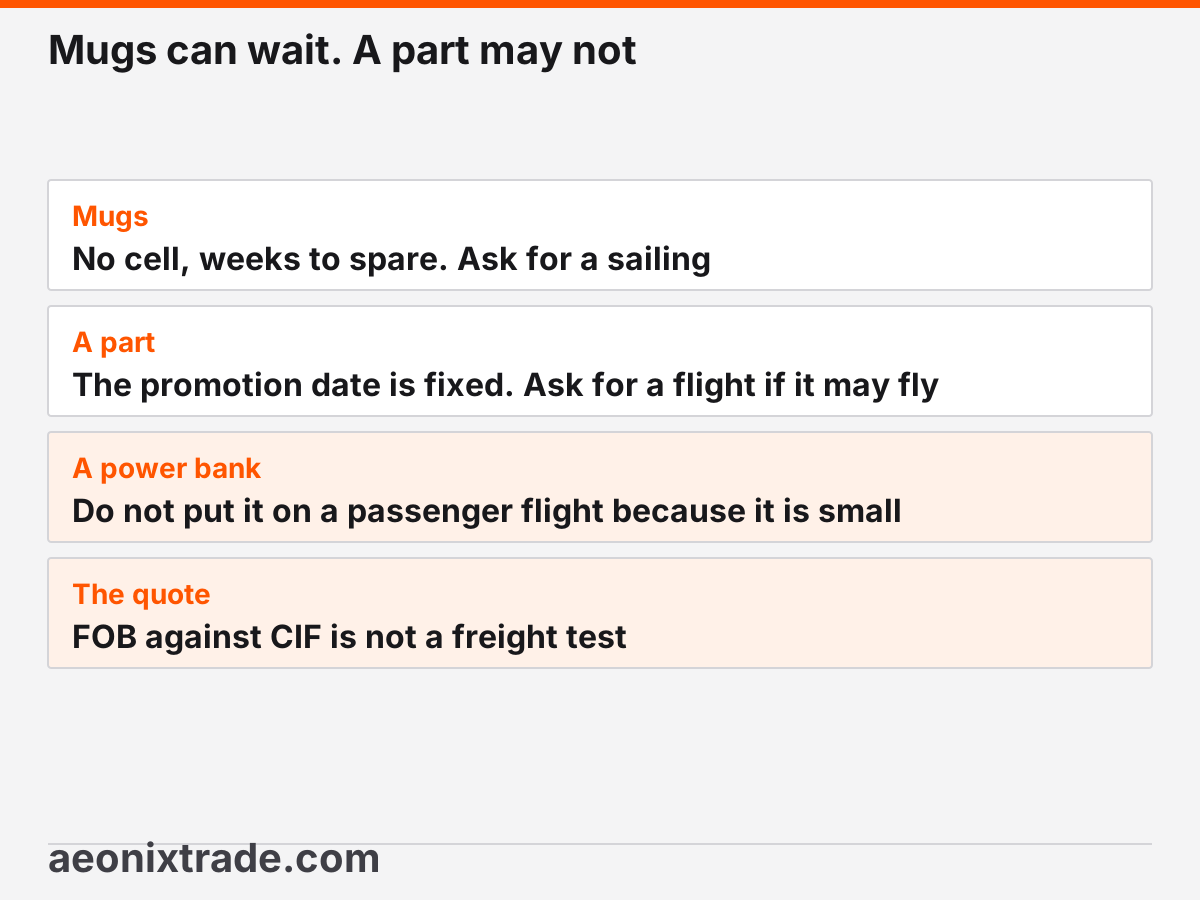
Two shipments sit on the same buyer's desk. One is cartons of ceramic mugs. No battery, FOB, and the shop does not need them for several weeks. The other is a replacement part for a promotion with a date that will not move. A third carton, easy to forget, is a box of power banks a supplier offered to "add to the air shipment."
The mugs are a sailing, if the ready date and the cut-off line up. The part is a flight, if the airline will take it. The power banks are not a passenger-flight add-on. Lithium-ion batteries shipped by themselves are a dangerous-goods question, and IATA's 2026 battery guidance says that packing path is forbidden on a passenger aircraft unless a named special provision is approved. The full battery wording is on the electronics and battery page. Sample-sized versions of the same choice are on shipping samples.
What you are actually booking
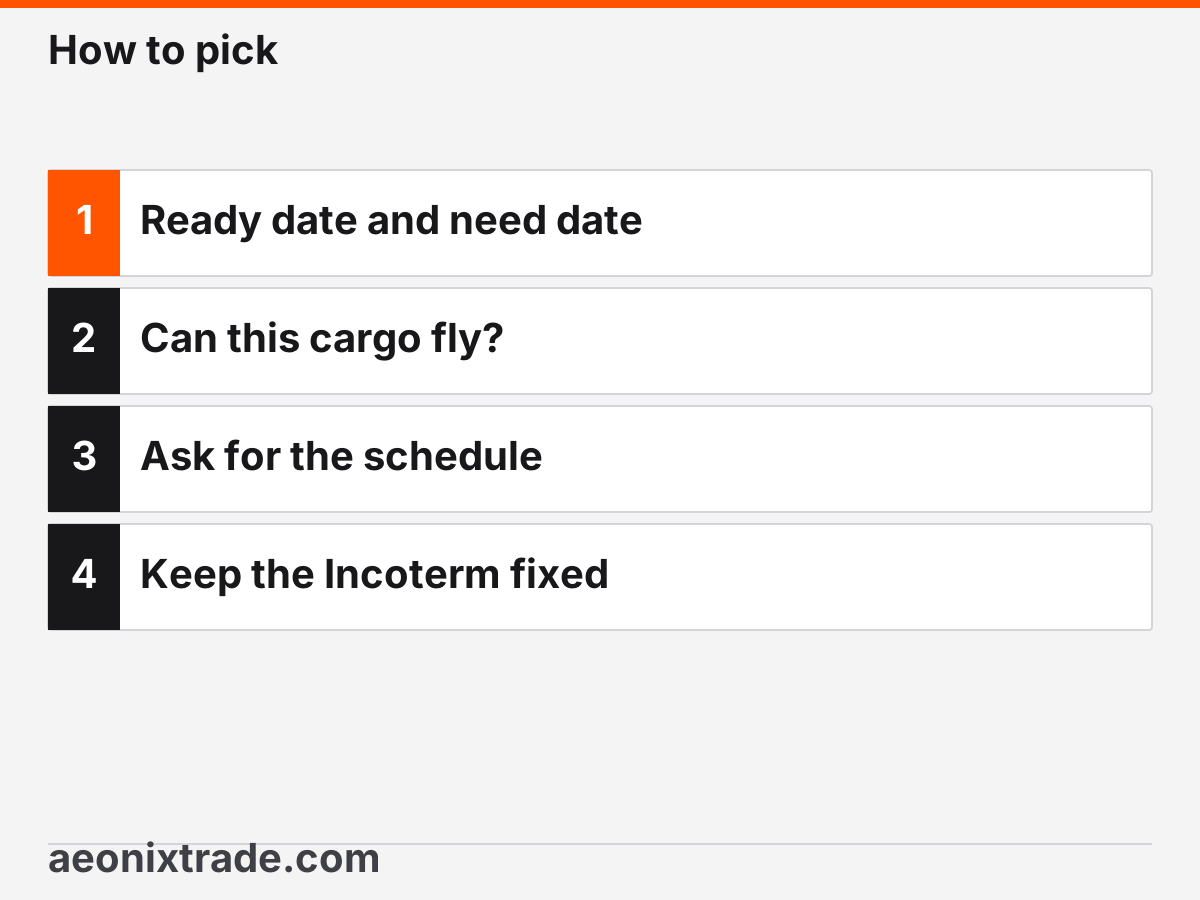
A sea booking is a vessel, a cut-off, and an ETA the carrier publishes for that voyage. For cargo that will enter the United States by vessel, the advance filing clock is in 19 CFR 149.2, discussed on shipping time from China. That rule is about ocean vessels. It is not an air rule.
The Federal Maritime Commission describes itself as the US agency for the international ocean transportation system. It licenses ocean transportation intermediaries in the US foreign trades and expects common-carrier tariff rates and charges to be published where the law requires it. That does not set your freight rate, and it does not mean every forwarder on earth holds an FMC license. It does mean a US-trade ocean quote should name a carrier or an intermediary you can identify, not a number with no party attached. Whether the boxes are a full container or shared space is the LCL and FCL question, on LCL shipping, FCL shipping, and LCL from China.
An air booking is a flight. IATA's cargo program is the industry index for cargo rules. The battery document linked from IATA's lithium batteries page is the text read for cells. For dangerous goods at sea, IMO's maritime safety page says IMO develops the codes for the carriage of dangerous goods. Ask the ocean line which code edition they are applying. Do not invent a packing instruction from a blog.
| Situation | Lean sea | Lean air | Stop and read |
|---|---|---|---|
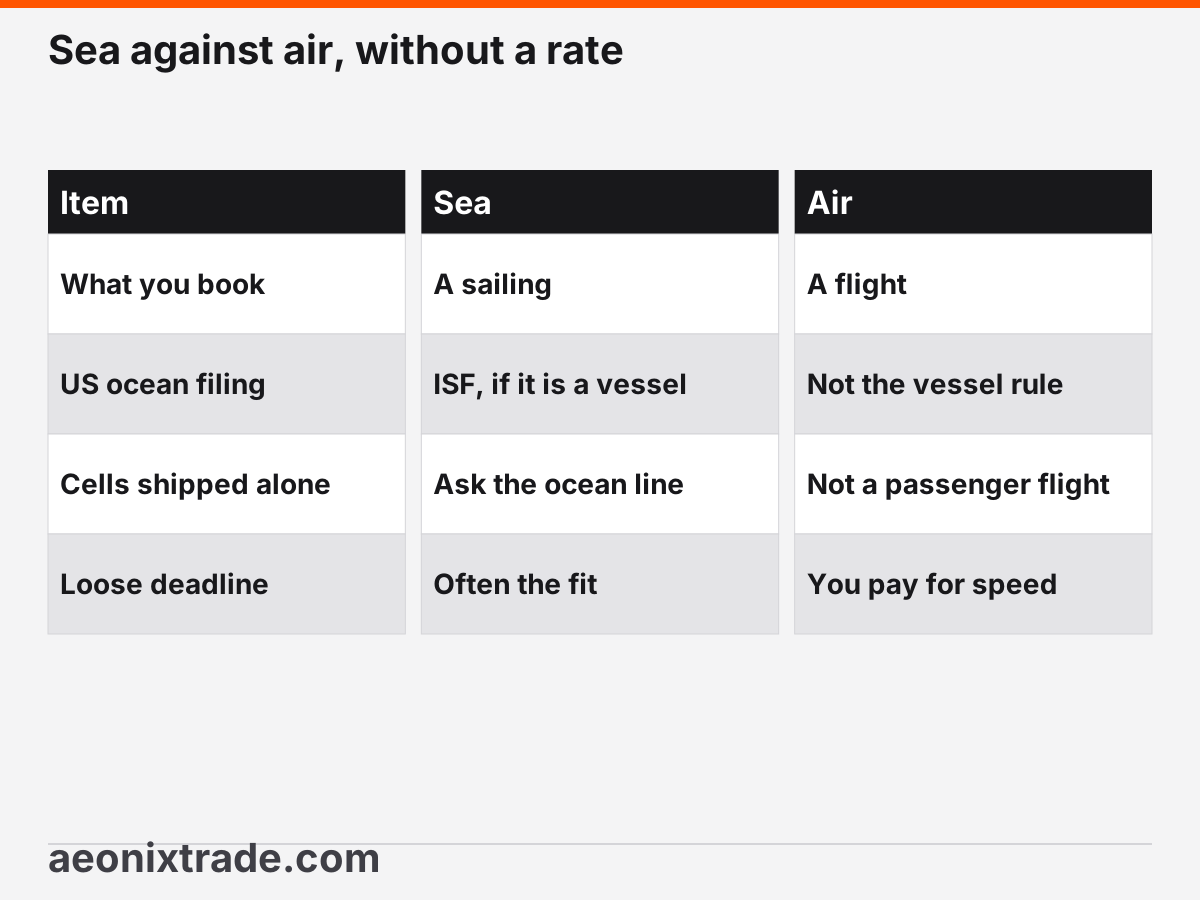
| The need date is weeks after the goods are ready, and there is no cell | Ask for a named sailing | Only if the date collapses | Same Incoterm on both quotes. FOB against CIF is not a mode test |
| The selling date will not move, and the goods are allowed on a flight | Only if a sailing still makes that date | Ask for a named flight and its cut-off | The ETA is the airport, not your dock |
| Lithium-ion batteries shipped by themselves | Ask the ocean carrier before you book | Not a passenger flight, on IATA's 2026 guidance, unless A201 approval exists | State of charge and the test summary |
| You are comparing two prices | List the destination charges as well | List the destination charges as well | A cheap freight line with a silent delivery charge is not the cheaper mode |
Ask both quotes for the same lines
Send one request and make the forwarder answer it twice, once for a vessel and once for a flight, only if the goods are allowed on both. The request names the commodity in plain language, the carton count, the gross weight, and whether any carton contains a lithium battery. It names the Incoterm you actually want, not "best price." It names who will be the importer in the destination country. It asks for the vessel or the flight, the cut-off, and the ETA at a named port or airport. It asks which destination charges are excluded. If one reply leaves those lines blank, you do not have a comparison yet. You have a teaser.
Weight and volume decide the shape of a sea quote more often than they decide an air quote, but this page will not give you a break-even kilogram. That number moves with the sailing and the flight in front of you. CBM is the volume unit the sea quote will use. Ask for it on the sea side, and ask for chargeable weight on the air side, and do not add the two into one fictional total.
Where this goes wrong
- Comparing an FOB sea quote with a CIF air quote and calling the difference "the cost of speed." You changed who buys the freight, not only the mode. Keep one Incoterm.
- Putting a lithium battery on a passenger flight because the carton is small. Size is not the test. The packing instruction is.
- Treating a forum's "30 days by sea, 5 days by air" as your transit. Those numbers are not a schedule. The only transit you can plan is the one on the sailing or the flight you are offered. How to lay the other clocks next to it is the shipping-time article.
- Forgetting that both modes still meet a destination release. Demurrage and detention, when the box sits, are explained on demurrage versus detention. They are not an air problem, and they are not a reason to skip the last free day on a sea shipment.
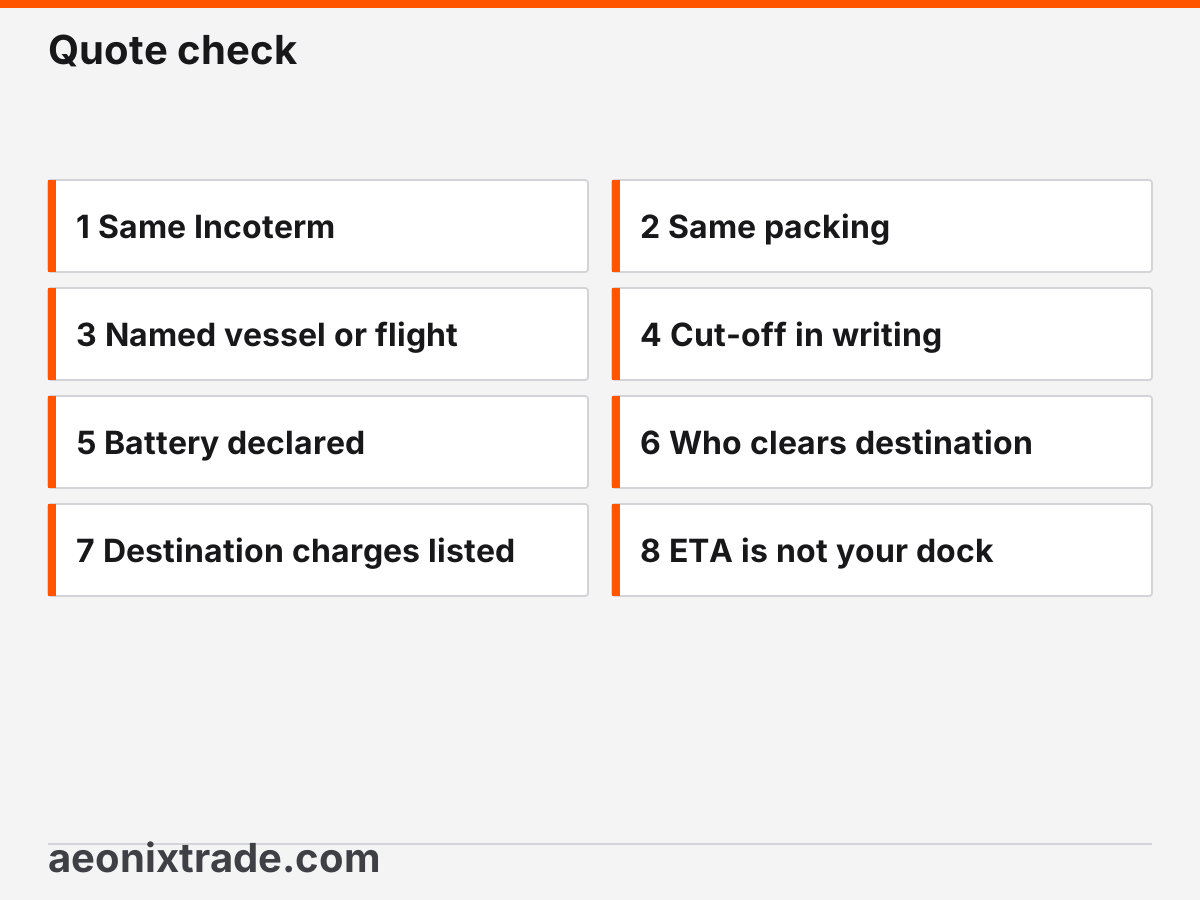
Rate shopping, without a number invented on this page, starts at shipping rates. Tell the forwarder the ready date, the Incoterm, the gross weight, the cartons, and whether any carton contains a cell. The RFQ form is the place to attach that file if the goods are not quoted yet. Which China port the sea shipment actually uses is on choosing the origin port.
Official sources
- Federal Maritime Commission: about the FMC, read November 9, 2026.
- 19 CFR 149.2, Importer Security Filing, eCFR, read November 9, 2026.
- IATA: cargo, read November 9, 2026.
- IATA: lithium batteries, and the 2026 battery guidance PDF, read November 9, 2026.
- IMO: maritime safety, read November 9, 2026.
Submit sourcing request
Can't find what you need?
Start with a product or image link, an approximate quantity and destination. Other details can follow.