Shipping Time from China: How to Plan Transit, Cut-offs and Customs Release
Published by Aeonix Trade.
Last fact-checked: November 9, 2026.
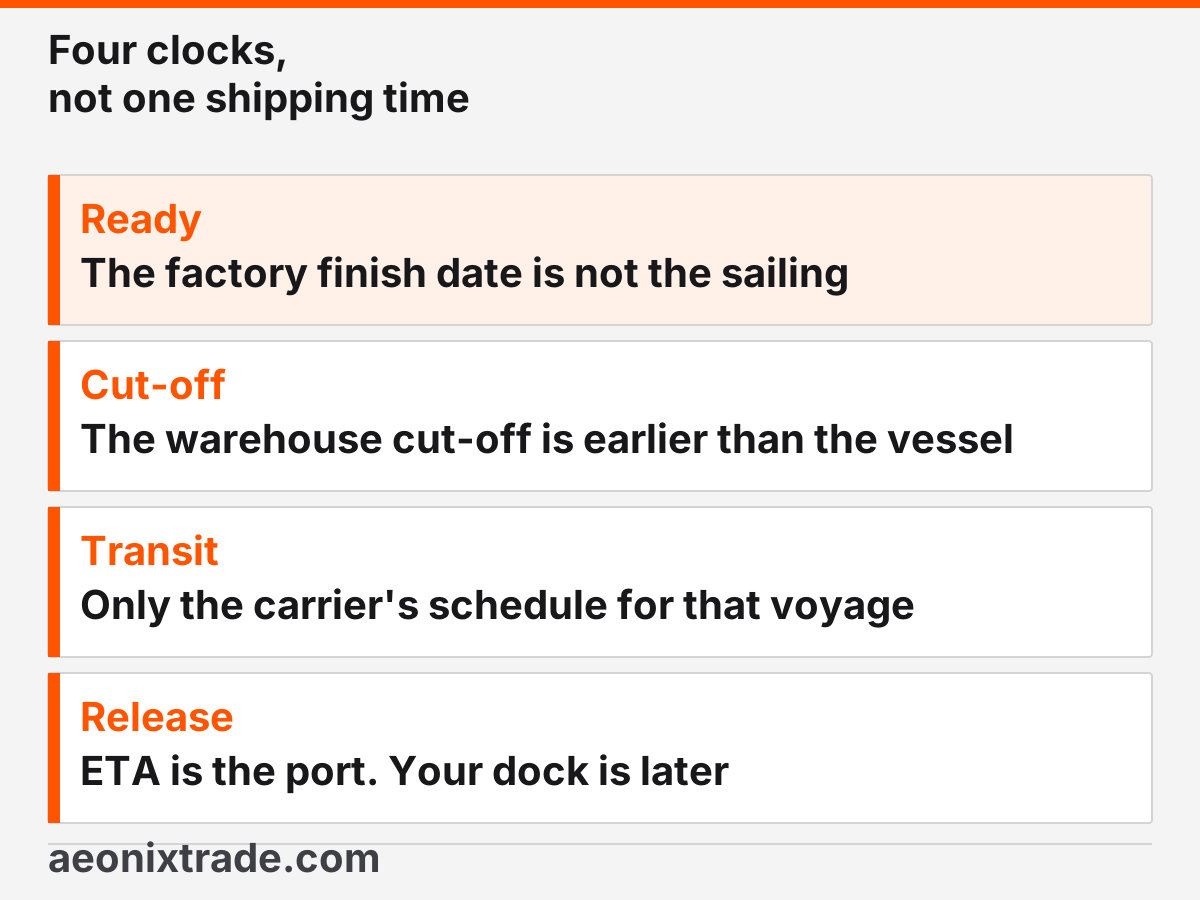
How long does shipping from China take? There is no single answer, and this page will not invent one. China shipping time is four clocks: the day the cargo is actually ready, the origin cut-off, the transit on the carrier's schedule for that sailing or flight, and release after arrival. A blog average that says "transit time China to the US" or "transit time China to the EU" in one number is not a plan. Other destinations publish their own advance-filing clocks. The 24-hour figures below are for cargo arriving in the United States by vessel. They are not a universal rule.
A typical case
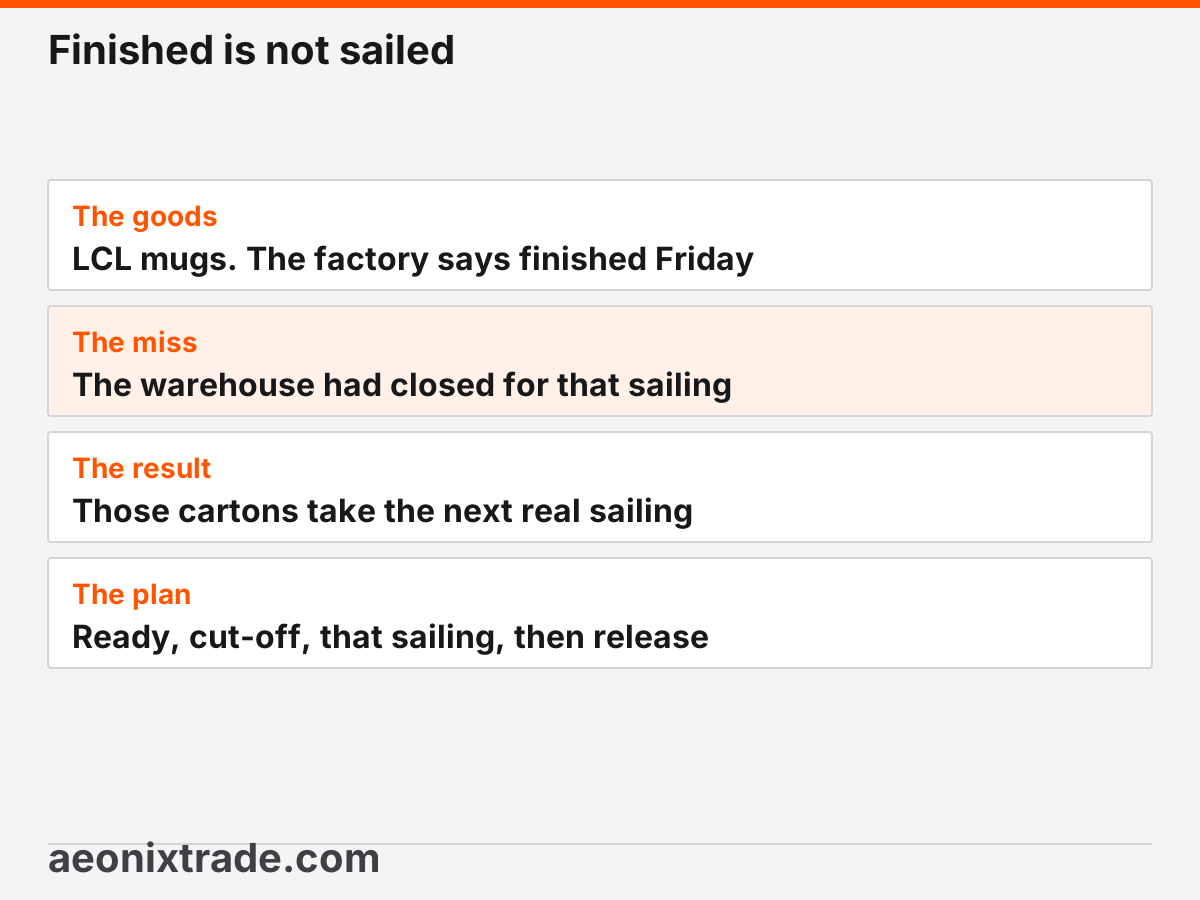
An LCL shipment of mugs is booked out of a China port. On Friday the factory says the cartons are finished. The buyer tells the retailer the goods will arrive "about a month after Friday." The consolidation warehouse had already stopped receiving for the sailing the forwarder had in mind. Those cartons take the next sailing that warehouse can actually make. Friday was a ready date. It was not a departure, and it was not a delivery.
The same mistake happens with air. A flight number with an ETA is the airport clock. The broker, the exam, and the delivery appointment sit after it. Sea or air as the mode choice is on sea freight versus air freight.
Read a schedule as four dates
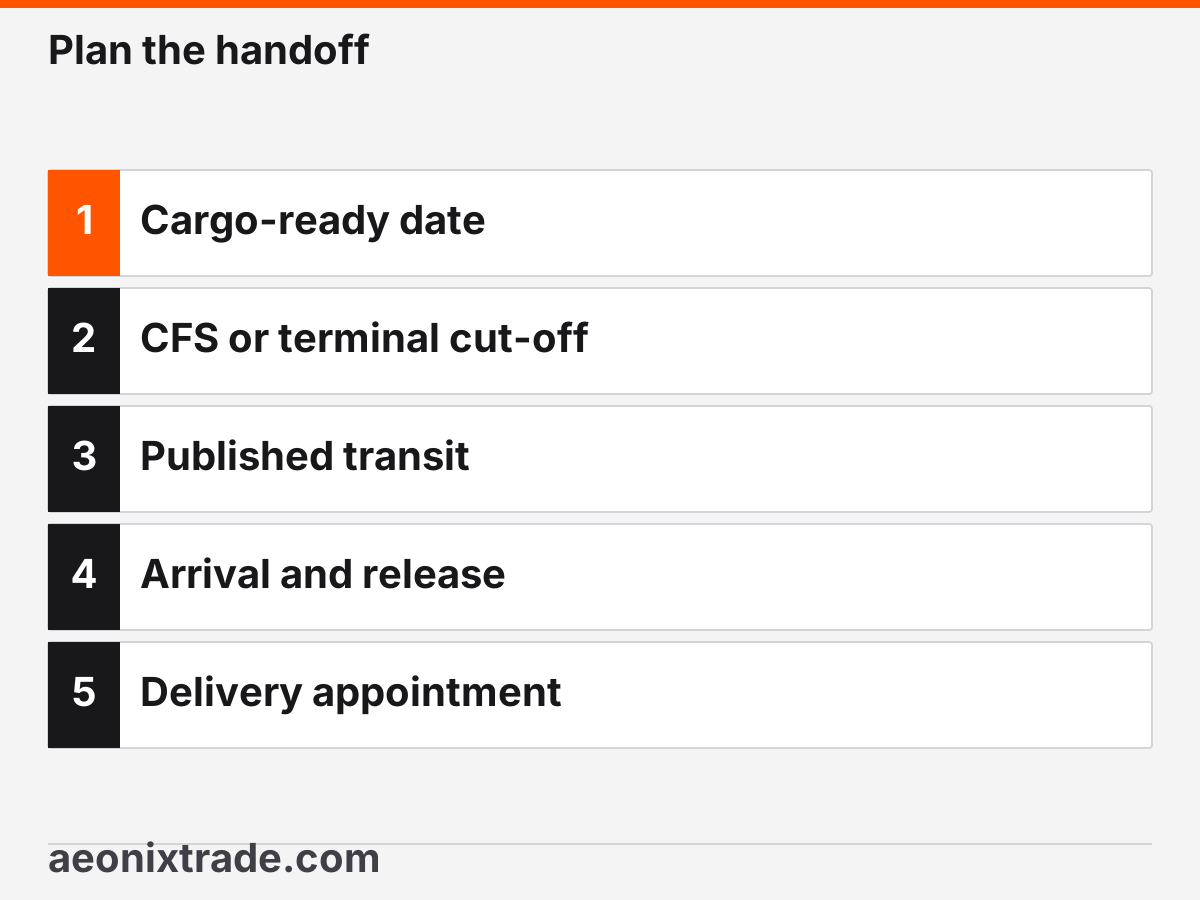
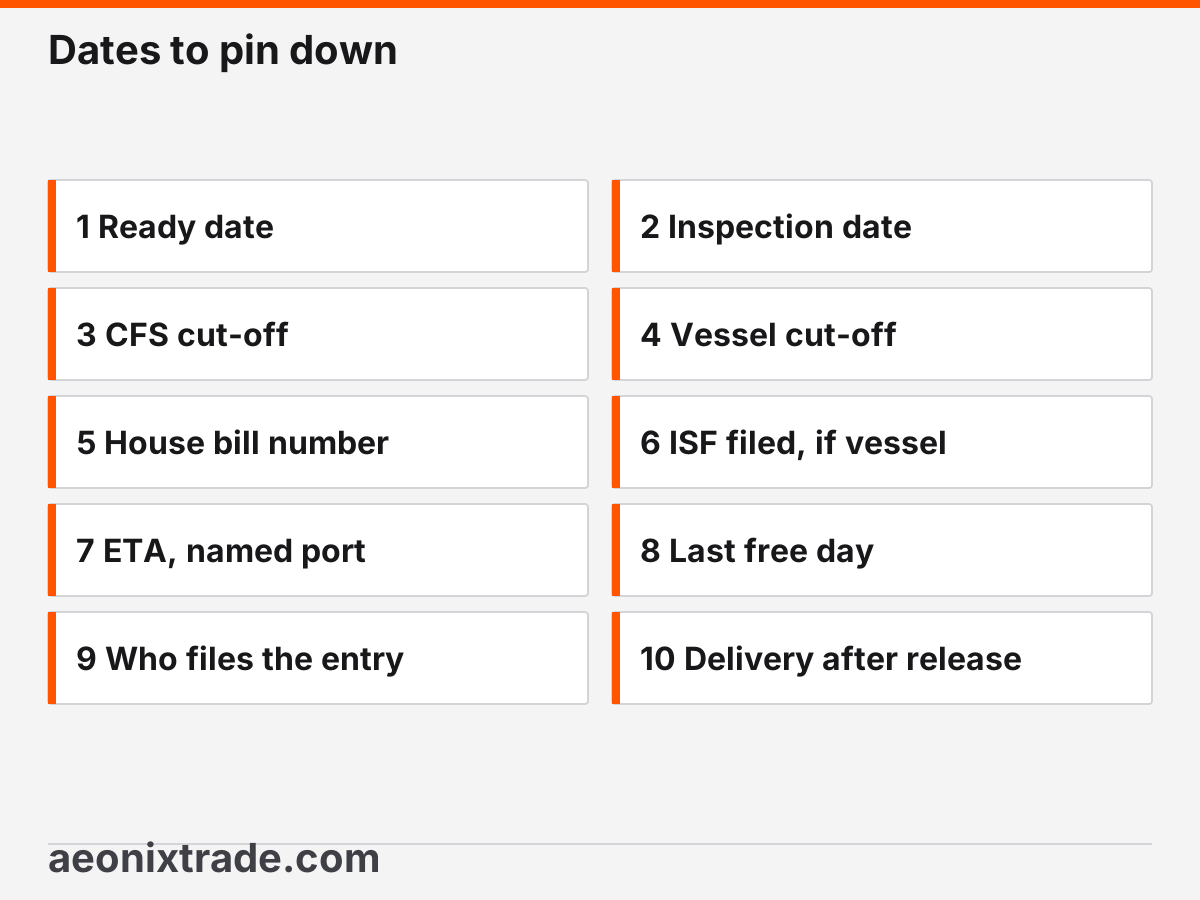
Ask the carrier or the forwarder for the service they are actually selling. You want the cargo-ready assumption, the receiving cut-off at the warehouse or terminal, the vessel or flight, and the ETA. The ETA is the port or the airport named on that offer. Your warehouse is a later appointment. What happens after the box arrives is on what happens when cargo arrives. The difference between terminal demurrage and equipment detention is on demurrage versus detention.
On a consolidated shipment the warehouse cut-off is earlier than the vessel cut-off. Missing the first one is enough to lose the sailing, even if the ship has not left. Ask for both times in writing. Verified gross mass, which the terminal will ask for on a full container, is a separate paper explained on VGM. It is another cut-off, not a transit day.
The US ocean filing clock is a real hour count
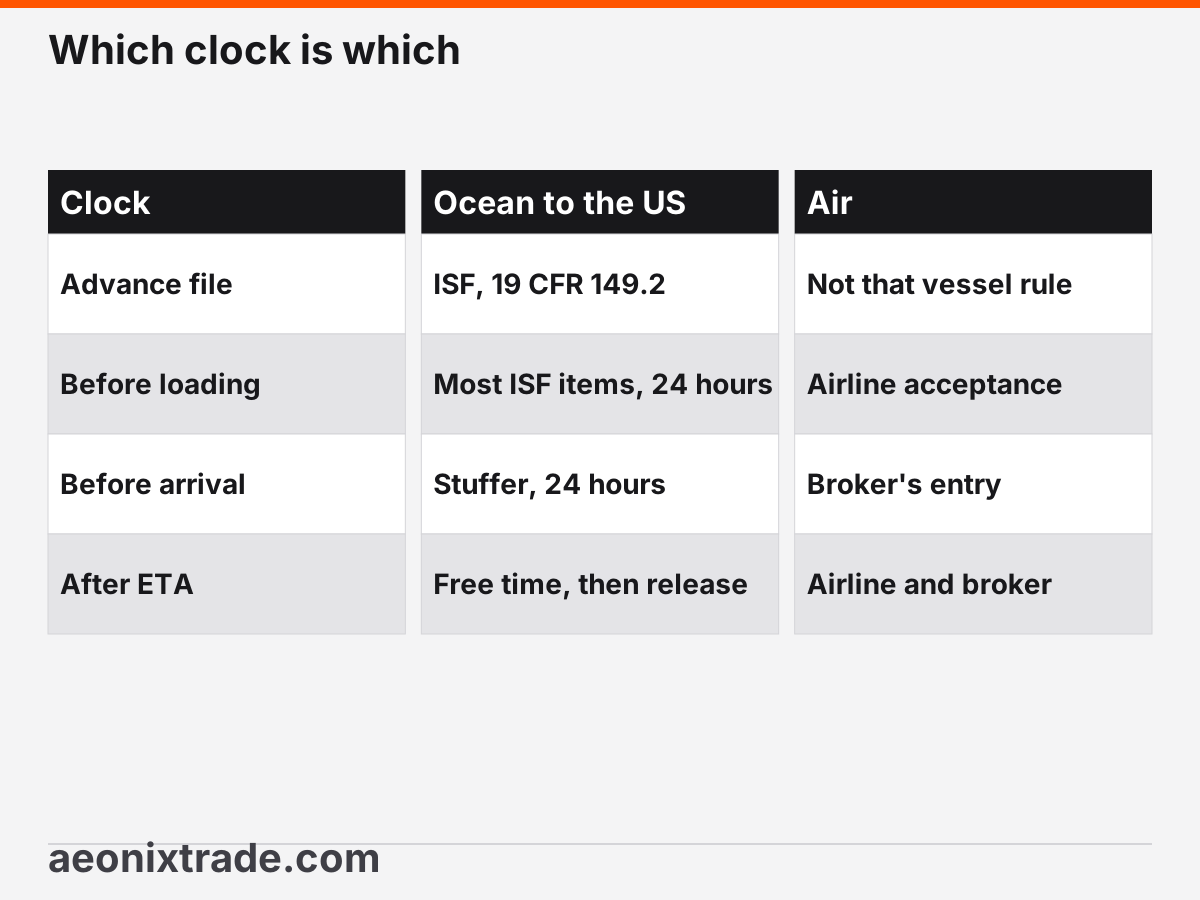
For cargo arriving in the United States by vessel, 19 CFR 149.2 is the Importer Security Filing rule. The eCFR text, read November 9, 2026, says the ISF Importer or an authorized agent must submit the filing through a CBP-approved system. With the break-bulk exception the section points to, the seller, buyer, importer of record number, and consignee number are due no later than 24 hours before the cargo is laden at the foreign port. The manufacturer or supplier, ship-to party, country of origin, and commodity HTSUS number are on that same 24-hour-before-loading clock. The container stuffing location and the consolidator are due as early as possible and no later than 24 hours before arrival at a US port, or on lading if the foreign port is less than a 24-hour voyage from the closest US port.
That rule applies to cargo arriving by vessel. It does not apply to a flight. Bulk and some break-bulk cargo have the exceptions written in that part. Read them before you assume you are exempt. The bill of lading number has to match the filing to the manifest. If you do not have the house bill yet, you do not have a complete filing. The Federal Maritime Commission is the US ocean-transport regulator. It is not the agency that receives the ISF. Customs and Border Protection is the agency named in 149.2. CBP's own ISF brochure page did not return a readable response from this network, so the codified section is the text cited here.
| Clock | What to ask for | What it is not |
|---|---|---|
| Ready | The day cartons pass the check you agreed, not the day someone hopes to finish | A sailing date |
| Origin cut-off | Warehouse receiving cut-off and vessel or flight cut-off, both in writing | The ETA |
| Transit | The published time for this voyage or this flight only | A country-to-country average |
| US vessel filing | ISF elements on the clocks in 19 CFR 149.2 | An air requirement |
| Release | Entry filed, any exam finished, cargo released, then a delivery slot | The ETA printed on the arrival notice |
Where this goes wrong
- Promising a retailer a delivery date that was calculated from the factory's "finished" message. Add the cut-off, the actual sailing, and release before you promise anything.
- Filing the ISF late because the house bill number was still blank. The regulation ties the filing to the cargo and, in practice, the filing has to match the bill. Get the bill number from the forwarder before the 24-hour mark, not after the ship has sailed.
- Using one transit number for the US and for the EU. The US vessel rule above is specific. Other destinations have their own advance filings. Look them up on that customs site. Do not copy the 24-hour figure across.
- Ignoring free time because the ETA looked comfortable. Free time starts from the terminal's clock, which is explained in the arrival article. A fast ocean transit can still become an expensive week if nobody files the entry.
Shared-container timing, including the warehouse step, is on LCL shipping and how LCL from China works. The service page is LCL shipping from China. Which terminal you are even counting is on choosing the origin port. Put the ready date and the need-by date on the RFQ form, and ask shipping rates for a named sailing rather than a slogan.
Official sources
- 19 CFR 149.2, Importer Security Filing, eCFR text read November 9, 2026.
- Federal Maritime Commission, read November 9, 2026.
- IATA cargo program, the air index, read November 9, 2026. No air transit day is taken from it.
Submit sourcing request
Can't find what you need?
Start with a product or image link, an approximate quantity and destination. Other details can follow.