Hong Kong Transshipment from China, Before You Call It a New Origin
Published by Aeonix Trade.
Last fact-checked: November 10, 2026.
The forwarder offers two routings for the same cartons. One leaves a mainland port and goes to your seaport. The other stops in Hong Kong, and the email adds, almost as an aside, that the goods will then be "Hong Kong origin." The stop can be a real transport choice. The aside is the part to refuse until someone shows you the rule that says so. This article is that refusal, plus the official page that actually talks about cargo passing through Hong Kong. It does not describe a way to change origin, and it does not quote a duty rate.
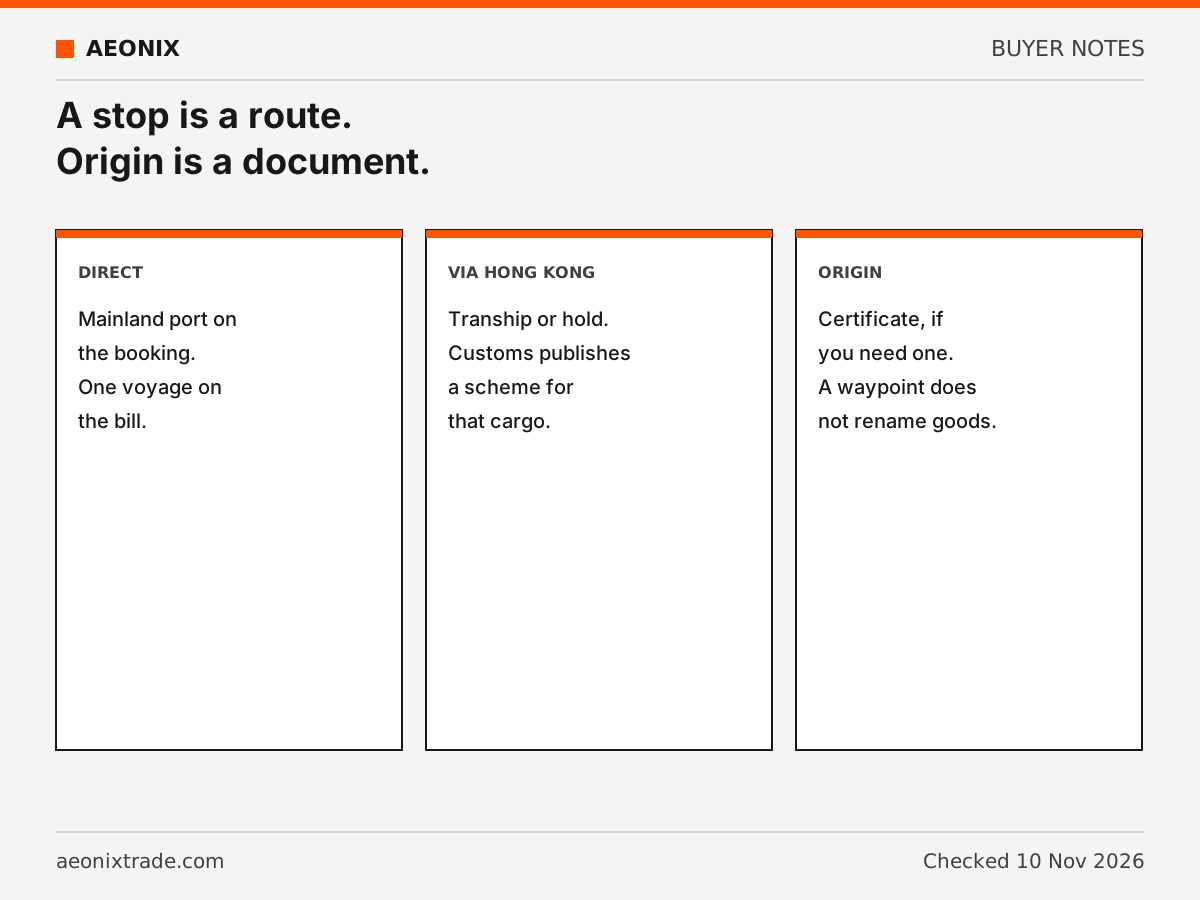
Where the box is loaded in China is choosing a China origin port. What the carrier's document does is the bill of lading. If you need a paper that states origin, that is the certificate of origin, and a preference claim is a different document from a chamber stamp. The wider set of papers sits on Incoterms and shipping documents.
Shipping via Hong Kong from China is a route
Direct export means the booking leaves a mainland port and the bill of lading names that voyage. A Hong Kong step means the cargo is transhipped or held there before it continues. Hong Kong Customs publishes both ideas under trade facilitation, including a scheme with a specific name: the Free Trade Agreement Transhipment Facilitation Scheme. The index is trade facilitation. The scheme's principle page, opened 10 November 2026, says it sets out the requirements of the Chinese mainland and of relevant signatories for transhipment cargo via Hong Kong.
On that principle page, goods going on to the mainland in containers for the whole journey are tied to documents that prove the container number and the seal number stay unchanged. Where that evidence is not available, the page says importers have to provide a Certificate of Non-manipulation issued by Hong Kong Customs. Other destinations on the same page have their own lines. Several of them ask for that certificate when a single through bill of lading cannot be provided. Read the line for the destination you actually use. A line written for one agreement is not a rule for every port you ship to. The page is Principle of Application.
| What someone said | What the pages support | What they do not support |
|---|---|---|
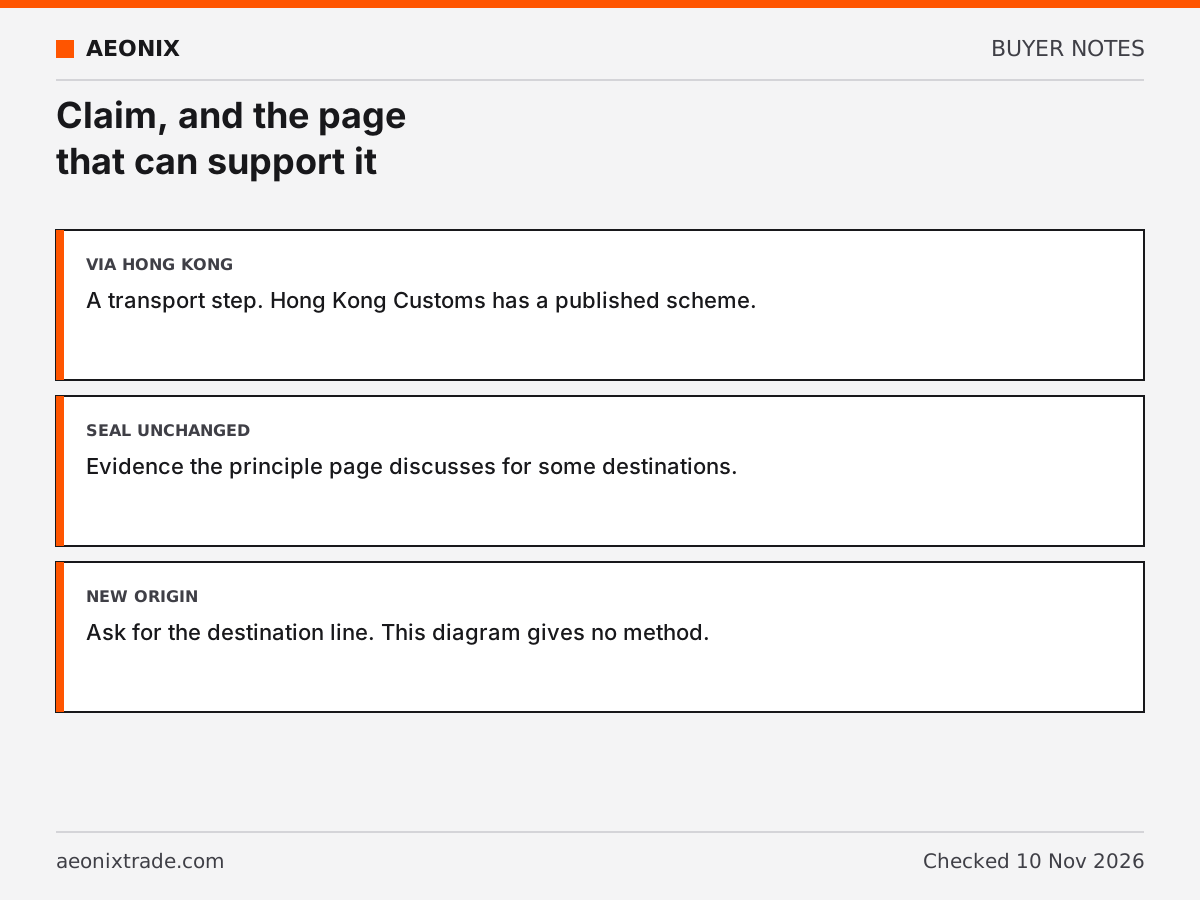
| "Ship via Hong Kong." | A transport step. Hong Kong Customs has published schemes for transhipment cargo. | A new factory, or a new origin, by itself. |
| "The seal stayed intact, here is the through bill." | The kind of evidence the principle page discusses for some destinations. | A duty percent. None is copied here. |
| "We can issue Hong Kong origin." | Ask them to point at the destination line and at the certificate of origin you would actually file. | A method for renaming Chinese goods. This article does not provide one. |
| "Hold the goods in Hong Kong and decide later." | A distribution choice, with storage and free-time clocks you have to read on the tariff. | A storage rate. None is printed here. See demurrage and detention for which clock is which. |
Origin stays a document, not a waypoint
A Certificate of Non-manipulation, where the principle page asks for one, is about the cargo not being manipulated during the Hong Kong stay. That is a different sentence from "the origin is now Hong Kong." The Australia line on the same page says traders can apply for a preferential tariff with the supporting document when the cargo arrives. It does not print a rate, and this article will not supply one. China Customs' English home, which opened the same day, is where mainland clearance topics are indexed: english.customs.gov.cn. The laws index also opened, at Laws and regulations, as a shell rather than a form you can copy a field from. No export declaration number is invented to fill that gap.
If the goods were bought at a dozen Yiwu booths, the export file on the mainland side is Yiwu export customs for market goods. The cartons still have to match. A Hong Kong stop does not repair a packing list that disagrees with the invoice.
When a Hong Kong step is worth discussing
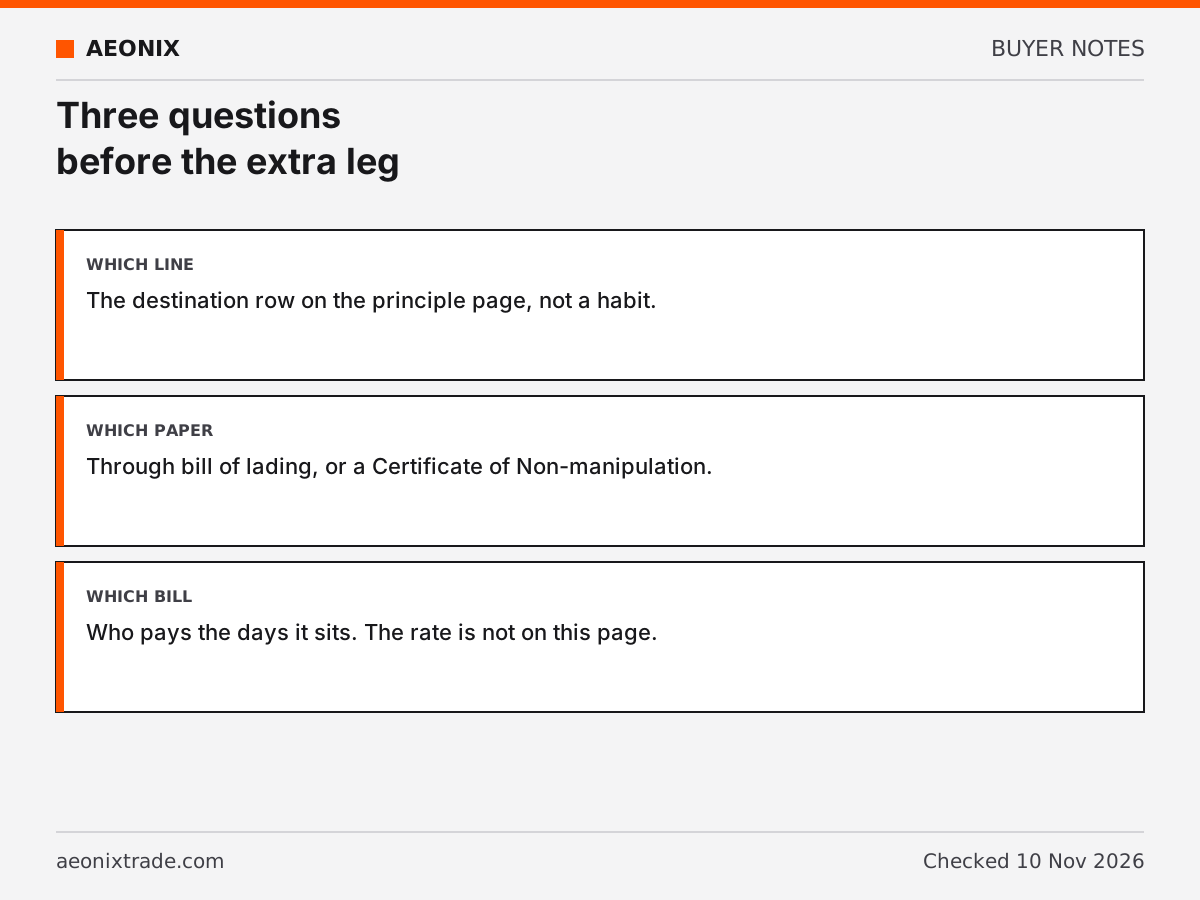
Ask the forwarder three questions before you accept the extra leg. Which destination line on the Hong Kong Customs principle page are they relying on? Can they give you a through bill of lading, or are they planning to ask for a Certificate of Non-manipulation? Who pays for the days the cargo sits, and where is that charge written? If the answers are "it is how everyone does it," you do not have a routing yet. You have a habit.
A fair week in the same city is a separate reason to be in Hong Kong. Walking a hall at the convention centre is HKTDC trade fairs for buyers. The badge from that week does not move the container, and it does not change the origin line either.
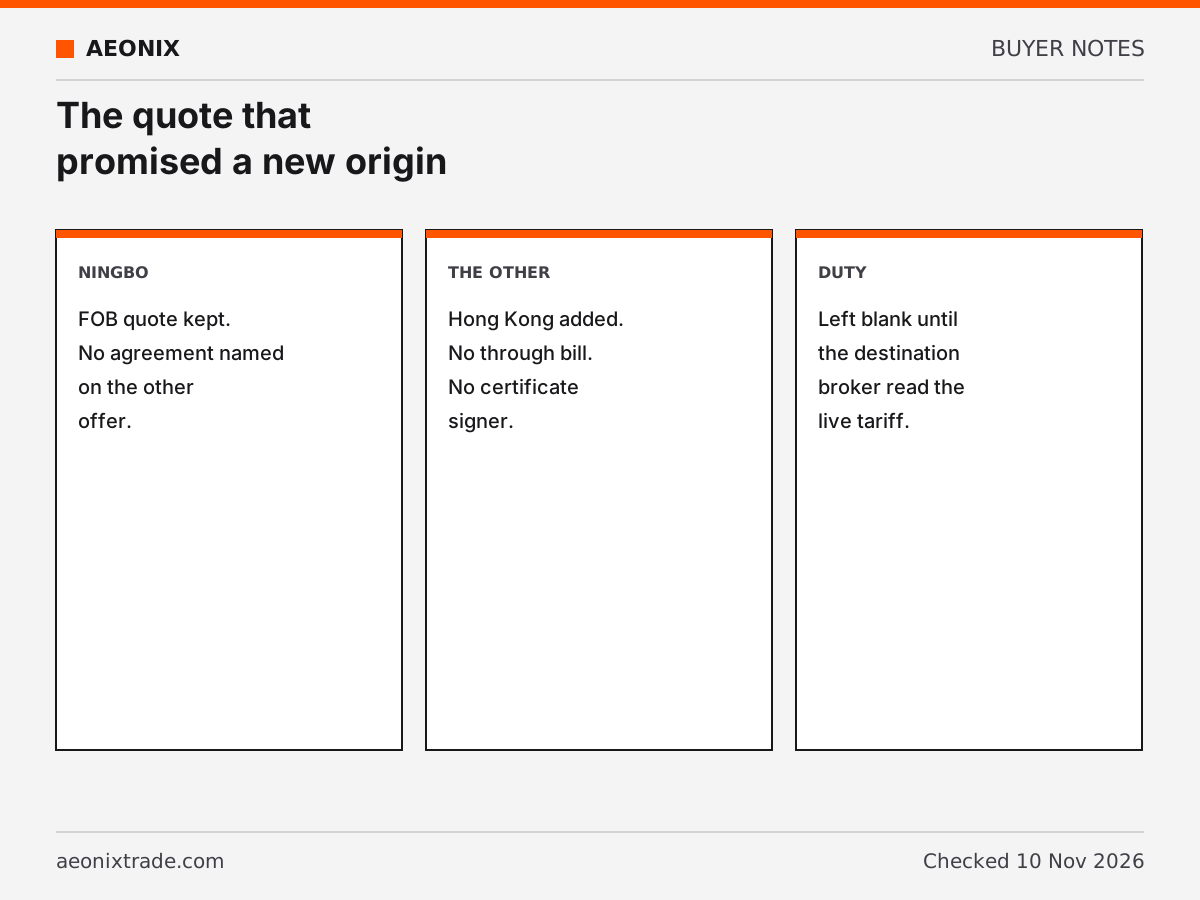
The buyer in this case had a FOB Ningbo quote and a second quote that added Hong Kong and promised a lower duty at destination. The second quote did not name an agreement, did not attach a through bill, and did not say who would sign a Certificate of Non-manipulation. They kept the Ningbo booking, and they asked the broker at destination to read the real tariff. The duty cell stayed blank until that reading existed. How surrender of originals works if you do use a through bill is telex release.
Before you add the Hong Kong leg
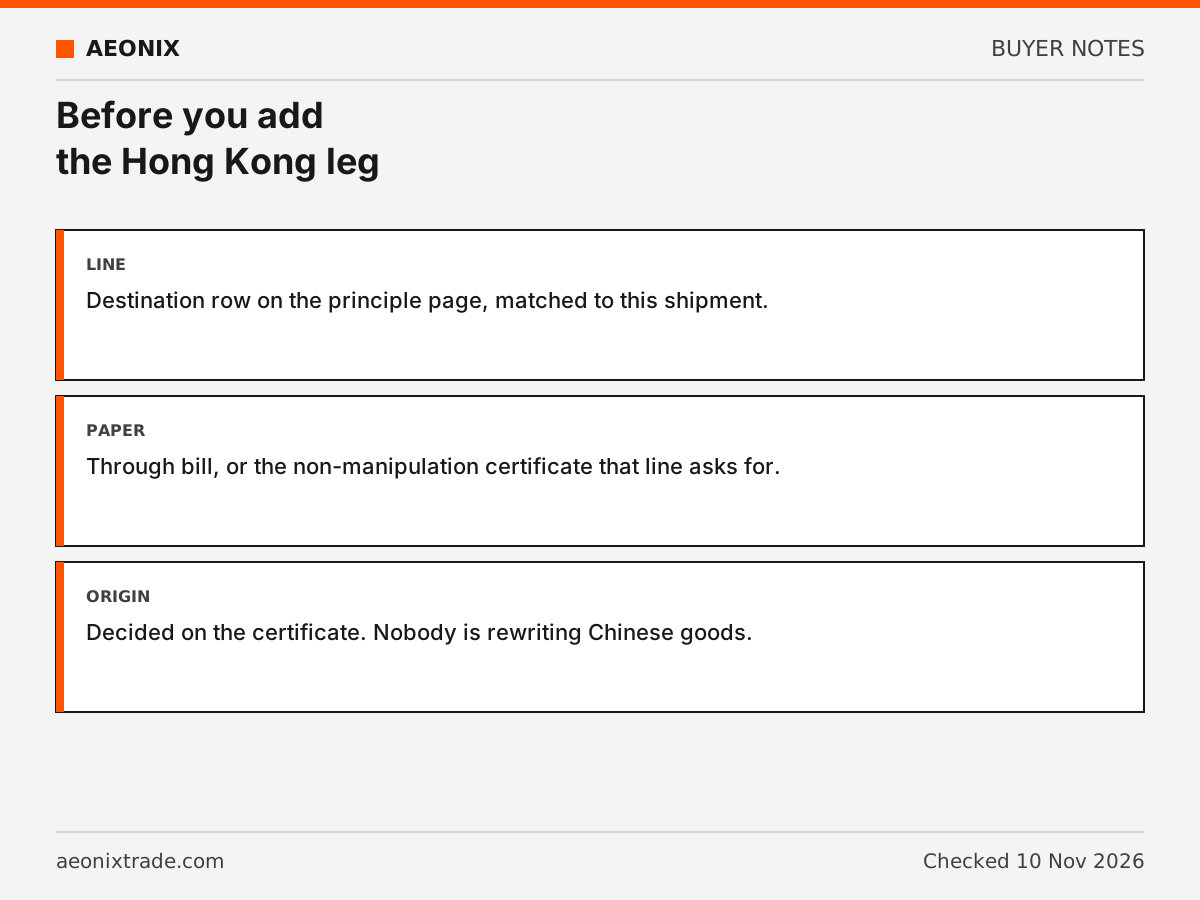
- The destination line on the principle page, opened and matched to this shipment.
- Through bill of lading, or a Certificate of Non-manipulation, as that line requires.
- Origin document decided separately, in the certificate of origin sense.
- Storage and free time read from the tariff that will bill you. No rate is on this page.
- No one on the email is offering to change the origin of Chinese goods.
Does a Hong Kong warehouse make the goods Hong Kong origin?
The pages checked describe a warehouse as a place the cartons sit, and they describe a Certificate of Non-manipulation as a statement that the cargo was not manipulated there. Origin stays the document your destination asks for. The principle page's preferential line, where it has one, still does not print a rate and does not rename the goods.
Should a small buyer use Hong Kong by default?
Only when the destination line, the bill of lading, and the cost of the extra days are written down. A default stop, added because a forwarder prefers it, is how a simple FOB shipment picks up a certificate you did not know you needed.
Who runs the file is also covered in How to Choose a China Sourcing Agent, agent fees and the contract, an agent, a forwarder, or a buying office, and where to find suppliers.
Official sources
- Hong Kong Customs, FTA Transhipment Facilitation Scheme, Principle of Application, opened 10 November 2026. Destination-specific rules, including container seal evidence and a Certificate of Non-manipulation.
- Hong Kong Customs, trade facilitation index, which lists the scheme.
- China Customs English home and laws and regulations, both opened 10 November 2026. The HTTPS certificate on the English host did not verify from here, so the working links are the HTTP pages that returned.
If the cartons are already listed and the open question is the routing, send the list on the RFQ form.
Submit sourcing request
Can't find what you need?
Start with a product or image link, an approximate quantity and destination. Other details can follow.