Shipping from China to Amazon FBA: Prep, Labels and Route Options
Published by Aeonix Trade.
Last fact-checked: November 10, 2026. The label size below is from Amazon's seller prep guide dated July 7, 2026. The bag thickness and the suffocation warning follow Amazon staff posts on Seller Central, not that guide. Seller Central help pages for packaging opened as a sign-in shell. Carton weight, box-content, and appointment rules were not readable, so they are not given as numbers.
A typical case
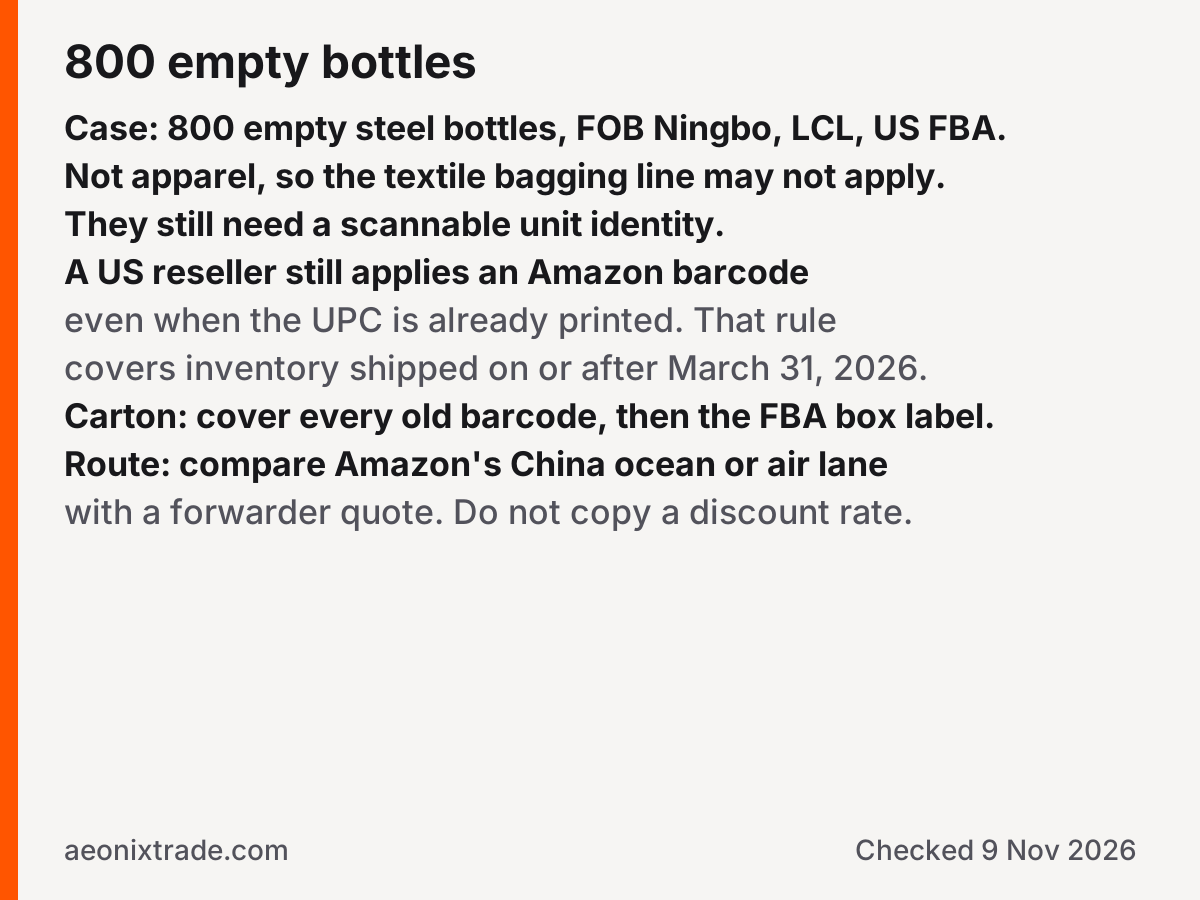
800 empty stainless drink bottles, FOB Ningbo, one LCL shipment, headed for a US fulfillment center. The factory can print a UPC. The forwarder can book a box. Neither of those facts tells you whether Amazon will receive the cartons.
FBA prep is the work that makes each unit scannable and each carton unambiguous before the goods leave China. Amazon's own description, on the FBA prep, packaging, and labeling guide dated July 7, 2026, is that the product goes from your supplier or warehouse to a fulfillment center, where it is unpacked, shelved, and later shipped to the customer. If the barcode, the bag, or the carton marking is wrong, Amazon says it may refuse, return, or repackage the delivery at your expense.
The route is a separate choice. Amazon Global Logistics describes ocean and air freight from China into the FBA network in the US, UK, EU, and Japan, and ocean freight from Vietnam to the US. You can also move the cargo with your own forwarder and create the FBA inbound shipment yourself. The prep rules do not drop out because the carrier changed.
Which barcode the bottle is allowed to wear
Amazon's July 7, 2026 guide still describes three barcodes and an older default. For a US fulfillment center, use the later announcement instead.
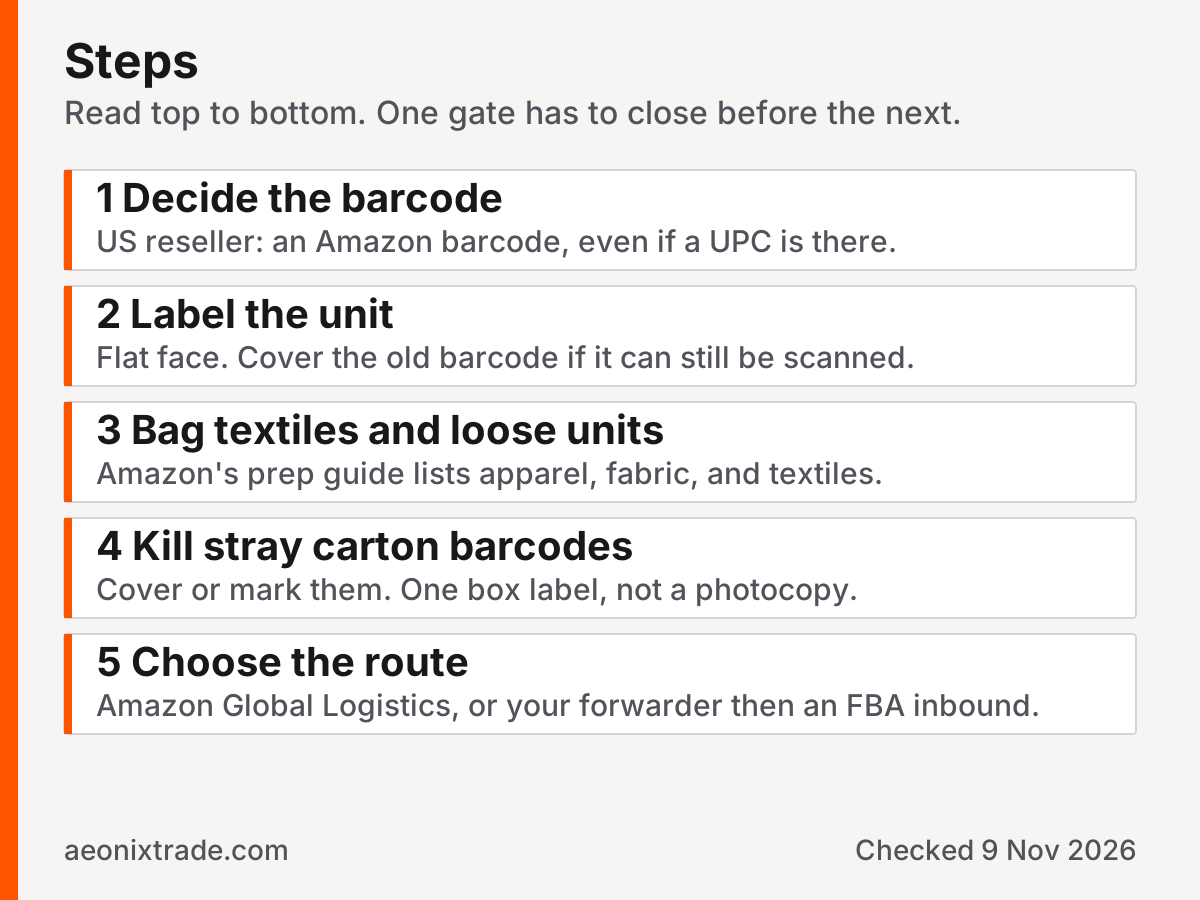
Amazon's Seller Central notice ends commingling for inventory shipped on or after March 31, 2026. A brand owner who holds the Brand Representative role in Brand Registry can leave a manufacturer barcode, such as a UPC, EAN, JAN, or ISBN, without adding an Amazon sticker just to keep the units separate. A reseller who does not hold that role applies an Amazon barcode even when the bottle already has a manufacturer barcode. If there is no manufacturer barcode, both the brand owner and the reseller use an Amazon barcode. The notice does not tell you to relabel units already sitting in the building. A shared UPC is no longer the reason a shopper receives another seller's unit on a shipment sent after that date. Do not skip the Amazon label because the July guide still calls the manufacturer barcode the default.
The same July guide still lists extra cases that need an Amazon barcode, including used goods, media, and some restricted or consumable products. Those lines can still apply. They do not restore commingling, and they do not let a reseller ship a US unit on the UPC alone. A Transparency code is a separate item-level mark for brand owners who enrolled. These empty bottles are not in that program unless you enrolled them. Check the listing. Do not treat a blog sentence as the switch.
Brand Registry itself is a separate enrollment. The Brand Registry page describes tools for brand owners. It does not label your cartons.
What goes on the sticker, and what goes over the old one
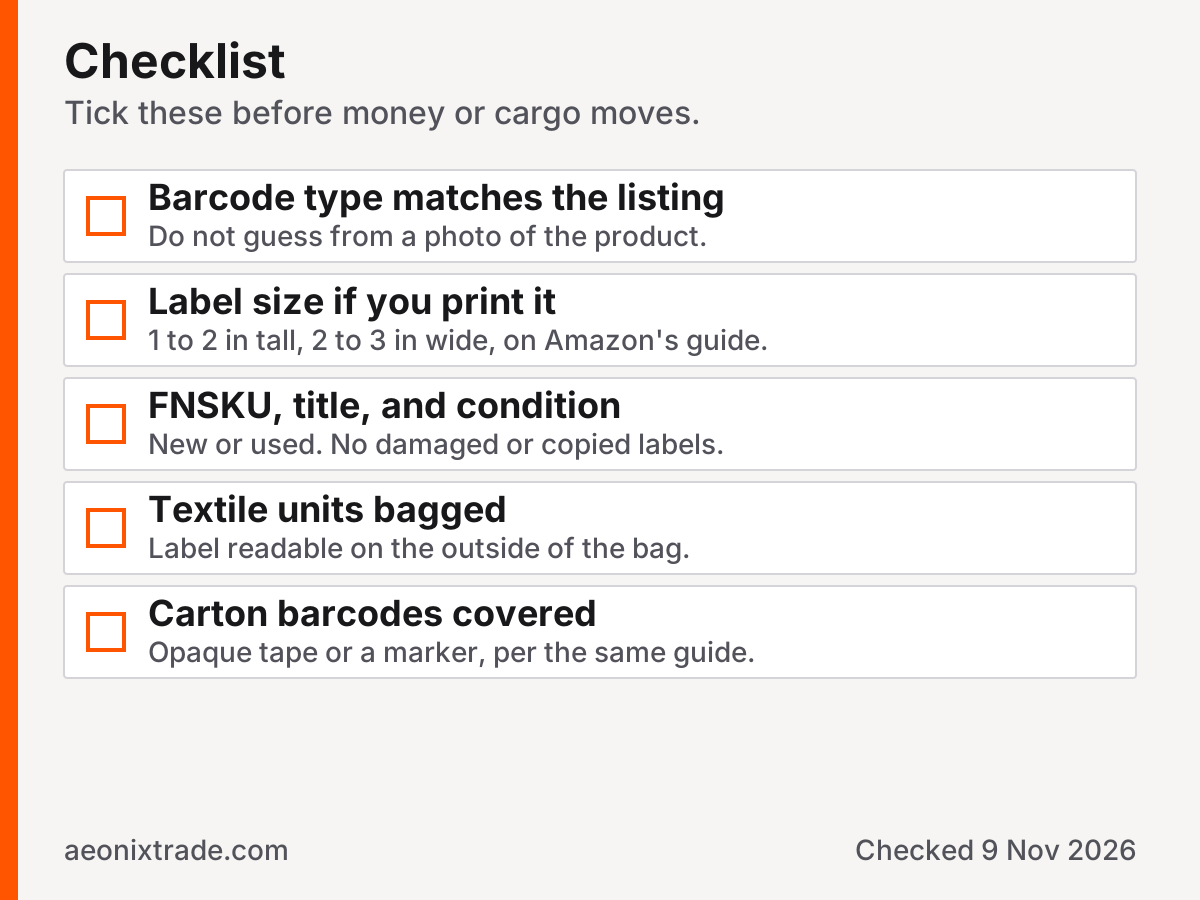
If you print Amazon barcode labels yourself, the July 7, 2026 guide gives the specification: 1 to 2 inches tall, 2 to 3 inches wide, black ink on non-reflective paper with adhesive, a laser printer at 300 DPI for best results. The label shows a scannable barcode, the FNSKU, the product title, and the condition, new or used. Place it on a smooth flat face. Avoid corners, edges, and curves. Amazon does not accept damaged or photocopied labels.
If the bottle needs no extra packaging, cover the original UPC, EAN, or ISBN so it cannot be scanned by mistake. If you add packaging, the label goes on the outside. For a large shipment the guide says to generate a label file per page and match title and condition to the unit, or to print a packing list that ties FNSKUs to products. That packing list is your factory document, not a substitute for the commercial packing list the forwarder files.
The same guide splits products into individual units and case-packs. Individual units can share a box and still be sold separately, even with different quantities or SKUs. A case-pack is the same SKU, condition, and quantity, usually packed by the manufacturer. If you sell items as one set and they are not an official set, pack them together and mark the outside "Sold as set," "Ready to ship," or "This is a set. Do not separate."
Every unit, including a multi-volume set, has to be one secure package. Amazon does not accept units that need multi-piece assembly. Loose sleeves get a bag, a non-adhesive band, or removable tape. Footwear is boxed or put in a poly bag with a suffocation warning.
Apparel is on the bagging list. Empty bottles are a different question.
The guide's bagging list includes perforated packs, pellets, powders, granules, plush, baby products, apparel, fabrics, textiles, jewelry, small products, and liquids. Do not copy that guide's film figures. Amazon staff on Seller Central state the bag requirements as at least 1.5 mil thick, transparent, and fully sealed, with a suffocation warning when the opening, measured flat, is 5 inches or larger. A bag whose opening is exactly 5 inches needs the warning. One millimeter is not the thickness those posts give, and a warning only above 5 inches misses the boundary. The barcode stays readable on the outside. The same posts say the bag should not extend more than 3 inches past the product. Clear bags, unless the product is an adult product or Amazon has asked for an opaque bag. If Seller Central's packaging page shows a different line on the day you buy the film, follow that page.
Sharp items, fragile items, ceramics, and glass get bubble wrap instead of a bag, with the label on the outside of the wrap.
These bottles are empty steel, not a liquid fill and not apparel. Do not bag them only because a clothing shipment needed bags. Do bag them if the listing or a later damage return makes Amazon add a prep requirement. The guide says Amazon may add prep after damage-related returns. Read the shipment, not last quarter's habit.
On the shipping box, remove, cover, or make unscannable every barcode already printed on the outside. The guide allows opaque tape or a black felt-tip marker. The point is that receiving scans the FBA carton identity, not a leftover UPC.
Two routes that both still need those labels
Amazon Global Logistics, on the page checked November 9, 2026, calls itself door-to-door ocean and air freight for FBA sellers. It says you can ship ocean or air from China to the FBA network in the US, UK, EU, and Japan, and ocean freight from Vietnam to the US. The service list on that page includes pickup at origin, export declaration, the cross-border ocean or air leg, destination customs clearance, and delivery to Amazon fulfillment centers or warehousing facilities, booked and tracked in Seller Central. FCL uses the whole container. LCL, Amazon says, is consolidated with other Amazon sellers' inventory and delivered to fulfillment centers.
The same page prints a new-seller offer. Offers change. Read the terms on that page on the day you book, and price the shipment from the live page rather than from a copied percentage.
The other route is the one your forwarder already sells. Under FOB, the seller's delivery point is on board the vessel and the main carriage is yours. The ICC Incoterms 2020 page is the rule set. How the pieces of an LCL quote are built is in what LCL means and how LCL from China works. A full container is a different buy, covered in FCL. Consolidation of several factories into one sailing is the job described on consolidation and LCL from China.
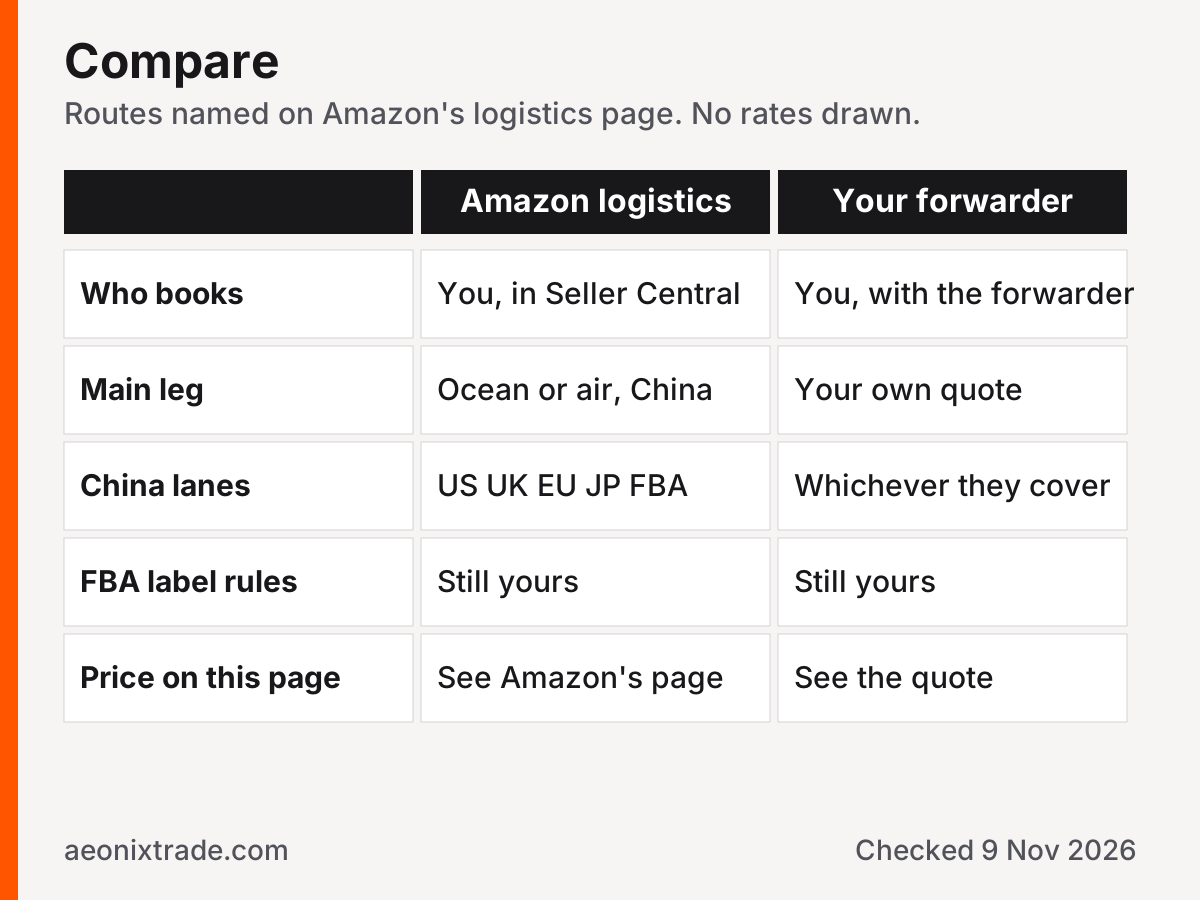
| Question | Amazon Global Logistics | Your forwarder, then FBA inbound |
|---|---|---|
| Who books the China leg | You, inside Seller Central, on Amazon's description | You, against the forwarder's quote |
| Lanes the page names | Ocean or air, China to US, UK, EU, and Japan FBA. Ocean, Vietnam to the US. | Whatever that forwarder actually covers. Ask. |
| Who clears destination customs | Included, Amazon's page says | Named on your quote. FOB does not include it. |
| Unit and carton labels | Still your prep | Still your prep |
| Rates | On Amazon's page that day | On the quote |
Neither route chooses your importer of record for you in a way this article can promise. If you are new to that role, read it before you pick a delivery term. The listing-side questions, packaging included, sit on China sourcing for Amazon sellers.
Where this shipment usually breaks
- A reseller prints the UPC and skips the Amazon barcode. For US inventory shipped on or after March 31, 2026, that seller does not have the Brand Representative exception. The unit is not labeled for the rule that replaced commingling.
- Labels are photocopied to save a printer. Amazon says it does not accept photocopies.
- The forwarder puts its own barcode on the carton and leaves it live next to the FBA box label. The guide says stray barcodes get covered or killed.
- Someone bags every SKU because a textile shipment needed bags. Bag what the guide and the shipment require. Do not invent a bag for empty steel.
- The balance is paid because the vessel closed, before anyone checked that the FNSKU matches the listing. Transit does not repair a label.
Questions worth asking before the deposit
Can the factory ship straight into FBA without a label?
No. The barcode still has to identify the unit and the seller, and for this US shipment it has to be on before the cartons reach the fulfillment center. Amazon's developer changelog says US prep and item-labeling services ended on January 1, 2026, including inventory that reaches FBA through Amazon Global Logistics. You, the factory, or a prep provider you hire does the work. Do not leave the bottles unlabeled because you expect Amazon to sticker them at the dock. If the shipment is for a marketplace other than the US, read that marketplace's prep page before you assume Amazon still offers the service.
Does LCL from Yiwu or Ningbo change the sticker?
No. The sailing changes the freight bill. The sticker follows the listing and the prep guide. A mixed container still needs one identity per unit and one clean carton label per box.
What if Seller Central shows a different carton limit on the day I ship?
Follow that shipment. The help page that would carry carton limits did not render on November 9, 2026, so use the limit Seller Central shows when you create the inbound.
Send the barcode setting, the bagging decision, and the route you want priced when you open a sourcing brief. A sample of the labeled unit, before bulk, is the check described in product samples from China.
The production file next to this one is Private Label Meaning, starting a private label from China, an NNN agreement versus an NDA, and the purchase contract.
Official sources
- Amazon, FBA prep, packaging, and labeling, dated July 7, 2026. Label size and carton barcodes. Its barcode-default and film figures are not the US rule used above.
- Amazon Seller Central: commingling ends March 31, 2026. Brand Representative sellers may keep a manufacturer barcode. Other resellers apply an Amazon barcode even when one exists. Read November 10, 2026.
- Amazon: US FBA prep and labeling services end January 1, 2026, including inventory sent through Amazon Global Logistics.
- Amazon Seller Central staff: poly-bag requirements. At least 1.5 mil, and a suffocation warning when the opening is 5 inches or larger, measured flat. Read November 10, 2026.
- Amazon Global Logistics, read November 9, 2026. China and Vietnam lanes, FCL, LCL, and what the service says it includes.
- Amazon Brand Registry, read November 9, 2026.
- ICC, Incoterms 2020. Who arranges the main carriage is a term, not a guess.
- 19 CFR 141.1. US entry of imported merchandise is a customs filing, separate from an FBA label.
- US Federal Maritime Commission. The ocean leg, when the cartons move by sea.
- IATA: lithium batteries. A cell in the carton is a cargo rule, not a barcode rule.
Submit sourcing request
Can't find what you need?
Start with a product or image link, an approximate quantity and destination. Other details can follow.