Import from China to Canada in 2026: Duties, Documents and Landed Cost
Published by Aeonix Trade.
Last fact-checked: 9 November 2026.
A Vancouver housewares buyer books one 20ft of ceramic tableware, handed over FCA at the Ningbo container terminal, for release at the marine office in Vancouver. The factory sheet says FOB. Under FOB the seller loads the goods on the ship. This is a container. ICC recommends FCA for containerised cargo. Write "FCA Ningbo container terminal."
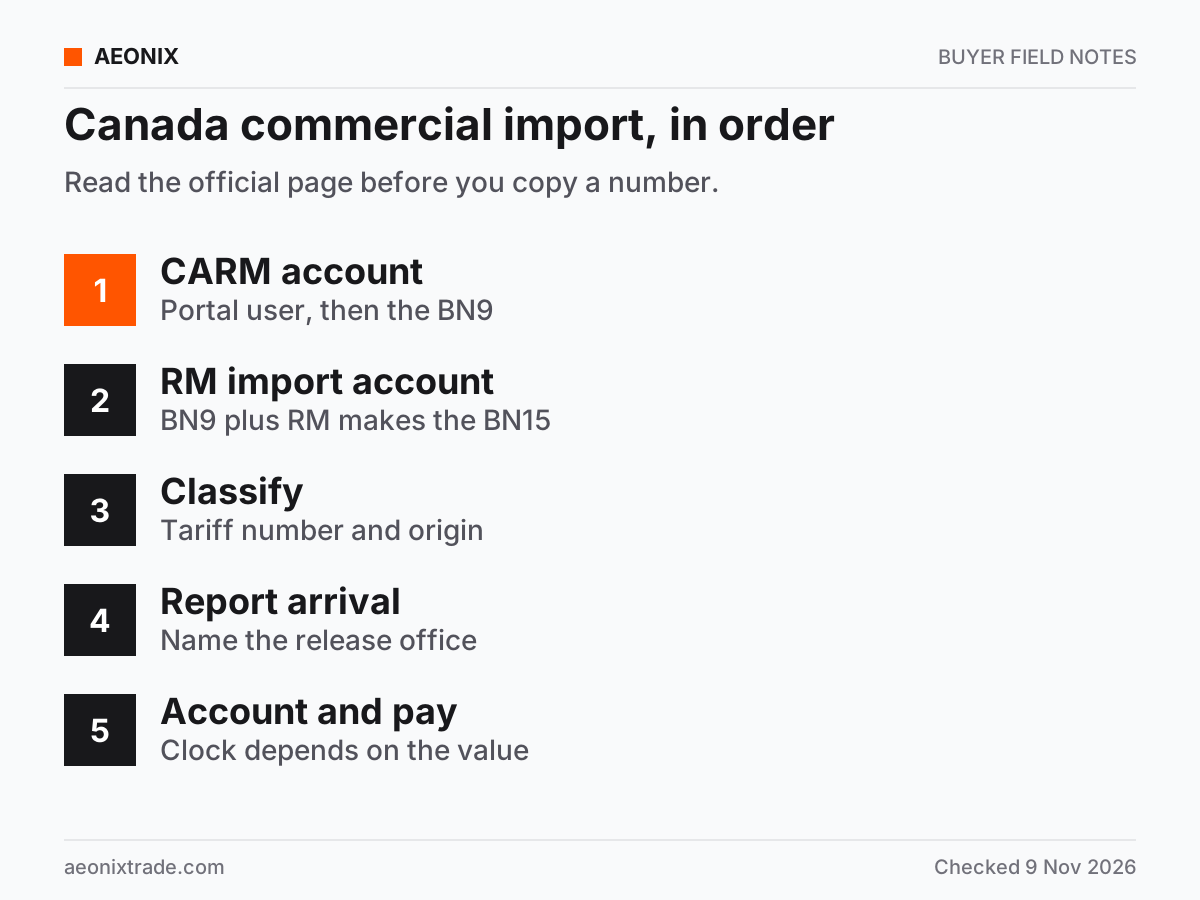
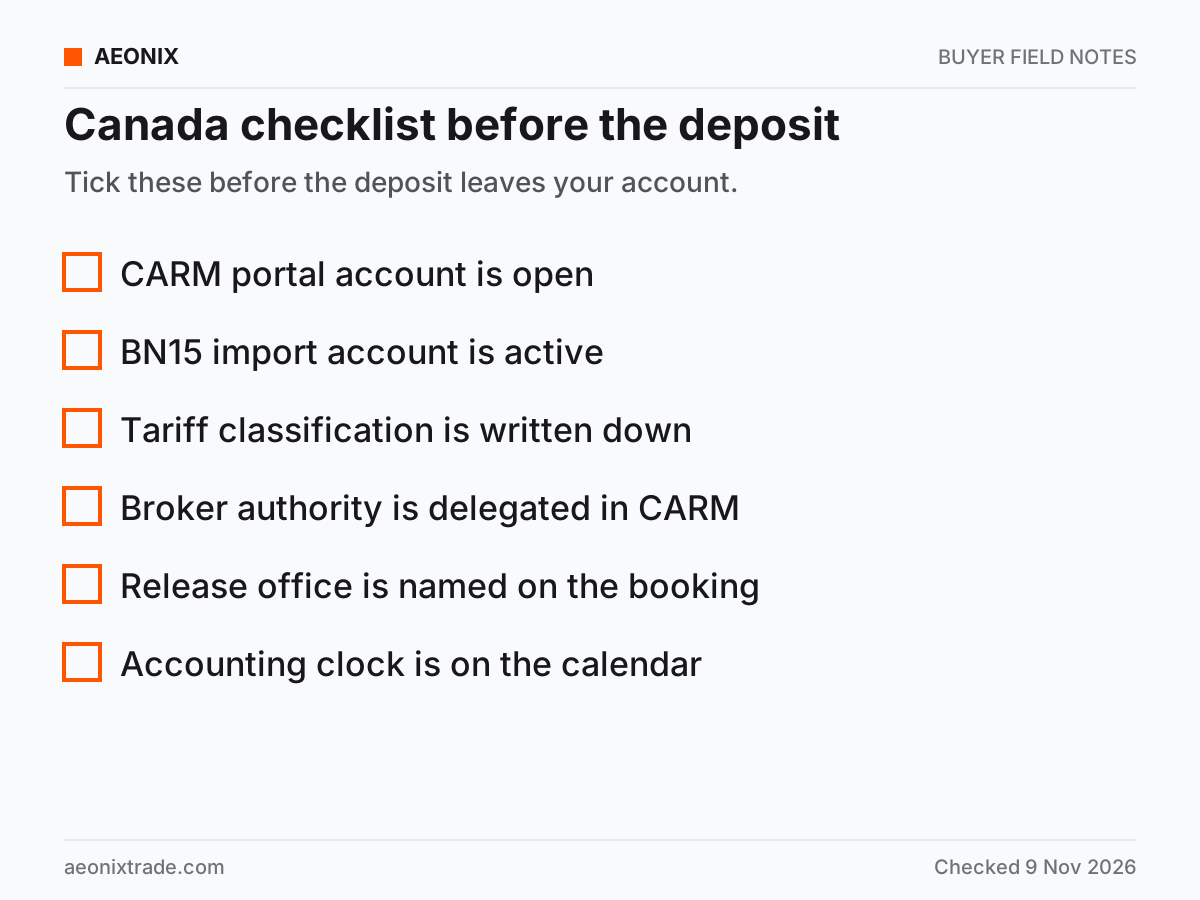
To import from China to Canada, start with a registration, not with a duty percent. Importing from China to Canada still runs through CARM before anyone can quote a rate. To import commercial goods, CBSA says every importer needs an account in the CARM Client Portal, a 9-digit business number (BN9), and a 6-character import-program account (RM). The BN9 and the RM together are the 15-character business number, the BN15. That is Set up your business to import, read on 9 November 2026. The BN9 registration in the portal is described there as available to Canadian resident businesses. A non-resident follows the instructions on that same page rather than a shortcut from a forwarder.
A typical Vancouver container
CBSA's commercial guide says you find the tariff classification number, then use that number and the country of origin to find the tariff treatment. The treatment is what sets the duty rate. The page is Determining duties and taxes, and the tariff menu is Customs Tariff. Canada import duty on China origin is that lookup. This page does not copy a percent out of it.
The same guide shows a worked example for goods of US$100. It labels the exchange rate as an example, and it calculates the example as if the goods were subject to 4% duty and 5% GST. The 4% and the exchange rate are samples for that illustration. Do not put 4% on ceramic tableware. Do not lift 5% off the illustration and treat it as a sentence this page has verified outside the example. Read the GST line on the live CBSA page, and the provincial tax with your broker, before you print a tax percent on a resale quote. The steps for the whole job are the guide to importing commercial goods.
The $20 line this container is not
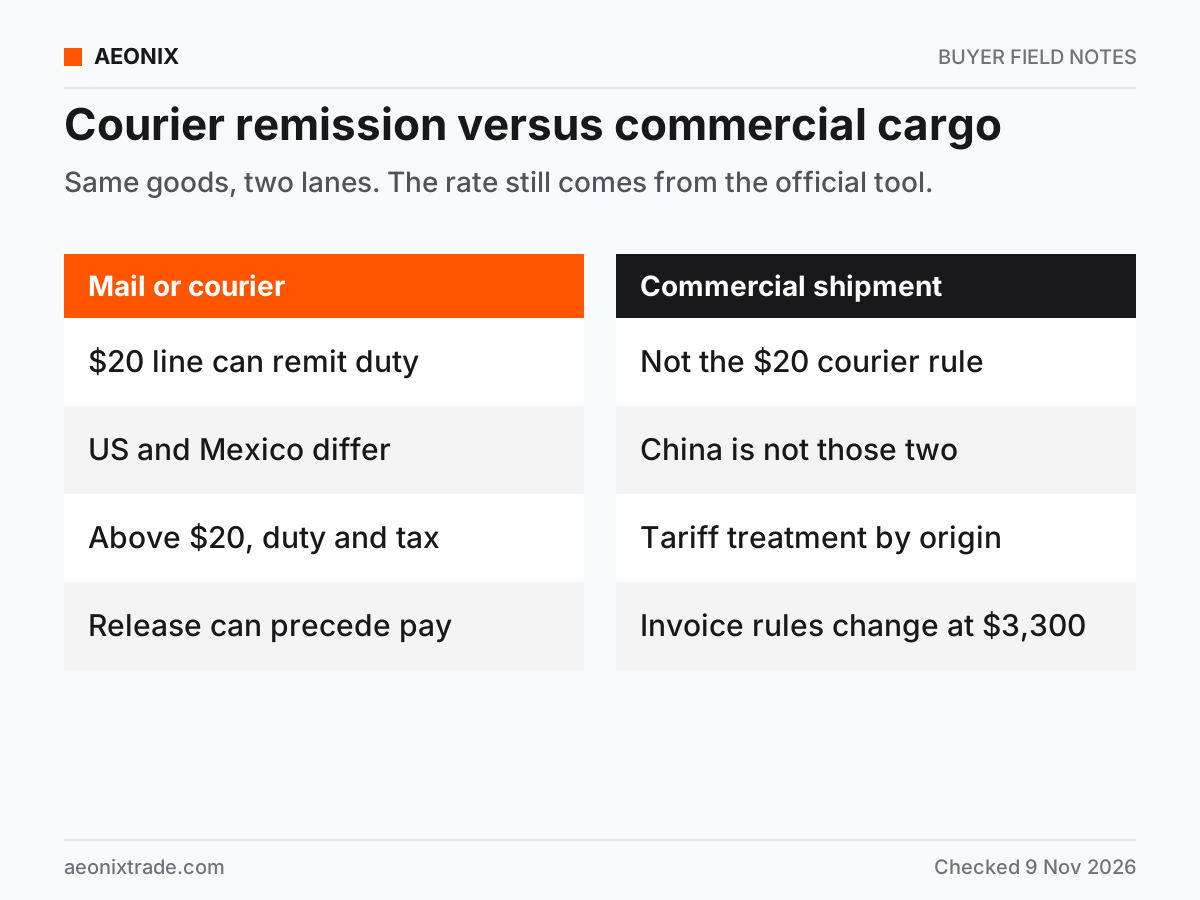
CBSA's low-value page, read on 9 November 2026, still remits duty and tax on mail of $20 and under from any country. Above $20, mail pays duties and taxes, including mail from the United States and Mexico. For courier shipments the page draws a different line. From any country other than the United States and Mexico, courier goods up to $20 are duty and tax free, and goods above $20 pay duties and taxes. The higher courier thresholds, up to $40 duty and tax free and up to $150 duty free, are printed for goods imported from the United States and Mexico. China is not those two countries. A container that only transits a US port is not "imported from" the United States. The page is low-value shipment thresholds.
Alcohol, cannabis, cigars, cigarettes, tobacco and some publications are named exceptions. A marine container of tableware is not a courier parcel and it is not under $20. Quote it on the commercial rules.
When you account
On that same low-value page, commercial goods not exceeding $3,300 are accounted for by the 24th day of the month following the month of release. Goods greater than $3,300 are accounted for within 5 business days of release, and a customs invoice is required for release and accounting. A 20ft of ceramic is above $3,300. Put the five-business-day clock on the calendar when the arrival notice comes in, not when someone remembers. CBSA also says most shipments are released at the office where they first arrive. Name that office when you book. The shipping step is Ship and report your goods.
Once the CARM account exists you can delegate a licensed customs broker. The broker does not become the importer because you delegated a login. If your company will sell the tableware, your company should be able to explain the declaration. A DDP offer that names a Chinese forwarder as the importer is the pitfall, not a shortcut.
Landed cost before the deposit
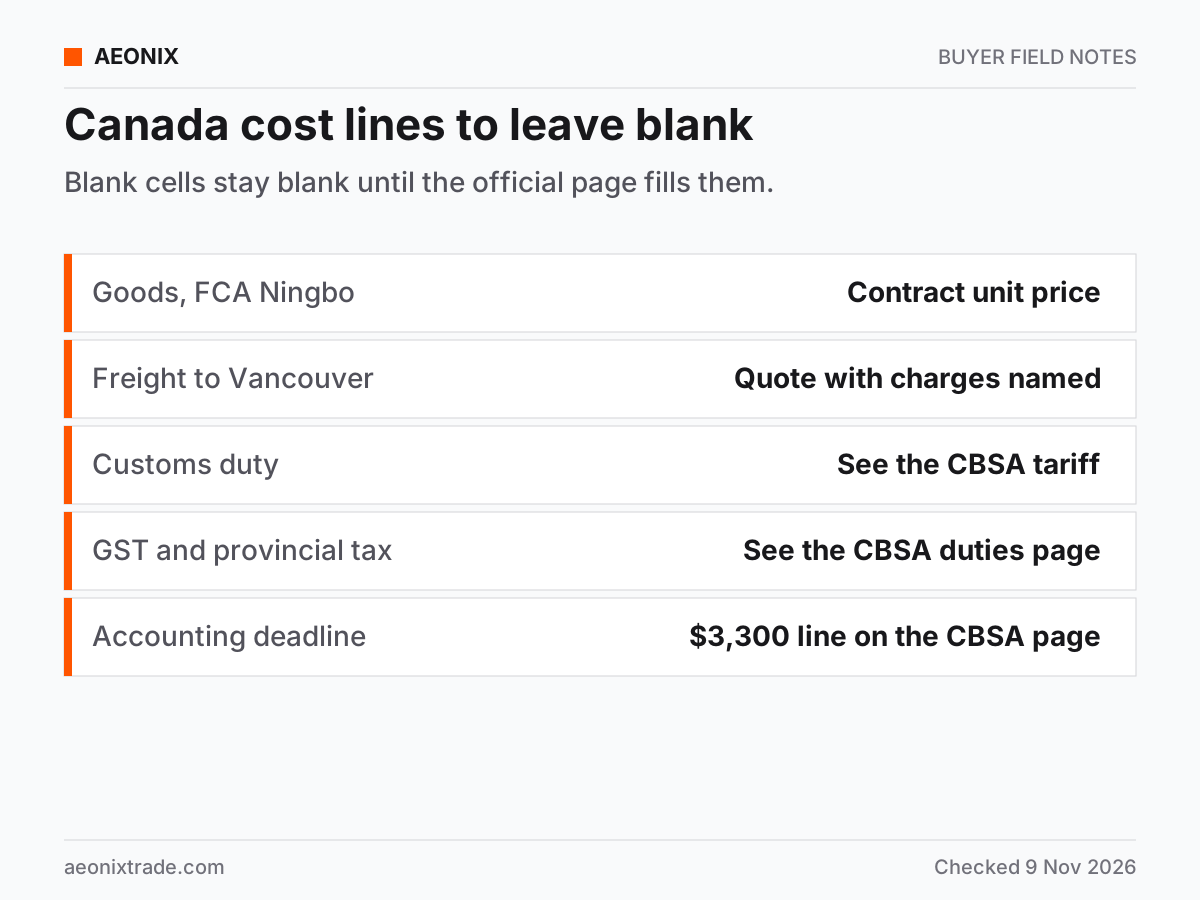
Build the sheet with the landed-cost guide. Customs value follows the WCO valuation rules your broker applies to the invoice and the freight papers. Leave the duty cell as "see the Customs Tariff." Leave the tax cell as "see the CBSA duties page" until you have read the live GST line yourself.
| Line | Ask for this | Do not assume |
|---|---|---|
| Goods, FCA Ningbo | Unit price and what is in the carton | That FCA includes ocean freight |
| Freight to Vancouver | A quote with the charges named | That port release is delivery to the shop |
| Duty | Tariff classification plus China origin | The 4% in CBSA's sample sum |
| GST and any provincial tax | The live CBSA and tax treatment for this importer | The 5% printed inside the sample sum |
| Accounting | Whether the shipment is over $3,300 | That the $20 courier remission applies to a container |
| Broker | A CARM delegation you can see | That the broker is the importer of record |
Where this lane goes wrong
- Booking the ship before the BN15 exists. CBSA's setup page says commercial importers need it.
- Treating a China container as if the US or Mexico courier thresholds applied.
- Copying 4% duty out of the worked example. The page presents that figure inside an illustration.
- Missing the five-business-day accounting clock on a shipment over $3,300.
- Paying the balance to a bank account that does not match the seller. Check it before the TT, as the supplier check describes.
The wider file is the first-time compliance checklist. After arrival, use the arrival sequence. A smaller order can move as LCL. The UK version of this problem is the United Kingdom guide, and a Pacific comparison is the New Zealand guide. All of them sit under import from China.
Questions buyers ask
Can I start with less than a container?
Yes. LCL does not put you on the $20 courier line. Classification, the BN15, and accounting still apply. The value of the commercial shipment is what sets the accounting clock.
Do I need a customs broker?
CBSA lets you delegate one in CARM. You can also learn the release yourself. What you cannot skip is the BN15 and someone who can report the goods. A broker login is not a substitute for being the importer.
What is the duty from China?
The tariff treatment for the classification and for China as the origin. This page does not print a rate, because the CBSA page does not print one rate for every product.
See also which Incoterm to use and the customs clearance sequence.
Official sources
- Guide to importing commercial goods into Canada.
- Determining duties and taxes: classification, origin, and a worked example whose duty and exchange rate are samples.
- Set up your business to import: CARM, BN9, RM, BN15. Read 9 November 2026.
- Ship and report your goods.
- Low-value shipment thresholds: the $20 mail and courier lines, the US and Mexico courier lines, and the $3,300 accounting split.
- Customs Tariff: where the duty rate is published. No rate is copied here.
- Incoterms 2020.
- WCO customs valuation.
If you want the Ningbo handover checked before the deposit, use the RFQ form.
Submit sourcing request
Can't find what you need?
Start with a product or image link, an approximate quantity and destination. Other details can follow.