Import from China to New Zealand in 2026: Duties, Documents and Landed Cost
Published by Aeonix Trade.
Last fact-checked: 9 November 2026.
An Auckland gift shop brings one LCL lot of home accessories, handed over FCA at the Ningbo container terminal, for clearance in Auckland. The factory calls it FOB. For cartons that are handed to the carrier before the ship is loaded, ICC recommends FCA rather than FOB. Write "FCA Ningbo container terminal."
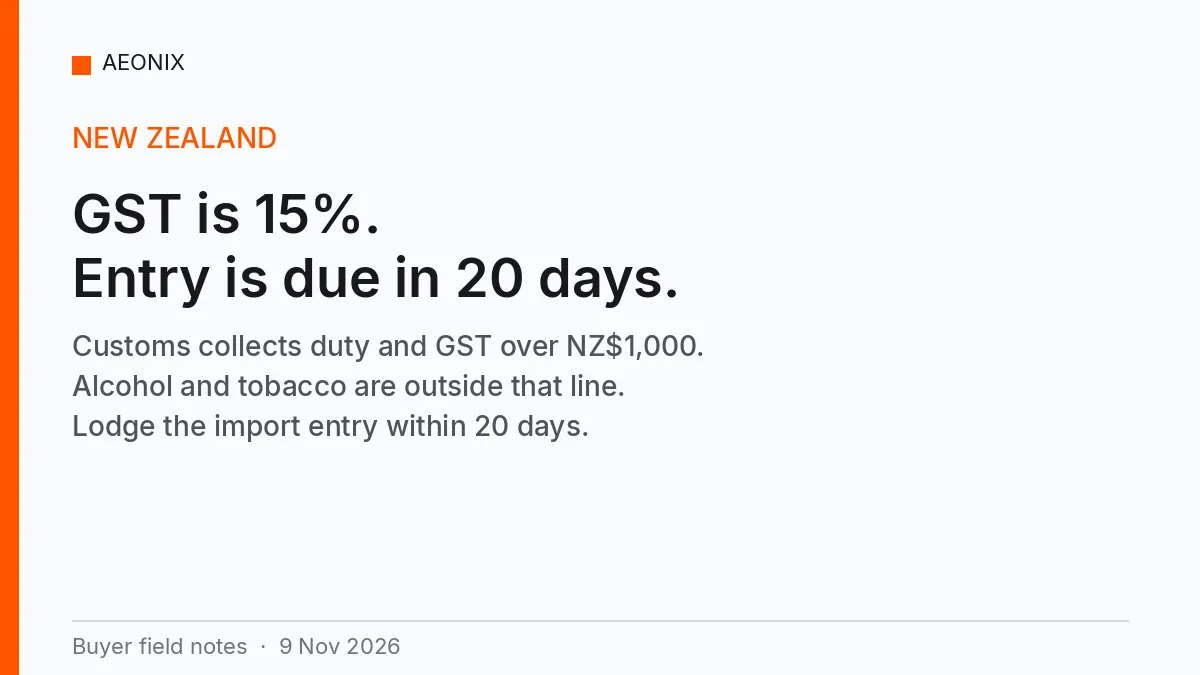
To import from China to New Zealand, for a commercial lot, you lodge an electronic import entry against a tariff line. Importing from China to New Zealand is that entry, not a parcel guess. New Zealand Customs, on the duty and allowances page read on 9 November 2026, says it does not collect duty or GST unless the shipment is over NZ$1,000. That exemption does not apply to alcohol or tobacco. GST of 15% applies to imported items, including goods bought online. Overseas suppliers may charge GST on items valued at NZ$1,000 or less. If several orders from the same supplier arrive on the same day, Customs treats them as one shipment, and that can push the value over NZ$1,000. The page is Duty and allowances. The same points are repeated on Duty and GST.
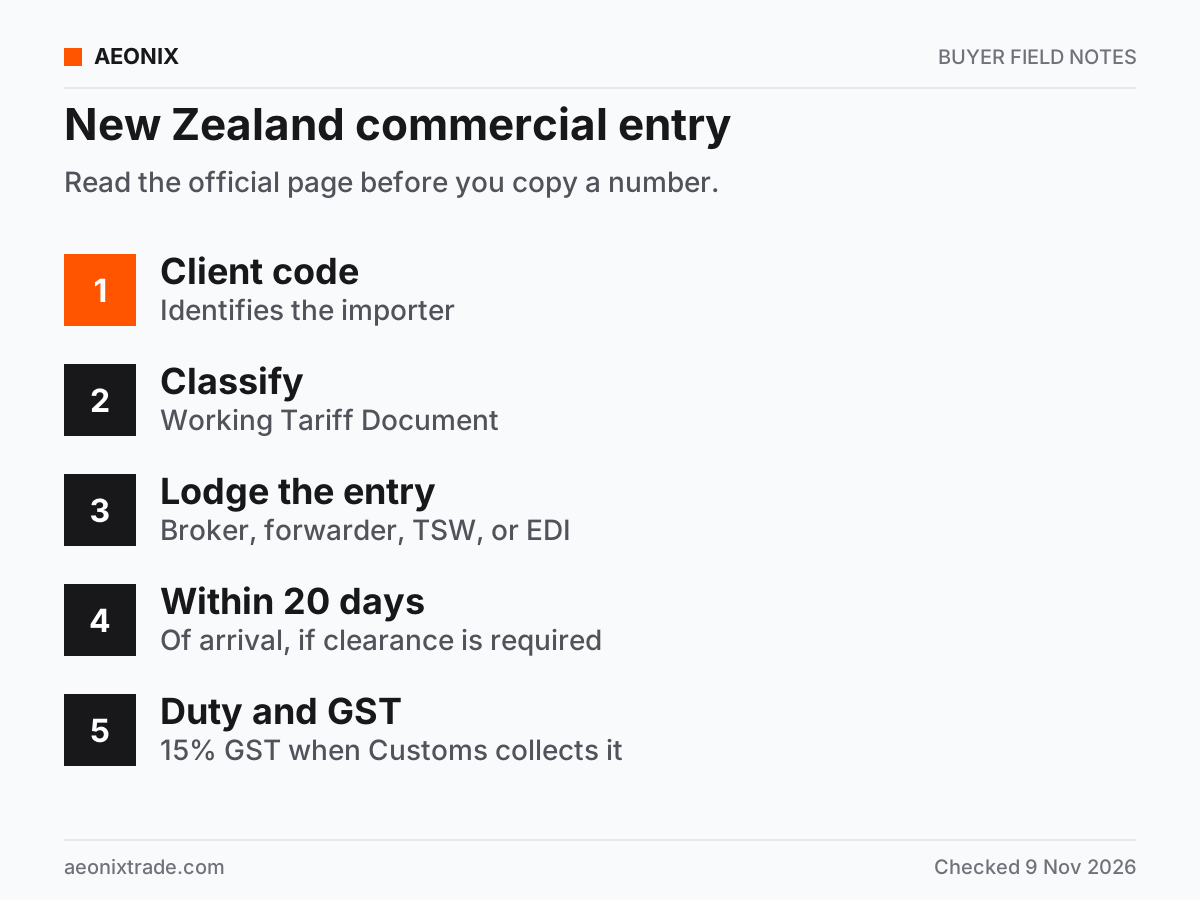
A typical Auckland lot
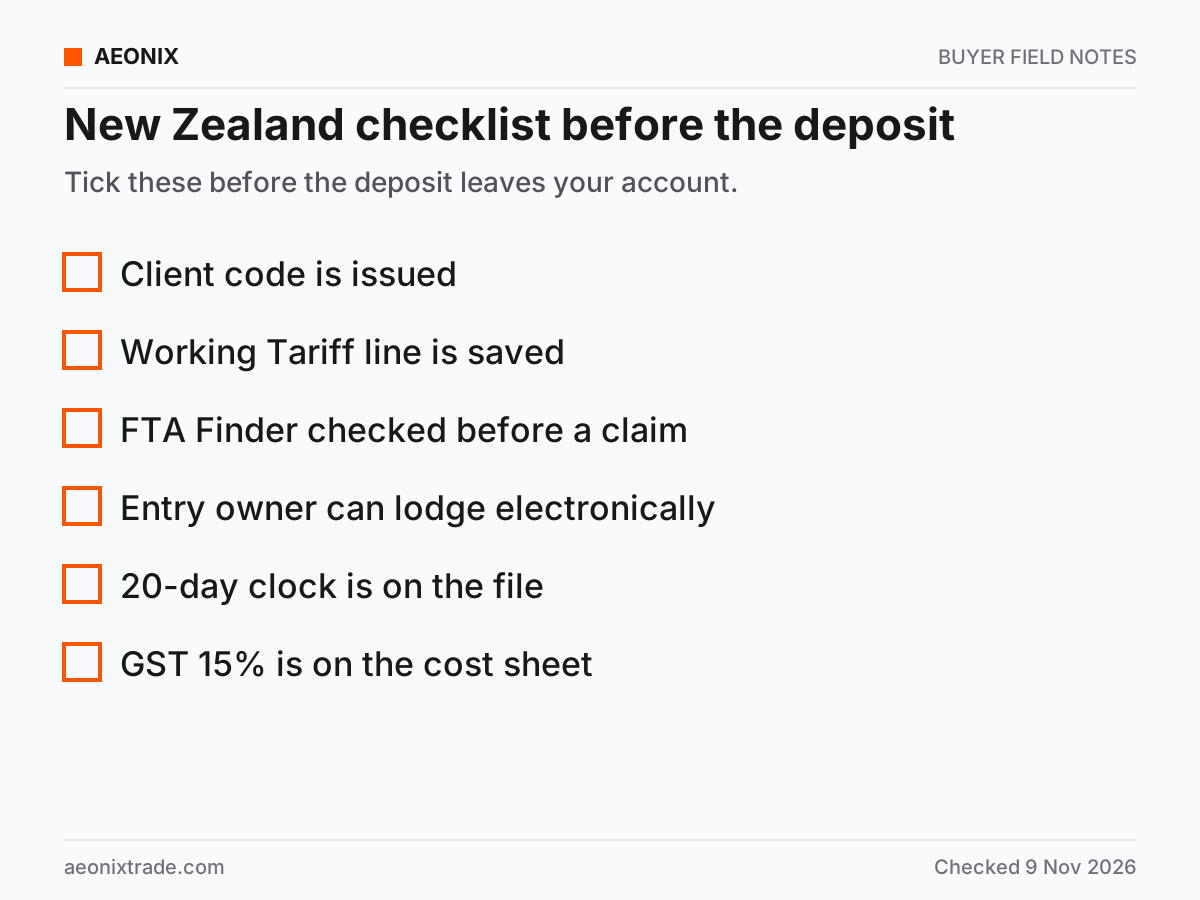
A commercial shipment of accessories is over NZ$1,000. Customs will collect duty, if the tariff says so, and GST. The duty rate is in the Working Tariff Document. Before anyone claims a preference, check the FTA Finder. Chinese origin is not a preference just because a factory stamped a form. The finder is the page Customs points to for items exempt from duty. New Zealand import duty on China origin is the Working Tariff line, not a percent this article can honestly print for every accessory.
When Customs calculates GST, the duty page says it uses the amount you paid for the item, plus international freight, postage and insurance, plus any import duty. The rate in that calculation is 15%.
Commercial goods are cleared on an electronic import entry. Customs does not offer the lodgement screen itself. You use a customs broker, a freight forwarder, Trade Single Window for some lodgements, or EDI software. If the goods need clearance, the import entry must be completed within 20 days of arrival. Goods stay in the operator's store until clearance. Customs says most of those stores offer a complimentary storage period of three to four days and then charge. That is the operator's clock, not a promise that your lot has four free days. The page is Lodge your import entry, read on 9 November 2026.
A client code identifies the importer. For a shipment that needs an entry, get the code before the ship sails. The page Customs links for it is Client codes. A broker can apply for it. The broker is still not the owner of the goods. If the shop will sell the accessories, the shop should be able to explain the entry. A DDP quote that leaves a Chinese forwarder as the importer is how the next reorder gets stuck.
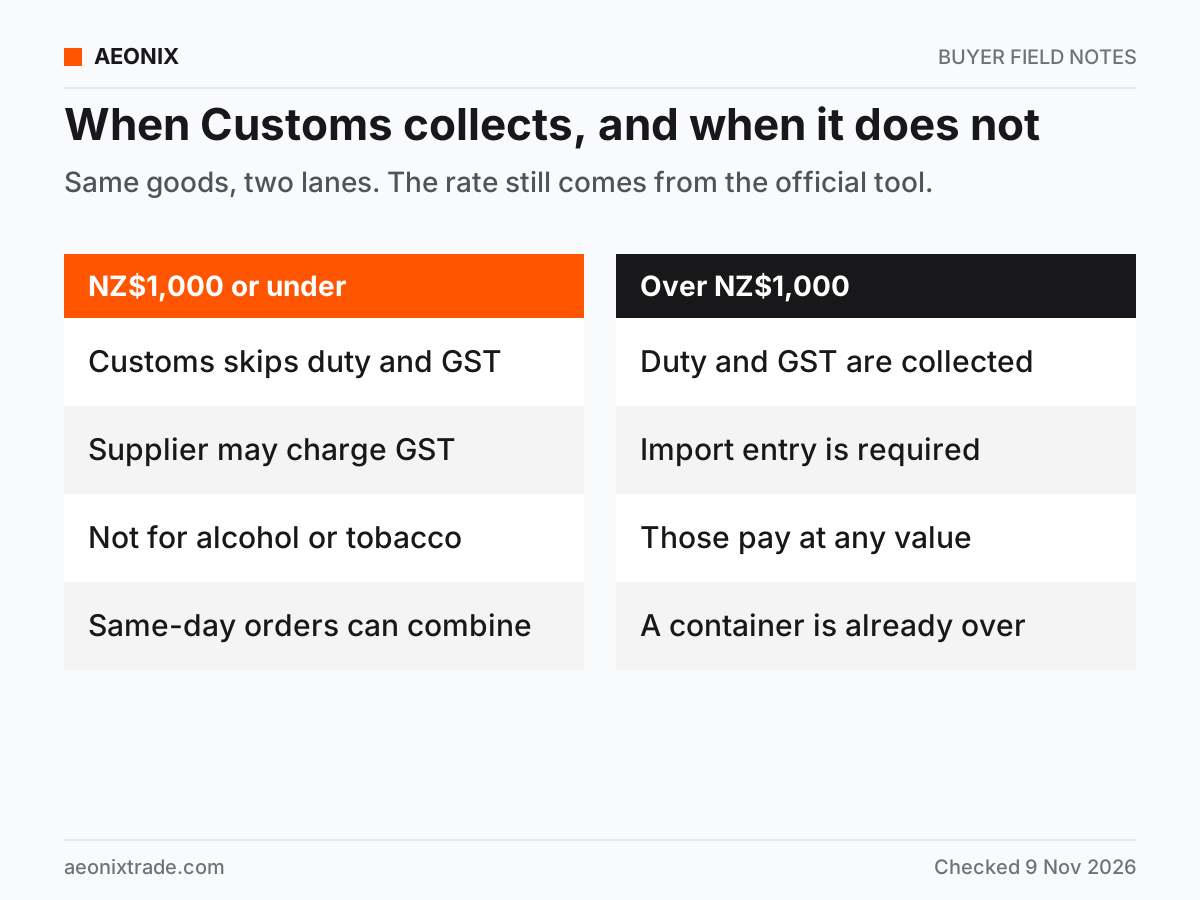
What the NZ$1,000 line is, and is not
The NZ$1,000 wording sits on Customs' send-and-receive pages and is written for items and gifts as well as ordinary imports. The commercial page does not repeat the threshold. It does say every imported item is cleared, and that an entry is lodged when clearance is required. A reorder of accessories above NZ$1,000 is that case. Do not split invoices so that two lots from the same supplier land on the same day under the line. Customs already says it will treat those as one shipment.
Alcohol and tobacco pay at any value. Home accessories are not those goods. If a carton contains wood, seed, or food, read the prohibited and restricted list from Start importing before the factory packs it. This page does not copy that list.
Inland Revenue's page for overseas businesses describes low-value goods and the cases where GST charged at sale and GST charged at the border can both appear. The page is when GST has been charged twice. A commercial entry over NZ$1,000 is the border charge. Keep the supplier's tax invoice so you are not paying the same GST twice and then guessing which one to claim.
Landed cost before the deposit
Use the landed-cost sheet. Duty stays "see the Working Tariff." GST, when Customs collects it, is 15% of goods plus freight and insurance plus duty, as the duty page describes it.
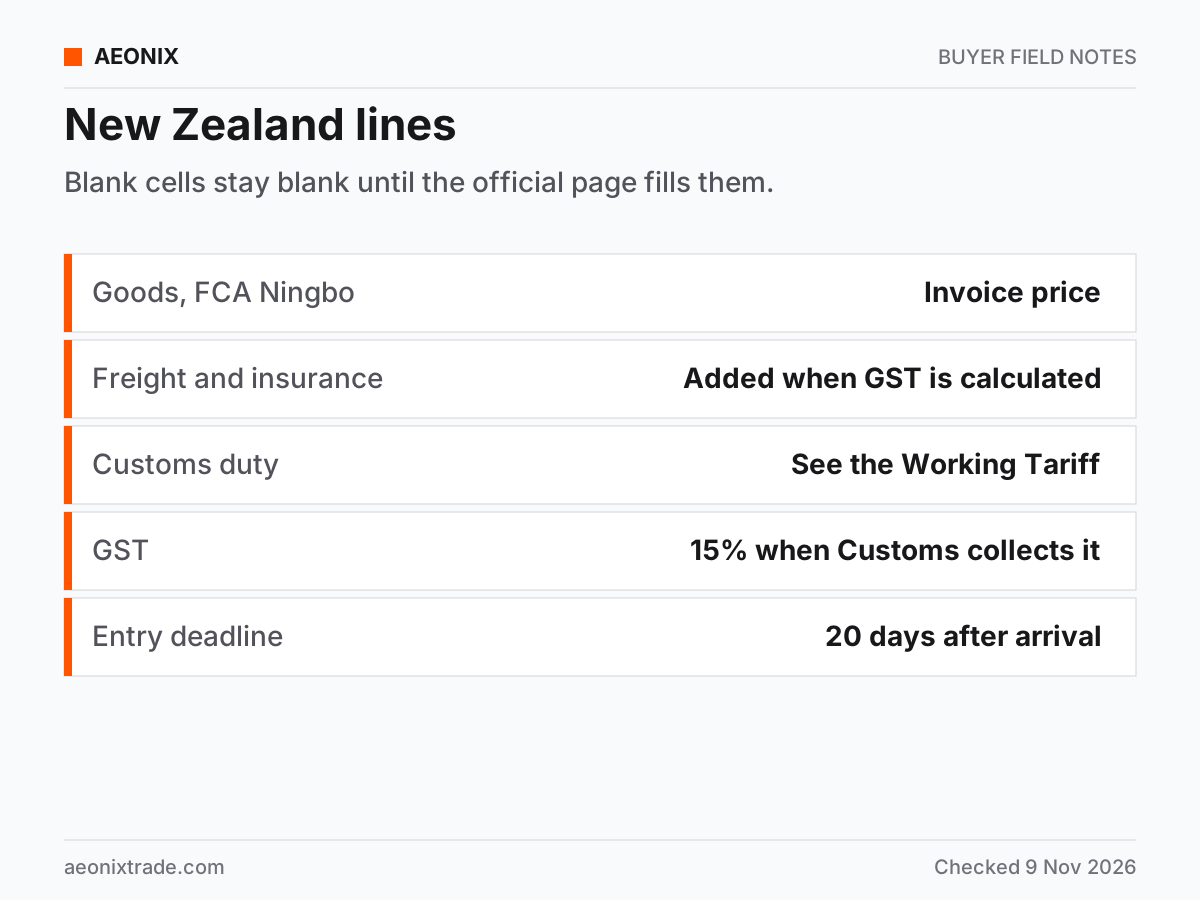
| Line | Ask for this | Do not assume |
|---|---|---|
| Goods, FCA Ningbo | Unit price and carton contents | That FCA includes freight to Auckland |
| Freight and insurance | Named charges, because they enter the GST sum | That GST is charged on the factory price alone |
| Duty | The Working Tariff line | A preference the FTA Finder does not show |
| GST | 15% when Customs collects it, as of 9 November 2026 | That a shipment over NZ$1,000 escapes GST |
| Entry | Lodged within 20 days of arrival | That "three to four days" of storage is a right |
| Client code | Issued before sailing | That the forwarder is the importer |
Where this lane goes wrong
- Pricing the reorder as if it were a personal parcel under NZ$1,000.
- Landing two supplier invoices on the same day and acting surprised when Customs adds them.
- Claiming a free-trade rate with no document the FTA Finder supports.
- Missing the 20-day entry and then paying storage that Customs already warned is charged after a short free period.
- Sending the TT to an account that does not match the seller. The supplier check is the step before the deposit.
The wider file is the first-time compliance checklist. After arrival, use the arrival sequence. How the LCL box is built is the LCL service. Australia's threshold is a different figure and a different form: the Australia guide. Canada's registration is different again: the Canada guide. The hub is import from China.
Questions buyers ask
Can I start with LCL?
Yes. The entry, the client code, and the NZ$1,000 test follow the consignment, not the container size.
Do I need a broker?
Customs will not key the entry for you. A broker, a forwarder, Trade Single Window, or EDI software has to lodge it. You still want the client code and the tariff line in your own file.
What is the duty from China?
The Working Tariff line for the classification. This page prints the 15% GST and the NZ$1,000 collection rule because Customs prints them. It does not print a duty percent, because the tariff does not have only one.
See also which Incoterm to use and the customs clearance sequence.
Official sources
- Duty and allowances: NZ$1,000 collection rule, alcohol and tobacco exception, GST at 15%, same-day shipments combined. Read 9 November 2026.
- Duty and GST.
- Working Tariff Document: the duty lookup. No duty percent is copied here.
- FTA Finder.
- Lodge your import entry: electronic lodgement, and 20 days from arrival.
- Client codes.
- Start importing.
- Inland Revenue, when GST is charged twice.
- Incoterms 2020.
- WCO customs valuation.
If you want the Ningbo handover checked before the deposit, use the RFQ form.
Submit sourcing request
Can't find what you need?
Start with a product or image link, an approximate quantity and destination. Other details can follow.